Butterflies are the one insect almost nobody is afraid of, which makes the search results for them strangely unhelpful. You get an encyclopedia entry, a museum page, a species list or a conservation appeal. Those are all good pages, and none of them is written for the person actually searching. That person is usually standing in a yard with a phone, looking at something orange, wondering what it is and whether it matters.
So this page starts where that reader starts. First the verdict, then the one check that tells a butterfly from a moth, then the three orange-and-black species that get mixed up more than any others. After that come the questions people genuinely ask: how long they live, what they eat, where they go at night, and what eats them.
Part 1 of 4
What they are
What butterflies are
Butterflies are insects in the superfamily Papilionoidea, inside the order Lepidoptera, the group whose wings are covered in tiny scales. Counts run from about 17,500 species worldwide up to 20,000, with roughly 650 to 775 in the United States. All of them have six legs, four scaled wings, two clubbed antennae and a coiled drinking tube.
The worldwide number is genuinely unsettled, and the gap is worth knowing about rather than hiding. The Smithsonian information sheet gives about 17,500 species and around 750 in the United States. Wikipedia puts it at about 18,500 worldwide, with 775 in the Nearctic region. The 2025 Xerces Society and US Geological Survey report counted about 650 species breeding in the contiguous states. That figure leaves out Hawaii, Alaska and the strays that wander up from Mexico. All three are right about different things.
What that means in practice is that butterflies are a small, tidy corner of a very large order. There are roughly 160,000 moth species worldwide against those 20,000, and in North America more than 10,000 moths against about 700 butterflies. Everything in Lepidoptera that is not a butterfly gets called a moth, which is why the variety on the moth side is so much wider. Our list of types of moths with pictures sorts the common US ones by size and colour.
Why they are called butterflies
Nobody knows for certain, and the honest answer is more interesting than the usual one. The Old English buttorfleoge is the oldest recorded form, and three explanations compete. One is that early observers saw yellow brimstone butterflies in spring and named the whole group after the colour of butter. Another is that folklore had them stealing milk and butter. The third is that the name came from the colour of their droppings. The butter-coloured spring butterfly is the version most often repeated. None of the three is proven.
Butterfly, moth or skipper, and which features actually settle it
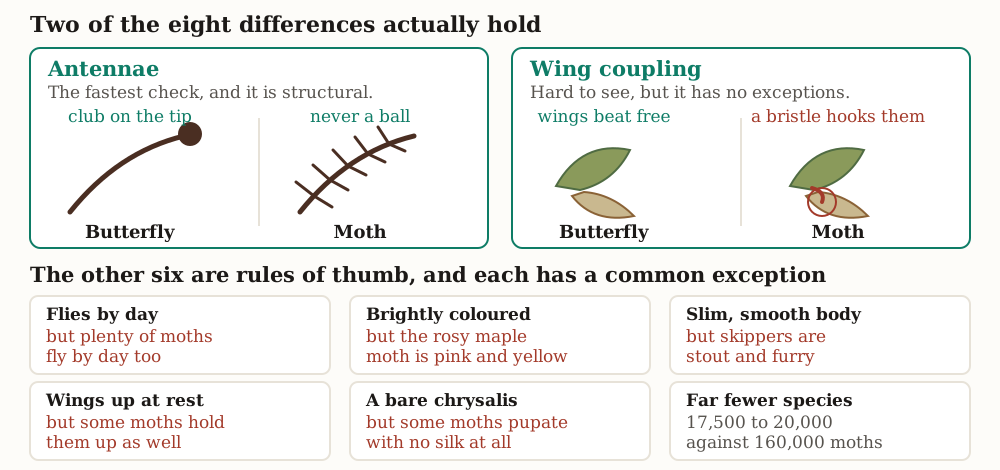
Eight features get used to separate butterflies from moths. Only two of them are structural, and only one of those two is visible in a photograph. Check the antenna tip. A butterfly antenna ends in a small round club or knob. A moth antenna tapers to a point, or is feathery, comb-like or saw-edged, and never ends in a ball.
That one check does more work than the other seven put together, and it is worth understanding why. Google’s own answer for this comparison lists eight differences. It then admits, in its own words, that “these are general rules; nature has notable exceptions, such as brightly coloured day-flying moths.” That hedge is correct. Six of the eight are tendencies rather than rules, and each has a common exception you will meet in a US yard.
The second reliable feature is the frenulum. It is a bristle on the hindwing that hooks into a catch on the forewing, locking the two wings together in flight. Moths have one, or a related structure called a jugum. Butterflies have neither, and rely instead on friction between the overlapping wings. It is a real anatomical difference, and it is also useless to you, because you cannot see it without a hand lens and a specimen holding still.
Butterfly against moth, and how much each feature is worth
Antenna tip
- Butterfly
- Small round club or knob
- Moth
- Tapered, feathery, comb-like or saw-edged
- How reliable?
- Structural. The one check that works from a photo. Skippers are butterflies with a club that hooks backwards
Wing coupling
- Butterfly
- None, the wings are held by friction
- Moth
- A frenulum or jugum hooks the wings together
- How reliable?
- Structural, and invisible without a lens. No use in the field
Wings at rest
- Butterfly
- Held up together over the back
- Moth
- Tented over the body, or flat and spread
- How reliable?
- Tendency. Skippers hold theirs half open, and mourning cloaks bask flat
Body build
- Butterfly
- Slim and fairly smooth
- Moth
- Stocky and furry
- How reliable?
- Tendency. Skippers are stout and hairy, and so are hawk moth relatives
When it flies
- Butterfly
- Day
- Moth
- Mostly night
- How reliable?
- Tendency. Hummingbird clearwings and many tiger moths fly by day
Colour
- Butterfly
- Bright
- Moth
- Brown, grey, white
- How reliable?
- Weak. Luna, rosy maple and io moths are as colourful as anything with a club
Pupa
- Butterfly
- A bare, hard chrysalis with no silk
- Moth
- A silk cocoon, often in soil or leaf litter
- How reliable?
- Tendency, and you rarely have the pupa in front of you
Species count
- Butterfly
- 17,500 to 20,000
- Moth
- About 160,000
- How reliable?
- True, and no help at all with the one in your hand
Two practical notes come out of that table. First, the antenna is the check, and everything else is supporting evidence. Second, if the antenna ends in a club that bends backwards like a hook, you have a skipper, which is a butterfly, in the family Hesperiidae. Skippers fly by day, they are stout and furry, and they get posted as moths constantly. The e-butterfly citizen-science project names them as the group most easily confused with moths, because of their dull colours and thick hairy bodies.
Because the pupa keeps coming up, it is worth being precise. A butterfly makes a chrysalis, which is the hard outer skin of the pupa itself, with nothing wrapped around it. A cocoon is different: it is a silk envelope some moths spin on the outside. That distinction is the real content of the pupa vs chrysalis vs cocoon question.
What a butterfly looks like, part by part
A butterfly has three body sections, six legs, four wings and two antennae. The head carries the antennae, two compound eyes with thousands of facets, and a coiled tube called a proboscis. The wings are covered in overlapping scales, which are modified hairs and the source of the order name. Lepidoptera means scale-wing.
The legs are where butterfly anatomy catches people out. All adult insects have six, and butterflies are no exception, but one large family holds its front pair tucked up against the body and walks on four. The brush-foots include the monarch, the painted lady, the red admiral and the mourning cloak. So a great many of the butterflies you meet look four-legged and are not. Those reduced forelegs carry dense scale brushes, which is where the family name comes from.
Taste works through the feet. A female lands on a leaf and tastes it with receptors on her tarsi. She is deciding whether her caterpillars can eat it, and she decides before laying a single egg. The proboscis then handles drinking and nothing else: it uncoils like a party blower, draws liquid up, and coils back under the head. There are no jaws, no teeth and no sting anywhere on the insect.
The colours come from two separate systems, and both are in the scales. Pigment scales hold actual chemical colour, mostly browns, yellows, oranges and reds. Structural scales hold no pigment at all. They make blues, greens and metallic flashes by interference instead, which is why a blue morpho looks brown from some angles and electric blue from others. Crush the scale and the blue disappears, because there was never any blue pigment in it.
Part 2 of 4
Naming the one you found
How to tell one butterfly from another
Four things name a butterfly, in this order: wingspan, the colour and pattern of the upper wing, the underwing pattern, then where and when you saw it. A US butterfly runs from about half an inch across, in the western pygmy blue, to about 6.5 inches in the two-tailed swallowtail. So size alone cuts the field hard, before you look at anything else.
Start with the wingspan, because an adult butterfly never grows. Whatever span it has leaving the chrysalis is the span it dies with. That makes the measurement a fixed clue rather than a stage. Hold a dollar bill or a quarter beside it if you can, and photograph both together.
Then read the pattern, and read the underside as well as the top. This is the step most people skip and the one that settles the hardest cases. Many species that look nearly identical from above have completely different underwings. The upper surface signals to other butterflies, and the lower one camouflages the insect when the wings fold. A silver mark on the underside tells a question mark from a comma, and nothing on top does.
Location and date do more than they look like they should. Most butterflies fly for a few weeks in a defined range. So a photograph with a state and a month attached often narrows the answer to two or three species. National Park Service species lists work exactly this way, and the Shenandoah checklist runs to 82 butterflies, each with an abundance code and a season.
If the photo is good and the name still will not come, our free identifier answers what bug is this from the picture.
The orange-and-black problem: monarch, viceroy and queen
Three orange-and-black butterflies account for most of the misidentifications in the United States. One feature separates them: a thin black line running straight across the viceroy hindwing, crossing the veins. The monarch has no such line. A viceroy is also smaller, at 2.5 to 3 inches against the monarch 3.5 to 4.
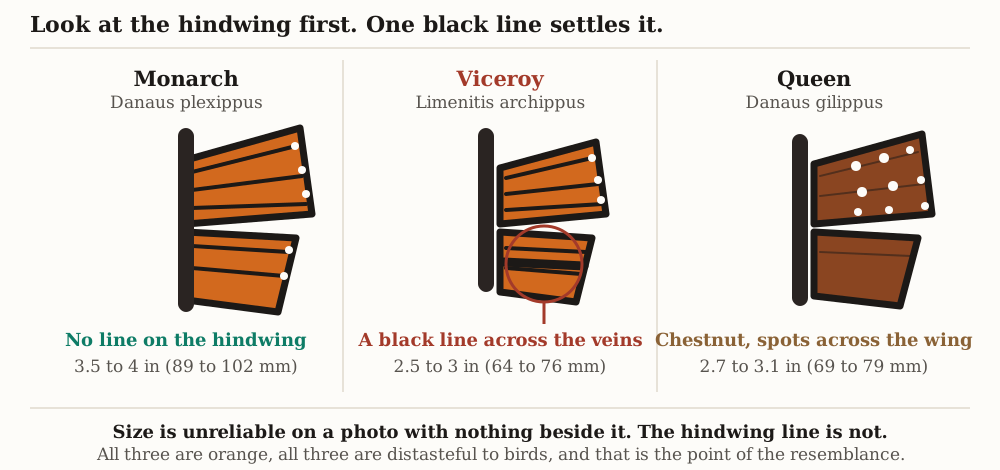
Size is the feature to distrust here. A photograph with nothing beside the butterfly for scale gives you no size at all. Published ranges also differ a little by source: the National Park Service Bandelier checklist gives the monarch 3.3 to 3.7 inches and the queen 2.4 to 2.6, from local specimens. The hindwing line does not vary.
The three orange-and-black look-alikes
Black line across the hindwing
- Monarch
- Absent
- Viceroy
- Present, crossing the veins
- Queen
- Absent
Wingspan
- Monarch
- 3.5 to 4 in
- Viceroy
- 2.5 to 3 in
- Queen
- 2.7 to 3.1 in
Overall colour
- Monarch
- Bright orange, heavy black veins
- Viceroy
- Deeper orange, finer veins
- Queen
- Darker chestnut brown, little vein black
White spots on the forewing
- Monarch
- In the black margin only
- Viceroy
- In the black margin only
- Queen
- Scattered across the wing
White spots in the margin
- Monarch
- Two uneven rows
- Viceroy
- One single row
- Queen
- Present, plus the scattered ones above
Caterpillar host plant
- Monarch
- Milkweed only
- Viceroy
- Willow, poplar, cottonwood
- Queen
- Milkweed and relatives
Range
- Monarch
- All 48 contiguous states
- Viceroy
- Most of the US, near wet ground and willows
- Queen
- Southern states, Gulf Coast, Southwest
The reason they look alike is worth correcting, because the textbook version is out of date. For decades the textbooks taught the viceroy as the classic case of a harmless species copying a poisonous one. Feeding trials since then have shown the viceroy is unpalatable to birds in its own right. Missouri’s Department of Conservation now describes it as “recognized as inedible itself”. That makes it Müllerian mimicry, two genuinely nasty species sharing one warning sign, rather than Batesian mimicry, a harmless fake copying a nasty original. A monarch gets its own chemistry from milkweed, storing cardenolides that make a bird sick.
None of the three is dangerous to handle. Poisonous here means poisonous to eat, and only to an animal that eats whole butterflies.
Part 3 of 4
How they live
From egg to butterfly, in four stages
Butterflies go through four stages: egg, caterpillar, pupa and adult. The egg takes about 3 to 7 days. A caterpillar then feeds and moults through roughly 5 instars over two to five weeks. Its chrysalis takes about 8 to 15 days in warm weather, and the adult that comes out has anywhere from a week to several months. The whole run from egg to adult is often about a month.
Only the caterpillar eats solid food, and only the caterpillar grows. That single split explains most of what follows on this page. The adult butterfly you are looking at is a mating and dispersal stage. It has a fixed body, a fixed wingspan and a fat budget it cannot top up by much.
Two points are specific to butterflies rather than to Lepidoptera generally. The pupa hangs or sits bare, with no silk spun around it, so a butterfly pupa stage found on a fence is exposed and often beautifully camouflaged. Moths more often spin a cocoon or burrow, and a hornworm pupa spends the winter several inches down in the soil. The moth life cycle differs most at exactly that stage.
Not every insect does it this way. A grasshopper hatches looking like a small adult and never pupates at all, so the grasshopper life cycle runs egg, nymph, adult. The four-stage version is called complete metamorphosis, and the larval side of it, from caterpillar to butterfly, has its own guide.
How long butterflies live
Most adult butterflies live about two weeks. The range runs from roughly a week at one end to nearly a year at the other. The long end belongs to two groups. One is the monarchs of the late-summer generation, which live 6 to 9 months to migrate and overwinter. The other is species like the mourning cloak, which pass the winter as adults under loose bark.
This is one of the few numbers on the topic where good sources openly disagree, so here is the disagreement rather than a single tidy figure. The Florida Museum of Natural History gives 7 to 10 days for an adult in the wild. Wikipedia gives about a week to nearly a year. The National Park Service Grand Canyon page says many species live about two weeks and a few reach nine months. They are measuring different things: a mean for small species in the field, the full species range, and a typical figure with the overwintering exception attached.
How long an adult lives, by group
Small blues, hairstreaks, whites
- Adult lifespan
- About 5 to 10 days
- Why
- Small bodies, small fat reserves
Most medium and large species
- Adult lifespan
- About 2 to 4 weeks
- Why
- The usual figure quoted as a butterfly's life
Summer-generation monarchs
- Adult lifespan
- 2 to 6 weeks
- Why
- Breed, lay, die, several generations a year
Migrating monarchs
- Adult lifespan
- 6 to 9 months
- Why
- Reproduction is paused, so the fat lasts
Mourning cloak, some tortoiseshells
- Adult lifespan
- Up to about 10 months
- Why
- Overwinter as adults and fly again in spring
Heliconius longwings
- Adult lifespan
- Several months
- Why
- Feed on pollen as well as nectar, which adds protein
One figure that gets repeated everywhere is simply wrong: the claim that butterflies live for a single day. Nothing in the group does that. The one-day insect is the mayfly, and the two get confused because both are short-lived and pretty.
What butterflies eat and drink
Adult butterflies drink, and they do not eat. The proboscis handles flower nectar, tree sap, rotting fruit, honeydew and dissolved minerals, and nothing solid. Caterpillars do all the chewing, and the overwhelming majority chew leaves, usually from a short list of host plants their mother chose for them.
The minerals matter more than the nectar for a question people ask a lot. Male butterflies gather on damp ground, mud, dung, carrion and sweaty skin to take up sodium and amino acids, and the behaviour is called puddling. That sodium then goes into the sperm package a male passes to a female at mating. It is why a butterfly lands on your arm on a hot day, and why a group of them will sit on a puddle edge for an hour.
So no, butterflies do not drink blood, which is a question with real search volume behind it. They will take minerals from a wound, from sweat, from tears and from a carcass, because all of those are salty liquid. None of that involves piercing anything. The insect that genuinely pierces skin in this order is a tropical moth in the genus Calyptra, and there is nothing like it in a US yard.
To feed one that has turned up exhausted, use a shallow dish of sugar solution or a piece of over-ripe banana. Set it where the butterfly can reach it with its feet. Experienced observers on the iNaturalist forum are blunt about the limits. One describes guiding the proboscis to sugar water very gently with a toothpick. Another says that once a butterfly tips over, it is usually done. By their own account this works about half the time.
Where butterflies live, and where they go at night
Butterflies live on every continent except Antarctica, in nearly any habitat that holds flowering plants, and they reach from sea level to about 16,000 feet in the Andes. In the United States the richest places are open sunny ground with a mix of flowers and bare soil: meadows, prairie, forest edges, roadsides, power-line cuts and gardens. At night they roost, which means they find cover and sit still.
Roosting is not sleeping in the way we mean it. A butterfly settles under a leaf, in a grass tussock, along a twig or in a crack in bark. Then it folds its wings up and drops into torpor, a state of low activity, until the air warms again. It cannot fly in the dark and it cannot fly cold, so the roost mostly keeps it from being eaten while it is helpless. Several species roost communally, hanging in groups on the same branch night after night.
Winter is handled four different ways depending on the species, and this is where most garden advice goes wrong. Some overwinter as eggs, some as caterpillars and some as a chrysalis. A few, including the mourning cloak and the question mark, pass it as adults tucked under bark or in a woodpile. Monarchs do something different again and leave, with the eastern population travelling up to about 1,500 miles to a handful of mountain sites in central Mexico. A tidy garden with every stem cut and every leaf raked removes the overwintering stage for three of those four groups.
Why a butterfly sits still with its wings open
A butterfly cannot fly until its flight muscles are warm. For most species that means a thorax temperature above roughly 27C (81F), well above a comfortable spring morning. It gets there by basking: holding the wings open and angled square to the sun until the muscles reach working temperature. So the butterfly sitting motionless on a warm stone is not resting, it is charging.
This is the number nobody writes down properly, and the gap shows. Google’s own answer for butterflies gives a range of roughly 15C to 40C body warmth to fly well. For that figure it cites a YouTube video. It had to reach for one, because no article on the page states the threshold as a number a reader can use. The published measurements are both more specific and more interesting.
- A black swallowtail needs a thorax above about 24C (75F) to fly at all, and above about 28C (82F) to fly strongly. Those figures come from a 1980 study in Ecology that put thermocouples into live butterflies.
- Across temperate species generally, powered flight needs a thorax between about 28C and 42C (82F to 108F), with vigorous flight in the narrow band from 33C to 38C.
- Overwintering monarchs in the Mexican mountains manage to fly from a thorax temperature as low as 12.7C to 16C (55F to 61F). That is far below every figure above, and it is one reason that population survives where it does.
Two things follow that are worth knowing in a garden. The temperature that matters is the insect’s own, not the air’s. A butterfly in sun runs its thorax about 7C warmer than the air around it. One alpine species holds a gap of over 20C, the widest anyone has measured. The same system works in reverse too. At about 40C (104F) butterflies turn their folded wings edge-on to the sun to shed heat, or move into shade entirely. A dark-winged butterfly basking flat at nine in the morning and hiding at two in the afternoon is running one mechanism in both directions.
A rusty patched bumble bee can shiver its flight muscles warm without any sun at all. Butterflies have no way to generate that heat internally, so they depend entirely on the weather. That is why a cold wet summer shows up in the following year’s counts.
What eats butterflies, and how they fight back
Birds take the most, followed by spiders, wasps, ants, praying mantises, dragonflies, lizards, frogs, mice and bats. Parasitoid wasps and flies kill a far larger share than any of those, by laying eggs in caterpillars rather than by catching adults. Of the eggs a female lays, only a small fraction reach the adult stage at all.
Google’s own panel names predators as one of five things to know about butterflies, and it is the section every ranking page writes in a single sentence. It deserves more, because the defences are the reason butterflies look the way they do.
Five defences, and the species that show each one
Stored toxins
- How it works
- The caterpillar eats a poisonous plant and keeps the chemistry as an adult
- A US example
- Monarch, from milkweed cardenolides
Warning colour
- How it works
- Orange, black and yellow advertise that toxin to anything that has tried one
- A US example
- Monarch, pipevine swallowtail
Shared warning sign
- How it works
- Two unpalatable species converge on one pattern, so both benefit
- A US example
- Viceroy and monarch, Mullerian mimicry
Eyespots
- How it works
- Large false eyes on the hindwing startle a bird or redirect its strike
- A US example
- Buckeye, owl butterfly
False head
- How it works
- Tails and lines at the rear wing corner mimic antennae and a head, so the bird grabs the wrong end
- A US example
- Gray hairstreak and other hairstreaks
The false head is the one most worth looking for, and once you have seen it you cannot unsee it. A hairstreak at rest sits head-down and rubs its hindwings, so the little tails twitch like antennae. A bird that strikes takes a mouthful of expendable wing corner, and the butterfly leaves in the other direction. Torn rear wing corners on hairstreaks are common, which is evidence the trick works.
Part 4 of 4
You and them
Do butterflies bite or sting?
No. No butterfly anywhere can bite or sting a person. The adult mouth is a soft coiled tube for sucking liquid, with no jaws, no teeth and no piercing structure. There is no stinger on the abdomen either. A butterfly that lands on your hand and seems to be tasting you is doing exactly that, through its feet and proboscis, looking for salt.
What can hurt you in this order is a caterpillar, and only a small number of them. Stinging caterpillars carry hollow hairs or spines connected to venom glands, and the reaction comes from contact rather than from a bite, so brushing against one is enough. Almost all of the US species that do this are moth caterpillars rather than butterfly caterpillars, which is one more reason the identification above is worth getting right.
Never try to identify an insect from a photograph of a mark on skin, including with an app. Marks do not carry enough information to say what caused them, and a butterfly in the room is a coincidence rather than an explanation. If you woke up with bites, something that genuinely bites is the better answer. For the other half of the order, do moths bite covers the same question.
Did I hurt it? Touching the wings, and a butterfly that cannot fly
Touching a butterfly’s wings does not kill it. The powder on your fingers is scales, which are modified hairs, and a butterfly loses them steadily all its life. Heavy scale loss makes flight less efficient and leaves a bald patch, so it is worth avoiding. Even so, it is not the death sentence most of us were taught as children.
Three related beliefs are all wrong, and they are worth clearing up together. Skin oil from your hands does not burn the wings. A tear or a missing wing corner does not ground a butterfly. Torn-winged butterflies fly perfectly well, which is why you see so many of them late in a season. And scales are not fairy dust, they are the structures carrying the colour.
There is one real exception, and it is about timing rather than touch. A butterfly that has just come out of the chrysalis has soft, folded wings, and spends an hour or more pumping fluid into them while they harden. Knock it in that window and the wing sets crooked permanently. One lepidopterist put it plainly on the iNaturalist forum: if they fall and crinkle the wing while it is setting, it sets that way for good and the butterfly will not fly. In that hour it is fragile. An hour later it is fine.
What actually helps a grounded butterfly
To pick one up, slide a finger under the body and let it step on, or use a leaf. Do not pinch the wings. Beyond that, honesty is better than a procedure, because there is not much that works.
- A cold butterfly is usually not injured. Put it somewhere sunny and sheltered and give it twenty minutes. Most of them fly off.
- A set, crooked wing is permanent. It will not heal, and taping it is not a treatment. The insect can still live out its time on the ground if something does not take it first.
- Food helps an exhausted one, not a damaged one. Sugar water or mushy fruit within reach is worth offering.
- One on its side is usually past helping. Experienced rearers say this plainly, and they are right.
- A butterfly indoors in winter is a hibernating adult that woke up early. Put it somewhere cold, unheated and sheltered, like a shed or an unheated porch, rather than outside into frost.
Are butterflies disappearing?
Yes, and the figure is well established. Total butterfly abundance in the United States fell by about 22% between 2000 and 2020. That is a decline of roughly 1.3% a year, and about two-thirds of the species studied dropped by more than 10%. That comes from a 2025 paper in Science by Edwards and colleagues, which pooled data from 35 citizen-science monitoring programmes across the lower 48.
One in five is a large loss for twenty years, and the pattern is not even. The Southwest saw the steepest declines, the Mountain Prairie states next, and the Pacific Northwest actually rose, largely because the California tortoiseshell has boom years. Habitat loss, pesticides, drought and warming are the causes named most often.
Where the monarch actually stands
The monarch is the species everyone asks about, and its official status is genuinely confusing, so it is worth stating carefully.
- IUCN. The migratory monarch, Danaus plexippus plexippus, was listed as Endangered on 20 July 2022. A petition challenged the population model behind that assessment in 2023, and the subspecies now sits at Vulnerable. The full species Danaus plexippus, which includes non-migratory populations, is Least Concern.
- United States. The Fish and Wildlife Service proposed listing the monarch as Threatened on 12 December 2024, with critical habitat, and reopened the comment period in March 2025. There is still no final rule: the statutory deadline passed in December 2025 and the decision has been pushed back. So the monarch is a candidate for federal protection, not a protected species.
- Population counts. The eastern population is measured in hectares of occupied forest in Mexico, not in individual butterflies. It reached a record low of 0.67 ha in the winter of 2013 to 2014. By 2025 to 2026 it was back to 2.93 ha across nine colonies, a 64% rise on the 1.79 ha of the winter before. The western population is counted at California overwintering sites each Thanksgiving, and its 2024 count of 9,119 was one of the three lowest in that programme’s history.
Both of those trends can be true at once, and reading one season as a recovery is the common mistake. Two numbers settle it. Researchers put the area needed for a stable eastern population at about 6 hectares, so the best winter in years is still under half of that. The ten-year average is 2.81 ha, which means a 64% rise landed the population almost exactly on its own decade average. A good winter in Mexico does not undo a twenty-year decline.
It has happened before, which is the part most pages leave out. The Xerces blue (Glaucopsyche xerces) was a small blue butterfly from the San Francisco sand dunes. It was last seen in 1941, and it is the first American insect known to have been driven extinct by human development. The conservation group that produced the decline report is named after it.
Butterflies are pollinators, though they are less efficient than bees, because long legs and a long proboscis keep the body away from the pollen. They do move pollen over longer distances than bees, they pollinate a set of flat open flowers that bees largely ignore, and their caterpillars feed nesting birds. Bees still carry more of the load, and bee identification comes down to size, shine and where it nests.
Butterfly myths, corrected
Myth 1
Myth: “Touching the wings kills them.”
Truth: No. The powder is scales, a butterfly sheds them throughout its life, and it flies on. Only a wing still soft from emergence is at real risk.
Myth 2
Myth: “Butterflies live for one day.”
Truth: No. Two weeks is typical, and migrating monarchs live 6 to 9 months. The one-day insect is the mayfly.
Myth 3
Myth: “A group of butterflies is called a kaleidoscope.”
Truth: This is a trivia-list invention with no source behind it. Entomologists say roost for a group settled for the night, and aggregation or puddling club for one gathered on damp ground.
Myth 4
Myth: “Butterflies remember being caterpillars.”
Truth: Partly true, and more interesting than the myth. Moth experiments have shown learned avoidance surviving metamorphosis, so some memory does carry across. The caterpillar body is largely rebuilt, but the brain is not entirely scrapped.
Myth 5
Myth: “All caterpillars turn into butterflies.”
Truth: No. Most turn into moths, by a wide margin. Sawfly larvae look like caterpillars but are related to wasps and turn into neither.
Myth 6
Myth: “Bright means butterfly, drab means moth.”
Truth: No. Luna and rosy maple moths are brilliant, and plenty of skippers and satyrs are brown. Check the antenna instead.
Myth 7
Myth: “A butterfly indoors needs rescuing right away.”
Truth: In summer, open a window. In winter it is a hibernating adult that your heating woke early, and it needs somewhere cold and sheltered rather than a flower.
When to do something, and when to leave it
Nothing on this page is a pest problem, which is unusual for this site and worth saying plainly. Butterflies do not damage a house, they do not bite, and the adults cannot eat anything you own. There are only four situations where any action makes sense at all.
The only four cases worth acting on
A butterfly in the house in warm weather
- What to do
- Open a window or door and let it leave on its own
A butterfly in the house in winter
- What to do
- Move it somewhere cold, dark and sheltered, such as a shed or unheated porch
Caterpillars stripping a vegetable plant
- What to do
- Identify it first, then hand-pick or use a row cover. Most garden caterpillars are moths
A spiny or hairy caterpillar near children
- What to do
- Do not touch it, and see the warning above
For garden caterpillars, sanitation and exclusion come first and work. A row cover keeps the egg-laying female off the plant, and hand-picking takes care of small numbers. If exclusion and hand-picking are working, no insecticide is needed at all. Where a treatment really is called for, use an EPA-registered product exactly as the label directs, because the label is the law. Remember too that anything which kills caterpillars kills the butterfly ones.
Pest control disclaimer. Photo-based identification can help, but it is not always perfect. For dangerous spiders, large infestations, or anything you are unsure about, contact a licensed pest control professional.
Frequently asked questions
Is a butterfly an insect?
Do butterflies sleep?
How many legs does a butterfly have?
Is it butterflies or butterfly's?
What does it mean when a butterfly lands on you?
Can you keep a butterfly as a pet?
What is the biggest butterfly in the world?
Do butterflies have a weakness?
Related guides
Moths
The other nine tenths of the order: what they eat, why they come to your light, and which few damage a home.
Caterpillars
The stage that does all the eating, how to tell one from a sawfly larva, and which ones sting.
Types of moths
16 common US moths sorted by size and color, with the feature that names each one.
Pupa
What a chrysalis is, how it differs from a cocoon, and what happens inside one.
Tomato hornworm
The big green caterpillar on your tomatoes, and the hawk moth it becomes.
Types of bees
The other daytime pollinators, sorted by size, shine and where each one nests.
Sources
- Poison Control, caterpillar stings and first aid
- US Fish and Wildlife Service, monarch butterfly listing status
- IUCN Red List, Danaus plexippus
- Edwards et al., Rapid butterfly declines across the United States during the 21st century, Science (2025)
- Xerces Society, State of the Butterflies in the United States
- Smithsonian, Butterflies
- Missouri Department of Conservation, Viceroy field guide