Part 1 of 5
Start here
Is it even a moth?
Check the antennae before anything else. A moth’s are feathery, or taper to a plain point, and never end in a ball. Butterfly antennae are thin with a small round club on the tip, and on a skipper that club hooks backwards. This one feature settles it faster than color, size or the time of day, and it is where most mistaken identifications go wrong.
Skippers are the ones people miss. They fly by day, they are stout and furry, and they look far more like a moth than a butterfly, so they get posted as moths constantly. If the antenna does end in a club, our guide to butterfly identification takes it from there. Two of the most-viewed identification threads on the main moth forum are answered with some version of “that is a skipper, not a moth”.
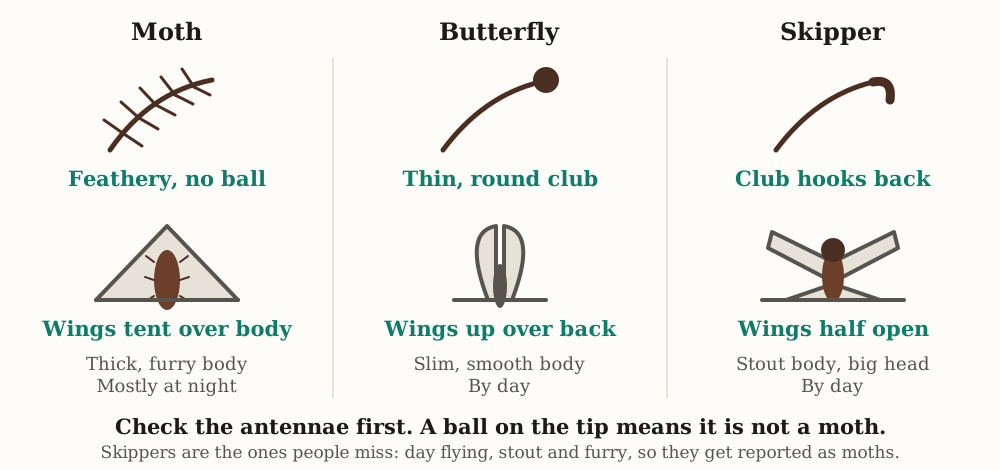
Moth, butterfly or skipper
Antenna tip
- Moth
- Feathery or tapered, no ball
- Butterfly
- Thin with a round club
- Skipper
- Club that hooks back
Wings at rest
- Moth
- Tented over the body or flat out
- Butterfly
- Held up together over the back
- Skipper
- Half open, like a jet
Body
- Moth
- Thick and furry
- Butterfly
- Slim and smooth
- Skipper
- Stout, with a large head
When it flies
- Moth
- Mostly at night
- Butterfly
- Day
- Skipper
- Day
Four other things get reported often enough to rule out before you work through the types of moths below. A caddisfly in house swarms at lights near rivers and lakes and holds its wings in the same roof shape, but its antennae are long and thread-like and it has no scales. The small fuzzy things on a bathroom wall are almost always moth flies in the bathroom, which breed in the drain. A flat seed-shaped case stuck to a wall in the South is a plaster bagworm. And bare patches in wool with no webbing usually mean carpet beetle larvae in wool, not moths at all.
Part 2 of 5
Identify what you found
Identify it by size first
Size narrows the field faster than anything else, because an adult moth never grows. Whatever wingspan it has when it emerges is the one it dies with, so the measurement is a fixed clue rather than a stage. The types of moths in the US run from about 2.5 mm across to 7 inches, and the average is close to an inch.
Hold a quarter next to it. A quarter is just under an inch across, which puts it on the boundary that matters. Almost anything smaller is an indoor species. Almost anything much larger came in from outside and cannot feed, which usually means a silk moth.
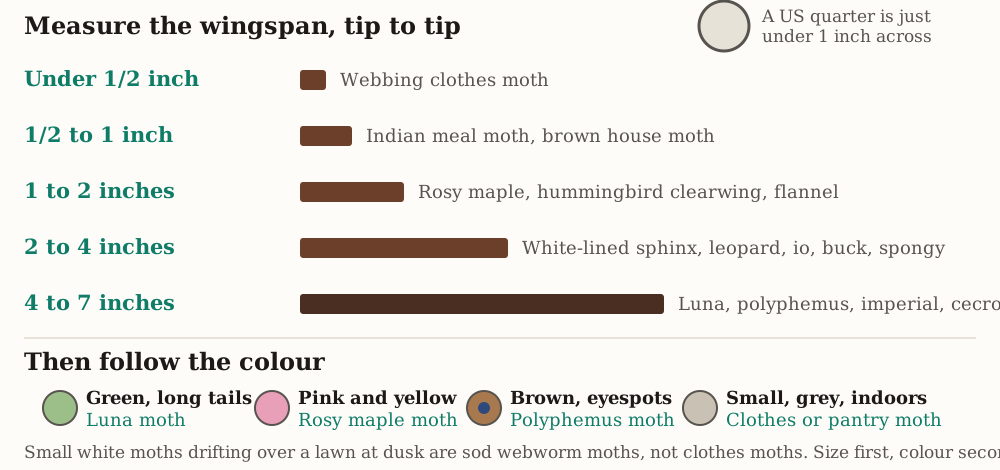
Then narrow it by color
Color on its own has too many answers, which is why searching for a brown moth returns half the types of moths in the country. Paired with a size band it usually lands on one species. A large brown moth with one eyespot on each hindwing is almost always a polyphemus moth. Four color routes cover most of what people ask about.
Color and size to a likely species
Pale green with long tails
- Size
- 4 to 4.5 in
- Most likely
- Luna moth
- The feature that confirms it
- Nothing else in North America is green with tails
Pink and yellow, woolly
- Size
- 1.25 to 2 in
- Most likely
- Rosy maple moth
- The feature that confirms it
- Pink legs and antennae, yellow body
Large brown with eyespots
- Size
- 4 to 6 in
- Most likely
- Polyphemus moth
- The feature that confirms it
- One blue-and-black eyespot on each hindwing
Huge reddish-brown, banded
- Size
- 5 to 7 in
- Most likely
- Cecropia moth
- The feature that confirms it
- Crescent-shaped spots, red body with white bands
White with black rings
- Size
- 2 to 3.6 in
- Most likely
- Giant leopard moth
- The feature that confirms it
- Rings are hollow, not solid dots
Small, grey or beige, indoors
- Size
- Under 1 in
- Most likely
- Clothes or pantry moth
- The feature that confirms it
- Where you found it decides which
One caution on the pink and yellow route. Rosy maple moths vary a lot, pale cream and nearly white individuals are common, and six other US moths are pink and yellow enough to cause doubt. Our guide to rosy maple moth look-alikes separates all six, with the one feature that gives each away.
Green has a size catch of its own. A large green moth with tails is the pale green luna moth, and North Carolina’s guide calls the adults unmistakable for exactly that reason. A small green one with wavy pale lines across the wings is usually a wavy-lined emerald, barely an inch across. The tropical relatives go bigger still, and a comet moth tail span reaches 6 inches.
16 types of moths, and whether each one matters
These are the types of moths behind most US sightings, sorted so the chip tells you the answer before you read the card. Nine are harmless, four are a nuisance indoors or in a forest, and three are safe as adults but have caterpillars that sting.
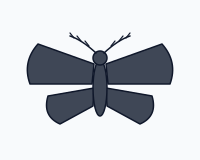
Luna moth
Harmless
- Size
- 4 to 4.5 in
- Where
- Woods and yards, at night
Pale green wings with a long twisted tail on each hindwing. The adult has no working mouth and lives about a week. Nothing else in North America is green with tails.
Cecropia moth
Harmless
- Size
- 5 to 7 in
- Where
- Trees and porch lights
North America's largest native moth. Reddish-brown with white bands and a crescent spot on each wing. Like the luna, the adult cannot feed.
Polyphemus moth
Harmless
- Size
- 4 to 6 in
- Where
- Porch lights, tree trunks
Tan to brown, with a large blue-and-black eyespot on each hindwing. That eyespot is what separates it from the cecropia moth.
Rosy maple moth
Harmless
- Size
- 1.25 to 2 in
- Where
- Maples, eastern US
Pink and yellow with a woolly body. This is the answer to most searches for a pink moth or a fluffy moth. Its caterpillar is the greenstriped mapleworm.
Imperial moth
Harmless
- Size
- 3 to 7 in
- Where
- Oak and pine woods
Big and yellow, blotched with purple-brown. Easy to mistake for a dead leaf when it rests on a trunk during the day.
Hummingbird clearwing
Harmless
- Size
- 1.5 to 2.2 in
- Where
- Flower beds, in daylight
Hovers at flowers and is constantly reported as a baby hummingbird or a strange bee. Olive-green thorax, burgundy abdomen, clear panels in the wings.
White-lined sphinx
Harmless
- Size
- 2.5 to 3.5 in
- Where
- Gardens at dusk, nationwide
The most-reported moth in the country. Brown with a pale stripe down each forewing and pink bands on the hindwings. Feeds on the wing like a hummingbird.
Giant leopard moth
Harmless
- Size
- 2 to 3.6 in
- Where
- Yards and lights, east and south
Bright white with hollow black rings. Unmistakable. Its caterpillar is a black bristly curler that is also harmless.
Isabella tiger moth
Harmless
- Size
- 1.75 to 2.6 in
- Where
- Everywhere, late summer
Dull orange-yellow as an adult and almost never recognised. Its caterpillar is the woolly bear, black at both ends with a rust band. It does not sting.
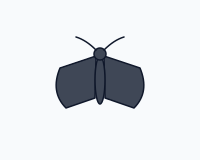
Webbing clothes moth
Nuisance
- Size
- About 1/4 in
- Where
- Closets, under furniture
Small, plain and golden-beige. It avoids light and flutters rather than flies. The larva, not the adult, is what eats wool and silk.
Indian meal moth
Nuisance
- Size
- 5/8 to 3/4 in
- Where
- Pantry, dry goods
The usual kitchen moth. The outer third of each forewing is coppery, the inner part pale. One female lays 100 to 400 eggs in stored food.
Brown house moth
Nuisance
- Size
- 5/16 to 9/16 in
- Where
- Cupboards, dark corners
Dark brown forewings with three or four black speckles. Its larvae are less fussy than a clothes moth and will take grain, wool and leather.
Spongy moth
Nuisance
- Size
- 1.2 to 2.6 in
- Where
- Northeastern forests
Renamed from the old name in 2026. Females are off-white and barely fly, males smaller and dark. The caterpillars strip whole stands of oak.
Southern flannel moth
Be careful
- Size
- 1 to 1.5 in
- Where
- Oaks and elms, southern US
The adult is a harmless ball of orange fuzz. Its larva is the puss caterpillar, and its sting is the worst of any US caterpillar. Do not touch it.
Io moth
Be careful
- Size
- 2 to 3.5 in
- Where
- East of the Rockies
Yellow or rusty, with a big black-and-blue eyespot that it flashes when disturbed. The green caterpillar has branched spines that sting.
Buck moth
Be careful
- Size
- 2 to 3 in
- Where
- Oak woods, day flying
Dark with a white band and a red-tipped abdomen, and it flies in daylight in autumn. Its spiny black caterpillar stings sharply.
Four record-holders are deliberately not on that list. None of them lives in the United States, so nobody is going to find one on a porch. Southeast Asia’s atlas moth has the greatest wing area. The white witch of Central and South America has the greatest wingspan, at roughly 11 to 12 inches. Australia and New Guinea have the Hercules moth at about 27 cm, and Australia’s giant wood moth is the heaviest at up to 30 grams. Among the types of moths you can actually meet in North America, the cecropia moth is still the largest.
Part 3 of 5
The ones you will actually meet
The moths you are most likely to see
Most lists of the types of moths rank them by how beautiful they are, which is no help when you are holding a phone over something on a wall. These ten are ranked by how often people actually report them. University of Florida extension published the counts from iNaturalist, where 9,389 US moth species had been recorded as of 2023.
The ten most-reported moth species in the United States, from iNaturalist records
1
- Species
- White-lined sphinx
- What gives it away
- Pale stripe along each forewing, hovers at flowers at dusk
2
- Species
- Isabella tiger moth
- What gives it away
- Dull orange adult; the caterpillar is the woolly bear
3
- Species
- Polyphemus moth
- What gives it away
- Big and tan, with a blue-ringed eyespot on each hindwing
4
- Species
- Luna moth
- What gives it away
- Pale green, long twisted tails
5
- Species
- Ailanthus webworm moth
- What gives it away
- Tiny, orange with white-edged black patches, looks like a beetle
6
- Species
- Salt marsh moth
- What gives it away
- White with scattered black dots, yellow-orange abdomen
7
- Species
- Fall webworm
- What gives it away
- Plain white adult; the larvae build webs over branch tips
8
- Species
- Giant leopard moth
- What gives it away
- White with hollow black rings
9
- Species
- Green cloverworm moth
- What gives it away
- Small, dark, narrow triangle at rest
10
- Species
- Eastern tent caterpillar moth
- What gives it away
- Dull brown with two pale stripes; spring tents in tree forks
The useful thing about that ranking is what is missing from it. Not one of the moths people worry about indoors appears, and not one of the stinging species does either. The moths you are most likely to meet are large, harmless and outdoors.
The small moths you find indoors
Only a handful of the types of moths in North America live in houses, and all of them are under an inch across and plainly colored. Where you see them is the strongest clue, because each one is tied to what its larvae eat. The adult you are looking at is not doing any damage.
Where you found it, and what it probably is
Closet, wardrobe
- What it is
- Webbing clothes moth
- What the larvae eat
- Wool, silk, fur, feathers
- The sign to look for
- Irregular holes, silk webbing under collars and cuffs
Pantry, dry goods
- What it is
- Indian meal moth
- What the larvae eat
- Flour, cereal, nuts, dried fruit, pet food
- The sign to look for
- Webbing and clumping inside a packet
Cupboards, dark corners
- What it is
- Brown house moth
- What the larvae eat
- Grain, wool, leather
- The sign to look for
- Speckled brown wings, three or four black dots
Bathroom wall
- What it is
- Not a moth: a drain fly
- What the larvae eat
- Biofilm in the drain
- The sign to look for
- Sits flat in a tent shape, never flies far
Lawn, at dusk
- What it is
- Sod webworm moth
- What the larvae eat
- Grass blades
- The sign to look for
- Dozens drifting low, then dropping into the turf
That last row catches people out. Small white moths rising out of a lawn in the evening are sod webworm moths. Their caterpillars chew grass at the soil line, and the brown patches that leaves look like drought or disease. If your lawn is thinning as well, our guide to what do grubs turn into covers how to tell the different causes of a dead patch apart.
For the closet, the short answer to do moths eat clothes is that the larvae do and the adults cannot, which is why killing the moths you see changes nothing. The same logic applies in the kitchen: the moth flying at the window is the end of a cycle that started in a packet weeks ago.
Part 4 of 5
Is it dangerous?
Do moths bite or sting?
No. Adult moths cannot bite you and cannot sting you. Most have a proboscis, a soft coiled tube for drinking nectar and sap that cannot break skin, and the large silk moths have no mouthparts at all. A moth landing on you leaves a few scales behind and nothing else.
That holds for a moth in the bedroom too, so one in the room while you sleep is not a threat. Never try to name an insect from a photograph of a bite, including with an app. Marks on skin do not carry enough information to say what made them. The tropical vampire moth exception, the allergy question and the rest of the detail are on our moth facts guide.
The caterpillars that really do sting
This is where the real risk among these types of moths sits. Five US moth caterpillars reliably carry venomous spines or hairs, and the reaction they cause has a name, lepidopterism: burning pain, hives, welts and sometimes blisters. It is a chemical reaction to hairs, not a bite, so brushing against one is enough.
The American dagger is the sixth name usually given, and it is worth one caveat. NC State Extension describes its toxins as “supposedly” present and the caterpillar “reputed” to sting, so treat that one as unconfirmed and still leave it alone. If what you found is not on this list, our guide answers do caterpillars bite and sorts the rest by what covers the body. For a larva you want to put a name to rather than just avoid, our caterpillar identification chart covers 21 common US species with the marking that names each one.
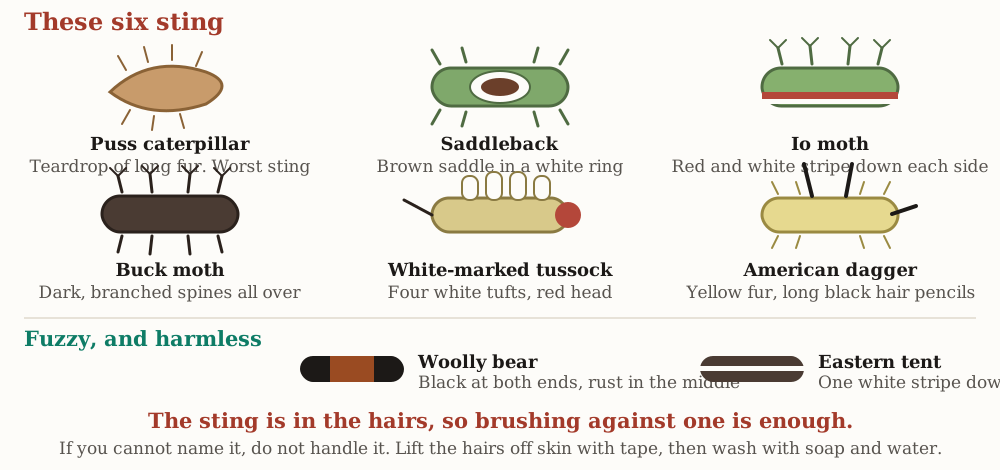
Stinging moth caterpillars in the United States
Puss caterpillar
- The marking
- Teardrop of long tan fur
- Where
- Southern states, oaks and elms
- How bad
- The worst. Pain spreads up the limb, and chest pain is reported
Saddleback
- The marking
- Brown saddle inside a white ring on green
- Where
- East and south
- How bad
- Severe burning, welts and blisters
Io moth
- The marking
- Red and white stripe along each side
- Where
- East of the Rockies
- How bad
- Sharp sting, welts that can last two weeks
Buck moth
- The marking
- Dark with branched spines on every segment
- Where
- Oak woods
- How bad
- Sharp, immediate, often several stings at once
White-marked tussock
- The marking
- Four white tufts on the back, red head
- Where
- Widespread
- How bad
- Itchy rash, worse in children
American dagger
- The marking
- Pale yellow fur, long black hair pencils
- Where
- Widespread
- How bad
- Burning rash from the black hairs
Most fuzzy caterpillars are harmless, and the fear is worse than the facts. The woolly bear, the eastern tent caterpillar and the fall webworm are all hairy and none of them stings. So is the green caterpillar with horn on your tomato plants, whose horn is a bluff and cannot sting at all. The honest rule is simpler than a field guide: if you cannot name it, do not pick it up.
Part 5 of 5
What is not true, and how to get a name
How moths live, in short
Moths pass through four stages, and only the caterpillar eats anything of yours. Adults drink nectar and sap, and many of the largest species emerge with no mouth at all and live about a week. That is why a big moth at your window cannot touch a sweater, and why killing the adults you can see does not stop damage that is already happening out of sight.
The life-cycle timings, what the adults and caterpillars actually eat, why moths spiral into a porch light, and the full step-by-step for clearing an infestation are all covered in our guide to moths.
Five things people get wrong about moths
These come up constantly when people ask about the types of moths in their house, and the first is asked almost every day by someone who feels guilty.
Myth 1
Myth: “Touching a moth's wings kills it, because the dust rubs off.”
Truth: The dust is scales, not fairy dust, and losing some does not ground a moth or kill it. Moths fly with torn and worn wings all the time. Handling still does minor damage, so lift one by sliding a finger under its body rather than taking it by the wings.
Myth 2
Myth: “Every moth in the house eats clothes.”
Truth: Two indoor species eat fabric, and both are small, plain and under half an inch. A big moth at the window got in from outside, cannot feed as an adult, and will never touch a sweater.
Myth 3
Myth: “The moths in a house are all the same kind.”
Truth: They are not even in the same family. The one in the closet eats wool and avoids light; the one in the kitchen eats grain and flies at you. They arrive by different routes and the fix for one does nothing for the other, so naming it first is not a detail.
Myth 4
Myth: “Any fuzzy caterpillar will sting you.”
Truth: Most do not. The woolly bear, the eastern tent caterpillar and the fall webworm are all hairy and all harmless. The ones that sting carry spines or dense fur over spines, and the six in the section above cover almost every US case.
Myth 5
Myth: “A moth in the bedroom is a threat while you sleep.”
Truth: No moth in a US home can bite you, asleep or awake. Adults either have no mouthparts at all or a soft drinking tube that cannot break skin.
How to photograph a moth so it can be identified
Most types of moths larger than about 1 cm can be named from a single good photograph, so the picture is usually worth more than a description. A few habits make the difference between an identifiable shot and an unusable one.
- Shoot from directly above if the wings are spread flat, and from the side if they are tented. Two angles are better than one.
- Use a flashlight held off to one side rather than the phone flash, which flattens the wing pattern and blows out pale moths.
- Crop tight before you upload. A moth filling the frame gets a far better answer than a moth lost in a wall.
- Turn the picture so the head points up or to one side, which is how field guides set them.
- Note the state and the date. Range and season rule out a great many look-alikes.
Some species genuinely cannot be separated from a photograph, and a few need a specialist to examine the specimen. If you want a starting point, our free identifier will tell you what bug is this from a photo and point you to the right guide.
Pest control disclaimer. Photo-based identification can help, but it is not always perfect. For dangerous spiders, large infestations, or anything you are unsure about, contact a licensed pest control professional.
Frequently asked questions
What does it mean if you see a white moth?
How long do moths live?
What do moths do in the winter?
Where do moths go during the day?
What eats moths?
What is the scientific name for moths?
Related guides
Cecropia moth
North America's largest native moth, and the cocoon fastened to a bare twig.
Polyphemus moth
The tan silk moth with one big eyespot on each hindwing, and how to read its cocoon.
Silk moth
Two insects share the name: the farmed Bombyx mori, which cannot fly, and the wild giants.
Comet moth
The Madagascan moon moth, with the longest tails of any silk moth.
Moths
What moths are, what they eat, why they come to your light, and which few damage a home.
Clothes Moths
The small beige moth whose larvae eat wool, silk and fur, and how to kill every stage.
Caddisfly
A moth-like insect from rivers and lakes that swarms at lights and cannot bite.
Drain Flies
The fuzzy little moth-shaped fly on the bathroom wall, and the fix that actually works.
Tomato Hornworm
The big green caterpillar on your tomatoes, which turns into a five-spotted hawk moth.
Carpet Beetles
The other thing eating your wool, and the one most often blamed on moths.
Lawn Grubs
Dead patches in the lawn, and how to tell grub damage from everything else.
Sources
- Poison Control, caterpillar stings and skin reactions
- EPA, mothballs and how to use them safely
- University of Kentucky Entomology, stinging caterpillars
- University of Florida IFAS, Magnificent Moths (WEC462)
- Smithsonian, Moths
- Xerces Society, All About Moths
- Missouri Department of Conservation, Moths field guide