People meet this moth once and remember it. The place is almost always a wall, a porch light, a door frame or a car, and the reaction splits two ways. Some readers are delighted. Others are not, and one of the most shared sighting posts of the year reads simply: what is this, it is so pretty but kinda scary too. Both reactions are reasonable, because the moth is large, furry and brown, and it flashes a pair of eyes at you.
Part 1 of 4
Name it
Is this a polyphemus moth?
A polyphemus moth is a large North American silk moth, Antheraea polyphemus, spanning 4 to 6 inches. The wings are tan, reddish-brown, grey or yellow-brown. Each hindwing carries one big eyespot ringed in yellow, white and black. Nothing else that size here has them.
So if you searched for a large brown moth, this is usually the answer. Only one other species comes close on size and colour, and that is the cecropia, which is bigger still and carries white crescents rather than eyes. Everything brown and smaller than your palm is something else entirely.
How big a polyphemus moth gets
The sources differ, and so it is worth giving all of them. University of Florida extension puts the wingspan at 10 to 15 cm, roughly 4 to 6 inches, following Covell’s field guide. Missouri’s Department of Conservation gives 3.5 to 5.5 inches. Wikipedia opens by calling 15 cm the average, then says in its own body that the range is 10 to 15 cm, so treat six inches as the top end and not the middle.
Finders overestimate it badly, which is worth knowing before you measure yours. One man in North Carolina logged his as eight inches across. Another measured 20 centimetres. Both had almost certainly found an ordinary large male. So put a coin or a credit card beside the moth before you decide, because a hand on a wall at night is a poor ruler.
How to say polyphemus
Say pol-ee-FEE-mus. The stress falls on the third syllable. Nobody on the first page of search results explains this, and yet people clearly want it, because the pronunciation is one of the commonest follow-up searches on the species. The name comes from the one-eyed cyclops of Homer’s Odyssey.
The eyespots, and the small pair you may have missed
Most descriptions stop at the two big eyespots, but there are four in total. Two sources say so and almost nobody else does. Missouri’s field guide notes a small eyespot in the middle of each forewing, and University of Maryland extension puts it more memorably still: this moth has not one eye but four. Look for pink-edged pale lines across the forewings too.
Why two can look like different moths
Colour is unreliable in this species, and that trips people up. Florida extension records considerable variation in wing colour even between specimens from one locality, citing Holland. So a moth may be cinnamon, chocolate, grey or almost yellow and still be the same species. Judge it on the eyespots instead, since those are constant.
Is a polyphemus moth dangerous? Can you touch one?
No, and there is almost nothing to qualify. A polyphemus moth has no working mouthparts, no sting and no venom. Its caterpillar has no stinging hairs either. You can hold either one safely, and the worst a reader has reported after repeated handling is a moth that was reluctant to leave.
Do polyphemus moths bite or sting?
They cannot do either. The adult mouthparts are vestigial, which means reduced to the point of being useless, so there is no apparatus to bite with. Moths have no sting anywhere in the group, and a polyphemus moth has no irritating hairs on its body. One man in North Carolina spent several seconds trying to pick his up off a car before it flew, and described it as quite docile.
Are polyphemus moth caterpillars poisonous?
No. This question sits in four of the eight related searches on the caterpillar, so plenty of people are worried, and the answer is reassuring. The caterpillar’s defences are a sphinx pose, where it rears up its front end, then clicking its jaws 50 to 55 times, and finally spitting a bitter fluid. A 2007 study by Sarah Brown and colleagues found that ants and mice both backed off from that fluid, and concluded the clicking is a warning it is coming.
Some saturniid caterpillars really do sting, so the distinction matters. The io moth, the buck moth and the southern flannel moth all carry venomous spines. A polyphemus caterpillar does not, and neither does a luna. If a big green caterpillar is smooth-looking with orange bumps, you are safe. Take care only with the spiky, tufted ones.
Is it a spider? No, but you are not the first to ask
Enough people search for tarantula moth that it is now a nickname, and Google even lists “is Antheraea polyphemus a spider?” among its related questions. The resemblance is real, because the body is stout and furry and the legs look thick. One Reddit thread calls it a tarantula with wings and another calls it a flying tarantula. Still, it is a moth, it has six legs rather than eight, and it cannot harm you at all.
How to move one safely
Slide a finger or a sheet of paper under the body and let the moth step on, rather than pinching a wing. Scales will come off on your skin, which does the moth no lasting harm. One warning is worth passing on though: a female heavy with eggs can squirt fluid at you if she is startled. It stains, and it is nothing worse than that.
Moths that look like a polyphemus moth
Three big silk moths come to the same lights, and the hindwing settles it in one glance. A polyphemus moth has one large eyespot per hindwing. A cecropia is bigger at 5 to 7 inches, with white crescent spots and no big eyespot. The luna is pale green, with long tails instead.
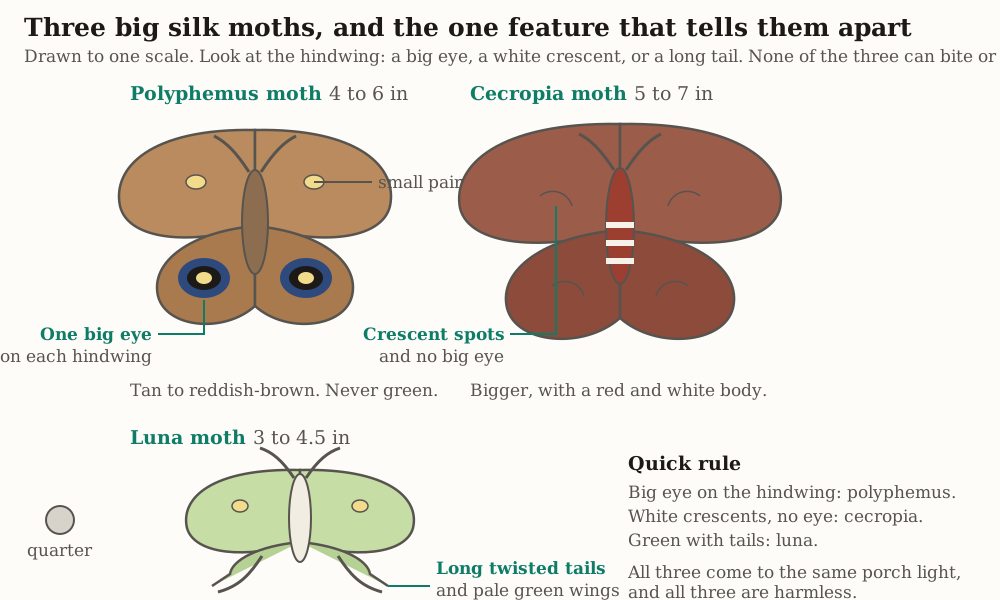
Big moths at a porch light, and the one feature that separates each from a polyphemus moth
One large eyespot on each hindwing
- The moth
- Polyphemus moth
- Wingspan
- 4 to 6 in
- Where you meet it
- Walls and lights, east of the Rockies
White crescent spots, no big eyespot, bigger again
- The moth
- Cecropia moth
- Wingspan
- 5 to 7 in
- Where you meet it
- The same wall. The largest native moth here
Pale green, with two long twisted tails
- The moth
- Luna moth
- Wingspan
- 3 to 4.5 in
- Where you meet it
- The same wall. Never brown
Smaller and yellower, and its caterpillar stings
- The moth
- Io moth
- Wingspan
- 2 to 3.5 in
- Where you meet it
- Gardens and woodland edges
The same moth, but west of the range above
- The moth
- Western polyphemus moth
- Wingspan
- 4 to 6 in
- Where you meet it
- Arizona and New Mexico, where this species is absent
Photographed abroad rather than found here
- The moth
- Giant peacock moth
- Wingspan
- 4 to 6 in
- Where you meet it
- Southern Europe only
Two of those rows catch people out. The first is the western polyphemus moth, Antheraea oculea, and almost nobody writing about this species mentions it. Every source says the polyphemus moth occurs in all of the lower 48 states except Arizona and Nevada, and none of them explains the gap. Its western cousin is the explanation, and public records hold several hundred sightings of it.
The second is the giant peacock moth of southern Europe, which spreads much further on social media than it ever does in life. If a spectacular eyespotted moth reached you as a photograph from a friend abroad, it is probably that one. For the wider sorting job, by size and by colour, our round-up of the brown moth types covers sixteen species. The green moth with tails has its own page, because a big green moth is never this one.
Part 2 of 4
Understand it
Why a polyphemus moth has no mouth, and how long it lives
A polyphemus moth adult has no working mouth and no functioning gut, so it never eats. It runs entirely on fat stored while it was a caterpillar. That is why the adult stage is so short, and most sources put it at under a week. Every giant silk moth lives the same way.
How short exactly is genuinely unsettled, and the published numbers are far apart. Wikipedia says less than one week. Google’s own answer panel said four to seven days one day and three to four days the next. Missouri’s Department of Conservation says a few weeks at most, which is two to four times longer than anyone else. Treat four to seven days as the working figure, and treat anything over a fortnight as unlikely.
How long each stage of the polyphemus moth life cycle takes
Egg
- How long it lasts
- About 10 days to 3 weeks
- What you would be looking at
- White, with two broad brown rings, stuck to a leaf
Caterpillar
- How long it lasts
- Five to six weeks
- What you would be looking at
- Green, growing through five stages
Cocoon
- How long it lasts
- About two weeks, or the whole winter
- What you would be looking at
- A papery brown lump wrapped in a leaf
Adult
- How long it lasts
- A few days, probably four to seven
- What you would be looking at
- The moth on your wall
Why a tattered moth is normal
Worn wings, missing scales and small tears are signs of age rather than injury, and there is nothing to treat. One finder in New York photographed a ragged male and worried about it, and the reply he got was the right one: hopefully it had already done its part. Since the adult cannot feed or repair itself, a scruffy polyphemus moth has simply used up the days it had. Leave it somewhere sheltered.
Are polyphemus moths rare?
No. A polyphemus moth is common and widely distributed, and Florida extension calls it the most widely distributed of our large silk moths. Public records carry 39,186 adult sightings from the United States alone. It is rarely seen rather than rare, because the adult flies at night for a handful of days.
The caterpillar is a different story, and it is found more readily than most people expect. The same records hold 14,047 caterpillar sightings, which is 36 for every 100 adults. For comparison, luna moth caterpillars run at only 15 per 100 adults. So if you want to meet a giant silk moth caterpillar, this is the likelier one by more than two to one.
Nor is the species in any legal trouble, which is the other half of the question people are really asking. The IUCN Red List rates it Least Concern and NatureServe ranks it Secure. Two independent assessments agree. That said, several of the pressures in the last section of this page are real and local, so common is not the same as safe forever.
Now that the moth has a name and a verdict, the rest of this page splits two ways. If you simply want to know what to do with the one in front of you, skip to what to do with yours. If you want the biology, read on.
Where and when you will see a polyphemus moth
A polyphemus moth lives in every state of the lower 48 except Arizona and Nevada, and from southern Canada down into Mexico. Adults are busiest in June and July, and nearly 94% of all sightings fall between March and September. You will almost always meet one at a light after dark.
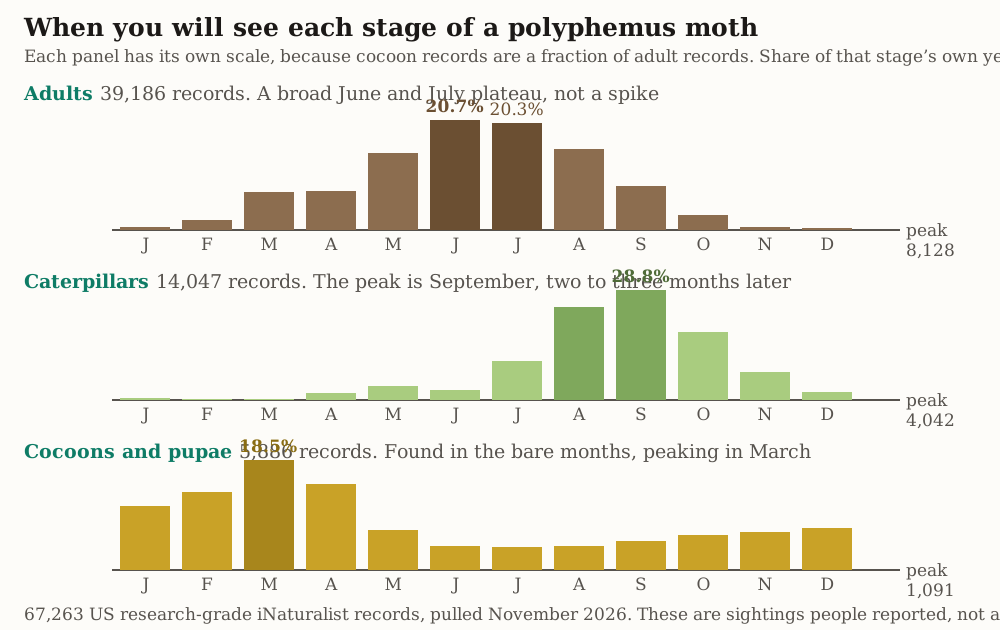
That chart is our own, and it answers a question none of the ranking pages touches: when do you look for each stage? We pulled every research-grade United States record from the public iNaturalist database in November 2026, then split it by life stage. Adults, caterpillars and cocoons turn out to peak in three different seasons. Bear in mind that these are sightings people chose to report, so the shape reflects when each stage is found rather than how many exist.
One brood or two, by latitude
Where you live decides how many generations a year you get, and one widely copied claim about this is wrong. Florida extension is precise: the species runs one brood a year from Pennsylvania northward and two from the Ohio Valley southward, and in Florida staggered emergence means adults turn up in any month. Wikipedia’s flat statement that two broods hatch throughout the United States does not hold for the northern half of the range.
Our own curve backs the extension version from a different direction. Adult sightings form a broad plateau across June and July, with no single month holding more than 21% of them. Set that against the cecropia, which has one brood a year and puts 47% of its adult records into June alone. One generation makes a spike. Two or more smear it across the summer.
Why it is at your porch light
Adults are drawn to light, and ultraviolet wavelengths in particular. Mercury vapour street lamps were once the worst offenders, though they are far less common now. There is a second reason you only ever see this moth on a wall. A silk rearer put it best: the underside of the wings reads as dead leaves. So a resting polyphemus moth on a tree is effectively invisible. For the general case, see why are moths attracted to light.
Part 3 of 4
The caterpillar and the cocoon
The polyphemus moth caterpillar
A full-grown polyphemus moth caterpillar is 60 to 75 mm long, about 2.5 to 3 inches, and startlingly fat. It is translucent yellow-green, its segments balloon outwards, and it carries rows of orange tubercles with silver outer faces. The head is brown. It grows through five stages in five or six weeks.
Wikipedia gives the full-grown length as 3 to 4 inches, and two better sources disagree. Florida extension says 60 to 75 mm, and the Carnegie Museum, which reared a batch, says 6 or 7 cm depending on how far it is stretched while eating. That caveat explains the whole argument. A caterpillar in mid-bite measures longer than the same animal at rest.
The five stages of a polyphemus moth caterpillar, and what changes at each one
First
- Length
- 3 to 6 mm
- What changes
- White, with two black bars across each segment
Second
- Length
- 14 to 15 mm
- What changes
- Turns yellow-green. The bristles start to look shorter
Third
- Length
- 20 to 25 mm
- What changes
- Green, with the yellow side lines now obvious
Fourth
- Length
- 40 to 45 mm
- What changes
- Orange tubercles, silver on their outer faces
Fifth
- Length
- 60 to 75 mm
- What changes
- Full grown and ballooned. Then it leaves the tree
Luna or polyphemus caterpillar?
These are the two big green caterpillars people confuse, and one feature separates them. Find a spiracle, one of the small dark breathing holes along the side. On a polyphemus caterpillar the yellow line runs across the spiracle, at about the middle of the segment. On a luna caterpillar the band sits at the back edge of the segment, behind the hole.
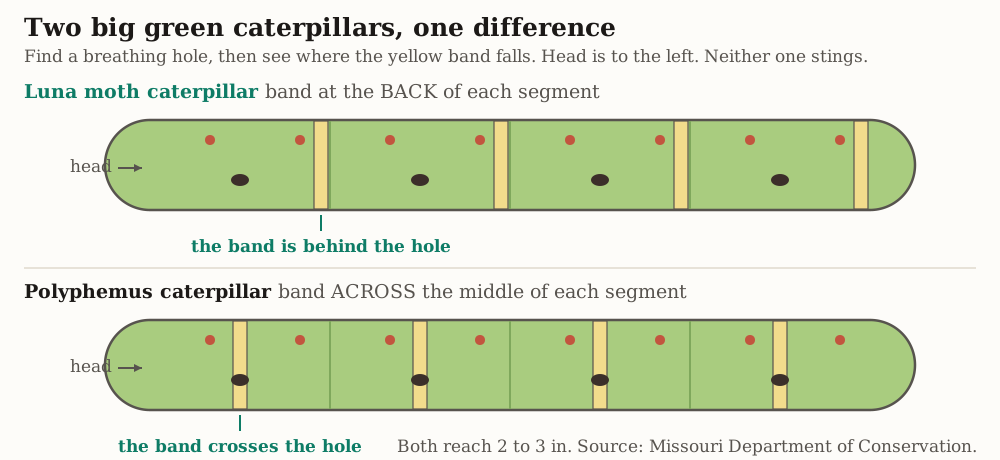
Two independent sources confirm that check, one from each side. Missouri’s field guide gives it on its luna page, and Florida extension describes the polyphemus lines as mid-segmental and touching the spiracles. For the other side of the comparison, see the luna moth caterpillar. A third big green caterpillar turns up in vegetable beds rather than trees, and that is the green caterpillar with horn on its rear end.
Polyphemus moth eggs
The eggs are small, flat ovals, white with two broad brown rings, and glued down with a dark brown cement. The largest recorded measured 2.4 mm. A female places them singly or in little groups of two or three on the leaves of a host tree, over several nights. Freshly hatched caterpillars eat their own egg shell before they start on a leaf.
Male or female caterpillar
You can sex a fully grown caterpillar, which almost nobody writes down. Turn it gently and look underneath at the ninth abdominal segment, counting back from the legs. A male has a small black pit there and a female has none. The finding is from a 1980 study by Miller and Machotka, and no page on the first page of search results mentions it.
What polyphemus caterpillars eat, and whether they hurt your tree
Polyphemus caterpillars eat the leaves of broad-leaved trees, and they are famously unfussy: over 50 species are on record. Oak, birch and maple are the three that nearly every source names. They almost never do real damage, because they are never numerous enough.
Host trees for a polyphemus moth caterpillar, grouped by how well attested each one is
Named by nearly every source
- Trees
- Oak, birch, maple
- Worth knowing
- Start here if you have to guess
Named by several
- Trees
- Willow, hickory, American elm
- Worth knowing
- Wikipedia puts elm, birch and willow first
Named by one or two
- Trees
- Hazelnut, ash, dogwood, apple, cherry, rose
- Worth knowing
- Regional preferences, not rules
One practical warning comes from a rearer rather than a journal, and it matters if you have brought a caterpillar indoors. Once a giant silk moth caterpillar has started on one kind of leaf, it does not like to switch. So feed it more of whatever it was found eating, and do not offer it a tidier alternative.
There is also a neat trick for finding one. Florida extension points out that frass, meaning caterpillar droppings, on a driveway or a parking area often means large caterpillars on the branches overhead. Older caterpillars add to the mess deliberately: after eating a leaf they cut through its stalk so the remains drop, which may be a way of hiding the evidence from birds.
As for your tree, the answer is almost always nothing to worry about. Florida extension records that polyphemus caterpillars are never common enough to damage their host trees significantly, with one real exception: commercial plums in California, where they occasionally count as a pest. On a shade tree in a garden, a caterpillar or two eats a handful of leaves and then leaves.
The cocoon, and the three kinds of hole in it
A polyphemus moth cocoon is an oval lump of tough brown silk wrapped in a leaf, at least 3 inches long, thick but papery. It is thicker and more rounded than a luna moth cocoon. Where you find it is less useful than you would hope, and the hole in it tells you more.
Where a polyphemus cocoon sits, and why sources disagree
Here is the thing that explains all the contradictory advice. This species uses every cocoon placement its whole family group has, which Florida extension sets out in four options, following Wagner and Mayfield. A cocoon may be fastened lengthways to a twig for good. It may hang by a silk stalk that is either strong enough to hold or weak enough to drop. It may sit among leaves with no attachment. Or it may be spun on the ground among fallen leaves and grass.
Missouri’s field guide gives the same answer in one sentence: cocoons usually fall to the ground in autumn when the leaves do, and sometimes they are attached to stems and stay there through the winter. So both halves of the internet are right, which is why they appear to disagree.
Our own records put a number on it. Cocoon sightings are 8.75% of all polyphemus records. For a cecropia, which always fastens its cocoon to a twig, the figure is 15.3%. For a luna, which never fastens at all, it is 0.2%. A species that does both lands between the two, and it does: 44 times the luna rate and about half the cecropia rate. The behaviour and the sightings agree.
There is even a published reason the species hedges. Cocoons left hanging in a tree are raided by squirrels and by hairy and downy woodpeckers. Cocoons in the leaf litter are more exposed to mice. Even so, Waldbauer argued in 1996 that litter cocoons gain real protection from being scattered at random, and that most of those left hanging in trees get hit by woodpeckers. Neither choice is safe, so the species makes both bets.
What made the hole
An empty cocoon is readable, and this is the most useful thing on the page for anyone holding one.
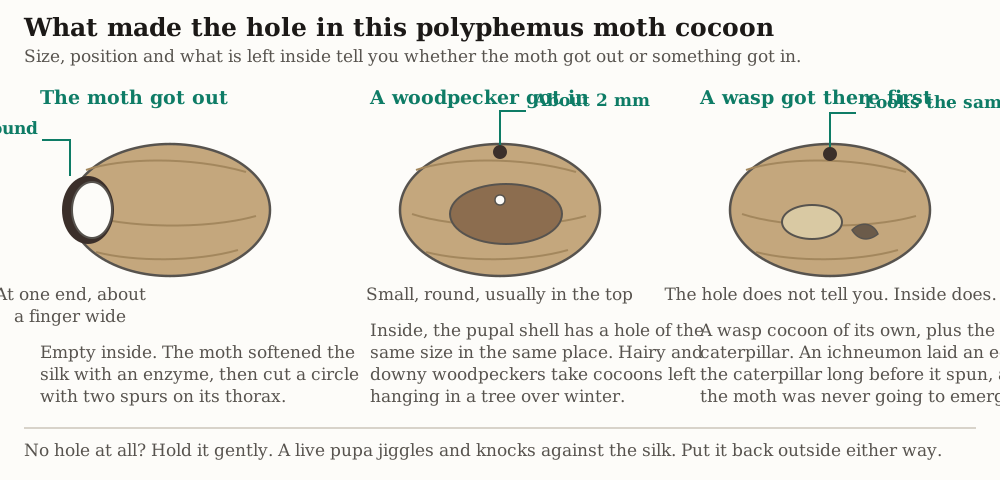
Reading the hole in a polyphemus moth cocoon
A wide, nearly round opening at one end
- What made it
- The moth itself
- How big
- About a finger wide
- What is left inside
- Nothing. It got out safely
A small round hole, usually in the top
- What made it
- A hairy or downy woodpecker
- How big
- About 2 mm
- What is left inside
- An empty pupal shell with a matching hole
A small round hole that looks identical
- What made it
- An ichneumon wasp
- How big
- About 2 mm
- What is left inside
- A wasp cocoon, plus the dead caterpillar
No hole, and it jiggles when you handle it
- What made it
- Nothing yet
- How big
- n/a
- What is left inside
- A live pupa. Put it back outside
What a photograph cannot settle
Be ready for an honest no on this one. Experienced identifiers on BugGuide routinely refuse to name a silk moth cocoon from a picture, and their replies read: either a polyphemus or a luna, probably a polyphemus, giant silk moth cocoon, my best guess. One Kansas reader was puzzled enough to X-ray hers before asking, and the answer she got still stopped at the family.
That is not sloppiness, it follows from the four placements above. Since where a cocoon sits cannot identify it, and since the silk looks much the same, there is often nothing left to go on. Shape and thickness narrow it, and waiting for the moth settles it. For what is happening inside either species, read our explainer on the pupa stage.
How a polyphemus moth gets out of its cocoon
It dissolves its own way out, then cuts. A polyphemus moth has no escape valve in the cocoon, unlike most giant silk moths, so it secretes an enzyme called cocoonase that digests the gum holding the silk together. Then it tears through with two pairs of small spurs on its thorax.
The best detail in that process is where the enzyme comes from. Cocoonase is released from the maxillary galeae, which are the structures that form the tongue in moths that feed as adults. This moth cannot feed, so the mouthparts it does not need have been repurposed to open the cocoon instead. Only the polyphemus and the luna lack the escape valve, and both solve it the same way.
Emergence happens in the afternoon, which gives the wings time to harden before the evening flight. Males come out a few days ahead of females from the same batch. A new adult then pumps body fluid into its wings and waves them gently for an hour or so. During that first day it also voids a reddish liquid called meconium, which is leftover waste from rebuilding a caterpillar into a moth.
All of which explains the commonest worry readers have. A polyphemus moth sitting motionless on the ground in daylight, with a red stain under it, is almost certainly a fresh one waiting for its wings. It is not injured, and it does not need help beyond being moved out of the sun.
The eyespots, and the owl they imitate
The eyespots are a bluff, and a specific one. Wikipedia makes the point nobody else on the search results page makes: the pattern across the two hindwings resembles the head of a great horned owl. A small bird that gets a sudden flash of that at close range has every reason to leave.
This is also why a search for a moth with eyes on its wings leads here nine times out of ten. Two other American moths do carry hindwing eyespots, so they are worth knowing. The io moth is smaller and yellower, and its caterpillar stings. The blinded sphinx hides blue eyespots that only show when its wings open all the way. Neither has anything near the size of these.
The behaviour fits the pattern. A startled adult flips its forewings forward and flaps, which exposes both hindwing eyes at once. Cryan recorded an occasion in 1973 when exactly that display appeared to save a polyphemus moth in flight from blue jays. The bluff costs the moth something, too, since the attacks it provokes often leave the wings torn, though torn wings do not stop it flying.
The family name points the same way. Saturniidae comes from the ringed eyespots of some of its members, which reminded early naturalists of the planet Saturn. So the rings are the family trademark, and this species wears the largest pair in North America.
Male or female?
The antennae answer it in a second. A male polyphemus moth has much bigger, bushier antennae and a slimmer body, because he has to track a female by scent across miles of darkness. A female has narrower antennae and a heavy abdomen full of eggs. Readers get this right unprompted all the time.
Telling a male polyphemus moth from a female, at three stages
Adult
- Male
- Bigger, bushier antennae, slimmer body
- Female
- Narrower antennae, heavy egg-filled abdomen
Caterpillar
- Male
- A small black pit under the ninth segment
- Female
- No pit there
Pupa
- Male
- No notch, and the antenna cases meet in the middle
- Female
- One notch under the fourth exposed segment
The pupa row is worth a second look, because it doubles as a species check. A female polyphemus pupa has one notch underneath, on the fourth exposed segment. A female luna pupa has two, on the fourth and the fifth. So if you are overwintering a cocoon and the pupa is exposed, counting notches tells you both the sex and, with luck, the species.
What the male does with those antennae is the whole point of the adult stage. A female calls with a pheromone, chemically a 90 to 10 mix of two related compounds, from late evening on the day she emerges. Males fly all night looking, and their response peaks in the last two hours before sunrise. Most arrive between about 11 at night and 1 in the morning. A pair then stays coupled through the following day and separates at dusk.
Part 4 of 4
What to do
What to do with the polyphemus moth you found
Almost nothing, in almost every case. A polyphemus moth needs no rescue, no food and no shelter from you, and the single commonest situation, a big green caterpillar crossing a path, needs no intervention either. Here is the whole list, in order.
A polyphemus moth, step by step
Leave it where it is
A polyphemus moth on bark or a shaded wall needs nothing from you. It flies at night, so sitting still all day is normal.
Move it only off hot ground
A sunlit driveway is worth moving it from. Slide paper under the body, let the moth step on, then set it on bark in shade.
Do not try to feed it
There is no mouth to feed. Sugar water, fruit and nectar all do nothing, so skip them and let the moth be.
Let a walking caterpillar walk
A big green caterpillar crossing a path is hunting for somewhere to spin. It is not lost, so nudge it off the tarmac and leave it.
Put a cocoon back outdoors
Set it in a sheltered pile of leaves at ground level. A warm house wakes the moth months early, into a season with no mates.
Record it, then turn the light off
Upload your photo to iNaturalist so the sighting counts. Then switch the outdoor light off for the night.
Step four deserves its own note, because it is the situation readers describe most often and no ranking page addresses it. Late caterpillars leave the tree on purpose to find a place to spin, and that is why they turn up on driveways, paths and hot tarmac. One reader found hers in a parking lot and brought it home. Another stood guard while her dogs went past. Moving a caterpillar off the asphalt is kind, but taking it indoors is not necessary.
One referral is worth knowing. If a moth is clearly injured rather than merely worn, no treatment exists. No exterminator or vet deals with moths either, so a local wildlife rehabilitator is the only sensible call. Most will tell you the same thing we have.
Still not sure what you have?
Photograph it from directly above, with the whole moth in frame and a coin beside it for scale. Then run the picture through our free bug identifier. If yours turned out to be small and beige and indoors rather than big and brown and outdoors, the answer is more likely a fabric moth in a wardrobe.
What eats a polyphemus moth, and what helps
Plenty does, at every stage. Tuskes and colleagues list 21 species of parasitic flies and wasps attacking this moth: ten tachinid flies, five ichneumonid wasps, four chalcidoid wasps and two others. Birds, squirrels, woodpeckers and mice take the rest. Being eaten is normal here.
Two pressures are more recent than that. One is Compsilura concinnata, a European fly released in North America from 1906 onward to control the spongy moth, which was then called the gypsy moth. It did not fix that problem and it attacks native silk moths instead. The other is light. Streetlamps pull night-flying insects away from breeding, an effect sometimes called the vacuum cleaner effect, and the moths that spend the night circling a lamp are not finding mates.
There is also an odd second-hand effect worth recording. When spongy moth caterpillars strip a quaking aspen, the tree responds by changing its leaf chemistry, and that response makes the aspen unusable to polyphemus caterpillars as well. So an introduced pest can shut a native moth out of a host tree without ever touching it.
What a household can change is shorter and more useful. Turn the outdoor light off, or fit one with no ultraviolet output. Leave fallen leaves under your broad-leaved trees through winter, since cocoons of this species spend it there. Skip the insecticide on a shade tree that does not need it. All three cost nothing, and all three touch this moth directly.
Pest control disclaimer. Photo-based identification can help, but it is not always perfect. For dangerous spiders, large infestations, or anything you are unsure about, contact a licensed pest control professional.
Polyphemus moth FAQ
What does it mean when you see a polyphemus moth?
How do you say polyphemus, and how is it spelled?
Are polyphemus moths pollinators?
Can I keep a polyphemus moth cocoon indoors over winter?
How many eggs does a polyphemus moth lay?
Is a polyphemus moth hard to raise?
Related guides
Luna moth
The pale green silk moth with tails, and the caterpillar check that separates it from this one.
Moths
What moths are, what they eat, and why they come to your light.
Types of moths
Name a moth by size and colour, with sixteen US species.
Rosy maple moth
The small pink and yellow silk moth from the same family.
Hummingbird moth
The day-flying moth people report as a tiny hummingbird.
Pupa
What happens inside the cocoon this moth spends the winter in.
Tomato hornworm
The other big green caterpillar in a garden, and its moth.
Clothes moths
The small beige moths whose larvae eat wool and silk.
Sources
- University of Florida IFAS Featured Creatures, Polyphemus Moth, Antheraea polyphemus (EENY-531), for the cocoon placements, the instar measurements and the caterpillar defences
- Missouri Department of Conservation, Field Guide, Polyphemus Moth, for the cocoon sentence and the four eyespots
- UF IFAS Extension Escambia County, Weekly What is it: Polyphemus Moth, for the cocoon and the tree damage answer
- Carnegie Museum of Natural History, Polyphemus Moth Rearing, for the instar sizes and the stretching caveat
- Prairie Haven, Antheraea polyphemus, for the first-hand account of a partial second generation
- iNaturalist API, the monthly record counts quoted above, United States research-grade observations
- BugGuide, a giant silk moth cocoon identification thread, for how far an expert will go from a photograph