Part 1 of 4
What it is
What a hummingbird moth is
A hummingbird moth is any of several day-flying moths in the hawk moth family that hover at flowers and feed on the wing. About 1,400 hawk moth species live worldwide and, by Audubon’s count, roughly 115 of them in North America. Almost all of those fly at night, so the few that work flowers in daylight are the ones people notice and photograph.
The name is a nickname rather than a species. Scientists call the family Sphingidae, and its members go by hawk moths or sphinx moths depending on who is writing. “Hummingbird moth” is the name the public reaches for. It has stuck to the handful that behave like the bird, hovering in front of a bloom, dipping in, then darting sideways to the next one.
Two features give the game away once you get close. The mouth is a proboscis, a soft tube up to twice the length of the body, kept coiled under the chin and unrolled into a flower. The wings and body are covered in scales, which is what every moth and butterfly has instead of feathers. On a clearwing most of those scales fall off during the first flight, which leaves the transparent panels the name refers to.
One warning about the word clearwing, because it leads people astray. It also names the Sesiidae, a separate family of wasp-mimicking borers that tunnel into trunks and stems and are a genuine garden problem. Search for clearwing moth and you will get both. If your insect was hovering at a flower in the open, it is not a borer. For everything else flying around your yard, our round-up of the common kinds of moths sorts them by size and color.
Which hummingbird moth you saw
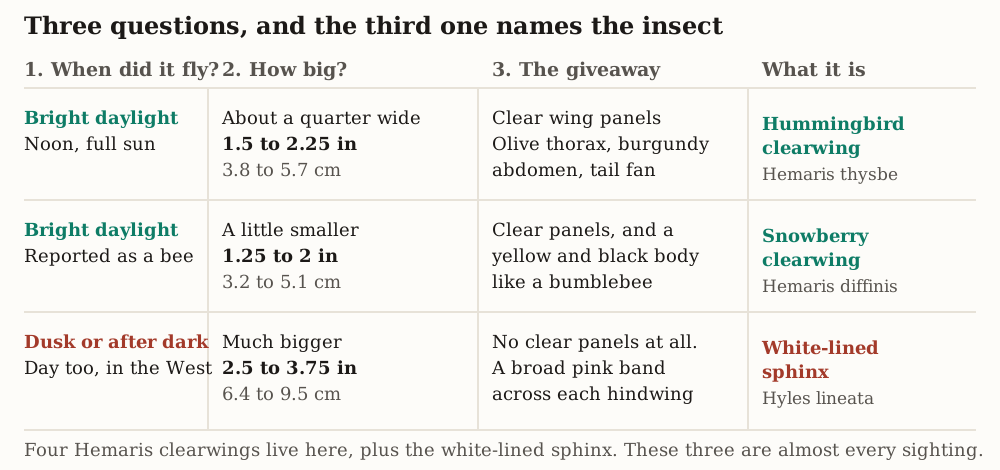
Three insects account for almost every American sighting. A fat, bee-like moth with see-through wing panels, in bright daylight, at 1.25 to 2.25 inches across, is a Hemaris clearwing. Something clearly bigger, 2.5 to 3.75 inches, with solid wings and a pink band, is a white-lined sphinx. Time of day and size settle it.
Table 1. The three insects Americans report as a hummingbird moth
When it flies
- Hummingbird clearwing
- Bright daylight only
- Snowberry clearwing
- Bright daylight only
- White-lined sphinx
- Day or night, busiest at dusk
Wingspan
- Hummingbird clearwing
- 1.5 to 2.25 in (3.8 to 5.7 cm)
- Snowberry clearwing
- 1.25 to 2 in (3.2 to 5.1 cm)
- White-lined sphinx
- 2.5 to 3.75 in (6.4 to 9.5 cm)
Wings
- Hummingbird clearwing
- Clear panels, reddish-brown borders
- Snowberry clearwing
- Clear panels, narrow dark borders
- White-lined sphinx
- Fully scaled, no clear panels
Body
- Hummingbird clearwing
- Olive-green thorax, burgundy abdomen
- Snowberry clearwing
- Yellow and black, like a bumblebee
- White-lined sphinx
- Brown, striped and checkered
The giveaway
- Hummingbird clearwing
- A flared tail fan, widest on males
- Snowberry clearwing
- A dark band through the eye
- White-lined sphinx
- A broad pink band across each hindwing
Scientific name
- Hummingbird clearwing
- Hemaris thysbe
- Snowberry clearwing
- Hemaris diffinis
- White-lined sphinx
- Hyles lineata
Where
- Hummingbird clearwing
- Eastern half of the US and Canada
- Snowberry clearwing
- Most of the US
- White-lined sphinx
- Nationwide, heaviest in the West
Caterpillar food
- Hummingbird clearwing
- Viburnum, honeysuckle, cherry, plum
- Snowberry clearwing
- Snowberry and honeysuckle relatives
- White-lined sphinx
- Purslane, evening primrose, four o'clocks, grape
Hummingbird clearwing, Hemaris thysbe
This is the one most easterners mean. Its thorax is olive to greenish-tan, the abdomen is red-brown to burgundy, and the clear wing panels are edged in reddish brown. At the back, the tail opens into a fan when it brakes. That flare is widest on males, and it is the detail that makes people think of a bird. Wisconsin Extension gives its wingspan as 1.5 to 2.25 inches.
Snowberry clearwing, Hemaris diffinis
Same shape, different paint job. The body is yellow to greenish-yellow with black bands, and a dark stripe runs through the eye. So it reads as a small bumblebee rather than as a bird. It is slightly smaller than thysbe, at 1.25 to 2 inches. People report this one as a bee far more often than as a hummingbird.
White-lined sphinx, Hyles lineata
The big one, and the most-reported moth in the country. Its wings are fully scaled, with a pale stripe running down each forewing and a broad pink band across each hindwing. It flies by day or night and is busiest at dusk. At up to 3.75 inches across, it comes closest to a real bird in size, so it causes most of the confusion.
The two rarer clearwings
Two more Hemaris species live here and turn up occasionally. The slender clearwing, Hemaris gracilis, is a little smaller than thysbe and keeps to pine barrens and dry open woods. The Rocky Mountain clearwing, Hemaris thetis, is the western counterpart of the snowberry clearwing and reads as a bumblebee too.
Part 2 of 4
Telling it apart
Hummingbird moth or hummingbird?
Size answers it first. A ruby-throated hummingbird spans 3 to 4.3 inches and a hummingbird clearwing spans about half that. After size, count the legs and look for antennae: a moth has six legs and two antennae, and a bird has two legs and none. Both hover and both feed on nectar, so behavior alone will not do it.
Table 2. Hummingbird moth against a real hummingbird, feature by feature
Antennae
- Hummingbird moth
- Two, thickened and often feathery
- Hummingbird
- None
Legs
- Hummingbird moth
- Six, tucked under in flight
- Hummingbird
- Two
Mouth
- Hummingbird moth
- A coiled tube, uncoiled into the flower
- Hummingbird
- A rigid beak with a tongue inside
Wings
- Hummingbird moth
- Four, covered in scales
- Hummingbird
- Two, covered in feathers
Wingspan
- Hummingbird moth
- About 1.5 to 2.25 in
- Hummingbird
- 3 to 4.3 in (ruby-throated)
Does it land?
- Hummingbird moth
- Often, on the flower it is drinking from
- Hummingbird
- Almost never while feeding
Sound
- Hummingbird moth
- A dry buzz from the wings
- Hummingbird
- A thin hum, plus chip calls
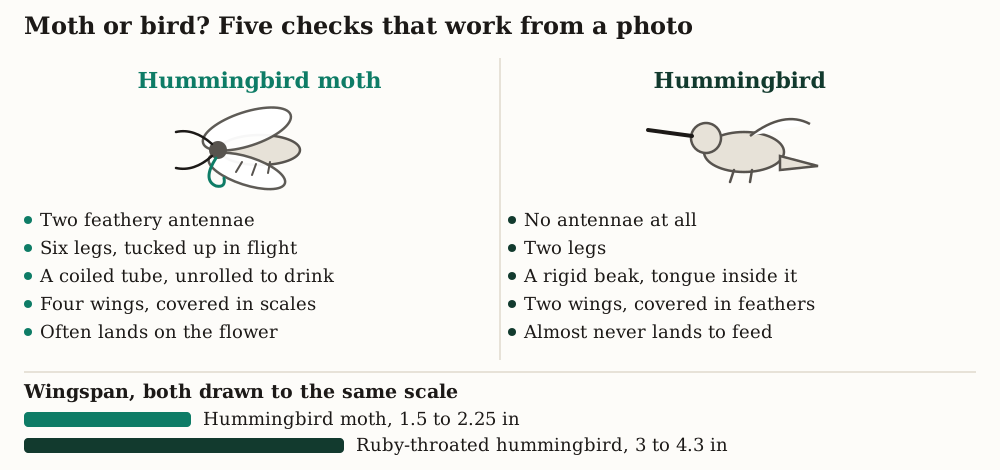
The resemblance is not a coincidence, and it is not a family relationship either. Birds and moths last shared an ancestor more than 500 million years ago. Hovering at flowers for nectar simply rewards the same equipment twice, which biologists call convergent evolution. Audubon records the moth beating its wings up to 70 times a second in a figure-eight path, while almanac.com puts the figure at 80. Either way it can hover, reverse and dart sideways, exactly as the bird does.
One honest limit: a blurred phone photo often cannot settle this at all. If the wings are a smear and the body is small in frame, look instead at what happened next. A moth that settled onto the bloom and kept drinking was a moth. A visitor that never touched the flower and shot away at head height was probably the bird.
Is it a bee or a bumblebee?
Often that is the first guess, and the snowberry clearwing earns it. Its yellow and black body copies a bumblebee closely enough to borrow the warning, which is a defense known as mimicry. The copy has no sting behind it. One reader on a gardening forum put it better than any field guide: it looked like “a bee on a serious workout plan”.
Three checks separate them. A bee carries pollen, either in baskets on its hind legs or in a brush under the abdomen, and a moth never does. A bee has a short tongue it folds away, while the moth unrolls a tube longer than its own body. And a bee lands on almost every flower it works, while a clearwing hangs in the air for a second and moves on. If it was fat, furry and slow on the flower, read our guide to the do bumble bees sting question instead, or compare it against the common bee species.
Does a hummingbird moth bite or sting?
No. A hummingbird moth has no stinger and no jaws. Its only mouthpart is the proboscis, a flexible straw built to reach into a flower, and it cannot pierce skin. Adults are harmless to people and to pets, and that holds for every one of the roughly 115 North American hawk moths, not just the three here.
The caterpillar is safe to handle too. It carries a horn at the tail, the anal horn that gives hornworms their name. That horn is not a sting, and it holds no venom. These caterpillars have no irritating hairs either, unlike the few stinging caterpillars that do deserve care.
Plants get off almost as lightly. Clearwing caterpillars eat honeysuckle, viburnum and snowberry leaves in ones and twos, which no gardener notices. Only the white-lined sphinx turns up in numbers. Even then, Colorado State Extension notes that it seldom damages crops, though big outbreaks do happen once its wild food runs out.
Part 3 of 4
Where and when
How rare is a hummingbird moth?
Not rare, but easy to miss. The white-lined sphinx is the single most-reported moth species in US records on iNaturalist, and the hummingbird clearwing is common across the whole eastern half of the country. So the honest answer to a first sighting is that you were not lucky, you were simply looking at the right moment.
Two things make them feel rare. Adults live a few weeks, and most places get one or two generations a year. Any one patch of flowers therefore has a short window. They also feed fast, hold still for nothing and leave. People who grow bee balm or phlox often see one every summer, while a gardener in eastern North Carolina reported that in his experience they are “VERY RARE”. Both are true, because this is a regional and seasonal animal rather than a scarce one.
Where and when you see them
Across the lower 48 and southern Canada, somewhere between late spring and early autumn, with the peak in mid-summer. Which species you get depends on where you are. The clearwings are strongest in the east, while the white-lined sphinx dominates the west and turns up almost everywhere. In the southern states a second generation runs into late summer.
Table 3. Which hummingbird moth to expect, by region
Northeast and Great Lakes: Ohio, Michigan, Pennsylvania, Illinois, Indiana, Minnesota, Maine
- Most likely species
- Hummingbird clearwing, then snowberry clearwing
- When to watch
- June to August, in the middle of the day
Southeast: Virginia, North Carolina, Georgia, Alabama, Florida
- Most likely species
- Hummingbird clearwing and white-lined sphinx
- When to watch
- May to September, with a second brood late
Plains and Midwest: Missouri, Kansas, Nebraska
- Most likely species
- White-lined sphinx, snowberry clearwing
- When to watch
- June to September, often at dusk
Mountain West: Colorado, Utah, Wyoming
- Most likely species
- White-lined sphinx
- When to watch
- June to September, heavy in good wildflower years
Southwest: Arizona, New Mexico, west Texas
- Most likely species
- White-lined sphinx
- When to watch
- March to October, following the rains
West Coast: California, Oregon, Washington
- Most likely species
- White-lined sphinx, Rocky Mountain clearwing inland
- When to watch
- April to September, dusk in hot weather
Time of day narrows it further. If you watched it in full sun at noon, you were watching a clearwing. If the light was going and the insect was big, it was the white-lined sphinx. After dark, a hovering hawk moth is more likely still to be a night-flying species. That includes the moth whose caterpillar eats tomatoes.
Part 4 of 4
The caterpillar and the garden
The caterpillar, and the tomato hornworm it is not
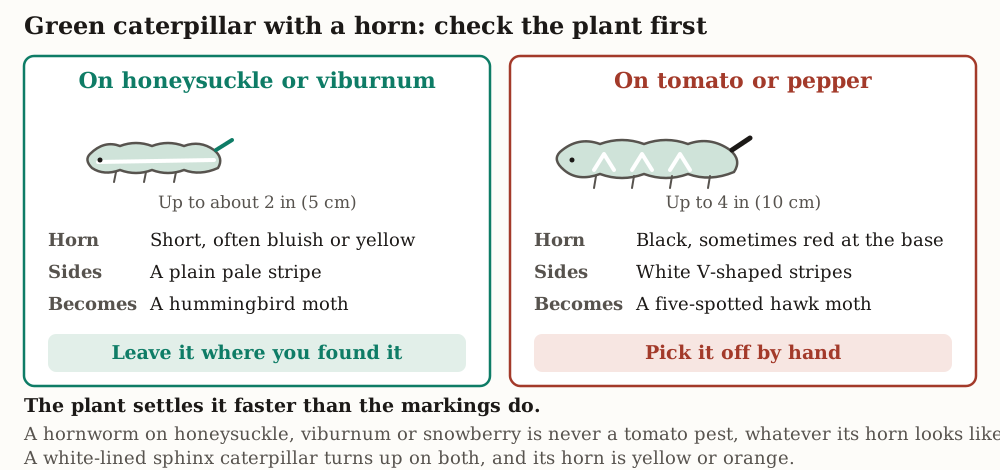
A hummingbird moth caterpillar is a green hornworm about two inches long. It has a pale stripe down each side and a horn at the tail. It feeds on honeysuckle, viburnum and snowberry, never on tomatoes. That one fact separates it from the tomato hornworm faster than any marking does, so look at the plant before you look at the caterpillar.
This is where real harm gets done, and the confusion runs in both directions. On gardening forums one side insists the tomato hornworm does not become a hummingbird moth and the other insists it does. Both are partly wrong, so here is the untangled version.
Table 4. Green caterpillar with a horn: which one is it?
Honeysuckle, viburnum, snowberry, cherry
- The caterpillar
- Hemaris clearwing: plain green, a pale side stripe, up to about 2 in
- The horn
- Short, stiff, often bluish or yellow
- What to do
- Leave it. It becomes the moth on this page
Tomato, pepper, potato, eggplant
- The caterpillar
- Tomato hornworm: up to 4 in, white V-shaped stripes
- The horn
- Black, or dark with a reddish base
- What to do
- Pick it off by hand; it defoliates a plant fast
Tomato and tobacco, with diagonal lines
- The caterpillar
- Tobacco hornworm: seven white diagonal stripes
- The horn
- Red
- What to do
- Same treatment as the tomato hornworm
Purslane, evening primrose, grape, sometimes tomato
- The caterpillar
- White-lined sphinx: green to nearly black, yellow or orange spots
- The horn
- Yellow or orange, sometimes black-tipped
- What to do
- Usually leave it; it rarely does real damage
Does the tomato hornworm turn into a hummingbird moth?
It turns into a hawk moth, which is not the same thing. The tomato hornworm becomes the five-spotted hawk moth, Manduca quinquemaculata, a grey insect with a wingspan of 4 to 5 inches that also hovers at flowers. Plenty of people call that a hummingbird moth, and the loose usage is why the argument never ends. It is not a clearwing, it is twice the size, and it flies at dusk and after dark rather than at noon. The tobacco hornworm becomes a close relative, the Carolina sphinx. Our guide to the tomato hornworm life cycle covers both and the damage they do.
The reverse mistake costs more. Because clearwing caterpillars are green hornworms too, gardeners find one on a honeysuckle and kill it as a tomato pest. One commenter on the Old Farmer’s Almanac put it plainly: “I’m sure people are killing these thinking they’re tomato hornworms.” Colorado State Extension lists the snowberry clearwing in its own table of common Colorado hornworms. That is how closely the two groups sit together. Check the plant first, and the question answers itself.
What hummingbird moths eat, and the flowers that bring them
Adults drink nectar and nothing else, which is why a long proboscis pays off. They favor deep or tube-shaped flowers that short-tongued insects cannot empty. Caterpillars eat leaves, and each species sticks to a narrow set of host plants, so what you plant decides both whether the moths visit and whether they breed.
For the adults, the reliable draws are bee balm, phlox, verbena, butterfly bush, honeysuckle, petunias, salvia, Joe-pye weed, purple coneflower and butterfly weed. Wild bergamot works as well as anything in a border. For breeding, plant or keep the hosts: viburnum and honeysuckle for the hummingbird clearwing, snowberry for the snowberry clearwing.
There is a practical reason to care beyond the pleasure of watching one. These moths pollinate while they feed, and they work blooms that bees handle poorly, including deep tubes and flowers that open towards dusk. That is the short answer to whether are moths pollinators, and it is also the argument against reaching for a spray when you find the caterpillars.
Life cycle, and how long one lives
Four stages, and most of the year is spent out of sight. Pale green eggs are laid singly on the underside of host leaves in spring. The caterpillar feeds for a few weeks, then drops to the ground and spins a thin brown cocoon in the leaf litter. Most regions get one or two generations a year, depending on latitude and warmth.
Table 5. The four stages of a hummingbird moth
Egg
- How long
- About a week
- Where to look
- Singly, on the underside of a host leaf
Caterpillar
- How long
- Three to four weeks
- Where to look
- On honeysuckle, viburnum or snowberry
Pupa
- How long
- Two to three weeks, or all winter
- Where to look
- In a thin cocoon under leaf litter
Adult
- How long
- A few weeks
- Where to look
- Hovering at flowers in daylight
Because the cocoon sits in the litter rather than in a tree, raking and bagging every leaf in autumn removes next year’s moths along with the leaves. Leaving a layer under the shrubs is the single easiest thing a gardener can do for them. The same habit protects anything else that overwinters there, which is covered in our guide to how insects pupate under leaf litter.
Adult lifespan is the one number worth treating carefully, because published figures disagree by a wide margin. A widely shared video says three to four weeks. Meanwhile almanac.com gives a range of three weeks to seven months, without saying which stage or species it means. A few weeks on the wing fits one or two generations a season, and that is the figure we would stand behind.
The hummingbird hawk moth, and whether it is in the US
The hummingbird hawk-moth, Macroglossum stellatarum, does not live in North America. It is a European, North African and Asian species with a wingspan of 5.0 to 5.8 cm, grey-brown forewings, orange-brown hindwings and a black and white checkered body. In Britain it arrives as a migrant from southern Europe, in numbers that change every year.
It matters here only because of search results. UK conservation pages about that moth rank high on American searches. So a reader in Ohio lands on an article about an insect thousands of miles away, and about bedstraw, a host plant their caterpillars never touch. If you are in the US, the hovering moth at your flowers was a clearwing or a white-lined sphinx. Those two names are what to search next.
Google’s own summary makes the same slip. It lists the European species among the common ones for a US query, then notes that it lives across Europe and parts of Asia. Treat any page that mixes the two as written for somewhere else.
Pest control disclaimer. Photo-based identification can help, but it is not always perfect. For dangerous spiders, large infestations, or anything you are unsure about, contact a licensed pest control professional.
Frequently asked questions
What does it mean if you see a hummingbird moth?
Are hummingbird moths good or bad?
Do hummingbird moths come out at night?
Is a snowberry clearwing a hummingbird moth?
What plants are host plants for the hummingbird clearwing moth?
Are hummingbird moths invasive?
How many kinds of hawk moth are there in North America?
Related guides
Types of moths
16 common US moths sorted by size and color, with the feature that names each one.
Moths
What moths are, what they eat, why they fly to lights, and which few damage a home.
Tomato hornworm
The big green caterpillar on your tomatoes, and the hawk moth it turns into.
Bumble bee
The fat, furry bee the snowberry clearwing is copying, and whether it stings.
Types of bees
Eight bees people actually meet, and how to tell each one from a wasp.
Pupa
The resting stage between caterpillar and adult, and what to do if you find one.
Sources
- Colorado State University Extension, Hornworms and Hummingbird Moths
- University of Wisconsin Horticulture Extension, Hummingbird Moth (Hemaris thysbe)
- UC IPM, Sphinx moths
- Mass Audubon, Hummingbird Moth (Clearwing Moth)
- Audubon, Why Hummingbird Moths Look and Act Just Like Hummingbirds
- Butterfly Conservation, Humming-bird Hawk-moth
- Missouri Department of Conservation, Hummingbird Clearwing