Almost nobody arrives here holding an insect in a jar. People arrive for two reasons. Some heard that silk comes from a moth and want to know how that works. Others met a huge moth on a wall, and the phrase they reached for was giant silk moth. Both are fair, and the answers differ. So the first job is to say which insect you have.
Part 1 of 4
Name it
Two insects called a silk moth
A silk moth is one of two things. The first is Bombyx mori, farmed for silk for more than 5,000 years. It spans 1 to 2 inches and cannot fly. The second is the family Saturniidae, the wild giant silk moths. Those run to about 75 species north of Mexico, at 3 to 7 inches. Both sit in the order lepidoptera, but in separate families. So they are relatives rather than one animal.
Size usually settles it on sight. The farmed one is about as wide as a credit card is long. It is cream to buff white, with a fat furry body. A wild one is the width of your palm or more. Its wings are brown, grey, green or pink, often with a clear eyespot on each. Where you meet them differs too. The farmed kind arrives indoors in a tub from a shop, and the wild kind turns up on a porch wall in summer.
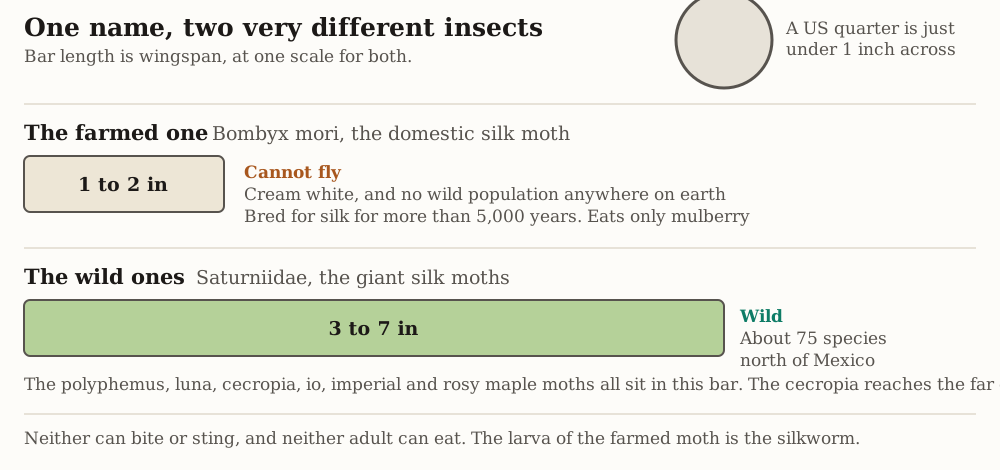
How the two silk moths differ, feature by feature
Can it fly?
- Farmed silk moth
- No. The body outgrew the wings
- Wild giant silk moths
- Yes, strongly, and almost always at night
Wingspan
- Farmed silk moth
- 1 to 2 in
- Wild giant silk moths
- 3 to 7 in, and a few are smaller
Colour
- Farmed silk moth
- Cream to buff white
- Wild giant silk moths
- Brown, grey, green, pink or tan, usually with eyespots
Where it lives
- Farmed silk moth
- Only in human care, nowhere wild
- Wild giant silk moths
- Wild across North America, about 75 species
What the caterpillar eats
- Farmed silk moth
- White mulberry leaves and nothing else
- Wild giant silk moths
- Oak, maple, walnut, birch, cherry, willow and more
What its silk is used for
- Farmed silk moth
- Nearly all the world's commercial silk
- Wild giant silk moths
- Tussah, muga and eri silk, and far less of it
Can the adult eat?
- Farmed silk moth
- No
- Wild giant silk moths
- No
Silkworm, silk moth, saturniid: the names people use
One name causes most of the confusion here, and it is worth clearing up early. The silkworm is the caterpillar, not a separate animal. So a shop selling silkworms and an article about the domestic silk moth mean the same insect at different ages. Other names pile up too. People write silkworm moth for the farmed one, and giant silkworm moths, wild silk moths or saturniids for the wild family.
A white silk moth is almost always the farmed one, and the reason is interesting. Thousands of years of breeding stripped its pigments out. So it is pale by accident rather than by design. A pink silk moth is usually something else. The small pink moth most people mean is a wild member of this same family. Has something been eating your jumpers? Then you want the moths that eat wool, which are tiny and unrelated.
Why a silk moth cannot fly, cannot eat, and lives about a week
The farmed adult lives 5 to 10 days and the wild ones about a week to two weeks. Both figures have one cause. The adult emerges with reduced or absent mouthparts, and the wild family has no digestive tract at all. So an adult silk moth cannot feed. It runs entirely on fat the caterpillar stored.
Sources differ on the exact number, which is worth knowing if you go looking. Backyard Brains gives 5 to 10 days for the farmed moth. Missouri Department of Conservation says the wild ones “usually only live about two weeks or less”, then “only a few weeks” further down the same page. Google itself shows a lifespan of 42 to 56 days here. That figure is the whole life cycle from egg to death, not the winged stage.
How long do silk moths live, stage by stage
The farmed silk moth, stage by stage, with the wild family for comparison
Egg
- Farmed silk moth
- About 14 days
- Wild giant silk moths
- Roughly 1 to 2 weeks
Caterpillar
- Farmed silk moth
- 25 to 28 days, five instars
- Wild giant silk moths
- About a month to a summer, four to six moults
Cocoon or pupa
- Farmed silk moth
- 2 to 3 weeks
- Wild giant silk moths
- 2 weeks in summer, about 9 months over winter
Adult
- Farmed silk moth
- 5 to 10 days
- Wild giant silk moths
- A week to two weeks
The flightlessness belongs to the farmed moth alone, and it is the thing people ask about most. Wikipedia puts it flatly: the moth “is not capable of functional flight”. Some individuals get off a surface briefly. But the body grew heavier and the wings never kept up, because breeders selected for cocoon size rather than for a moth that could leave. Its wild ancestor, Bombyx mandarina, still flies perfectly well.
Is a silk moth dangerous?
No adult silk moth can bite, sting or carry venom. The reason is simply that it has no working mouth. So there is nothing to treat, nothing to spray and nobody to call. One real caution does belong to the caterpillars, and it covers two or three species out of about 75.
University of Kentucky entomology puts the balance well. For the most part, it says, “this horrendous appearance is all show as far as harm to humans is concerned”. The exception is sharp: “the spines on the io moth caterpillar are true defensive weapons and can produce a painful sting”. Buck moth caterpillars sting too. Then there is the worst-looking one of the lot, the five-inch hickory horned devil, which the same source calls “entirely harmless to humans”.
Can you touch a silk moth caterpillar?
Usually yes. Still, Missouri Department of Conservation gives the sensible rule for a stranger in your hand: “we do not recommend handling any hairy or spiny caterpillars unless you’re certain they’re safe.” Lift it on a leaf instead. One tropical relative, the South American genus Lonomia, carries a toxin that can kill a person. Nothing like it lives in the United States.
That is the safety answer finished, and most readers came for something else. Want to know where the silk actually comes from? Carry straight on. Holding a caterpillar or a cocoon instead? Then skip ahead to the caterpillar section.
Part 2 of 4
The silk
Where silk actually comes from
Silk is cocoon material. The caterpillar spins its cocoon from a single continuous filament, 300 to about 900 metres long. Commercial silk is that filament unwound and spun into thread. The filament is a protein called fibroin, coated in a gum called sericin. It comes out of glands in the caterpillar's head, not from any part of the adult moth.
The scale is the part that surprises people. It takes 4,000 to 7,000 cocoons to make one kilogram of raw silk. The world produces at least 32 million kilograms a year, so nearly 10 billion cocoons go through the process annually. Even so, silk is under 0.2% of world fibre output, and about 70% comes from China. The caterpillar eats only white mulberry leaves to get there.
Are silk moths killed to make silk?
In conventional silk production, yes. The emerging moth releases enzymes that dissolve a hole in the cocoon. That breaks the single long filament into short pieces. So the cocoons are heated or boiled with the pupa still inside, which keeps the thread whole and kills the insect. Roughly 10 billion pupae a year go that way.
There is an alternative and it has a name. Ahimsa silk, also sold as peace silk, uses cocoons the moth has already left. The fibres come out shorter, so they are spun rather than reeled. Gandhi criticised ordinary sericulture on exactly these grounds. Eri silk makes the point neatly. Its cocoon has a natural opening, so the moth walks out alive and the silk is gathered afterwards.
Damaged cocoons are not wasted either. They go into silk wadding and quilt stuffing, so a torn cocoon still has a market. None of this is a reason to avoid silk, or to buy it. We are not going to tell you which to do. It is simply what happens.
Wild silk, and the moths that make it
Four named silks come from wild moths rather than the farmed one. All four of those moths belong to the giant silk moth family. The Florida Museum of Natural History holds a collection of them, and it is the clearest source on which moth makes which cloth. Wild silk is coarser. The museum says plainly that it is “not nearly as luxurious as domestic silk”.
The named wild silks, the moth behind each one, and where it is produced
Tussah, the best known wild silk
- The moth that makes it
- Antheraea pernyi
- Where
- China, on oak trees, and in Japan and Korea
Muga, golden without dyeing
- The moth that makes it
- Antheraea assamensis
- Where
- Assam, in northeast India
Eri, soft and spun rather than reeled
- The moth that makes it
- Samia ricini
- Where
- Northeast India and Southeast Asia
Tensan, greenish and costly
- The moth that makes it
- Antheraea yamamai
- Where
- Japan, for more than a thousand years
Fagara
- The moth that makes it
- Attacus atlas
- Where
- Tropical southeast Asia
Mulberry silk, the commercial one
- The moth that makes it
- Bombyx mori
- Where
- Originally China, now farmed worldwide
Tussah is also called tasar, and the name covers several close relatives rather than one species. That is why sources disagree about it. A silk retailer credits tussah to Antheraea mylitta, the Indian tasar moth. The museum credits Antheraea pernyi, the Chinese oak moth. Both are real tussah moths, so the honest answer is that tasar silk is a group of silks.
None of this happens in North America, and one record says why. The ailanthus silkmoth was brought here in the nineteenth century, partly to start a silk industry on ailanthus trees. Public records now hold three research-grade US sightings of it. The attempt did not take.
Part 3 of 4
The wild ones
The giant silk moths of North America
About 75 species live north of Mexico, and ten of them cover nearly everything people actually find. Sources differ on the count. Wikipedia says 42 species north of Mexico and southern California. Missouri Department of Conservation and BugGuide both say about 75, and BugGuide puts the world total near 2,600 against Wikipedia's 2,300. Either way, five moths will name most of what you meet.
The ten North American giant silk moths you are most likely to meet
Pale green with two long tails
- Species
- Luna moth
- Wingspan
- About 4 in
- Where its cocoon is
- Loose in the leaf litter
Tan, with a big eyespot on each hindwing
- Species
- Polyphemus moth
- Wingspan
- 3.5 to 5.5 in
- Where its cocoon is
- A leaf webbed onto the outside
Reddish brown with white bands, the largest native moth
- Species
- Cecropia moth
- Wingspan
- 5 to 7 in
- Where its cocoon is
- Spindle-shaped, bound along a twig
Dark brown or black, and the male flies in daylight
- Species
- Promethea moth
- Wingspan
- 2.5 to 4 in
- Where its cocoon is
- Hung from a leaf stalk, easy to spot in winter
Yellow with one dark eyespot per hindwing. Spines sting
- Species
- Io moth
- Wingspan
- 2 to 3 in
- Where its cocoon is
- Loose leaves near the ground
Yellow with lilac patches
- Species
- Imperial moth
- Wingspan
- 4 to 5.5 in
- Where its cocoon is
- No cocoon. It pupates in soil
Grey and yellow, and its caterpillar is the hickory horned devil
- Species
- Royal walnut moth
- Wingspan
- About 6 in
- Where its cocoon is
- No cocoon. It burrows to pupate
Pink and yellow, and much the smallest of these
- Species
- Rosy maple moth
- Wingspan
- 1.5 to 2 in
- Where its cocoon is
- In the soil or leaf litter
Tan with a white forewing spot, caterpillars in groups
- Species
- Orange-tipped oakworm
- Wingspan
- 1.5 to 2.5 in
- Where its cocoon is
- Underground
Dark, day-flying, and the spines sting
- Species
- Buck moth
- Wingspan
- 2 to 3 in
- Where its cocoon is
- Loose, at or below ground level
Which silk moth you are most likely to see
We counted. Public iNaturalist records for the United States hold nearly 300,000 research-grade sightings of this family, across 88 species, as of November 2026. The top five are about 71% of them. And the order has a surprise in it.
US research-grade iNaturalist records by species, November 2026
Polyphemus moth
- US records
- 67,264
Luna moth
- US records
- 60,152
Imperial moth
- US records
- 28,664
Rosy maple moth
- US records
- 27,752
Io moth
- US records
- 27,165
Buck and sheep moths, whole genus
- US records
- 15,537
Cecropia moth
- US records
- 12,951
Regal moth
- US records
- 7,616
Promethea moth
- US records
- 7,012
Ceanothus silk moth
- US records
- 5,393
Atlas moth
- US records
- None. 3,010 worldwide
Ailanthus silkmoth, introduced
- US records
- 3
The surprise is the cecropia. It is North America's largest native moth, and every article leads with it. Yet it sits seventh on that list, with about one record for every five of the polyphemus moth. So the biggest is not the one you are likeliest to find.
Two honest limits on those numbers. They count what people photographed and uploaded, not what lives in the woods. So a showy moth near a city beats a drab one in a swamp. A few rows are species groups rather than single species, because taxonomists have split the buck moths since the older field guides were written.
Our round-up of moth species covers the other large moths you might meet, including the hawk moths and the ones sorted by colour. Was yours hovering at flowers in daylight? Then it was probably not one of these at all.
When you will see a silk moth
Adults peak in July and run high from May to August, which holds about 77% of all adult records. Caterpillars peak about two months later, in August and September. Those two months hold just over half of all caterpillar records. So the two stages turn up in different seasons, which helps if you are looking on purpose.
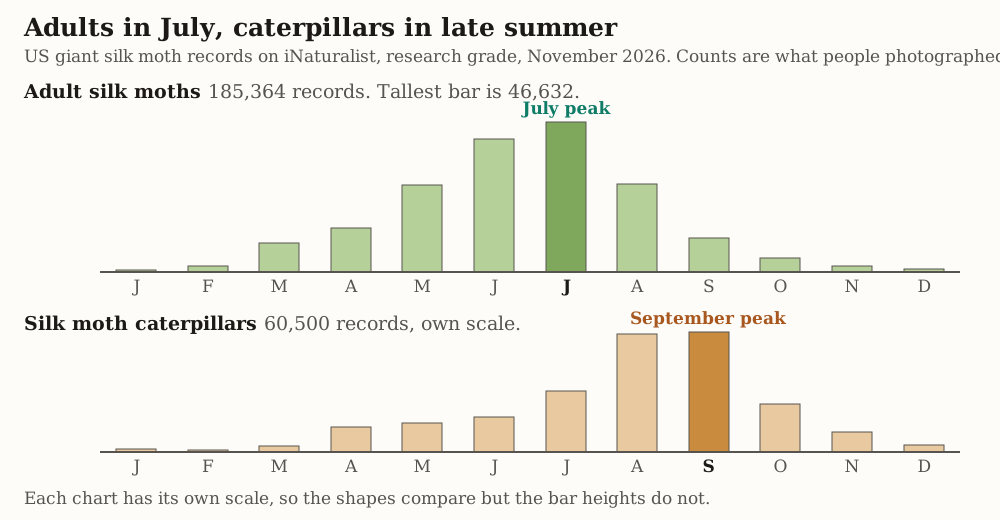
Most of this family flies after dark. So most sightings happen at a lit window or a porch wall, not in a wood. Two exceptions are worth knowing. The male promethea flies in the late afternoon, and buck moths fly by day in autumn. Everything else turns up at night, which is also why are moths attracted to light is such a common question.
Dates shift with latitude. Missouri records cecropias from April to June and lunas from April to August. Its season closes in October, as the buck moths appear. Further north everything runs later, and most species manage one generation a year. The far south gets two or three.
The silk moth caterpillar
A full-grown one is 2 to 4 inches long, fat and usually green. Rows of raised fleshy knobs run along its back, each tipped with a short bristle. It is seldom hairy. The farmed caterpillar, the silkworm, differs again. That one is smooth and pale grey-white, about 3 inches at the end, and it eats mulberry leaves only.
The confusion worth settling is with a hornworm. Both get big and green, and both turn up on garden plants. So people mix them constantly. Wikipedia's description of the family gives the test. Large caterpillars outside this family “are almost universally Sphingidae, which are seldom hairy and tend to have diagonal stripes on their sides. Many Sphingidae caterpillars bear a single curved horn on their hind end.”
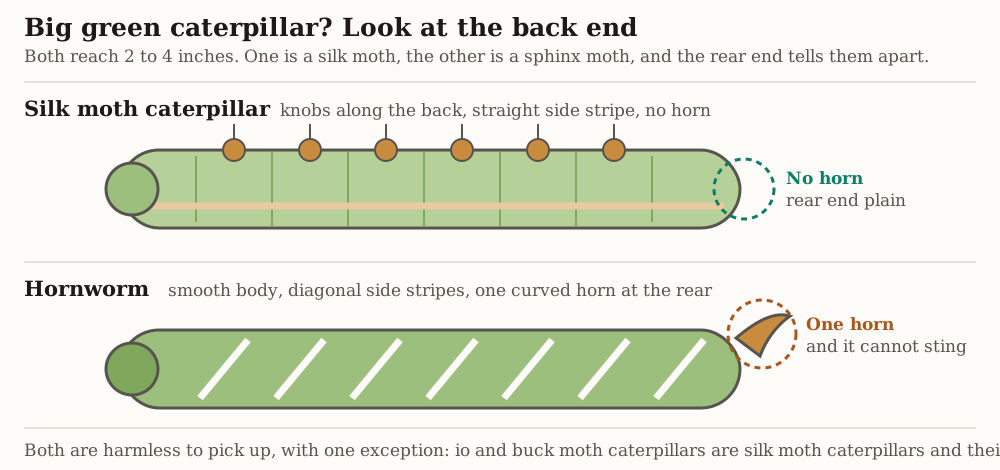
So check the tail. A single curved horn means a green caterpillar with horn. That one becomes a hawk moth, such as the white-lined sphinx moth. Knobs along the back and a plain rear end mean a silk moth. Thin stripes and a yellow line low on the side point instead to a luna moth caterpillar.
Do they damage trees?
Rarely enough that most years you do nothing. One or two large caterpillars can strip a small branch. A few species feed in groups and do more, the oakworms especially. University of Kentucky's advice starts where it should: hand picking is usually enough, with gloves if the caterpillar is an io. A spray is a last resort, for a tree being stripped by caterpillars you cannot reach. The label on the product is the law.
The cocoon, and what to do if you find one
Cocoon shape is one of the better ways to name a wild silk moth, because the strategy differs by species. A cecropia spins a spindle about three inches long and binds it along a twig. The polyphemus webs a leaf onto the outside of its own. Promethea cocoons hang from a leaf stalk, so bare winter trees give them away. Then there is the luna moth, whose cocoon simply falls to the ground with the leaves.
Several species skip the cocoon altogether. The regal and imperial moths burrow into soil and pupate there with almost no silk, so raking never turns one up. For what a cocoon is, and how it differs from a chrysalis, see our explainer on the cocoon and chrysalis.
If you have found one, the useful advice is short. Most of this family spends about nine months as a pupa, and needs a cold winter to come out on time. So put it back outdoors, in a sheltered pile of leaves at ground level. A warm house triggers an early emergence in February, into a season with no mates.
Part 4 of 4
What to do
Can you keep a silk moth?
You can raise the caterpillar, and you cannot keep the adult. Four of the questions Google lists on this topic are about keeping one, so it clearly comes up a lot. The honest answer has a hard limit in it. An adult silk moth has no mouth, so it has 5 to 14 days whatever you do. Keeping one really means keeping a caterpillar.
A silk moth, caterpillar or cocoon, step by step
Work out which one you have first
A cream moth the size of a stamp, indoors, in a box from a shop is the farmed kind. A big moth on your wall in summer is a wild one. What you can do next is different for each, so start here.
Do not try to feed the adult
There is nothing to feed. Neither kind has a working mouth, so sugar water, fruit and nectar all do nothing. An adult that will not drink is unable to take anything at all.
Give a caterpillar its own tree
The farmed larva eats mulberry leaves and nothing else, so without a mulberry tree it will starve. A wild caterpillar needs the tree you found it on. Oak, maple, walnut, birch, cherry and willow cover most of them.
Leave a cocoon outdoors through the winter
Most of the wild family spends about nine months as a pupa, and cold is part of the trigger. A warm room brings a moth out in February with no mate and no food. Set the cocoon back in a sheltered pile of leaves instead.
Record it, then turn the light off
Upload your photograph to iNaturalist so the sighting counts, because nobody formally tracks these moths. Then switch the outdoor light off for the night. Both cost nothing, and the light is one of the few pressures a household can change.
Still not sure what you have?
Photograph it from directly above, with the whole insect in frame and a coin beside it for scale. Then run the picture through our free bug identifier. A clear shot of the back end settles the caterpillar question on its own. For the adults, scale does most of the work.
A silk worm nest in a tree is not a silk moth
If you are searching for a silk worm nest, you have the wrong insect, and that is good news. No silk moth builds a communal web. The farmed one does not live outdoors in the United States at all. A silken bag full of caterpillars in a tree is a fall webworm or an eastern tent caterpillar.
The difference matters, because the advice is opposite. A silk moth caterpillar is a solitary insect you can leave alone or move onto a leaf. A webworm nest holds dozens. It is a cosmetic problem late in the season, and pruning out the branch tip is the usual answer. Either way, the two are not related.
What is happening to the wild silk moths
In parts of the Northeast they are thinning out, and one introduced insect carries much of the blame. The tachinid fly Compsilura concinnata was released by the US Department of Agriculture in 1906 to control the gypsy moth. In Northern Woodlands' words, “it didn't work”. The fly went on to attack about 200 species of moths and butterflies instead.
George Boettner of UMass-Amherst is blunt about what his studies found. “The numbers I saw could cause a collapse of this system.” Yet the same article admits a real gap in the evidence: “there's no one officially tracking silk moth populations.” That is exactly why the counts above are worth having, incomplete as they are.
Three things a household can change are short and genuinely useful. Turn the outdoor light off, or fit one with no ultraviolet in it. Leave fallen leaves under your hardwood trees over winter, since several of these species spend it there. Skip the insecticide on a shade tree that does not need it.
Six silk moth facts worth knowing
- The farmed silk moth has no wild population anywhere. Public records hold 813 sightings worldwide and not one is research grade, because every single one is a captive animal.
- Its wild ancestor is still out there. Bombyx mandarina has 768 research-grade records, all of them in Asia and none in the United States.
- The female calls with a scent called bombykol. A male picks it up on his feathery antennae, from as far as 10 kilometres away.
- The family's name may not mean what people say it does. Missouri Department of Conservation traces Saturniidae to the genus Saturnia, named after Juno, daughter of Saturn. The commoner story credits the ringed eyespots on the wings.
- One wild relative was imported to start an American silk trade. The ailanthus silkmoth arrived in the nineteenth century and now has three US records to its name.
- Some of the family never spins a cocoon. The regal and imperial moths burrow into the ground and pupate there with barely any silk. That is an odd habit for a silk moth.
Pest control disclaimer. Photo-based identification can help, but it is not always perfect. For dangerous spiders, large infestations, or anything you are unsure about, contact a licensed pest control professional.
Silk moth FAQ
Is a silk moth the same as a silkworm?
Are there silk moths in the USA?
Can you keep a silk moth as a pet?
Are silk moths rare?
What does a silk moth cocoon look like?
What does it mean when a silk moth visits you?
Related guides
Moths
What moths are, what they eat, why they come to your light, and which few damage a home.
Types of moths
Name the moth you found by size and colour, with sixteen common US species and the feature that confirms each.
Luna moth
The pale green member of this family, the one with long tails, and what to do if you find one.
Rosy maple moth
The smallest of the giant silk moths, pink and yellow, and the six moths mistaken for it.
Caterpillars
How to identify a caterpillar of any kind, which ones sting, and what to do next.
Pupa
What happens inside the stage these moths spend nine months in, and how a cocoon differs from a chrysalis.
Tomato hornworm
The other big green caterpillar people find in a garden, and the sphinx moth it becomes.
Bug identifier by picture
Upload the photograph you already took and get a name back.
Sources
- University of Kentucky Entomology, ENTFACT-701, Giant Silkworm Moths, for the io moth sting and the per-species sizes
- Missouri Department of Conservation, Field Guide, Giant Silkworm and Royal Moths
- Florida Museum of Natural History, McGuire Center, Wild Silks Collection, for tussah, muga, eri and tensan silk
- Northern Woodlands, Night Flyers: North American Silk Moths Face Invasive Threat
- BugGuide, Family Saturniidae, for the species counts and the family's common names
- iNaturalist, Family Saturniidae, for the observation records quoted above