Reports of weevils in flour bring two kinds of reader. One found the insects mid-bake and wants to know whether to throw the bag out. The other has flour that looks dusty or smells musty, with nothing visible in it at all. That is a different pest, with a different answer. Both are covered below, starting with what you are actually holding.
Part 1 of 3
What it is
It is probably not a weevil
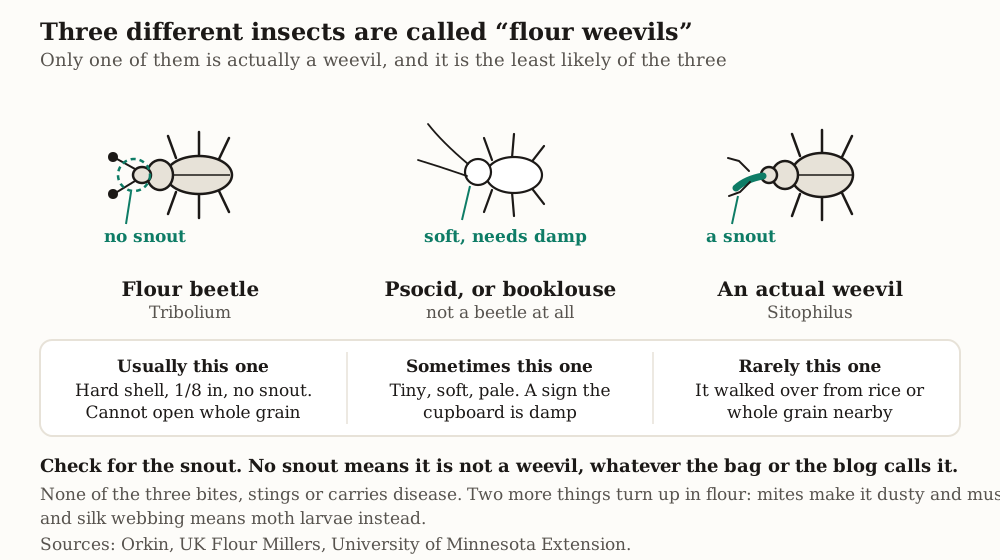
A weevil has a long snout with its jaws on the tip. The insect in your flour almost never does. What gets called weevils in flour is usually a flour beetle, in the genus Tribolium. That is a darkling beetle, and it has no snout at all. Orkin puts it bluntly: these beetles are not actually weevils.
Google agrees, in a way worth noticing. Search for weevils in flour and the first result is Wikipedia’s page on the flour beetle. The facts panel beside the results is about flour beetles too. The common name has simply outlived the insect it described.
Why the difference actually matters
Not for the treatment, which is the same, but for understanding how this happened. A flour beetle cannot open a sound whole grain. It needs flour, meal, broken kernels or something already damaged. A true weevil can drill into an intact grain, which is why rice weevil larvae develop inside rice while flour beetles never could.
So finding beetles in flour and none in your rice is normal, and it is not a sign you missed something. The weevils that walk into houses from the yard are a third thing again, and our guide to house weevils covers those.
Is the flour safe to eat?
Yes. Rutgers Cooperative Extension states it directly: eating them will not harm you. The insects behind weevils in flour carry no disease, they do not poison what they live in, and baking kills every stage anyway. Rutgers also answers the part people do not say out loud, which is that pantry pests are not uncommon and are not a reflection of anyone’s housekeeping.
That is the health answer, and it is settled. It is not the whole question, though. What makes sense for a bag of flour is not what makes sense for a sack of rice.
Keep it or bin it
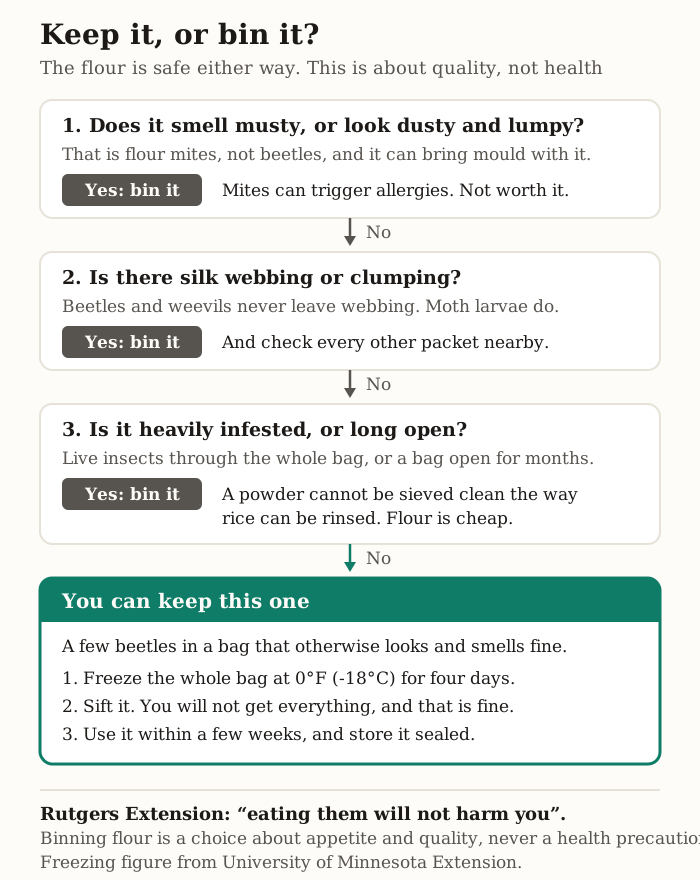
Most bags with weevils in flour are worth binning, and that is a different answer from the one we give for rice. Three things make flour the harder case. You cannot sieve a powder clean the way rice can be rinsed. Flour is also cheap to replace, and a musty smell points to mites and possible mould rather than beetles.
When it is worth keeping
- A few beetles in a bag that smells and looks normal. Freeze it for four days, sift it, and use it within a few weeks.
- An expensive or hard-to-replace flour, where the maths is different from a supermarket bag.
- Anything you are about to bake thoroughly, if the quantity of insects does not put you off.
When to bin it
- It smells musty, sour or faintly minty. That is mites, and it can come with mould.
- There is webbing or clumping. Moth larvae, not beetles, and a different clean-up.
- Live insects right through the bag, or a bag that has been open for months.
- You will not enjoy eating it. That is a legitimate reason on its own.
Part 2 of 3
Where it came from
Is it actually a weevil?
Usually not. A weevil carries its jaws on the tip of a long, down-curving snout, and the beetle found in most bags has no snout at all. Five different things get reported as weevils in flour: flour beetles, real weevils, psocids, mites and pantry moth larvae. Three checks separate them, and none needs a magnifier. Webbing means moth larvae. Flour that looks dusty and smells musty, with nothing visible, means mites. A snout means you really do have a weevil, and it walked over from rice or whole grain nearby.
Our sorter for bugs in flour works through all five in order, with a diagram, so start there if you have not named yours yet. The keep-or-bin decision above is the same whichever of them you have, apart from the mite exception.
Flour mites, and the smell that gives them away
Flour mites are not insects, and they are too small to see as individuals. What you notice instead is the flour itself: it looks dusty, slightly lumpy, and the surface seems to shift if you watch it. The smell is the real tell, a musty or faintly minty note that a clean bag never has.
They need humidity, so they are a storage problem rather than a bad-luck problem. Minnesota Extension lists them among the pests of stored food. The fix is the same either way: discard the flour, dry the cupboard, and store what you keep sealed.
Webbing means moths, not weevils
If the flour is held together by fine silk strands, or you find small caterpillars, that is pantry moth larvaeand the beetles are off the hook. Weevils and flour beetles leave no webbing at all, which makes this the single most reliable sign on the page. One popular guide to flour bugs tells readers that cobwebby strands mean infestation without once mentioning moths, which sends people hunting for the wrong insect.
Pantry moths and fabric moths are different animals with different habits. Our page on the signs of clothes moths explains how to tell the two apart.
Red flour beetle or confused flour beetle?
There are two, they look nearly identical, and the antennae separate them. The red flour beetle has antennae that end in an abrupt three-segment club. The confused flour beetle widens gradually over about four segments instead. Its name comes from the confusion between the two species, not from any behaviour of its own.
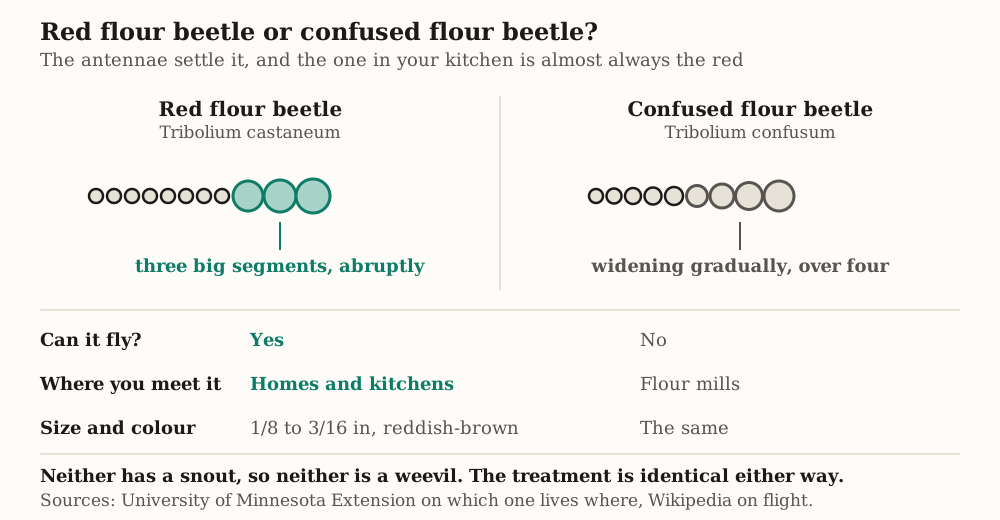
For a kitchen the answer is usually the red one. Minnesota Extension puts it simply: red flour beetles are common in homes, while the confused flour beetle is found in flour mills. Red flour beetles also fly, which the confused flour beetle does not, and that explains the readers who find beetles in a bedroom with nothing in the pantry.
Knowing which you have changes nothing you do. It is worth a look because people ask. The clubbed antenna also rules out a weevil, because a weevil’s antennae come off its snout and bend like an elbow. The other beetles a kitchen meets are sorted in our guide to the types of beetles in house cupboards and beyond.
How they got into a sealed bag
They were in the bag when you bought it, as eggs or very small larvae. Grain picks up insects anywhere between the field and the shelf, and milling does not remove every egg. Thin paper and cardboard packaging is no barrier either, because flour beetles crawl into folds and seams.
Warmth and time do the rest, and that is the whole story of how weevils in flour appear. A bag that sits at the back of a cupboard for a year is a different proposition from one used in a fortnight. So the answer to “did the shop sell me bad flour” is almost always no. The answer to “could I have prevented it” is yes, by freezing it on the way in.
Part 3 of 3
What to do
How to clear it out
With weevils in flour the cupboard matters more than the bag. One infested packet left behind restarts the whole thing, and adults live about a year, so there is no waiting it out. None of this needs a product.
The flour cupboard clear-out, step by step
Deal with the open bag first
Work the keep-or-bin checks above. If it goes, double-bag it and put it in the outdoor bin rather than the kitchen one. Adults walk out of a kitchen bin and back onto the shelf. If it stays, freeze it at 0°F (-18°C) for four days before it goes anywhere near the cupboard again.
Take everything else out and look at it properly
Flour beetles move between packets, so one infested bag is rarely the whole story. Check flour, cornmeal, cake and pancake mixes, cereal, crackers, dried pasta, spices, birdseed and dry pet food. Tip anything suspect onto a white plate and leave it a minute. Beetles start moving and show up against white.
Vacuum the shelves rather than wiping them
Get into the corners, the shelf-pin holes and the gap at the back, where spilled flour collects. Empty the vacuum outside. For psocids this matters twice over, because the UK Flour Millers advise cleaning cupboards with a vacuum rather than liquids: adding moisture is what they want.
Wash and dry, and skip the bleach
Warm soapy water is enough, and the shelf must be fully dry before anything goes back. Minnesota Extension says washing with detergent, bleach or ammonia will not keep pantry pests from returning, and warns those chemicals are a hazard if they reach food. Bleach is doing nothing here that soap and drying do not.
Move everything into glass or metal
Flour beetles crawl into folds and seams, and they get through paper, cardboard and thin plastic. Rigid containers with gasket lids stop them. This is also what stops one infested packet spreading along a shelf, which is the usual way a small problem becomes a six-month one.
Fix the damp, if there is any
Mites and psocids both need humidity, and both vanish when a cupboard dries out. Check for a leak behind or under the unit, run the extractor when you cook, and leave a gap behind packed shelves. A cupboard that stays dry does not get either of them, whatever else you do.
Beetles in a bedroom with an empty pantry
This comes up constantly and it is not strange. Red flour beetles fly and wander, so they show up on windowsills, in bedrooms and in living rooms well away from food. The source is still food somewhere: a forgotten snack in a drawer, birdseed, dry pet food or a packet in another room. Our guide to beetles in house rooms sorts the other ones that do the same thing.
How to stop it happening again
- Freeze new flour for four days before it goes in the cupboard. This is the single habit that ends repeat infestations, because it kills the eggs that came home in the bag.
- Decant into glass or metal with gasket lids. Paper and thin plastic are not barriers, and sealed containers also stop one packet infecting a shelf.
- Buy what you will use in two to four months. Most of these problems are really storage-time problems.
- Keep the cupboard dry and ventilated. Damp is what mites and psocids need, and neither can establish without it.
- Use the older bag before the newer one, and write the date on the container when you decant.
- Include the spices, baking mixes, birdseed and pet food. These are the packets that get skipped every time.
What does not work
Weevils in flour attract more folk remedies than almost any other pantry problem, and one widely read guide recommends four of them in a single list.
Myth 1
Myth: “Bay leaves in the container keep them out.”
Truth: Minnesota Extension states there is no evidence that bay leaves or sticks of spearmint gum prevent or get rid of stored-food insects. It is the most repeated piece of advice on this topic and there is nothing behind it.
Myth 2
Myth: “Garlic cloves, tea tree oil or dried chillies work as deterrents.”
Truth: These appear together in one of the guides ranking for this search, which admits several were never tested. No extension source supports any of them, and none reaches an egg inside a sealed packet.
Myth 3
Myth: “Bleach the shelves and they will not come back.”
Truth: Minnesota Extension says washing with detergent, bleach or ammonia will not keep pantry pests from returning, and warns those chemicals are dangerous if they reach food. Warm soapy water and thorough drying does the same job safely.
Myth 4
Myth: “Spray the cupboard with a household insecticide.”
Truth: Insecticides are not recommended in food cupboards, and they cannot reach anything inside a packet. Any food that contacts pesticide has to be thrown out, so the spray costs you more flour than the beetles did.
Myth 5
Myth: “Sifting the flour makes it as good as new.”
Truth: Sifting removes adults and some larvae. It does not remove eggs, cast skins or droppings from a powder, which is exactly why flour is a weaker candidate for saving than rice is.
Myth 6
Myth: “A few hours in the freezer is enough.”
Truth: It is not. Use 0°F (-18°C) for four days, the conservative end of what the sources give. Google's own answer panel says 24 hours on a related search and three to four days on this one, which should tell you how much the short figures are worth.
Myth 7
Myth: “Weevils in flour mean your kitchen is dirty.”
Truth: Rutgers Cooperative Extension answers this directly: pantry pests are not uncommon and are not a reflection of anyone's housekeeping. They arrive sealed inside shop-bought packaging.
Myth 8
Myth: “They can bite you, or they are dangerous to pets.”
Truth: No insect found in flour bites people or pets, and none carries a disease you can catch. The only genuine health point is that heavy mite infestations can trigger allergies.
Still not certain what you are looking at? Photograph it from directly above against something pale and run it through our free photo bug identifier before you decide what to throw away.
Pest control disclaimer. Photo-based identification can help, but it is not always perfect. For dangerous spiders, large infestations, or anything you are unsure about, contact a licensed pest control professional.
Weevils in flour FAQ
Does all flour get weevils?
What do flour weevil larvae look like?
Why do my flour beetles turn up in the bedroom?
Is there such a thing as a boll weevil in flour?
Can I just bake with it and kill them that way?
How long do flour beetles live?
Related guides
Weevils
The wider guide: pantry, home-invading and garden weevils, and which of the three you have.
Rice weevil
The weevil that can open a whole grain, and whether rice it has been in is still safe.
House beetles
Beetles found indoors, sorted by room, including the ones that wander away from food.
Drugstore beetle
The other brown pantry beetle, which breeds in spices and dry pet food.
Types of beetles
Name any beetle by size, colour and shape, starting with whether it is a beetle at all.
Clothes moths
Webbing means a moth. How the fabric and pantry moths differ, and what each one eats.
Small black bugs
The tiny dark insects of the kitchen and bathroom, sorted by where you found them.
Carpet beetles
Often found near stored food but feeding on wool and fur instead.
Sources
- Rutgers Cooperative Extension, I Found Bugs in My Cereal, Pasta or Cake Mix. What Do I Do?
- University of Minnesota Extension, Pantry pests: Insects found in stored food (reviewed 2024)
- Orkin, Weevils: on the flour weevil being a Tenebrionidae beetle rather than a weevil
- UK Flour Millers, Psocids: on psocids being called flour weevils, and cleaning with a vacuum rather than liquids
- Wikipedia, Flour beetle (Tribolium), for the species, size and flight