Part 1 of 5
Start here
Is it a bed bug? The six-point check
A bed bug has 6 legs, short antennae and no wings. Its body is a flat oval 4 to 5 mm long, about 1/5 inch, which swells to 5 to 7 mm and turns deep red once it feeds. It is reddish brown and shaped like an apple seed, with fine lines across the back. All six points below have to fit.
Miss one, and you are holding something else. Our own bed bug pages have carried three different adult sizes over the years, so here is the figure to trust. The UC Statewide IPM Program gives an unfed adult as about 1/5 inch, and the nymphs as 1/20 to 1/5 inch and yellowish-white. Colorado State University’s look-alike page says 9.5 mm, more than twice that, and we do not use it.
A bed bug has all six of these
Check every line. One mismatch rules a bed bug out.
Six legs, and no more
Eight legs means a tick or a mite. More than eight means a woodlouse or a centipede.
Short antennae
Antennae as long as the body mean a cockroach nymph. Never count antennae as legs.
No wings and no hard wing covers
A bed bug has two small pads where wings would be. A seam down the back means a beetle.
Flat and oval, like an apple seed
A round, humped, shiny body means a spider beetle. Hairy and banded means a carpet beetle larva.
4 to 5 mm long unfed, 5 to 7 mm fed
That is about 1/5 inch unfed. A just-hatched nymph is only 1 mm and pale.
Found within 8 feet (2.4 m) of a bed
Dark specks that smear matter more than the bug. Pale shed skins in the seams count too.
Size alone will not do it, because several look-alikes land in the same few millimeters. Colour will not either. A hungry bed bug is pale tan, and a fed one is almost black. For every stage drawn out, see our guide to what a bed bug looks like at each stage.
What bugs look like bed bugs?
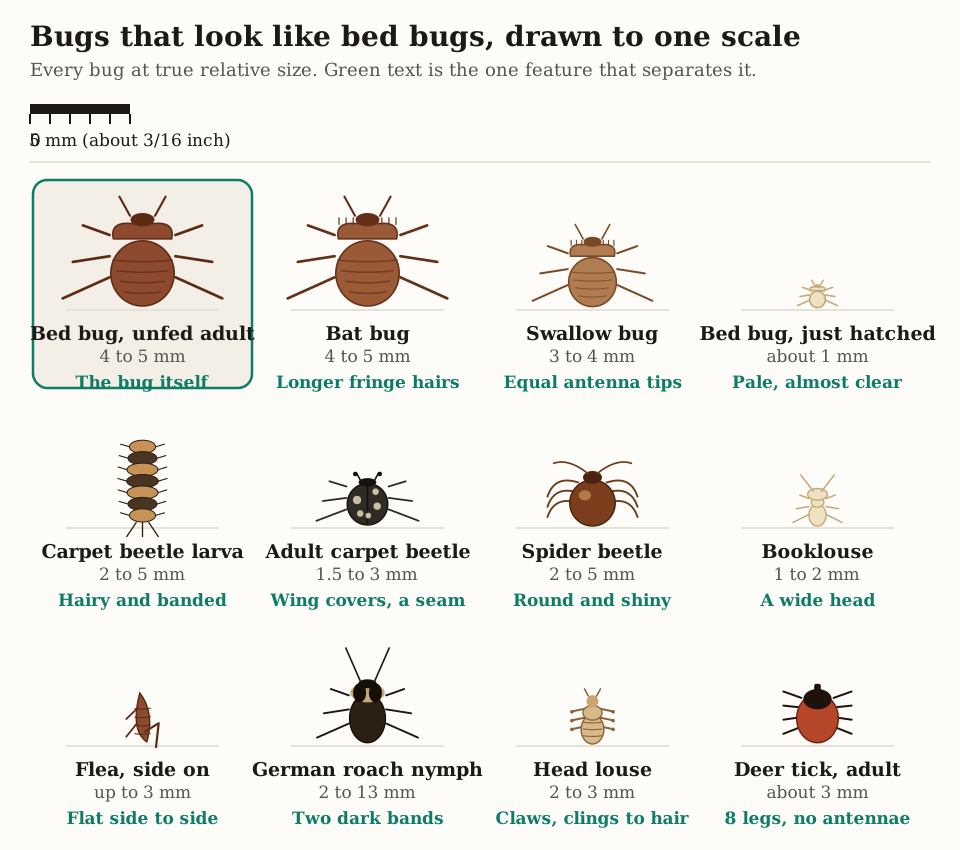
Fourteen bugs that look like bed bugs turn up often enough to matter. Carpet beetles lead by a wide margin. Then come young cockroaches, fleas, booklice and spider beetles. Bat bugs and swallow bugs are the two that genuinely need magnification. Ticks, lice and bird mites fill out the list.
A kissing bug is the odd one, because it is far larger than a bed bug rather than the same size. Each of the fourteen has a single feature that settles it. So the table below puts that feature in the first column.
Where you found the bug narrows the list faster than anything else. That is how the rest of this page is arranged: the bed and the couch first, then the sill and the wall, then the kitchen.
The 14 bugs that look like bed bugs, and the one feature that separates each
Fringe hairs behind the head longer than the eye is wide; needs a hand lens
- Look-alike
- Bat bug
- Size
- 4 to 5 mm (1/5 in)
- Where you find it
- Upper rooms under an attic or wall void where bats roost
- Bites people?
- Yes
Last two antenna joints nearly equal in length; paler and hairier
- Look-alike
- Swallow bug
- Size
- 3 to 4 mm (1/8 in)
- Where you find it
- Rooms behind cliff or barn swallow nests under the eaves
- Bites people?
- Yes
Hairy and banded, with a tuft of hairs at the tail; crawls like a tiny caterpillar
- Look-alike
- Carpet beetle larva
- Size
- 2 to 5 mm (1/12 to 1/5 in)
- Where you find it
- Wool blankets, feather pillows, closets, lint under the bed
- Bites people?
- No, but its hairs can raise a rash
Hard wing covers meeting in a seam, and antennae with a clubbed tip
- Look-alike
- Adult carpet beetle
- Size
- 1.5 to 3 mm; the black kind 3 to 5 mm
- Where you find it
- Sunny window sills, light fittings, flowers outside
- Bites people?
- No
Flattened side to side, so it looks thin from above, and it jumps
- Look-alike
- Flea
- Size
- up to 3 mm (1/8 in)
- Where you find it
- Pets, pet bedding, carpet, ankles
- Bites people?
- Yes
A head wider than the section behind it; pale, soft, almost clear
- Look-alike
- Booklouse
- Size
- 1 to 2 mm
- Where you find it
- Damp paper, books, window condensation, mouldy bedding
- Bites people?
- No
Eight legs and no antennae at all
- Look-alike
- Tick
- Size
- 1.5 to 3 mm unfed
- Where you find it
- Came in on a person, a dog or clothing
- Bites people?
- Yes
Six clawed legs built to grip a hair shaft
- Look-alike
- Head louse
- Size
- 2 to 3 mm
- Where you find it
- On the scalp, behind the ears, at the nape
- Bites people?
- Yes
Lives in the seams of worn clothing and bedding rather than on the body
- Look-alike
- Body louse
- Size
- 2.3 to 3.6 mm
- Where you find it
- Seams of clothes and bedding worn for days on end
- Bites people?
- Yes
A speck smaller than a pinhead with eight legs, in numbers near one spot
- Look-alike
- Bird or rodent mite
- Size
- about 1 mm
- Where you find it
- Near a bird nest, a dead mouse or a rodent runway
- Bites people?
- Yes
Antennae nearly as long as the body, and it runs for cover
- Look-alike
- Cockroach nymph
- Size
- 2 to 13 mm by stage
- Where you find it
- Kitchens, bathrooms, behind warm appliances
- Bites people?
- Almost never
A round, humped, shiny body on long thin legs, with long antennae
- Look-alike
- Spider beetle
- Size
- 2 to 5 mm
- Where you find it
- Pantries, old flour and grain, bird nests, rodent droppings
- Bites people?
- No
A head tucked under a hood, so it looks headless from above; it flies to lamps
- Look-alike
- Drugstore or grain beetle
- Size
- 2 to 3.5 mm
- Where you find it
- Spices, flour, cereal, pet food, a backpack
- Bites people?
- No
A long cone-shaped head and a striped edge; two to five times a bed bug
- Look-alike
- Kissing bug
- Size
- 1/2 to 1 inch (13 to 25 mm)
- Where you find it
- Wood piles, dog kennels and rodent nests in the southern US
- Bites people?
- Yes
How often it really is something else
Usually, it is. The Bugs Without Borders survey asked 375 pest professionals about this. It is run by the National Pest Management Association with the University of Florida. It found that 90% have been called out for “bed bugs” that turned out to be something else. Carpet beetles made up 60% of those calls, flies 48% and cockroaches 32%.
Hold on to that while you look, because the fear drives expensive decisions. People throw out mattresses, pay for treatments and fight with landlords over bugs that were never bed bugs. Spend five minutes on the bug in front of you first.
Part 2 of 5
Found in the bed
Bugs mistaken for bed bugs in the bed or on the couch
Nine of the bugs that look like bed bugs turn up in bedding and upholstery. They are bat bugs, swallow bugs, carpet beetle larvae, fleas, booklice, ticks, head lice, body lice and bird or rodent mites. Two are near-identical relatives of the bed bug and need a lens. The other seven separate on one feature you can see in a sharp photo.
Bat bugs, the one you cannot settle from a photo
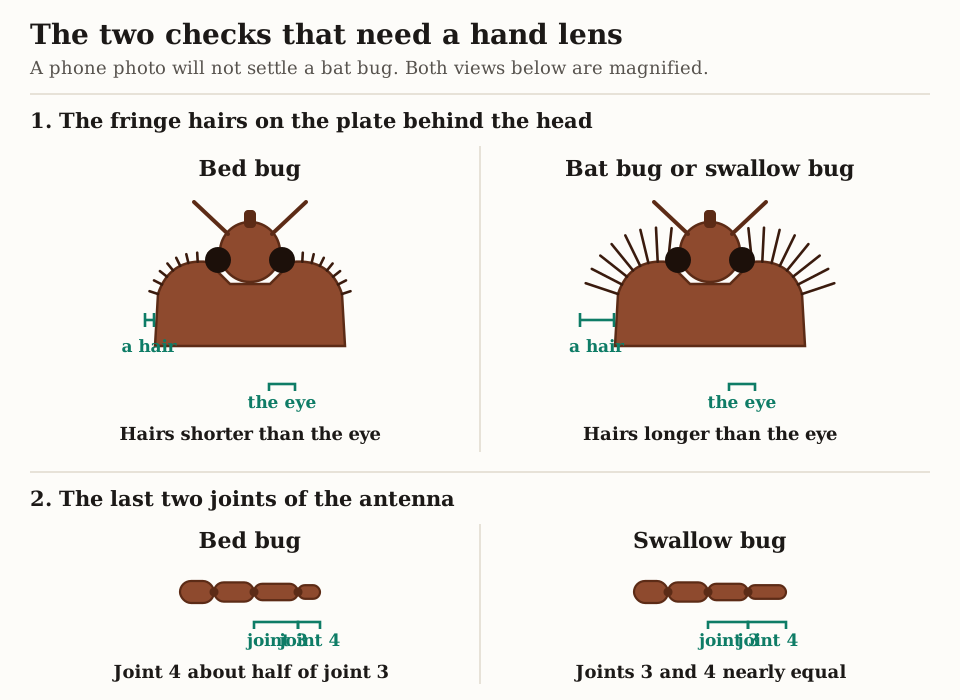
A bat bug is the same size, shape and colour as a bed bug. It runs 4 to 5 mm and reddish brown, because it is a close relative in the same genus. The one published check is the fringe of hairs on the plate behind the head. On a bed bug those hairs are shorter than the width of one eye. On a bat bug they are longer.
You need a hand lens, a microscope or a very good macro photo to see it. So say it plainly: a phone snapshot will not decide this one. In 2023, Iowa State University Extension reported that most suspected bed bugs sent to its diagnostic clinic that year were bat bugs instead.
Two species turn up in US homes, and most guides name only one. Colorado State University lists the eastern bat bug, Cimex adjunctus, and the western bat bug, Cimex pilosellus. Where you found it matters too. Bat bugs stay in the upper parts of a building near the roost: attics, wall voids, chimneys and under shingles. They also turn up one at a time, rather than in the clusters bed bugs form.
They do bite people, but they cannot breed on human blood. So they never build an infestation of their own. Removing the bats is the first step, and bats are protected, so that is work for a licensed professional. Spraying while the bats are still in the roof gives short-term relief at best.
Swallow bugs, a spring and autumn problem
A swallow bug is 3 to 4 mm long, a little smaller than a bed bug, paler brown and noticeably hairier. It has the same long hairs behind the head as a bat bug, plus a second check. Its last two antenna joints are nearly equal in length. A bed bug’s final joint is about half the length of the one before it.
It lives in cliff and barn swallow nests under eaves and bridges. Bites on people cluster in two windows: spring, before the swallows come back, and autumn, after they leave. Those are the weeks the bugs go looking for another host. Sealing the entry points works best between October and early April, while the nests are empty. Like bat bugs, swallow bugs cannot reproduce on human blood.
Carpet beetle larvae and bed bug nymphs
This is the mix-up that fills forum threads, and it is also the easiest to settle. A carpet beetle larva is 2 to 5 mm long and banded tan and brown. It is covered in stiff hairs, with a tuft of longer hairs at the tail. A bed bug nymph is smooth, flat, oval and pale yellowish-white, 1 to 5 mm by stage, with no hairs at all.
Both really do turn up in a bed. Carpet beetle larvae feed on wool blankets, down, feather pillows and the lint under a bed. So “not in the bed” is wrong, and we have corrected that line on our own look-alike table. Where they differ is what they are after. The larva eats the bedding, while the bed bug eats you.
Shed skins cause as much confusion as the bugs. A bed bug cast skin is a pale tan, see-through shell in the exact shape of the bug, found in the seams. A carpet beetle cast skin is brown and bristly, and it holds its sausage shape.
Our full carpet beetle guide has both side by side. It also covers the itchy rash the larval hairs can cause, which is the other reason people reach for bed bugs first. That rash is not a bite, and no rash names an insect on its own.
Fleas
An adult flea is no larger than 1/8 inch, about 3 mm, and dark reddish brown. So the colour and size are a fair match. The shape is not. A flea is flattened side to side, as if walking on edge, so from above it looks like a thin sliver. A bed bug is flattened top to bottom and looks broad from above.
Then watch what it does. Fleas jump, and bed bugs cannot jump at all. Fleas also need a host with fur. An infestation almost always means a cat, a dog or an animal that recently lived in the space. Black specks in a pet bed that smear rust red on damp paper are flea dirt, which bed bugs do not leave.
Booklice
A booklouse is 1 to 2 mm long, soft, wingless and light tan to almost clear. The check that settles it is the head. On a booklouse the head is wider than the section behind it. A bed bug’s head is narrower than its body. Size helps too: a newly hatched bed bug is about the length of an adult booklouse, and an adult bed bug is roughly three times longer.
Booklice do not bite. They eat the microscopic mould that grows on damp paper, board and fabric. That is why they turn up on a window sill with condensation, in old books, and yes, occasionally in damp bedding. Penn State Extension puts the fix in one line. Hold the relative humidity under 50% and the mould goes, which takes the booklice with it. Our guide to pale specks in the house covers them and the mould mites they travel with.
Ticks
An unfed tick is 1.5 to 3 mm, flat, oval and brown, which reads as a bed bug at a glance. Count the legs: eight on a nymph or an adult, and six on a larva, but never with antennae. A bed bug always has six legs and a pair of antennae. A tick also has mouthparts that stick out in front like a short beak.
Ticks in a bed almost always arrived on a person, a dog or a pile of clothes. They turn up one at a time. The brown dog tick is the exception, since it can breed indoors where dogs live. Our tick and bed bug comparison puts the two side by side at every stage.
Head lice and body lice
An adult head louse is 2 to 3 mm long and tan. Its six legs end in claws shaped to grip a hair shaft. That grip is the tell, along with where you find it: on the scalp, behind the ears and at the nape. It never wanders across a sheet. Head lice cannot hop or fly, and their eggs sit within a quarter inch of the hair base.
Body lice are the closer call, because they really do live in bedding. CDC puts an adult body louse at 2.3 to 3.6 mm. It says they live and lay eggs in the seams of clothing and bedding used by an infested person. Unlike bed bugs, they can spread disease, including epidemic typhus and relapsing fever. So a body louse infestation is a medical matter, not a pest control one. Our head lice guide explains how to check.
Bird and rodent mites
A bird or rodent mite is about 1 mm, a moving speck smaller than a pinhead, with eight legs and no antennae. You usually see them in numbers rather than one at a time. They also appear suddenly, often within days of a nest being abandoned or a mouse dying in a wall.
They do bite people. Texas A&M AgriLife Extension describes them as minute, 1 mm mites that normally infest rodents and bird nests. They occasionally bite humans after they disperse, and they cannot survive or reproduce without their natural hosts. So the fix is the nest or the dead animal, not the mattress. Spraying alone does not end it.
Tiny red specks in numbers on a sunny wall are a different thing again. Those are usually clover mites, which our guide to tiny red bugs covers.
Part 3 of 5
Other places you find them
Bed bug look-alikes on a window sill or a wall
A small brown bug on a sunny sill is almost never a bed bug. Bed bugs avoid light and stay within about 8 feet (2.4 m) of where someone sleeps. Two of the bugs that look like bed bugs dominate the sill. One is the adult carpet beetle, which flies to windows in spring. The other is the kissing bug, which is far larger and mostly southern.
Adult carpet beetles
An adult carpet beetle is 1.5 to 3 mm long and round rather than oval. The black carpet beetle is larger, at 3 to 5 mm. The varied kind is mottled with white, brown and yellow scales. Two features settle it: hard wing covers that meet in a straight seam down the back, and antennae that end in a club. A bed bug has neither.
Adults fly, and they gather at windows in spring on their way out to flowers. A few on a sill usually mean larvae feeding on something indoors. So it is worth finding the wool, fur, feathers or lint they live in, rather than treating the window.
Kissing bugs
A kissing bug is 1/2 to 1 inch long, two to five times a bed bug. It has a long cone-shaped head and a flat body edged with orange or red stripes. Adults have wings and fly. People meet them on a wall or near a light in the southern US, usually close to wood piles, dog kennels or rodent nests.
They matter more than the other look-alikes here, because some carry the parasite that causes Chagas disease. Do not crush one against your skin. Capture it in a sealed container without touching it, then contact your state or county health department. Our kissing bug guide covers the states where they live.
Look-alikes in the kitchen or the pantry
A small brown bug in a kitchen is almost certainly after food, not blood. Three groups account for nearly all of them: young cockroaches, spider beetles, and the pantry beetles that live in flour, spices and cereal. None of the three bites, and none needs a bed treatment.
Cockroach nymphs
A young cockroach is flat, oval, wingless and brown, so a small one genuinely looks like a bed bug. Two things separate them. Its antennae are nearly as long as its body, where a bed bug’s are short. It also runs for cover the moment a light comes on, while a bed bug moves slowly.
German cockroach nymphs, the common indoor kind, run from about 2 mm at hatch to 13 mm in the last stage. They are dark brown to nearly black. The plate behind the head carries two broad dark bands with a pale gap between them, and the youngest ones look almost solid dark. Our guides to young cockroaches at every stage and to the German cockroach explain what finding one means.
Spider beetles
A spider beetle has a round, humped, shiny body on long thin legs, with long antennae held out in front. So people often count eight limbs and think spider or tick. It runs 2 to 5 mm long, pale brown to almost black. The humped shape is what makes people think of a fed bed bug, and that is where the confusion starts.
It is not a blood feeder. Iowa State University Extension calls adults and larvae scavengers, feeding on broken grain, seeds, dried fruit or meat, wool, hair, feathers and animal droppings. The round body is full of food. Our guide to small dark bugs by room covers that whole lane.
Drugstore and grain beetles
A drugstore beetle is about 2 to 3.5 mm, reddish brown and shaped like a short cylinder. Its head tucks under a hood, so from above it looks headless. That headless look is the resemblance. Sawtoothed and merchant grain beetles are flatter and narrower, 2 to 3 mm, with tooth-like points along each side of the middle section.
All of them fly to lamps and windows, which no bed bug can do. All of them live in stored food: spices, flour, cereal, dried pet food, even a snack left in a backpack. Our drugstore beetle guide shows how to find the packet they came out of.
Not a bug at all: shed skins, specks and droppings
Plenty of the finds people photograph are not insects at all. The usual four are a bed bug cast skin, which is real evidence, a carpet beetle cast skin, flyspecks and flea dirt. Each one looks different once you know what to compare, and one simple test separates two of them.
What the specks and skins in a bed actually are
A pale tan see-through shell shaped like the bug
- What it is
- A bed bug cast skin
- How to tell
- Hollow, flat and oval, with a rounded head end. Found in seams and along the frame
A brown bristly shell that holds a sausage shape
- What it is
- A carpet beetle cast skin
- How to tell
- Stiff hairs still on it. Found in closets, under rugs and in lint
Dark spots that smear brown or black when damp
- What it is
- Bed bug fecal spotting
- How to tell
- They soak into fabric like ink and do not flake off. In clusters near a seam
Dark specks that smear rust red on damp paper
- What it is
- Flea dirt
- How to tell
- Loose and powdery before you wet it. Needs a pet or an animal in the space
Hard black dots that sit on the surface
- What it is
- Flyspecks
- How to tell
- They stay as raised dots on a wall or a sill and scrape off dry
Pepper-like specks with a greasy smear
- What it is
- Cockroach droppings
- How to tell
- Clustered in cupboards and behind appliances, not in bedding
Signs matter more than a single bug, because they say whether something is living in the bed. A bug passing through leaves nothing behind. Our guide to the earliest signs of bed bugs goes through each one, and how to check a bed properly shows where to look first.
Part 4 of 5
What it means for you
Which bugs that look like bed bugs bite, and which cannot
Eight of the 14 bugs that look like bed bugs bite people. They are bat bugs, swallow bugs, fleas, ticks, head lice, body lice, bird or rodent mites and kissing bugs. Four never bite at all, and two sit in between. A carpet beetle larva does not bite, but its hairs can raise an itchy rash, and cockroach nymphs bite only very rarely.
Here is the part most guides get backwards. You cannot work out which bug bit you by looking at the marks. UC IPM calls telling bed bug bites from other arthropod bites “difficult to impossible”. Texas A&M lists detergents, cosmetics, mould, static electricity, paper fibres, medications and allergies among the things that raise bite-like marks with no insect involved. So identify the bug, not the bite.
What the pattern does tell you is something more useful. It says whether anything is feeding in the bed at all. Marks that appear overnight, night after night, in the same room, point to a blood feeder somewhere in that room. Our bed bug bite reference explains what marks can and cannot show.
What each look-alike means, and what to do first
A bat bug or a swallow bug
- What it means
- A bat or bird roost in the building, not a bed bug infestation
- What to do first
- Have the roost dealt with first. Bats are protected, so use a licensed professional
A carpet beetle larva or an adult
- What it means
- Wool, feathers, fur or lint being eaten somewhere indoors
- What to do first
- Find and clean the source, then vacuum. No bed treatment
A flea
- What it means
- A pet, or an animal that recently lived in the space
- What to do first
- Treat the pet and vacuum thoroughly. Follow a flea plan
A booklouse
- What it means
- Damp and mould
- What to do first
- Dry the room out and hold the humidity under 50%
A tick
- What it means
- It came in on a person, a dog or clothing
- What to do first
- Remove it if it is attached, keep it, and watch for a rash or fever
Head lice or body lice
- What it means
- A person, not the furniture
- What to do first
- Ask a doctor or pharmacist. Wash and hot-dry clothing and bedding
A bird or rodent mite
- What it means
- An abandoned nest or a dead animal nearby
- What to do first
- Find and remove the nest, then clean. Sprays alone will not end it
A cockroach nymph, spider beetle or pantry beetle
- What it means
- Food, damp or clutter, not blood
- What to do first
- Clear old food, vacuum shelves, store food in sealed jars
A kissing bug
- What it means
- A rare find, mostly in the southern US
- What to do first
- Do not crush it. Bag it without touching it and contact your health department
A bed bug, fed or unfed
- What it means
- A real infestation, which spreads to other rooms and units
- What to do first
- Do not throw the mattress out. Start with a full inspection
What to do with a bug you think is a bed bug
Keep it whole, photograph it from above beside a coin, and count the legs before you spend a cent. The first five steps below cost nothing and take about ten minutes. Together they settle most finds. Only then does it make sense to buy anything.
Eight steps, cheapest first
Keep it whole
Press clear tape over it, or seal it in a bag or a jar. Do not crush it. A squashed bug loses the legs, antennae and body hairs that settle the question. Most forum threads that end in nothing end because the specimen was lost.
Photograph it from above
Skip the flash, which blows out the colour. Set a coin beside it for scale. A US penny is 3/4 inch (19 mm) across and a dime is 11/16 inch (18 mm). Take one shot from above and one from the side.
Count the legs and check the antennae
Six legs with short antennae fits a bed bug. Eight legs means a tick or a mite. Antennae nearly as long as the body mean a cockroach nymph. Clubbed tips mean a beetle.
Write down where you found it
A mattress seam, a sunny sill, a pantry shelf, a pet bed and a car seat each point to a different short list. Add the room and the date. Note whether the building has bats, swallow nests or pets.
Search the bed with a torch
Part the mattress seams and the edge of the box spring. Pull the bed off the wall. Check the frame joints and the back of the headboard. Dark spots that smear, pale shed skins and live bugs are the evidence. This step costs nothing.
Set interceptors under the bed legs
Interceptor cups are cheap and need no chemicals. Over one or two weeks they catch bugs travelling to and from the bed. An empty cup after two weeks is real evidence that the bed is clear.
Get it named before you treat
Send the photo to your county extension office. Or upload it to our bug identifier. Each of these bugs needs a different plan, so treating the wrong one wastes the money and leaves the real problem in place.
Hold off on sprays and bombs
Most look-alikes need cleaning, drying out or a nest removed, not a pesticide. If exclusion and sanitation are successful, insecticide treatments are not required. Spraying also destroys the evidence you need.
If it does turn out to be a bed bug, do not start with a spray. Our complete bed bug guide covers the plan from inspection onward. And what actually kills bed bugs sorts the methods that work from the ones that only sound convincing.
Still unsure which of the bugs that look like bed bugs you are holding? Upload a sharp photo to our bug identifier, then count the legs yourself as well.
Part 5 of 5
Corrections and questions
Mistakes in other bed bug look-alike guides
The pages that rank for this search repeat six errors, and each one can send a reader the wrong way. One of them is ours, so it is here too. Each correction names the source behind it, because a correction is only worth anything if you can check it.
Mistake 1
Mistake: In 84% of cases, people who called about another pest turned out to have bed bugs (Orkin).
Reality: That garbles an older survey, and it points the wrong way. The current Bugs Without Borders survey asked 375 pest professionals, through the National Pest Management Association and the University of Florida. It found that 90% have been called out for “bed bugs” that were something else. Carpet beetles made up 60% of those calls.
Mistake 2
Mistake: Booklice have wings and bigger heads than bed bugs (The Spruce).
Reality: The booklice found in houses are wingless. Penn State Extension describes them as soft and wingless, 1 to 2 mm long, with a head wider than the thorax. The wide head is the real check. The wings are not there.
Mistake 3
Mistake: Cockroach nymphs have a more cylindrical, tube-like body (Orkin, and the Toronto Metropolitan University handout).
Reality: Cockroaches are flattened top to bottom, which is how they slide into a crack. A young cockroach looks flatter than a bed bug, not rounder. Its antennae, nearly as long as its body, are what settle it.
Mistake 4
Mistake: Spider beetles look bloated as if fed on blood, although they are blood feeders (Toronto Metropolitan University).
Reality: They are not blood feeders. Iowa State University Extension calls adults and larvae scavengers, feeding on broken grain, seeds and dried fruit. It also names wool, hair, feathers and animal droppings. That humped body is full of food.
Mistake 5
Mistake: A booklouse is never on the bed. A carpet beetle larva is not in the bed. (Our own look-alike table, until this page shipped.)
Reality: Rarely, not never. Booklice live on the mould that grows in damp bedding. Carpet beetle larvae feed on wool blankets, down and feather pillows. We have changed our own wording to rarely.
Mistake 6
Mistake: Rubbing alcohol, diatomaceous earth and steam kill bed bugs on contact (The Spruce).
Reality: Rubbing alcohol is the dangerous one. EPA lists it with kerosene and gasoline as treatments to avoid, because they ignite from a spark or a cigarette. Steam works only where the steam reaches. Desiccant dusts must be EPA-registered products placed in cracks and crevices, never spread across a floor.
Where we are less sure, we say so. The bat bug check is reliable but needs magnification, so a bat bug found without a lens stays an open question. Bird mite sizes differ between sources by species. And a single unfed bug with no spots, no skins and no bites anywhere in the room is weak evidence either way. That is what the interceptors are for.
Pest control disclaimer. Photo-based identification can help, but it is not always perfect. For dangerous spiders, large infestations, or anything you are unsure about, contact a licensed pest control professional.
Bed bug look-alike FAQ
How to know 100% if you have bed bugs?
Will bed bugs go away if I stop sleeping in my bed?
Can bed bugs live in a vacuum cleaner?
Are dust mites the same as bed bugs?
Why does only one person in the bed get bites?
Do you always need a pro to identify bed bugs?
Related guides
Bed bugs
What they are, how they spread, and the plan that clears them.
What do bed bugs look like?
Egg, nymph and adult, fed and unfed, with sizes at every stage.
Early signs of bed bugs
Spots, skins and smells, plus the false alarms.
How to check for bed bugs
Where to look first, with a torch and ten minutes.
Carpet beetles
The top false alarm: larvae, adults and the rash.
Tick vs bed bug
Eight legs or six, and where each one lives.
Baby cockroach
Young cockroaches at every stage, and what one means.
Tiny white bugs
Booklice, mould mites and springtails in damp rooms.
Small black bugs
Spider beetles and other dark specks, sorted by room.
Bugs that look like ticks
The same job for ticks: 17 look-alikes, one check each.
Sources
- UC Statewide IPM Program, Pest Notes: Bed Bugs, Publication 7454 (adult and nymph sizes, the pronotal hair check, why bites cannot name the bug)
- Colorado State University Agricultural Biology, Bed bug look-alikes (the eastern and western bat bugs, the swallow bug antenna check, why neither breeds on human blood)
- Iowa State University Extension, Bed Bugs or Bat Bugs: ID is Crucial to Management, July 2023 (the diagnostic clinic finding, the hair rule)
- Penn State Extension, Booklice (1 to 2 mm, wingless, head wider than the thorax, no bites, the 50% humidity fix)
- National Pest Management Association, Bugs Without Borders bed bug misidentification release, December 15, 2025 (375 professionals, 90% false alarms, carpet beetles 60%)
- US Environmental Protection Agency, Do-It-Yourself Bed Bug Control (rubbing alcohol, kerosene and gasoline, and using registered products as labelled)
- Texas A&M AgriLife Extension, ENT-3006, Diagnosing Mysterious Bug Bites (bird and rodent mites, the non-insect causes of bite-like marks)