Is it a baby cockroach? The one-minute check
Check four things. A baby cockroach has no wings at all, and its antennae are as long as its own body. The body is flat and oval, widest at the back. You cannot see its head from above, because a smooth shield covers it. Most of the ones found indoors are 1/16 to 1/2 inch (2 to 13 mm) long.
Behavior backs that up. Baby cockroaches bolt for the nearest dark edge the moment a light comes on. They run flat out, not in short hops. So something that ambles, jumps, or sits still while you fetch your phone is probably not a roach.
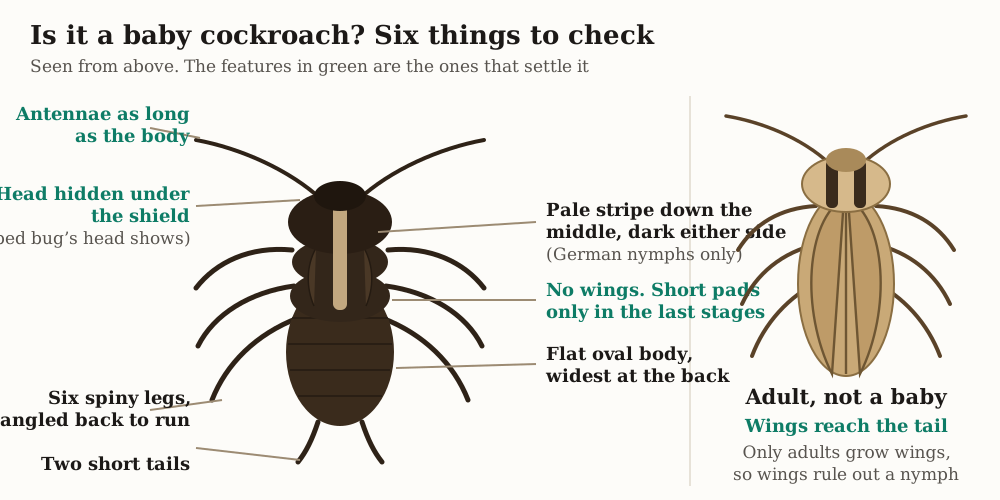
Color is the least reliable clue, because it changes with age and with species. Young German nymphs are so dark they look black, while older ones carry a pale stripe. Any nymph that molted in the last few hours is white. Still, the shape and the antennae stay the same at every stage.
Baby cockroach identification checklist
Check each clue below to narrow down what you saw.
No wings anywhere on the body
Young nymphs have nothing at all on the back. Older ones grow two short pads near the shoulders, and the pads stop well short of the tail. Anything with wings down to the tip is an adult.
Antennae as long as the whole body
They sweep the air constantly while it walks. A bed bug has short, stubby antennae instead, and a beetle's are shorter again.
You cannot see its head from above
The pronotum, the smooth shield behind the head, hangs over it like a hood. Look straight down and you see the shield, not a face.
Flat and oval, widest towards the back
A roach nymph is built to wedge into a crack. Seen from the side it is almost as flat as a card.
It runs for cover the second the light comes on
Nymphs are quick, and they go for the nearest dark edge. Something that strolls, jumps or stays put is almost certainly not a roach.
Two short tails at the back end
These are cerci, and most people never notice them until they zoom in on a phone photo. Bed bugs and beetles do not have them.
Dark, not pale
A white one is not a different insect. It is a baby cockroach that molted in the last few hours, and it will darken by morning.
A roach with wings is an adult, not a baby
This is the fastest test there is, and it settles most of the photos people post. Only adult cockroaches grow working wings. Baby cockroaches have nothing on the back at first. Two short wing pads appear near the shoulders in the last stages. Those pads never reach past the middle of the body, so a small roach with wings down to its tail is a small adult, not a baby.
One exception runs the other way, and almost nobody writes it down. An adult female oriental cockroach never grows past short wing pads, so she looks wingless for life. Size settles it. She is glossy black and about an inch (25 mm) long, far bigger than any nymph you would call a baby.
How big is a baby cockroach?
A newly hatched German cockroach is about 1/16 inch (2 to 3 mm) long. That is smaller than a sesame seed, and about the width of a pencil lead. It reaches 1/2 inch (13 mm) by the time it is grown. Baby cockroaches of the big outdoor species start a little larger and finish near an inch.
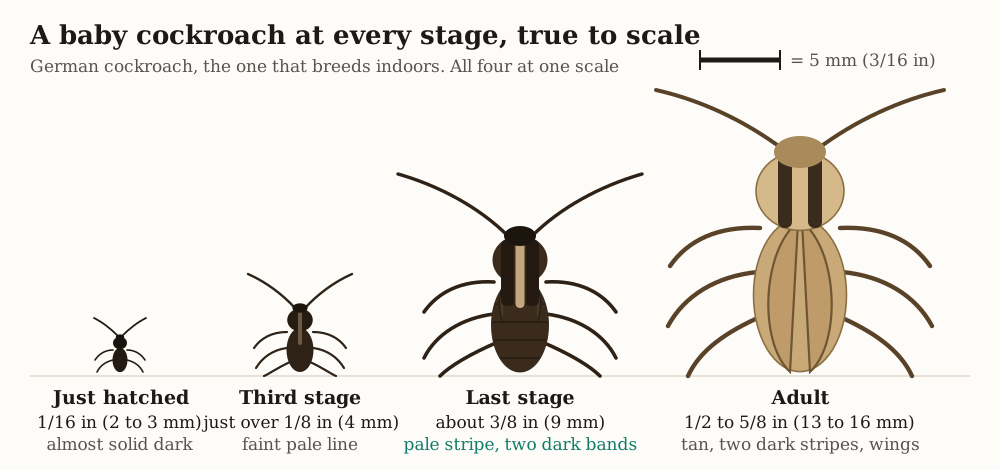
Almost every page on this subject says baby cockroaches hatch at about 1/8 inch. Measured first-stage German nymphs come in at 2.3 mm, just under 3/32 inch. So 1/16 to 1/8 inch is the honest range for the smallest ones. That matters in practice. At 2 mm a nymph looks like a speck of dirt, so people miss the first generation.
Sizes for the other species are shakier, and it is worth saying so. Published figures for a newly hatched American cockroach range from 1/8 inch to 1/4 inch. We have not found a measured source behind either number, so treat those as rough. Late-stage nymphs are easier, because they are close to the adult size of their species.
What baby roaches look like, species by species
Five species turn up in American homes, and their young look different enough to tell apart. A German nymph is dark with a pale stripe between two dark bands. An American or oriental nymph carries no stripes at all. Brown-banded nymphs show two thin pale bands across the back, and smokybrown nymphs have white antenna tips.
Which baby roach is it?
Dark brown to black, with a pale stripe down the middle between two dark bands
- Species
- German cockroach nymph
- Nymph size
- 1/16–1/2 in (2–13 mm)
- Where it turns up
- Kitchen and bathroom, near warmth and water
- What it means
- Breeding indoors. The one you least want
No stripes or bands at all, reddish brown, big for a nymph
- Species
- American cockroach nymph
- Nymph size
- 1/8 in to 1 1/4 in (3–32 mm)
- Where it turns up
- Basements, drains, crawl spaces, garages
- What it means
- Usually came up a drain or in from outside
Shiny and uniform, reddish brown darkening to near black
- Species
- Oriental cockroach nymph
- Nymph size
- 1/8 in to 1 in (3–25 mm)
- Where it turns up
- Floor drains, damp basements, under sinks
- What it means
- A damp problem, often from outdoors
Two thin pale bands running across the back
- Species
- Brown-banded cockroach nymph
- Nymph size
- 1/16–1/2 in (2–13 mm)
- Where it turns up
- Bedrooms, furniture, high on walls, electronics
- What it means
- Breeding indoors, away from the kitchen
Dark with white antenna tips and a pale band across the back
- Species
- Smokybrown cockroach nymph
- Nymph size
- 1/8 in to 1 in (3–25 mm)
- Where it turns up
- Porches, attics, mulch and garages in the South
- What it means
- An outdoor species that got in
The German and brown-banded figures are measured. The three large species start from published hatch sizes that no primary source has pinned down, so read the low end as approximate.
Baby German cockroach: the stripe nearly everyone describes wrong
Google’s own answer for this search offers two options: “two parallel dark stripes or a pale tan center stripe”. It is not a choice. There is one pattern, and both descriptions are halves of it. UF/IFAS describes the nymph as dark brown to black with distinct dark parallel bands running the length of the pronotum, the shield behind the head. The pale tan line people see is the gap between those two bands.
Age changes how much of it shows. The newest hatchlings look almost solid dark brown to black, so the stripe is hard to make out at all. By the middle stages the pale gap is obvious, and a UF/IFAS extension post describing why nymphs confuse people sums the look up as dark with a light band on the back. By adulthood the body has gone tan and the two dark stripes stand out against it.
Why it matters: people rule out a German cockroach because the baby cockroach they found is black rather than tan, and that is the wrong call. Our guide to the German cockroach and its nymphs covers the adult, the egg case and the control problem.
Baby American and oriental cockroaches
Both hatch white, darken within hours, and then grow up plain. An American cockroach nymph is grey-brown at first and reddish brown later. Each segment has a darker edge, and there are no stripes anywhere. Wing pads appear at about the third or fourth molt. That is the stage people start calling a baby palmetto bug.
An oriental baby cockroach is shiny from the start, reddish brown early on and almost black by the last stages. Finding one points at damp: a floor drain, a crawl space or a basement wall. In the South both species travel under the same nickname, and our guide to palmetto bugs sorts out which large roach a state actually means.
Baby brown-banded and smokybrown cockroaches
A brown-banded baby cockroach is the one people find in a bedroom rather than a kitchen. It is about the size of a German nymph. Two thin pale bands cross the back, rather than running down it. This species likes warm, dry, high places, so look behind picture frames, inside furniture joints and around electronics.
A smokybrown baby cockroach is darker, with white tips to its antennae. A pale band crosses the back and fades as it grows. It is a Southern outdoor species that breeds in mulch, attics and tree holes, then wanders in. So one or two indoors usually means a way in rather than a colony in the wall.
Why is the baby roach white?
Because it has just molted. A nymph sheds its shell to grow. For a few hours afterwards the new shell is soft and white, then it hardens and darkens. There are no albino cockroaches, and a white baby cockroach is not a different species or a rare find. It does tell you something useful though. Molting happens where roaches live, so a white one means you are near the harborage.
How fast baby cockroaches grow up
A German cockroach goes through six or seven molts. In a warm kitchen it can be breeding within about two months, while a cool room stretches that to 31 weeks. The big species are far slower. An American cockroach molts six to 14 times and needs roughly 600 days to reach adulthood.
Molts and growing-up time by species
German cockroach
- Molts before adult
- 6 to 7, and six most often
- Egg to adult
- About 2 months in a warm home, up to 31 weeks when cool
- Where the figures come from
- UF/IFAS and Penn State Extension
American cockroach
- Molts before adult
- 6 to 14, usually quoted as 10 to 13
- Egg to adult
- About 600 days
- Where the figures come from
- UF/IFAS
Oriental cockroach
- Molts before adult
- 7
- Egg to adult
- About a year, with reports from 200 to 800 days
- Where the figures come from
- UF/IFAS
Brown-banded cockroach
- Molts before adult
- 6 to 8
- Egg to adult
- About 160 days
- Where the figures come from
- UF/IFAS and LSU AgCenter
Smokybrown cockroach
- Molts before adult
- Not firmly reported
- Egg to adult
- About 600 days
- Where the figures come from
- UF/IFAS
Molt counts are where published pages drift apart, and the gaps are worth seeing. Terminix tells readers cockroaches go through “5 to 10 molting stages”, which is too low for the American cockroach: UF/IFAS reports that it molts six to 14 times, and 10 to 13 is the count usually quoted. Molts vary with temperature and food, so a single number was never going to hold.
There is a practical use for all this. Baby cockroaches of different sizes in the same cabinet mean overlapping generations, so the group has been there for weeks rather than days. Finding shed skins says the same thing, because nymphs molt where they shelter rather than out in the open.
What it means if you find a baby cockroach
It means roaches are breeding close by, usually within a few feet. Baby cockroaches cannot fly and do not travel the way adults do, so one did not wander in from next door. In an established German cockroach population about 80 percent of the insects are nymphs, which is why the babies are what people see first.
Why do I see baby roaches but no adults?
Because there are more of them and they are less careful. Baby cockroaches are the most common stage in any roach population. Young ones also get pushed to the edges of a crowded hiding place, and the adults keep the best spots. A second reason is timing. One female carried in on a bag can lay a case of eggs and then die. That leaves a kitchen full of young roaches and no adult in sight for weeks.
Is it better to see baby roaches or big ones?
Small is worse news indoors. A single big roach in a basement or bathroom is often a wanderer from a drain or a yard. It may have no family with it. A baby cockroach cannot wander, so it was born where you found it. The one exception is a large nymph in a damp basement. That points outdoors, the same way the adult would.
I only found one. Should I worry?
Worry is the wrong word, but do act this week. One baby cockroach in a kitchen is enough reason to put down sticky traps and check the result after three nights. An empty set of traps means you got lucky or it came in with shopping. Several nymphs in different sizes on one trap means a breeding group. Start baiting properly at that point.
Are baby roaches a sign of a dirty home?
No, and this is the fear behind most of the posts people write at two in the morning. Roaches follow warmth, water and tight cracks rather than mess. They also arrive in grocery bags, cardboard boxes, second-hand appliances and the pipe runs between apartments. So a spotless kitchen beside an infested unit gets them anyway. An infestation says more about the building than the housekeeping.
Are baby cockroaches dangerous?
Not directly. Baby cockroaches do not sting, and bites are rare enough to discount. The real issue is what builds up where they live. The EPA lists cockroach droppings and body parts as an asthma trigger, and proteins in their feces and saliva set off allergic reactions in some people. Nymphs shed skins too, so a breeding group adds to that load faster than a couple of adults would.
What can be mistaken for a baby cockroach?
Eight bugs account for nearly every wrong call, and bed bugs lead them. One feature sorts most of them in a second: look for the head. A baby cockroach keeps its head tucked under a shield, so from above you see no face. Its antennae are as long as the body. Nothing else on the list has both.
Baby roach or something else?
Head hidden under a shield, antennae as long as the body, runs instantly
- What it is
- Cockroach nymph
- Size
- 2–13 mm (1/16–1/2 in)
- Where you find it
- Kitchens, bathrooms, behind appliances
Round and flat, nearly as wide as long, head and short antennae in plain view
- What it is
- Bed bug
- Size
- 1–5 mm
- Where you find it
- Mattress seams, headboard, bed frame
Fuzzy and carrot-shaped, with a tuft of hairs at the tail, moves slowly
- What it is
- Carpet beetle larva
- Size
- 2–5 mm
- Where you find it
- Carpet edges, closets, under furniture
Hard shell split by a line down the middle, short antennae, walks instead of darting
- What it is
- Small beetle
- Size
- 2–6 mm
- Where you find it
- Windowsills, pantries, around doors
Back legs much thicker than the rest, jumps when disturbed
- What it is
- Young cricket
- Size
- 5–12 mm
- Where you find it
- Basements, garages, under boxes
Three tails at the back, tapered body, silver scales
- What it is
- Silverfish
- Size
- 10–15 mm
- Where you find it
- Bathrooms, bookshelves, under sinks
Head wider than the body, pale, barely visible, found on damp paper
- What it is
- Booklouse
- Size
- 1–2 mm
- Where you find it
- Damp walls, books, stored food
Full wings reaching the tail, yet only half an inch long
- What it is
- Adult brown-banded or Asian cockroach
- Size
- 13–15 mm
- Where you find it
- Anywhere indoors. Wings mean adult
Extension offices get these calls constantly, and beetle larvae and crickets are the two usual wrong answers. For the small dark specks that turn up away from kitchens, our round-up of small black bugs found in houses works through the rest, and carpet beetles and their larvae have a guide of their own.
Baby cockroach or bed bug?
Compare the outline first. A bed bug is a flat oval disc, almost as wide as it is long. Its small head and short antennae show from above. A baby cockroach is about two and a half times longer than it is wide. The antennae are long and sweeping, and no head shows. Then check where it was. Bed bugs stay within a few feet of where people sleep, while roach nymphs live near food and water.
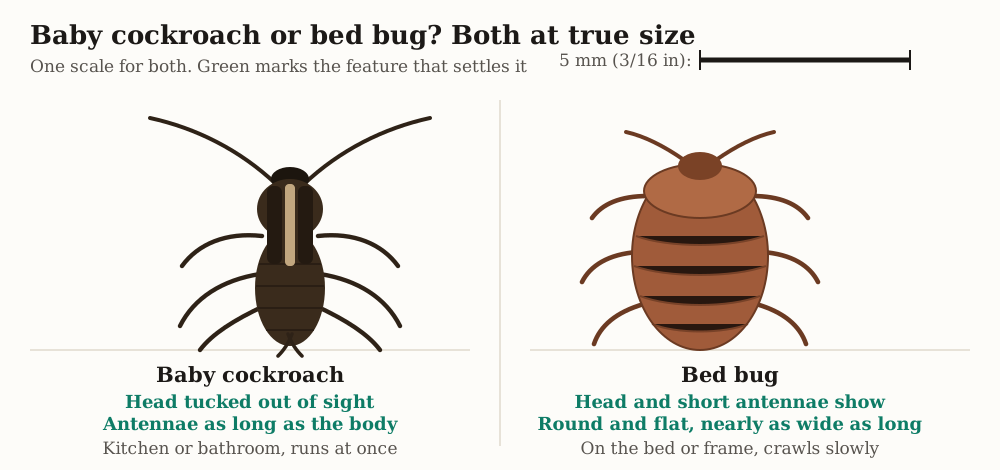
Speed separates them too. Disturb a bed bug and it crawls, but disturb a baby cockroach and it is gone. If the find was on or near a bed, start with what bed bugs look like at every stage. A fed bed bug nymph and a young roach are the most common mix-up people post.
Where baby cockroaches hide
In cracks too narrow to look into, close to food and water. An adult German cockroach fits in a gap 1/16 inch (1.6 mm) wide, and baby cockroaches use tighter ones than that. So the hiding places are not the cabinets you can open. They are the seams and voids behind them.
- Behind and under the fridge, around the warm motor and the drip tray.
- Under the sink, where the pipe goes through the wall and the damp collects.
- Inside cabinet corners and hinges, especially the upper ones near a kettle.
- The dishwasher and washing machine housings, warm and humid together.
- The gap beside and behind the stove, which collects grease.
- Bathroom cabinets, the tub overflow and the toilet base, where many people meet their first nymph.
- Cardboard and paper stacks, which hold warmth and offer endless edges.
- Electronics, because a games console or a TV box is warm and full of dark gaps.
Look for the signs rather than the insects. Pepper-like specks in a cabinet corner, pale shed skins in several sizes, and an empty egg case all mean roaches bred in that exact spot. Our guides to what roach droppings look like and cockroach egg cases and how they hatch show what each one looks like up close.
What to do when you find a baby roach
Trap before you treat. Three nights of sticky traps costs a few dollars. It tells you which corner the group lives in, and that one fact decides everything after it. Then cut off water, clean where they feed, and bait that corner. Most of these steps cost nothing at all.
Six steps, cheapest first
Put sticky traps down tonight, before you treat anything
Lay flat sticky traps in the corners you cannot see into: behind the fridge, under the sink, inside cabinet corners and beside the dishwasher. Leave them three nights. Whichever trap fills up tells you where the group lives. That one corner is the only place worth treating hard.
Take away the water first, then the food
Roaches last weeks without a meal but only days without water. So fix the dripping tap and wipe the sink dry at night before you scrub anything else. Then store dry food in sealed containers, empty the trash before bed, and lift the pet bowl overnight. None of that costs anything.
Clean where they feed, not the whole house
Scrub the gap beside the stove, the shelf edges, the underside of the cabinets and the floor under the fridge. Their droppings pull in more roaches. So wiping away the pepper-like specks with hot soapy water matters as much as the crumbs do.
Bait the spot the traps pointed you to
Use a gel bait registered by the EPA for cockroaches indoors, and follow its label, because the label is the law. Pea-sized dots pushed into cracks near the harborage beat one big blob. Never spray insecticide over bait, and never clean right beside it. Both keep roaches off the bait.
Seal the cracks once the numbers drop
Caulk the gaps along baseboards, around pipe collars and behind cabinet frames. Do this after baiting rather than before. Otherwise you close them into the wall on the wrong side of the bait.
Get help if the count is still climbing after three weeks
German roaches in an apartment usually need a professional. The neighbors and the shared pipe runs feed the problem straight back to you. If you rent, tell the landlord in writing the day you find them, and attach a photo.
If exclusion and sanitation get on top of the problem, you do not need an insecticide at all. Where you do, a gel bait placed in cracks is the tool that fits nymphs, because they feed on the bait and on each other’s droppings rather than crossing a sprayed floor. The full treatment plan, including what to do about a heavy infestation, sits in our guide to getting rid of roaches for good.
Myth 1
Myth: “A bug bomb will clear them out.”
Truth: Total release foggers do not reach the cracks and wall voids where nymphs sit, and the spray pushes them deeper in. UC IPM tells homeowners to avoid foggers and bombs for cockroaches. The aerosol is a hazard indoors on its own.
Myth 2
Myth: “Vinegar or peppermint oil down the drain gets rid of them.”
Truth: Neither has been shown to clear a cockroach population. The smell fades in a day, and the drain still holds the damp and the food film that drew them there.
Myth 3
Myth: “Baby roaches mean the place is dirty.”
Truth: Baby cockroaches need warmth, water and a tight crack far more than they need mess. They also ride in on grocery bags, cardboard, second-hand appliances and shared walls. So a spotless kitchen next to an infested one still gets them.
Myth 4
Myth: “Spreading diatomaceous earth over the floor will kill them.”
Truth: A broadcast layer is a dust you breathe, and roaches walk around open powder anyway. Use only an EPA-registered product, puffed lightly into cracks and voids, and keep it dry.
Myth 5
Myth: “One baby roach means the whole house is infested.”
Truth: It means roaches are breeding somewhere near where you found it. That is a smaller claim and a far more useful one. Three nights of sticky traps will tell you whether it is one corner or the whole kitchen.
If you rent: the landlord, the neighbors and why one apartment is not enough
Tell the landlord in writing the day you find them, and keep the photo with a date on it. In most states a landlord carries responsibility for pest control in a multi-unit building, though the detail varies. So report it in a message or an email, not a phone call.
The harder truth is that treating one apartment often fails. German cockroaches move between units through pipe runs, shared walls and cabinet voids. A neighbor’s untreated kitchen simply refills yours. Ask for the units either side and the one below to be inspected at the same time. Meanwhile keep baiting your own place, because an untreated kitchen gets worse while the paperwork moves.
Pest control disclaimer. Photo-based identification can help, but it is not always perfect. For dangerous spiders, large infestations, or anything you are unsure about, contact a licensed pest control professional.
Baby cockroach FAQ
Do baby cockroaches bite?
Can baby cockroaches live without adult cockroaches around?
How many baby cockroaches come out of one egg case?
I only see them at night. Is that normal?
Can baby roaches get inside a TV or a games console?
What do baby cockroaches eat?
Still not sure what you photographed? Upload it to our bug identifier by picture and check the answer against the checklist above, or see whether roaches actually bite people if something bit you overnight.
Related guides
German cockroach
The small striped one that breeds indoors, and the hardest of them to clear out.
American cockroach
The big reddish one from drains and basements. Nymphs grow for about two years.
Oriental cockroach
Glossy, near black, tied to damp. The female never grows full wings.
Palmetto bug
A nickname, not a species. Which large roach it means depends on your state.
How to get rid of roaches
The full treatment plan: traps, baits, sealing and when to call someone.
Cockroach eggs
What an egg case looks like, how many are inside, and how long until it hatches.
Cockroach poop
Pepper specks, smears and what the size of them tells you about the species.
What bed bugs look like
Every stage, side by side. The mix-up that sends most people searching at night.
Small black bugs
The other dark specks found indoors, sorted by size and by room.
Sources
- EPA, Asthma Triggers: Gain Control (cockroaches and pests)
- UC IPM Pest Notes 7467, Cockroaches
- UF/IFAS Featured Creatures EENY-002, German cockroach
- UF/IFAS Featured Creatures EENY-141, American cockroach
- UF/IFAS Extension St. Lucie County, How Insects Grow: Why Cockroach Nymphs Cause Confusion (2025)
- Penn State Extension, German Cockroaches