Do cockroaches bite?
Yes, cockroaches bite people, and the bite is real. It is also rare. Two US Army entomologists searched the whole published record up to 1957 and found human bites reported at least 18 times. Almost every case came from a ship or a room with hundreds of roaches in it.
A cockroach is not built to feed on you. It has chewing jaws, called mandibles, and not the piercing tube a mosquito or a bed bug uses, so it cannot drink blood. When a roach does bite, it is feeding on what sits on the skin: food residue, grease, dead skin and nails.
The jaws are strong enough for that job. Researchers measured the hardest bites of an adult American cockroach at about 0.32 newtons and noted that the species chews through wood and leather. So a roach can break skin. There is no stinger and no venom, so nothing is injected into the wound.
Both halves of that matter. Do cockroaches bite? Yes. Do they bite often enough to explain a week of itchy bumps? Almost never, and no cockroach stings at all.
How we know: the bites on the record
The evidence is old, and most of it is second hand. Only one entry is an experiment. The rest are accounts from doctors, naval officers and entomologists, gathered in a 1957 Smithsonian monograph on the medical importance of cockroaches. Read together, they show a pattern.
Human cockroach bites in the published record
Nicols, 1870
- Where
- A room in tropical Australia
- Who was bitten
- An adult with blistered feet
- What was described
- Skin eaten away from a blister, a raw sore by morning, bluish scars four years later
Durie, 1870
- Where
- At sea
- Who was bitten
- Sailors
- What was described
- A toenail nibbled off down to the quick
Smith, reported 1902
- Where
- A house in Brazil
- Who was bitten
- About a dozen children
- What was described
- Eyelashes bitten off; toenails bitten
Kellogg, 1908
- Where
- Ships arriving in San Francisco
- Who was bitten
- Sailors
- What was described
- Fingernails gnawed, so the crews slept in gloves
Gal'kov, 1926
- Where
- Mine barracks in the Urals
- Who was bitten
- A nursing baby
- What was described
- Tiny wounds over the face, hands and belly
Pavlovskii and Shtein, 1931
- Where
- A laboratory
- Who was bitten
- Volunteers, skin wetted with sugar water
- What was described
- Slight pain and itching, then scabs within 24 hours
Bronson, 1943
- Where
- A West Indies schooner
- Who was bitten
- The sleeping crew, and the cook
- What was described
- Calluses gnawed nightly; galley grease eaten off a face with a layer of skin
Rageau and Cohic, 1956
- Where
- New Caledonia
- Who was bitten
- Nursing infants
- What was described
- Skin of the ears nibbled, scabs gnawed open
Denic and others, 1997
- Where
- Three US infant death scenes
- Who was bitten
- Three babies who had died
- What was described
- Marks first mistaken for abuse, strangulation and burns
Uieda and Haddad, 2013
- Where
- Amazonia
- Who was bitten
- Indigenous people
- What was described
- German cockroach bites, in a short dermatology report
Cases 1870 to 1956 are collected in Roth and Willis, 1957. Walter Ebeling’s textbook Urban Entomology counts 20 reports in that collection and calls them “rare and not serious”.
Two things stand out. Nearly every account predates modern pest control, and nearly every one describes someone asleep who could not brush the insect off. The forensic paper from 1997 is the newest case series, and it comes from death scenes rather than from a clinic.
What is missing matters too. No modern case series exists, and nobody has published a photograph of a fresh cockroach bite examined by a doctor. So a record this thin is the honest answer to “do cockroaches bite”: yes, and hardly ever. When a page shows you a picture of one, it is worth asking where the picture came from.
Which cockroaches bite?
The American cockroach and the Australian cockroach are named most often. The only experiment used oriental cockroaches. German cockroaches turn up twice: once in a 1956 report from the New Hebrides, and once in that 2013 report from Amazonia.
By species, then, the answer hardly changes: possible, and rare. Our guides to the small indoor German cockroach, the big American cockroach and the dark oriental cockroach answer it one at a time, and so does the page on what people call a palmetto bug. If you think you have a water bug, read that one: the roaches people call water bugs behave like other roaches, while a true giant water bug in a pond really will bite a finger that grabs it.
Do baby roaches bite?
Probably not, and no report names one. Baby roaches, called nymphs, have the same kind of jaws as the adults at a fraction of the size. A newly hatched German nymph is only about 2 to 3 mm long, roughly the size of a pinhead. It may nibble dead skin, and a wound from one is unlikely.
There is one caveat. The small species, not the big ones, were blamed in the reports about nursing infants. So size is not the whole story, and the thing that mattered in those rooms was the number of insects. Our guide to what a baby cockroach looks like helps you check what you actually have, since nymphs get mistaken for bed bugs more than for anything else.
When and where cockroaches bite
So when do cockroaches bite? At night, while people sleep, and on the same few places every time. The accounts name fingernails, toenails, eyelashes, calluses on hands and feet, the greasy skin of the face, and the thin skin of the ears. The 1931 experiment aside, every case came from a heavy infestation.
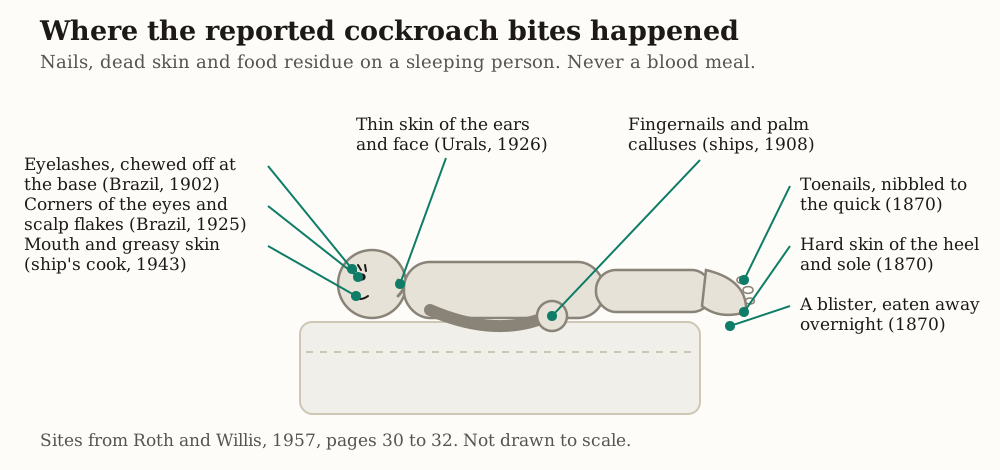
Why do cockroaches bite at all? For food, not out of temper. A cockroach feeds at night and eats almost anything, including keratin. Nails, dead skin, the flakes on a scalp and the crust in the corner of an eye are all food to it. In a room with crumbs on the floor, it never needs your skin at all.
That is why so many old cases come from ships. Sailors slept in packed quarters with no way to control the insects and little loose food about. One ship’s cook woke from a nap to find the roaches had eaten the galley grease off his face, taking a layer of skin with it.
Can roaches bite you in your sleep?
So do cockroaches bite a sleeping person? In theory yes, and that is when the documented bites happened. In practice a roach runs from anything that moves. If you can roll over and brush an insect off your foot, you almost certainly will, and that ends the meal. The people in the reports could not do that.
So be careful with the conclusion. Bumps that appear night after night on your feet and ankles, in a home with roaches but no other sign, point away from the roaches. Bed bugs and fleas are the likelier pair, and both leave evidence you can go and find.
Who is actually at risk
Four groups: a baby asleep in a crib, anyone bedridden or sedated, anyone with an open scab, and anyone living with a very heavy infestation. Three of the oldest reports describe nursing infants. The 1997 forensic paper describes bites on three infants who had died, and those marks were first read as abuse.
A bite, or just nibbling?
So do cockroaches bite, or do they just nibble? Mostly the second. Most accounts describe eating rather than attacking, and the difference is worth knowing. A Brazilian report from 1925 describes cockroaches gnawing the fine flakes on the scalps of sleeping people, the matter in the corners of their eyes, and their feet. None of that has to break skin, and it can leave no mark at all.
The eyelash reports are the same kind of thing. A roach chews the lash off near the base, which is why the children in that Brazilian house woke with lashes missing rather than with wounds. If you wake with eyelashes gone and you have a roach problem, mention it to a doctor, and treat it as odd rather than as an emergency.
What does a cockroach bite look like?
There is no reliable description, and the sizes you read online have nothing behind them. The one experiment, from 1931, induced oriental cockroaches to bite skin wetted with sugar water. It records slight pain and itching, then scabs within 24 hours, with the skin destroyed almost down to the layer beneath.
The older accounts describe wounds rather than neat bumps. A man who slept with blistered feet woke to find the skin eaten away from a blister, leaving a raw patch about the size of a coin, and he still had bluish scars four years later. A baby in a mining barracks had tiny wounds over the face, hands and belly. Sailors had nails gnawed to the quick.
Put those together and the honest answer is this. A cockroach bite looks like a small sore, a scab or a nibbled nail, and nobody has published enough fresh cases to say more than that.
As many people search for a picture of the mark as search “do cockroaches bite”, and the picture is the one thing nobody can supply honestly. That gap is why the same borrowed image and the same unsourced sentence travel from site to site.
Where the “1 to 4 mm red bump” came from
Google’s own answer and all the leading results give the same figure: a bright red raised bump about 1 to 4 mm wide, like a mosquito bite, usually on its own rather than in a cluster. We went looking for the source. The earliest dated version we found is a blog post on a pesticide maker’s website, published in December 2018.
It is not in Roth and Willis, not in Ebeling, not in MedlinePlus and not in any extension factsheet we read. Wikipedia’s article on cockroach bites repeats the mosquito comparison and cites that same blog. So the pest pages, the encyclopedia and the AI answer are quoting each other.
We are confident the figure is unsourced, though we cannot prove who wrote it first. None of this says a cockroach bite is never small and red. It says nobody has measured one.
The same blog post illustrates cockroach bites with a photograph of bed bug bites. The image is a 2013 file on Wikimedia Commons by James Heilman, MD, named Bedbugb1, described there as “Bedbug bites” and filed in the Commons category of that name. Its caption also calls roach bites “slightly larger than a bed bug bite”, which sits oddly beside the 2 to 5 mm our bed bug bite guide gives.
Cockroach bite vs bed bug bite
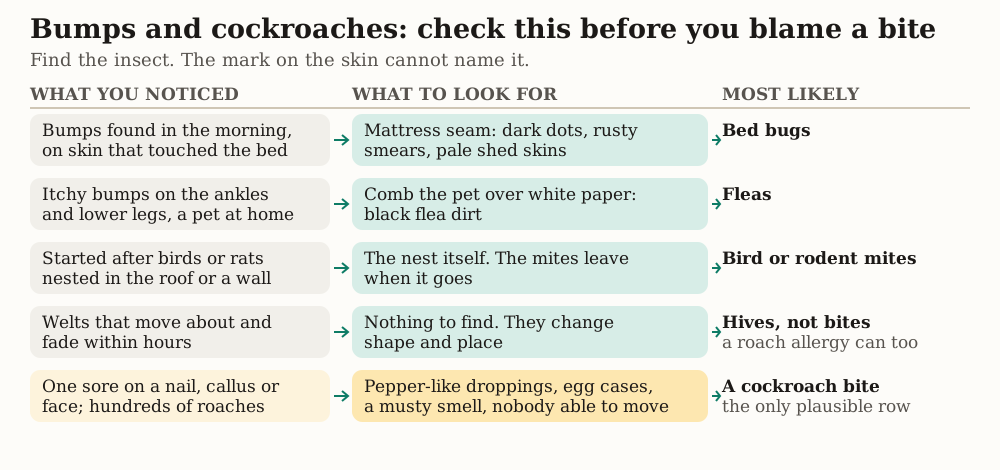
You cannot separate them by the mark, so separate them by the evidence. Bed bugs leave dark droppings like dots from a marker pen along the mattress seam, rusty smears on the sheet and pale shed skins. Roaches leave specks like ground pepper, smears in damp corners, egg cases and a musty smell.
Timing helps as well. Bed bug bites turn up in the morning on skin that touched the bed, night after night, and they spread as the population grows. The reported roach bites are one-off events in rooms that were overrun. Our guide to checking a bed properly takes 30 to 45 minutes, and it is the fastest way to settle this.
You have bites and you have roaches. What is biting you?
The useful question is not really do cockroaches bite, but what else is in the room. Start with bed bugs and fleas, because those two bite people indoors every day. Texas A&M AgriLife’s factsheet on mystery bites lists 9 common indoor causes, and the cockroach is not one of them.
That factsheet also warns that a cockroach infestation can cause skin reactions people mistake for insect bites. So in a home with roaches, itching is not proof of a bite at all.
What you found, and what it points to
Bumps found in the morning on skin that touched the bed, often in a line or cluster
- Most likely cause
- Bed bugs
- The sign that settles it
- Dark ink-dot droppings along the mattress seam, rusty smears, pale shed skins
- Read next
- Bed bug bites
Very itchy bumps on the ankles and lower legs, with a cat or dog in the house
- Most likely cause
- Fleas
- The sign that settles it
- Black flea dirt in the pet’s coat, or something jumping onto white socks
- Read next
- Flea bites
Biting that started after birds or rodents nested in the roof, eaves or a wall
- Most likely cause
- Bird or rodent mites
- The sign that settles it
- The nest itself. The mites leave once it is gone
- Read next
- Bite chart
One or two itchy bumps on bare skin, worse at dusk or near an open window
- Most likely cause
- Mosquitoes
- The sign that settles it
- A whine at night, and standing water nearby
- Read next
- Mosquito bites
Welts that move around the body and fade within hours
- Most likely cause
- Hives, not bites
- The sign that settles it
- Nothing to find, and they change shape and place
- Read next
- See the allergy section below
Itchy patches in a dry room, with no insect ever found
- Most likely cause
- Static, dry air or a new product on the skin
- The sign that settles it
- Small shocks that feel like bites; the itch tracks a new soap or detergent
- Read next
- Change one product at a time
A sore on a nail, a callus or the face, in a room with hundreds of roaches
- Most likely cause
- A cockroach bite is possible
- The sign that settles it
- Pepper-like droppings, egg cases, a musty smell, and someone who cannot move away
- Read next
- This page
A sore that keeps growing, darkens or opens up
- Most likely cause
- Needs a doctor, whatever caused it
- The sign that settles it
- Spreading redness, pus, warmth or a fever
- Read next
- See when to see a doctor
How to find out what is really biting you
Strip the bed and check the seam
Pull the sheets off and run a flashlight along the mattress piping, the seams and the frame joints. Dark dots like marker pen, rusty smears and pale shed skins mean bed bugs. That is the first thing to rule out, because bed bugs cause most of the bumps people find in the morning.
Comb the pet over white paper
If there is a dog or a cat in the house, comb it over a sheet of white paper and look for black grit, which is flea dirt. You can also wear white socks around the house for ten minutes and watch for anything that jumps on.
Put sticky traps where the bites happen
Texas A&M AgriLife advises placing several sticky traps in the rooms where the bites seem to start. Roach hotels catch small specimens just as well. Leave them a few nights, then look at what is stuck to them.
Catch anything you find
Texas A&M suggests lifting tiny specimens straight off the skin with tape, and dropping anything larger into a jar of alcohol. One insect in a jar answers more than a week of guessing.
Look for a bird or rodent nest
Mites that bite people usually come from a nest in the roof, the eaves or a wall. The biting often starts within days of the birds or rats leaving. Deal with the nest and the mites go with it.
Rule out the room itself
Dry indoor air builds static, and Texas A&M notes that static shocks can feel like bites. A new soap, detergent or fabric softener can also leave skin itching. So can a cockroach allergy, with no bite at all.
Photograph the insect, never the skin
Trap one under a clear cup on white paper, set a ruler beside it, and shoot from above in daylight. Our bug identifier can name it from that photo. No tool can name it from a picture of the bump.
Hives and an allergy rash mistaken for bites
A cockroach allergy can show up on the skin. The Asthma and Allergy Foundation of America lists “itchy skin or skin rash” among the symptoms, beside the usual sneezing and wheezing. So a room full of roaches can leave you itching without a single bite.
A 2026 case report in the journal Cureus shows how easily this gets mixed up. A 22-year-old woman in Philadelphia came in with two days of itching and raised wheals over her arms, legs, trunk and face after heavy cockroach exposure at home. The wheals could be drawn onto her skin by stroking it, which pointed at a physical hive reaction rather than an allergy to the insects, and a daily antihistamine settled it.
The 1957 monograph holds an older version of the same story. A Brooklyn doctor treated a patient who broke out in hives two days after stamping on a mass of cockroaches. The hives kept returning until she threw out the shoes she had been wearing at the time.
So if the itching keeps up and no insect ever turns up, ask about an allergy test rather than guessing. An allergist can test for cockroach allergy with a skin prick or a blood test.
What to do after a cockroach bite
Treat it as a minor insect bite. Check first for signs of a severe allergic reaction, then wash the bite with soap and water. MedlinePlus advises ice wrapped in a cloth for 10 minutes on and 10 minutes off, with an antihistamine or an anti-itch cream if you need one. Then watch it for several days.
Step by step, after a bite
Check for emergency signs first
Trouble breathing, swelling of the face or mouth, a tight throat, feeling weak or turning blue can mean a severe allergic reaction. MedlinePlus says to call 911 for any of them. Everything below is for a reaction that stays at the bite.
Wash it with soap and water
Soap and water is the first step MedlinePlus gives for any bite or sting. It clears away dirt, grease and whatever the insect walked through, which is what lowers the risk of infection.
Cool it
MedlinePlus suggests ice wrapped in a washcloth, 10 minutes on and 10 minutes off, repeated. Do not put ice straight on the skin. Raise an arm or a leg if it swells.
Ease the itch if you need to
MedlinePlus lists an antihistamine or an anti-itch cream. Follow the package directions, because we give no doses here. Ask a pharmacist first for a child, during pregnancy, or if you take other medicines.
Leave the skin alone
Do not scratch it open, and do not pick at a scab. Several popular pages tell you to pour rubbing alcohol or hydrogen peroxide on a bite. MedlinePlus does not, and neither do we.
Watch it for several days
MedlinePlus says to watch for increasing redness, swelling or pain over the next several days. Those are the signs of infection, and they need a doctor. A bite that is worse on day three is not healing.
Keep the insect if you caught one
A bug in a jar is worth more than any photo of your skin. It lets a doctor or a pest professional work from the real thing, and it ends the guessing about what bit you.
Can you get sick from a roach bite?
No disease has been shown to pass to a person through a cockroach bite. The realistic risk is an ordinary skin infection from scratching an open one. Cockroaches do carry bacteria on their bodies, and both Salmonella and E. coli have been found in laboratory and farm work, yet neither has been traced to illness in a home.
One disease idea was built on roach bites: leprosy, raised in the 1940s. The 1957 review reported that the evidence for insect spread of leprosy was presumptive, and it was never confirmed. Our guide to cockroach droppings and what they carry goes through the germ question in detail, because the droppings matter far more than the jaws.
Can a cockroach bite kill you?
No. No death from a cockroach bite appears anywhere in what we read, and the bite injects nothing at all. The thing that can kill after any bite or sting is a severe allergic reaction, which is rare and treatable when someone acts fast. Trouble breathing or a swelling face is a 911 call, whatever bit you.
The bigger risk is the allergen, not the bite
Do cockroaches bite? Rarely. Do they make people ill? Often, and through the air rather than the jaws. In a New England Journal of Medicine study of 476 inner-city children with asthma, 36.8% were allergic to cockroach and 50.2% of their bedrooms held high allergen levels. Children who were both allergic and exposed had 0.37 hospital stays a year, against 0.11 for the rest.
The trigger is not the insect you see. The EPA says certain proteins in cockroach feces and saliva cause allergic reactions and set off asthma symptoms, and that droppings or body parts of cockroaches and other pests can trigger asthma. Dead roaches still carry it, so a home can be clear of live insects and still be full of allergen.
Clearing the insects helps. In a trial in 102 New Orleans homes, insecticidal bait on its own cut roach numbers for a full 12 months, and the children’s asthma improved with it. That was one cheap measure rather than a whole treatment program, which is why it is worth knowing about. The full method is in our cockroach control guide.
Can a cockroach bite cause anaphylaxis?
The top result says severe allergic reactions involving anaphylaxis may rarely occur, and Google repeats it. We could not find a single reported case. The published papers do pair cockroaches with anaphylaxis, though for a different reason: people allergic to cockroach or dust mite can react to shrimp they have never eaten, because one protein in each looks alike to the immune system.
So here is the honest version. Severe allergy to cockroach protein is real, and it shows up in the airway and the gut rather than through a bite. A severe reaction to any bite is an emergency. No case of anaphylaxis from a cockroach bite has been published.
How to keep cockroaches off you at night
Start with four things that cost nothing. Stop eating in the bedroom, wash your face and hands before bed, strip crumbs out of the bedding, and pull the bed about 4 inches (10 cm) off the wall. A roach comes to a bed for food residue, so take the residue away and the bed stops being worth the trip.
Then deal with the insects, because bedroom habits only buy you time. Gel bait placed where the droppings are does the real work, and a tidy bedroom in a badly infested apartment is still a badly infested apartment. Our step by step on clearing roaches matches the method to the species, since German roaches and the big outdoor species need different handling.
Two things people try do not work. Sleeping with the light on helps a little, and a hungry roach will still cross a lit room. Spraying the bed helps not at all, and it puts an insecticide where you breathe for eight hours.
Cockroach bite myths
At least 8 common beliefs about these bites are wrong, and most of them come from pages sitting on the first page of Google. Two are ours to correct: the 1 to 4 mm figure that every leading result repeats, and the photograph of bed bug bites used to show a cockroach bite.
Myth 1
Myth: “Roaches never bite.”
Truth: Do cockroaches bite? Yes. Human bites were reported at least 18 times in the record up to 1957, and Ebeling counts 20 reports. Rare is not the same as never, and a flat denial is why people stop trusting the rest of a page.
Myth 2
Myth: “A cockroach bite is a red bump 1 to 4 mm wide.”
Truth: No paper, extension service or medical body gives a size. The earliest dated source we found is a pesticide maker’s blog post from December 2018, and the pages repeating it cite each other.
Myth 3
Myth: “You can tell a roach bite from a bed bug bite by looking.”
Truth: You cannot. The page ranking first for this search illustrates cockroach bites with a Wikimedia Commons photograph of bed bug bites.
Myth 4
Myth: “Roach bites spread disease.”
Truth: No disease has been traced to a cockroach bite. Scratching an open bite can cause an ordinary skin infection, which is a different thing.
Myth 5
Myth: “A roach bite can cause anaphylaxis.”
Truth: No case has been published. Severe allergy to cockroach protein is real, and it shows up through the air you breathe, not through the jaws.
Myth 6
Myth: “Roaches bite because they are aggressive.”
Truth: They are scavengers. Every account describes feeding on nails, dead skin, scabs or food residue on someone asleep, and a roach runs from anything that moves.
Myth 7
Myth: “Baby roaches bite more, because they are growing.”
Truth: No report names a nymph. A newly hatched German nymph is about 2 to 3 mm long, and its jaws are a fraction of an adult’s.
Myth 8
Myth: “Squashing a roach is harmless.”
Truth: It smears allergen onto a surface you touch, and one 1950s patient broke out in hives for days after stamping on a mass of cockroaches. A German female also carries her egg case until shortly before it hatches.
When to see a doctor
Most bites need no doctor at all. Call 911 for trouble breathing, swelling of the face or mouth, a tight throat or weakness, which are the signs MedlinePlus lists for a severe reaction. See a doctor within a day or two for spreading redness, pus, a fever, or a bite that is worse after 2 days.
Who to call about a bite and about the infestation
911
- When
- Trouble breathing, swelling of the face or mouth, a tight throat, weakness or turning blue
- Why
- The MedlinePlus signs of a severe allergic reaction
Emergency room, without waiting
- When
- You know you have a severe allergy to insect bites and you have been bitten
- Why
- A severe reaction moves fast, so do not wait for symptoms
Doctor, the same day
- When
- A broken bite on a baby, a spreading red streak, or a sore on the eyelid or in the mouth
- Why
- These need a look even without an allergy
Doctor, within a day or two
- When
- Redness, swelling or pain that increases after the first day, pus or a fever
- Why
- Possible infection, which may need antibiotics
Pediatrician or pharmacist
- When
- Before giving a child anything for the itch
- Why
- The right product and amount depend on age and weight, and we give no doses
Allergist
- When
- Itching, a rash or wheezing that keeps up in a home with roaches
- Why
- A skin prick or blood test can confirm cockroach allergy
Poison Control, 1-800-222-1222
- When
- Any question about a bite, or if someone swallows bait or insecticide
- Why
- Free, confidential and open 24 hours a day
Landlord, in writing
- When
- A heavy infestation in a rented home
- Why
- The infestation is the thing to fix, and a written record helps
Still not sure what bit you? Catch the insect, then let our free bug identifier name it from a clear photo. That answer is worth more than any picture of the mark on your skin.
Medical disclaimer. This page is for general information only. It is not a medical diagnosis. If you have severe symptoms, trouble breathing, swelling of the face or throat, fast spreading redness, fever, severe pain, pus, or signs of infection, contact a doctor or your local emergency number.
Pest control disclaimer. Photo-based identification can help, but it is not always perfect. For dangerous spiders, large infestations, or anything you are unsure about, contact a licensed pest control professional.
Cockroach bite FAQ
Do cockroach bites hurt?
How long does a roach bite take to go away?
Do roaches have teeth?
Why should you never squish a cockroach?
Is it safe to sleep in a house with cockroaches?
Do cockroaches bite pets?
Related guides
Bed bug bites
The usual cause of itchy bumps you find in the morning, and how the pattern misleads people.
Bug bite identification
A chart of 20 bites by look, place and timing, plus the warning signs.
How to get rid of roaches
Bait where the droppings are, and the method that matches your species.
Cockroach poop
What the specks mean, the allergen risk, and how to clean them up safely.
Baby cockroach
How to tell a roach nymph from a bed bug, which is the real question behind most of these photos.
How to check for bed bugs
A 30 to 45 minute inspection that settles what is biting you at night.
German cockroach
The small indoor species behind most infestations, and the one linked hardest to asthma.
Sources
- MedlinePlus Medical Encyclopedia, Insect bites and stings (first aid, infection signs and when to call 911)
- Texas A&M AgriLife Extension, Diagnosing Mysterious “Bug Bites”, ENT-3006 (what really bites indoors, and skin reactions mistaken for bites)
- US EPA, Asthma Triggers: Gain Control (proteins in cockroach feces and saliva as an asthma trigger)
- UC IPM Pest Notes: Bed Bugs, Publication 7454 (telling bites apart is “difficult to impossible”, so find the insect)
- Roth LM and Willis ER, The Medical and Veterinary Importance of Cockroaches, Smithsonian Miscellaneous Collections 134(10), 1957, section IX (every documented bite case on this page)
- Ebeling W, Urban Entomology, chapter 6, University of California, Riverside (“20 reports”, rare and not serious, and the species implicated)
- Wikimedia Commons, File:Bedbugb1.JPG, James Heilman MD, 2013, described as “Bedbug bites” (the photograph used to illustrate cockroach bites)