First, which roach do you have?
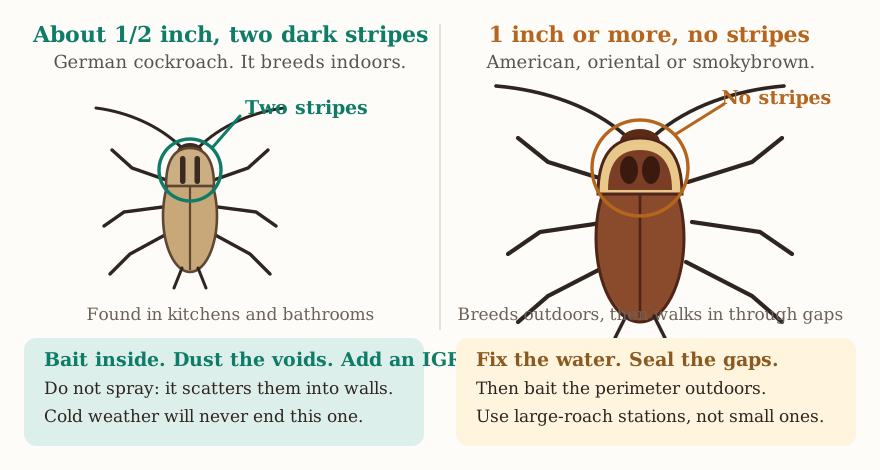
Measure it. A roach about half an inch long with two dark stripes behind its head is a German cockroach, and it breeds inside your kitchen. Anything an inch or longer with no stripes breeds outdoors and walked in. The two need different plans, so this one question saves weeks.
Everything about how to get rid of roaches follows from that answer. It is also the step almost every article skips. Extension guidance is blunt that control for the small indoor species differs considerably from control for the large outdoor ones. Bait and dust indoors will not touch a roach that lives in your mulch bed. A perimeter spray outside does nothing to a roach that has never been outdoors in its life.
Table 1. The roach you found, and the plan it needs
Two dark stripes behind the head
- Which roach
- German cockroach
- Size
- 1/2 to 5/8 in (13 to 16 mm)
- Where it breeds
- Indoors only
- The plan
- Bait, dust, growth regulator. Never spray
Two pale bands across the back, often found away from the kitchen
- Which roach
- Brown-banded cockroach
- Size
- About 1/2 in (12 to 14 mm)
- Where it breeds
- Indoors only, warmer rooms
- The plan
- Same as German, but slower to bait
Reddish brown, pale figure-of-eight on the head shield
- Which roach
- American cockroach
- Size
- 1 1/2 to 2 in (38 to 50 mm)
- Where it breeds
- Outdoors, sewers and drains
- The plan
- Fix water, seal gaps, bait the perimeter
Glossy near black, cannot fly, slow
- Which roach
- Oriental cockroach
- Size
- About 1 to 1 1/4 in (25 to 32 mm)
- Where it breeds
- Outdoors, drains and soil
- The plan
- Fix water, cover drains, trap and seal
Even dark mahogany, no pale markings, flies well
- Which roach
- Smokybrown cockroach
- Size
- 1 to 1 1/2 in (25 to 36 mm)
- Where it breeds
- Outdoors, mulch and attics
- The plan
- Seal soffits and vents, bait the perimeter
Small, wingless, pale or very dark
- Which roach
- A nymph of any of the above
- Size
- From about 2 mm
- Where it breeds
- Wherever the adults are
- The plan
- The same plan as the adult
If the one you found is big and you live in the South, the name you were given may be a nickname rather than a species. Our guide to what palmetto bug actually covers sorts out which of four large roaches you have, and the three insects called water bugs does the same for that name. Small wingless ones are covered in our guide to baby roaches.
One roach at night, or many?
A small striped roach on the counter at night is almost never alone. Around four fifths of a German cockroach population is nymphs, and nymphs stay hidden, so the adult you saw came out of a group you have not met yet. Put traps down and you will find out how big it is within a night or two.
One big roach in a basement in autumn is a different matter. Large species wander in alone all the time, especially after rain or a cold snap, and a single sighting can mean nothing more than a gap under a door. So with a large roach, count before you treat.
What to do tonight, before you buy anything
Four jobs cost nothing, and all four make every product you buy later work better. Find out where the roaches actually are, dry the kitchen out, take the food away, and stop spraying. Water comes first: with neither food nor water adults die in about two weeks, but with water alone they last a month.
Before any of it, one thing worth hearing. Roaches do not mean a dirty home. The small striped species turns up in carefully kept kitchens all the time, usually arriving in a delivery box, a grocery bag, a secondhand appliance or through a shared wall. So none of the cleaning below is a punishment. It is how you make your bait the best meal in the room.
How to find where they are hiding
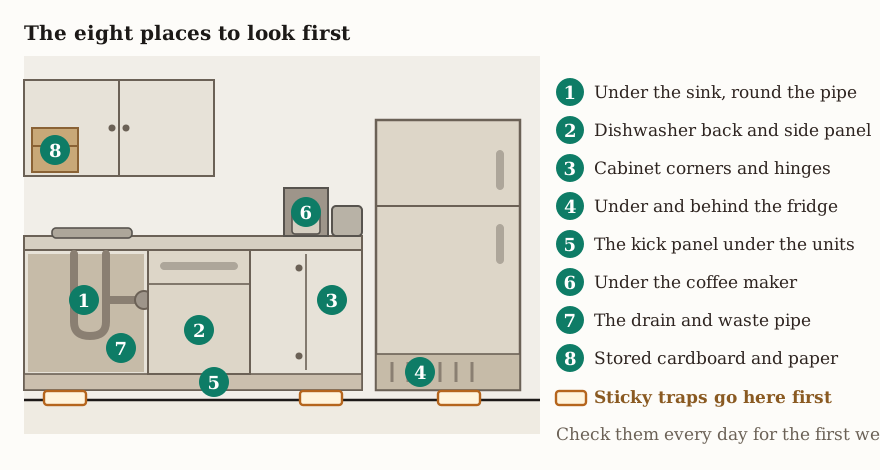
Glue boards are the best way to find a roach population, and they cost a few dollars. Put six down in the kitchen. Two go where the floor meets the wall, one under the sink and one beside the fridge. The last two go inside the cabinet you suspect and by the back door. Then check them every morning for a week.
Many traps catch something within the first 24 hours, so you usually know by tomorrow. Also take a torch and a small mirror on a handle to the places a trap cannot sit. Check the void behind the kick panel, the motor housing under the fridge and the side of the dishwasher. Look for pepper-like specks and brown smears, because those mark a harborage. Our guide to what cockroach droppings look like shows what you are looking for.
Dry it out and starve them
- Fix the drip. The trap under the sink, the running loo, the condensation on a cold pipe. All three are a water supply.
- Dry the sink and bath at night. A wiped-out sink removes the easiest drink in the house.
- Lift the pet bowl overnight, and sweep around it. Pet food left down defeats bait more often than anything else.
- Seal the dry goods. Flour, cereal, rice, sugar and pet food go into tubs with lids rather than opened packets.
- Wipe the grease. Behind the hob, the side of the oven, the extractor filter.
- Rinse the recycling, and use a bin with a lid that you empty every night.
- Vacuum the cracks, ideally with a HEPA filter, since dry sweeping lifts roach allergen into the air.
- Get the cardboard out. Boxes and paper bags are shelter, and they are also how roaches arrive. Flatten and bin them the day they come in.
Stop doing the thing that is making it worse
If the kitchen has been sprayed every week, stop. Sprays give a quick knockdown and no lasting control, and they can repel and scatter roaches into other parts of a building, from which they come back later. Resistance to the actives in household sprays is also widespread now, so the spray that worked in 1995 is not the same tool today.
There is a second cost, and it is the one that wastes your money. Spray or cleaner near a bait spot keeps roaches off the bait, so the two methods cancel each other out. Pick one, and indoors it should be bait.
What actually kills roaches, method by method
Bait kills roaches, and very little else does the whole job. Gel bait and bait stations cut populations within 2 to 4 weeks. Boric acid dust in a void works slowly and keeps working for years while it stays dry. Sprays kill what they soak. Bug bombs, measured in 20 treated homes, cut nothing at all.
Table 2. Every popular method, rated
Gel bait
- What it really does
- Eaten, then carried through the group in droppings and bodies. Cut trap counts at both 2 and 4 weeks in a field test
- Use it?
- Yes, this is the main tool
Bait stations
- What it really does
- The same actives behind child-resistant plastic. Slower than gel, because less bait is exposed
- Use it?
- Yes, where children or pets reach
Boric acid dust
- What it really does
- Clings to a roach and is swallowed when it grooms. 7 days or more to show. Lasts for years while dry
- Use it?
- Yes, in voids and cracks only
Insect growth regulator
- What it really does
- Stops nymphs maturing and eggs hatching, and makes roaches eat more bait. Does not kill adults
- Use it?
- Yes, alongside bait
Sticky traps
- What it really does
- Catch and hold, and show you where to treat. Never reduce a population on their own
- Use it?
- Yes, to find them and to measure
Diatomaceous earth
- What it really does
- A drying dust that roaches avoid. Only useful puffed into a void
- Use it?
- Only in voids, never broadcast
Contact spray
- What it really does
- Kills what it soaks, repels the rest, and cancels nearby bait
- Use it?
- Rarely, and never near bait
Bug bomb (total release fogger)
- What it really does
- No measurable drop across 20 treated homes. Kitchen residues up a median of 85 times
- Use it?
- No
Boric acid or borax mixed with sugar at home
- What it really does
- An unregistered mixture at a strength nobody has checked
- Use it?
- No, buy the registered product
Bleach, vinegar, baking soda, essential oils
- What it really does
- Kill or mask what they touch, and nothing more
- Use it?
- No, see the remedies below
Three of those rows deserve the detail. That is where the money goes when people look up how to get rid of roaches.
Why bug bombs fail, with the numbers
This is the one place the evidence is unusually clean. Researchers treated 20 infested apartments with four different bug bombs and 10 more with gel bait, then counted roaches on glue boards at two weeks and four weeks. The bombed homes showed no significant change from where they started. The baited homes dropped significantly at both counts.
They also caged roaches collected from the same buildings and exposed them directly to the foggers. Fewer than 38% died. Meanwhile insecticide on kitchen surfaces rose by a median of 85 times. A month later, more than a third of those surfaces were still raised (DeVries and others, BMC Public Health, 2019).
Cost does not rescue the bomb either. In the same study the foggers cost $7.80 to $12.50 a home, against $14.00 to $23.40 for the gel. The authors concluded that cost should not decide between them. The bombs also cost the resident about 6 hours against 2 hours for bait, because everyone has to leave while a fogger discharges.
One correction while we are here, since you may have read the opposite. Google’s own summary of this question warns that foggers scatter roaches deeper into walls, and credits that warning to the New York State Department of Health. That page never mentions foggers. The warning itself is right, but it comes from university extension services and from the field test above.
Why spraying every week makes it worse
A weekly spray round feels like progress and usually is not. The pattern in apartment buildings is worse still. In a field trial of resistance management, a spray mixture failed to cut numbers at all. It also seemed to repel roaches into apartments that had never been infested. So a neighbour being sprayed can be the reason your kitchen got worse.
The order matters more than the product. Sanitation and sealing come first, then bait and dust, and only after those have genuinely failed does a spray earn a place. UC IPM puts it plainly: sprays should not be necessary if you are doing the rest. Indoor chemical treatment is warranted only when a population is established, not for one wandering intruder.
How to get rid of roaches, step by step
Put six sticky traps down tonight
Place glue boards where the floor meets the wall, under the sink, beside the fridge and inside the cabinet you suspect. Check them every morning for a week. The trap that fills tells you where everything else goes, and those same traps later tell you whether the plan is working.
Take the water away
Fix the drip under the sink, dry the sink and bath before bed, lift the pet bowl overnight and run the extractor fan for longer. Roaches last about a month on water alone, but only about two weeks with neither food nor water, so this step does more than any amount of sweeping.
Take the food away
Seal flour, cereal, sugar and pet food into tubs. Wash the dishes before bed, wipe the grease behind the hob, rinse the recycling and empty a lidded bin every night. Bait only wins if it is the best food in the room.
Clear the cardboard out
Flatten and remove boxes, paper bags and stacked newspaper, starting with the cabinet under the sink and the floor of the pantry. Corrugated cardboard is both a hiding place and the way roaches arrive in the first place.
Bait where the traps filled
Use a gel bait and put down many small spots instead of one long line. Labels ask for three to five spots per ten feet of cabinet edge when numbers are high, each about a quarter of an inch across. Put them in corners, along hinge lines and behind the fridge, never out on an open surface.
Dust the voids you cannot reach
Puff boric acid powder into the gap behind the kick panel, the void behind a cabinet, the openings around pipes and the space under the fridge. It has to be a film you can barely see. Any powder still visible afterwards gets brushed into the crack or removed, and it only goes where children and pets cannot reach.
Add a growth regulator if the numbers are high
An insect growth regulator stops nymphs maturing and eggs hatching, and it makes roaches eat more bait. It does not kill adults, so it goes alongside the gel rather than instead of it. Look for hydroprene or pyriproxyfen on the pack.
Seal the gaps once the counts fall, then keep trapping
Caulk around pipes and cables, fit door sweeps and close the gap behind the kick panel. Sealing early traps roaches inside with your bait, so it comes last rather than first. Leave two traps down for a month after the final sighting.
How to use gel bait so it actually works
Gel bait fails for three reasons: too much in one place, too far from where roaches walk, and spray or cleaner nearby. Labels ask for 3 to 5 spots per 10 linear feet of edge where numbers are high, and 1 to 3 spots where they are light. Each spot is about a quarter of an inch across and half a gram, which is to say smaller than a pea.
Many small spots beat one long line for a simple reason. A roach will not cross an open floor to reach food, so a spot four feet from a harborage may as well be in another room. Spreading the same syringe over fifteen places puts bait inside fifteen roach routes instead of one.
Where the spots go
Put the spots in cabinet corners, along hinge lines, and under the sink around the pipe. Add more behind and under the fridge, and inside the kick panel gap. Pull the lower drawers out and bait the empty drawer wells too. Keep them out of sight and away from food preparation surfaces. Then follow the label on the pack you bought, because the label is a legal instruction rather than a suggestion.
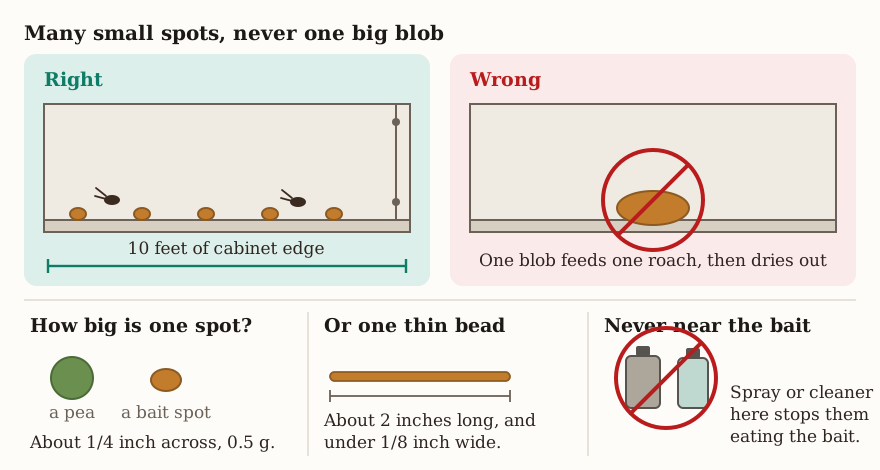
One placement rule is worth more than all the others. Bait next to the fecal spotting rather than next to the sink. Those specks carry an aggregation scent that pulls roaches to that exact spot, which is why you bait first and scrub second.
A bait also reaches roaches that never visit it. They eat droppings, regurgitated food and dead nestmates, so an active ingredient moves through a group on its own (Buczkowski and Schal, Journal of Economic Entomology, 2001). Notice what that is not, though. There is no queen and no central nest to destroy. A roach group is an aggregation held together by smell, so “kill the colony” is the wrong picture and the wrong plan.
When they stop eating the bait
Bait aversion is real and well documented. A population offered the same bait again and again can stop taking it. The fix is to switch brand or type, not to put more of the same down.
Rotating actives on a schedule does not buy what people think, though. In a field trial of resistance management, rotation was mostly ineffective because the roaches carried cross-resistance between different actives. Boric acid was the one exception in that study: the roaches selected no resistance to it at all. So switch when a bait is being ignored, and not because a month has passed.
Add a growth regulator if the numbers are high
An insect growth regulator is the second product almost nobody buys, and on a heavy infestation it changes the timeline. Hydroprene and pyriproxyfen interrupt development, so nymphs never reach breeding age and eggs stop hatching. They work on insecticide-resistant strains, and they make roaches eat more bait.
They do not kill adults, so an IGR goes alongside gel bait rather than instead of it. One limit is worth knowing: a growth regulator works on what a roach eats before her egg case forms. A case that is already made and glued down is beyond its reach, which is part of why this job runs in weeks.
Boric acid, used the way the label intends
Boric acid is the cheapest thing that works, and the way people use it is why it usually does not. It has to be a film you can barely see, in voids and cracks only. It takes 7 days or more to show in the counts, lasts for years while it stays dry, and one pound covers about 2,000 square feet of a home.
The mechanism explains the thin film. Boric acid is not repellent, and the powder carries a positive charge, so it clings to a roach walking through it and is swallowed when the roach grooms itself. A visible heap gets walked around instead. A barely visible dusting gets carried.
Where it goes, straight off the label: under and behind the fridge, stove, sink, dishwasher, washer and dryer. Also into the openings around drains, water pipes and electrical conduits. And into cracks along baseboards and in the corners of cabinets, cupboards and closets. Pull the lower drawers right out and dust the empty drawer wells, then put the drawers back.
Two label rules decide whether it works. Any powder still visible after you apply it must be brushed into the cracks or removed. And it goes only where children and pets cannot reach, which rules out open floors and every surface in the room.
Keep it dry, too. A deposit that gets wet, dries and cakes loses its charge and stops being picked up, so clean the old deposit out and start again. Boric acid is also toxic to plants, so it is an indoor product only.
Borax is not boric acid
These are two different chemicals, and the internet treats them as one. Borax carries about 11% boron and boric acid about 17%, so a recipe written for one is the wrong strength in the other. A homemade mixture of powder and sugar is unregistered as well. So nobody has checked its strength or written its label, and for a pesticide the label is the law. Buy the registered roach powder or the registered gel instead. Our guide to borax used as an ant bait works through the same chemistry on the ant side.
Where diatomaceous earth fits
Diatomaceous earth and silica aerogel dry an insect out rather than poison it, and both do work in the right place. Both are also repellent, which is the catch. Scattered across an open floor they push roaches somewhere else instead of killing them, and that somewhere else is usually a wall void or the next room.
Use an EPA-registered product, puff it into a void or a crack, and never broadcast it over a floor or a work surface. Avoid breathing the dust while you apply it.
Can you get rid of roaches overnight?
No, and every honest page on that search says so. You can kill the roaches you can see tonight, because soapy water, a labelled contact spray or a shoe all work on a roach in front of you. None of it reaches the group in the wall. Expect fewer roaches in 1 to 2 weeks and several weeks more after that.
Soapy water is the household option that genuinely kills. Soap breaks the waxy layer that stops a roach drying out, so a soaked roach dies in seconds. Skip the rubbing alcohol that gets recommended for this: it is flammable, and it is not a pesticide.
Bleach gets asked about constantly, so here is the straight answer. Bleach kills a roach it soaks and does nothing else, because it leaves no residue a roach will eat. More important than the roaches: never mix bleach with ammonia or any other cleaner, since CDC warns that the mixture gives off a poisonous gas.
The reason there is no overnight fix is simple. Roaches spend the day pressed into gaps and come out at night, so the ones you can reach are a small share of the total. Anyone promising to show you how to get rid of roaches in one night is selling something. Females carrying an egg case feed very little and avoid open spaces. So the first round of bait misses exactly the roaches that are about to breed.
How long it really takes
Table 3. What to expect, week by week
Night 1
- What happens
- Traps start filling, often within 24 hours
- What you do
- Put the bait and the dust down
Days 1 to 3
- What happens
- The roaches that fed on bait start dying
- What you do
- Leave the bait alone and do not clean near it
Week 1
- What happens
- The first real drop, which the traps show before you notice it
- What you do
- Top up any spot that has dried out
Weeks 2 to 4
- What happens
- Counts fall significantly. This is the window the field trial measured
- What you do
- Re-bait at week 2 and again at week 4
Weeks 4 to 6
- What happens
- A second wave of nymphs hatches from cases laid before you started
- What you do
- Keep baiting. This is normal, not failure
Weeks 6 to 8
- What happens
- Most kitchens reach no sightings and empty traps
- What you do
- Seal the gaps, keep two traps down
Still catching at week 8
- What happens
- Bait aversion, a harborage you never found, or an untreated unit next door
- What you do
- Switch bait type, then call a professional
Two of those rows are our own reading rather than a published figure, and it is fair to say which. The drop at weeks two and four comes from the field trial. Extension guidance gives the one to three day death. Our six to eight week finish line is an estimate, built on those numbers plus the time an egg case takes to hatch. So treat it as a guide and not a promise.
Home remedies for roaches, checked one by one
Nine remedies dominate the search for how to get rid of roaches, and one of them works. Boric acid, used as a registered product in voids, is real. The other eight either kill only what they touch or do nothing anyone has measured.
Myth 1
Myth: “Baking soda mixed with sugar kills roaches.”
Truth: No published test supports it. The usual explanation, that soda reacts with acid inside the roach, has no source behind it either, and we went looking. Put the sugar away and use a registered bait, which is the same idea done properly.
Myth 2
Myth: “Bleach kills roaches.”
Truth: It kills the roach it soaks, like any liquid that drowns one, and it leaves nothing behind that reaches the rest. One safety point matters more than the roaches here: CDC says never to mix bleach with ammonia or any other cleaner, because the mixture gives off a poisonous gas.
Myth 3
Myth: “Dish soap and water kills roaches.”
Truth: True, and only that. Soapy water breaks the waxy layer that stops a roach drying out, so it kills what it lands on within seconds. Nothing in a wall ever meets it, so treat it as a way to deal with the one on the counter.
Myth 4
Myth: “Vinegar keeps roaches away.”
Truth: Vinegar is a cleaner, and a useful one. It lifts the grease and the fecal odour that mark a route, which is worth doing before you bait. No study shows it repelling or killing roaches, though, so it is a cleaning step rather than a control method.
Myth 5
Myth: “Peppermint or tea tree oil drives roaches out.”
Truth: A strong smell can keep roaches off a surface while the smell lasts, and that is the whole effect. Nothing shows an oil spray reducing a population. Cornell's veterinary college also lists peppermint oil as toxic to cats and tea tree oil as highly toxic to cats and dogs, so in a pet home the trade is worse than it looks.
Myth 6
Myth: “Bay leaves, cucumber peel or coffee grounds repel roaches.”
Truth: No evidence for any of the three. Roaches walk over all of them to reach food, and coffee grounds are food. Clearing the clutter they were hidden under does more than the remedy did.
Myth 7
Myth: “Fabric softener sheets smother them.”
Truth: A soaked roach dies from the liquid, not from the brand on the bottle. Dry sheets tucked into a cabinet do nothing at all, and they take up the space where bait should be.
Myth 8
Myth: “An ultrasonic plug-in clears a kitchen.”
Truth: No. Extension guidance does not list these devices among the methods that work, and no published test shows one clearing a room of roaches. The money buys a gel bait and a pack of glue boards instead.
Myth 9
Myth: “You should never kill a cockroach, because it releases its eggs.”
Truth: Killing the one on your counter is fine and changes very little. There is a grain of truth in it: a German female carries her egg case until a day or two before it hatches, so crushing a late-stage female can leave a case behind that still hatches. The better reason to stop squashing them is the mess. Droppings and shed skins carry the proteins that set off asthma, so wipe with a damp cloth or use a vacuum with a HEPA filter rather than sweeping dust into the air.
What smell do roaches hate?
None of them enough to walk away from food and water. That is the honest answer, and it is worth more than a list of oils. Strong smells can keep roaches off one surface while the smell lasts, then the roaches use a different route.
Repelling is also the wrong goal. A repellent moves a problem into the next wall or the next apartment. That is exactly what the apartment field trial measured, when a spray pushed roaches into units that had been clean. The smell that really changes roach behaviour works the other way round: their own droppings pull them in, which is why the bait goes next to the spotting.
The chalk is illegal, not a secret
Insecticide chalk comes up in forum threads as a cheap miracle that the authorities took away. The real story is less romantic, and it is worth knowing before you order any.
Small roaches in the kitchen: the German plan
Most people searching how to get rid of cockroaches have this one, and it is the hard version of the job. A German cockroach lives and breeds indoors only, so cold weather will never end it and nothing outside your walls matters. Bait, dust, a growth regulator and no spraying is the whole plan, repeated for 4 to 8 weeks.
Two facts explain why your last attempt failed. First, about four fifths of the population is nymphs tucked into gaps, so killing the adults you see barely dents it. Second, resistance to the actives in household sprays is now normal rather than rare, and a population can also learn to refuse a bait it has met too often.
Treat every room the traps catch in, not just the kitchen. Heavy populations spread to sofas, recliners and beds wherever crumbs collect, and a bedroom catch means the bedroom gets bait too. Our German cockroach identification guide covers the stripes, the nymphs and the egg cases in detail.
Some small roaches turn up in a living room or high on a wall rather than in the kitchen. If they also show two pale bands across the back, they are brown-banded cockroaches. Same plan, with one adjustment: they are harder to bait, so expect to try more than one product and to place bait higher up as well as low down.
Big roaches coming in from outside
A roach over an inch long almost always breeds outdoors and walked in, so most of the work moves outside. Fix the water first, then close the gaps, then bait the perimeter. Sealing a building is the single most effective thing an owner can do about large roaches, and it costs less than any product.
They come from sewers and floor drains, crawl spaces, mulch beds, tree holes, attics and soffit voids. So start with the route rather than the roach. A floor drain that has dried out is an open door. The fix costs nothing: keep water sitting in the trap, or put a weighted cover over a drain you never use.
Water, gaps, then bait
- Drains and pipes. Keep traps wet, cover unused drains, and seal around every pipe and conduit that passes through a wall.
- Doors and windows. Fit door sweeps, repair torn screens and close the gap at the bottom of a garage door. A rolled towel works tonight if money is tight.
- The first foot of soil. Pull mulch back from the wall and keep a strip of gravel 6 to 12 inches wide around the foundation, which dries that band out.
- Attics and soffits. Check that soffit and attic vents fit tightly and are screened, since smokybrown roaches use them.
- Wood and clutter. Move firewood away from the wall, clear leaf litter, and cut back branches that touch the roof.
- Bait outside, not inside. Granular bait around the perimeter and bait stations made for large roaches. German cockroach stations are too small to be any use here.
Which one you have changes the detail, so it is worth naming it. Our guide to the big reddish roach that comes up from drains covers that species. So does our guide to the glossy near-black one that cannot fly. And which roaches actually fly settles a question people ask after one comes at them in the dark.
Roaches in an apartment, and what your landlord owes you
In an apartment you cannot win alone, and the evidence is specific about why. In a field trial across infested buildings, a repellent spray in treated units pushed roaches into units that had not been infested before. So this is partly a building job, and in the United States it is partly your landlord’s job.
Working out how to get rid of roaches in an apartment is half pest control and half paperwork. Start with what you can still do by yourself, because it is not nothing. Bait and dust your own unit properly, seal around your own pipes and behind your own kick panel, and keep trapping. Sealing cuts movement between units even though it rarely stops it altogether, and the traps give you a record.
Then the legal part, in outline. Every US state recognises an implied warranty of habitability, and a habitable home is one free of hazards including infestations. What that entitles you to, and how you enforce it, is state and city law rather than federal, so the specifics live in your local housing code and your lease. The usual route is a written request to the landlord, then a call to the city housing or health inspector if nothing happens.
Put it in writing
Email beats a phone call, because an email dates itself. Keep a short log as well: the date, the room, how many roaches, and a photo of the glue boards. Then keep every reply you get.
Ask what is being applied, too. If the building sprays, a spray near your bait is wasted money, and a repellent spray in the unit next door can be the reason yours got worse. A manager who knows you are tracking it also tends to escalate faster.
A heavy infestation
Heavy means roaches out in daylight, roaches in rooms away from the kitchen, and glue boards that fill overnight. At that point doing it yourself still helps and will not finish it, because the source is spread across units you cannot enter.
So ask for the right thing in the right words: a building-wide treatment, led by monitoring, using bait and dust. A unit-by-unit spray round is the version that keeps failing, and now you know why. One last thing, since it comes up in every thread on this: an infestation in a shared building is not a verdict on your housekeeping.
Why the roaches came back
Five causes cover nearly all of it, and four are about method rather than product. That is good news, because it means the bait you already bought will probably work when you use it differently.
- The bait ran dry. A spot that empties or hardens halfway through the job feeds part of the group and teaches the rest to look elsewhere.
- Spray cancelled it. Insecticide or cleaner near a bait spot keeps roaches off the bait, so both methods do nothing.
- A harborage was never found. Bait placed where it looks tidy misses the void where they actually live, and the counts barely move.
- The egg cases outlived the adults. Eggs laid before you started hatch weeks later, which looks like a brand new infestation.
- They walked back in. From a neighbouring unit, a delivery box, a secondhand appliance or an unsealed pipe.
Underneath all five sits the answer to why roaches are so hard to kill. They breed fast, and they spend the day where your hands cannot reach. Most of the population is immature and hidden. Many populations also carry resistance to the sprays sold for them. None of that beats bait placed properly and left alone.
The egg cases outlive the adults
What kills roaches and their eggs? Bait and a growth regulator, in that order, over weeks rather than days. Bait kills the adults and nymphs that feed on it. A growth regulator eaten before a case forms stops that case hatching.
The problem is a case that is already made. A German female carries hers until a day or two before it hatches. Each case holds 30 to 40 eggs. So nothing sprayed on the outside of a case reliably kills what is inside. That is the real reason this job runs in weeks, and why a second wave around week four or five is expected rather than a sign of failure. Our guide to cockroach egg cases and what kills them covers the detail.
When to call a professional, and what it costs
Call when the glue boards are still filling after a month of correct baiting. Roaches out in daylight in more than one room is another trigger. So is sharing walls with units that nobody is treating. A professional has two things you do not: products sold only to licensed applicators, and the standing to treat a whole building.
A good service inspects first, puts monitors down, then uses bait and dust with a growth regulator, and comes back to check. The weak ones book a monthly spray round and nothing else. So ask what the monitoring and bait plan is before you sign, because a monthly spray with no bait is the approach the research keeps finding does not work.
They will also need something from you. Extension guidance is blunt that overcrowded cabinets and closets stop a technician treating properly, and that poor sanitation defeats the best of them. Clear the cabinets before the visit and you get a better result from the same money.
On price, two halves, and only one has a real number. The DIY half does: in the 2019 field trial the gel bait came to $14.00 to $23.40 a home in materials, plus about two hours of work. The professional half does not. No extension service or government body publishes a US price for cockroach work. A quote also moves with the size of the home, the species, and how many visits it includes. So get two or three written quotes, check what happens after visit one, and treat any site quoting a national average as guessing.
How to keep roaches out for good
Once the traps stay empty, three habits keep them that way: no standing water, no open food and no easy way in. Keep two glue boards down for a month after the last sighting, because a trap is the only thing that tells you early. Nobody wants to learn how to get rid of roaches twice.
- Check what comes in. Flatten and bin delivery boxes the day they arrive, and look over secondhand appliances and furniture before they come through the door. Both are common ways a kitchen infestation starts.
- Keep it dry. Fix drips the week you notice them, dry the sink at night and run the extractor fan for longer.
- Keep food closed. Tubs with lids, a lidded bin emptied nightly, pet bowls lifted overnight.
- Keep the gaps closed. Caulk around pipes and cables, fit door sweeps, and repair screens before summer.
- Keep the outside dull. Mulch pulled back, gutters clear, firewood away from the wall.
- Keep two traps down. One under the sink and one beside the fridge, checked monthly.
Knowing what you are dealing with is half of this job. If something turns up that you cannot place, our six-check guide to naming a household bug narrows it down. No photo needed. And whether cockroaches bite answers the question most people ask next.
Pest control disclaimer. Photo-based identification can help, but it is not always perfect. For dangerous spiders, large infestations, or anything you are unsure about, contact a licensed pest control professional.
Frequently asked questions
Is it okay to sleep with a cockroach in the room?
Will spraying Lysol keep roaches away?
How long can roaches live without food?
What is the best bait for roaches?
Why are there more roaches after I put bait down?
Can roaches come up through the drain?
Do I have to throw my food out?
Will one treatment be enough?
Are bug bombs ever the right choice?
How do I know the roaches are gone?
How do I get rid of roaches in my car?
Related guides
German cockroach
Two dark stripes and half an inch long: the indoor breeder behind most kitchen infestations, and why baits stop working.
American cockroach
The big reddish one with the pale figure-of-eight. Size, flight, egg cases and why it is the easier problem.
Oriental cockroach
The shiny near-black one that cannot fly, and what finding one in a basement means.
Palmetto bug
A Southern nickname for four large roaches. Which one you have depends on your state, and it changes the plan.
Water bug
Three insects share the name. Indoors it is almost always a roach, in a pond it is the one that bites.
Baby cockroach
Small, wingless and dark: how to tell a roach nymph from a bed bug, a beetle or a booklouse.
Cockroach eggs
What an egg case looks like by species, where they are glued, and what actually kills the eggs inside.
Cockroach poop
Pepper-like specks and smears: how to read them, tell them from mouse droppings, and clean up safely.
Do cockroaches bite?
Rarely, and the records are specific about when. What the marks on your skin probably are instead.
Flying cockroach
Which species fly, which only glide, and which cannot leave the ground at all.
What bug is this?
Name a bug in six checks without a photo: legs, body, wings, colour, size and the room you found it in.
Borax for ants
The same borate chemistry on the ant side, including why the ratio people remember is the wrong number.
Sources
- EPA, Safety Precautions for Total Release Foggers
- CDC, How to Safely Clean and Sanitize with Bleach
- National Pesticide Information Center, Boric Acid General Fact Sheet
- UC IPM, Pest Notes: Cockroaches (Publication 7467)
- Mississippi State University Extension, P3346, Control Cockroaches In and Around Your Home
- DeVries and others 2019, Bug bombs and gel baits compared in 30 homes, BMC Public Health
- Fardisi and others 2019, Insecticide resistance management in German cockroaches, Scientific Reports