Does borax kill ants?
Yes, and it kills them by being swallowed rather than touched. Borax is a slow stomach poison, so a worker that drinks a weak bait lives long enough to walk home and share it. About 1.2% borax in the liquid is the target. Stronger mixes kill the forager at the dish, so the nest never gets a dose.
Ants feed each other mouth to mouth, which entomologists call trophallaxis. One forager fills its crop, returns to the nest, and passes the meal to other workers, to the larvae and to the queen. So a single visit to your bait can dose dozens of ants that never left the wall.
That sharing is the whole mechanism, and it sets one hard rule: the poison has to be slow. A fast kill stops the delivery. This is also why spraying the trail works against you, a point covered in our guide to clearing an ant infestation.
Borax does work. In laboratory colonies, sugar water carrying about half a percent boric acid killed every worker and queen within 14 days. The same studies found consumption drops off once the bait goes above 1%, because the ants taste it and walk away. So the failures people report with borax for ants are almost always failures of strength, not of borax.
Borax and boric acid are not the same thing
Borax carries 11.34% boron and boric acid carries 17.48%, so a gram of borax delivers about two thirds the dose a gram of boric acid does. They are different compounds with different pH, 9.3 for borax and 5.0 for boric acid. Swapping one for the other spoon for spoon changes the strength of the bait by a third.
Borax is sodium tetraborate decahydrate, a mineral salt mined and sold as a laundry booster. Boric acid is made by treating borax with an acid, and it is the form sold as an insecticide and as a pharmacy powder. Both work the same way inside an ant, and both can kill plants.
Borax against boric acid, where it matters for a bait
Boron it carries
- Borax
- 11.34%
- Boric acid
- 17.48%
Dose per level teaspoon
- Borax
- About two thirds as much
- Boric acid
- The reference
pH
- Borax
- 9.3, alkaline
- Boric acid
- 5.0, acidic
Usually sold as
- Borax
- Laundry booster and cleaner
- Boric acid
- Insecticide powder, pharmacy powder
Eye hazard
- Borax
- Can be corrosive to the eye
- Boric acid
- Irritant
Sold with ant directions?
- Borax
- No, not on a laundry box
- Boric acid
- Yes, on registered products
Because of that gap, every number on this page says which compound it belongs to. Use borax amounts for borax and boric acid amounts for boric acid, and never top up a borax mix to make it feel stronger.
Can 20 Mule Team borax be used to kill ants?
It is the same chemical, and it is the box most people reach for. It is also not an insecticide in the legal sense. EPA defines a pesticide as any substance intended to destroy, repel or mitigate a pest. Such a product has to be registered before it can be sold or distributed for that use. A laundry booster carries no registration number and no pest directions.
That matters for a practical reason rather than a moral one. The box in the laundry aisle gives you no rate, no placement rules and no first aid written for this use. The maker lists cleaning, laundry, odor control and crafts. It also tells you not to take it internally, and to keep it out of reach of children and pets. Nothing on it is about ants.
How strong a borax ant bait has to be
The window is narrow, and it is the number almost every page on borax for ants leaves out. Research and extension baits run 0.5 to 1% boric acid in sugar water, which is about 0.8 to 1.5% borax once you allow for the lower boron. Below that the bait feeds the colony and kills slowly or not at all. Above 1% the ants cut back and then refuse it.
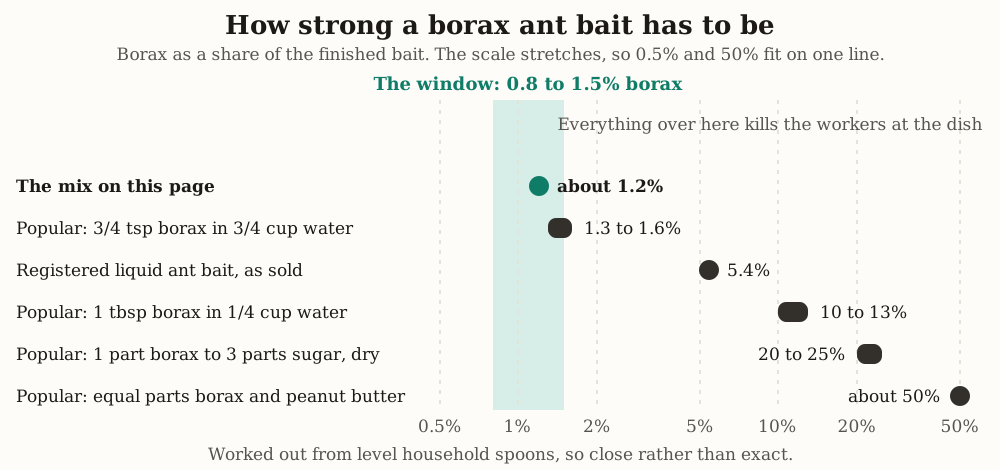
Look at where the popular recipes land. One tablespoon of borax in a quarter cup of water is 10 to 13% borax, roughly 7 to 9 times over the ceiling. Equal parts borax and peanut butter is about 50%, which is 30 to 60 times over. Both will leave a ring of dead ants and a colony that never tasted it.
The floor matters as well, and the evidence there is thinner. Half a percent boric acid cleared lab colonies over 14 days in one trial and produced no delayed kill at all in another. So treat half a percent as the floor rather than the target, because a bait below it is mostly a sugar delivery service.
Why the borax-to-sugar ratio is the wrong number
Nearly every recipe is written as a ratio: one part borax to three or four parts sugar. A ratio of two dry ingredients cannot set the strength of a liquid, because the water is most of what the ant drinks. The same one-to-three mix can come out at 6% or at 1.2% depending on how much water goes in.
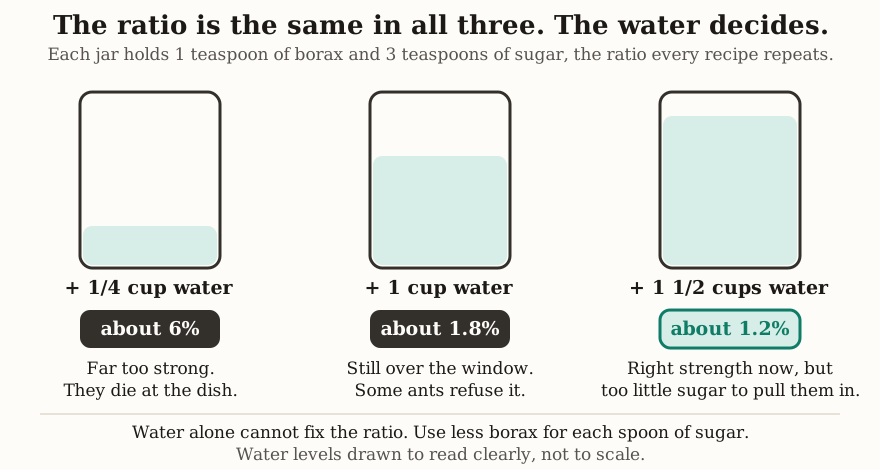
There is a catch in the fix, and it is the part nobody mentions. Thinning a one-to-three mix with enough water does bring the borax down. It waters the sugar down with it, though, and a bait with almost no sugar stops attracting anything. So the real correction is to the ratio itself: about one part borax to fifteen parts sugar, then a full cup of water.
What the popular borax recipes actually come to
3/4 tsp borax, 1/4 cup sugar, 1 cup hot water (the mix below)
- Borax in the bait
- about 1.2%
- Same as this much boric acid
- about 0.8%
- Against the 0.5 to 1% that works
- In the window
3/4 tsp borax, 1/4 cup sugar, 3/4 cup warm water
- Borax in the bait
- 1.3 to 1.6%
- Same as this much boric acid
- 0.85 to 1.05%
- Against the 0.5 to 1% that works
- At the top edge, usable
1 1/2 tbsp borax, 1/2 cup sugar, 1 1/2 cups water
- Borax in the bait
- about 4 to 5%
- Same as this much boric acid
- 2.5 to 3%
- Against the 0.5 to 1% that works
- About 3 times too strong
1 tbsp borax, 3 tbsp sugar, 1/4 cup water
- Borax in the bait
- 10 to 13%
- Same as this much boric acid
- 6.5 to 8.5%
- Against the 0.5 to 1% that works
- 7 to 9 times too strong
1 part borax to 2 or 3 parts sugar, with about 1 part water
- Borax in the bait
- 19 to 27%
- Same as this much boric acid
- 12 to 18%
- Against the 0.5 to 1% that works
- 12 to 18 times too strong
1 part borax to 3 parts sugar, sprinkled dry
- Borax in the bait
- 20 to 25% of the powder
- Same as this much boric acid
- 13 to 16%
- Against the 0.5 to 1% that works
- No set strength until water is added
Equal parts borax and peanut butter
- Borax in the bait
- about 50%
- Same as this much boric acid
- about 32%
- Against the 0.5 to 1% that works
- 30 to 60 times too strong
Registered liquid ant bait, as sold
- Borax in the bait
- 5.4%
- Same as this much boric acid
- about 3.5%
- Against the 0.5 to 1% that works
- Works as labeled, and the trade dilutes it to 1 or 2%
Those percentages come from level household spoons, so treat them as close rather than exact. The spread is the point: following two different pages gives you baits that differ by a factor of forty.
One more check on the figure. The registered liquid bait sold in stores is 5.4% borax. Its own label tells professionals to dilute it to 1 or 2% borax for a large, multi-queen infestation. That is a product label arriving at the same number the research does.
The mix
Three quarters of a level teaspoon of borax, a quarter cup of sugar and 1 cup of hot water. That comes out at about 1.2% borax and about 17% sugar, which puts it inside the window on both counts. It makes enough for a week of small stations, and it costs pennies.
The sweet bait
- 3/4 level teaspoon of borax (about 3 g), or 1/2 level teaspoon of boric acid if that is what you have.
- 1/4 cup of granulated sugar (about 50 g).
- 1 cup of hot water (about 240 ml, hot from the tap).
Stir the borax into the hot water until the liquid is clear, then stir the sugar in. Both spoon sizes land near the same dose, because borax carries less boron than boric acid, so do not use the two measures together.
For grease eaters: stir 3/4 of a level teaspoon of borax, or 1/2 a level teaspoon of boric acid, into 1 cup of peanut butter. Spread a smear of it in a closed station rather than a dollop, since the ants work the surface.
Two things to get right. Mix it in a labeled jar, never in a soda bottle or a food container. Keep it away from counters where food is prepared. Then set it out in something closed, which is the next section.
Using borax for ants, step by step
Clear the competition first, because it costs nothing
Wipe the sticky spots, seal the sugar, empty the toaster tray and lift pet bowls overnight. Bait only works when it is the best meal in the room. On a light trail this step alone sometimes ends the problem, and it costs nothing.
Work out whether your ants want sugar or grease
Put a dab of jam and a dab of peanut butter on a card by the trail, then come back in an hour. Whichever one carries a crowd tells you which bait to make. Most kitchen trails pick the sugar, but thief ants and pharaoh ants usually go for the grease.
Stir the borax into hot water first
Hot water from the tap is enough. Stir until the liquid runs clear with nothing gritty left in the bottom, because loose grains get picked out and left behind rather than eaten. Add the sugar after the borax has gone.
Soak cotton balls or fill a bottle cap
Two cotton balls in a jar lid hold the liquid without drowning anything. A bottle cap with a few drops in it works just as well. Make up only what you will use in a week, then keep the rest in a labeled jar away from food.
Put the bait inside something closed
A margarine tub with the lid on, and two small holes punched low in the side, keeps the bait reachable for ants. It also keeps it out of reach of children and pets. That one step solves most of the safety problem, so do not skip it.
Set it where the ants already walk
Put the stations next to the trail and next to the gap the line comes in through, not where the kitchen looks tidiest. A station six inches off the trail may as well be in another room. For a heavy infestation, 20 to 30 small placements beats one big dish.
Leave the trail alone and expect more ants
Numbers climb for a day or two, because a worker that finds food recruits nestmates to it. Do not wipe the trail, do not spray anything nearby, and do not clean the counter with bleach next to a station. Sprays and cleaners stop ants reaching the bait.
Keep it wet and top it up daily
Sugar water dries out, and as it dries the borax left behind gets stronger. A bait that has gone sticky or hard is finished, so tip it out and refill. The trail going quiet after a few days is normal, so check the bait rather than the floor.
Judge it at three to four weeks, then stop
Give a careful baiting program 3 to 4 weeks before calling it a failure. Pull the stations once the trail has been gone for a week. Then caulk the gap, fix the drip and store the sugar sealed, so the next colony finds nothing worth the walk.
How long does borax take to work?
Numbers go up for a day or two, then down. Expect to see fewer ants within 5 to 10 days, and allow 3 to 4 weeks of careful baiting for a colony that stays gone. The registered borax bait says complete control may take up to two weeks on its own label. Nothing honest promises overnight.
- Hours 1 to 48: more ants, often many more, as the first finder recruits the rest. This is the sign the bait was accepted.
- Days 3 to 10: the trail thins. Some of the quiet is the colony feeding its brood instead of foraging, so judge it by the trail and not by dead ants.
- Weeks 2 to 4: the trail should be gone. Keep the stations stocked through this stretch, because an empty station mid-job sends the survivors looking elsewhere.
- After week 4: if a strong trail is still working, the bait is wrong, the species is wrong, or there is more than one nest.
Most people trying borax for ants give up around day three, which is the worst possible moment. Dead ants around the bait on day one are not progress either. They are the clearest sign the mix was too strong, because a worker that dies at the dish has carried nothing home.
Can you just sprinkle borax to kill ants?
No, and that is the most common first attempt at borax for ants. Borax has to be swallowed, because it is a stomach poison rather than a contact killer. Adult ants also live on liquids and filter out solids. Worker ants cannot swallow particles bigger than 2 microns, which is finer than any powder you can pour.
A line of powder across a doorway does something smaller. Ants groom it off and some gets ingested, so a few die and the rest reroute. Nothing reaches the nest, which is the only thing worth aiming at.
Loose powder has a second cost. It sits where a crawling baby or a dog can reach it, with no container around it. A dissolved bait in a closed tub does the job properly instead. So dissolve it.
Why your borax is not killing the ants
When borax for ants fails, it is nearly always one of five things: too strong, undissolved, dried out, the wrong food type, or the right bait judged too early. A bait at 10% borax fails for the same reason a dried-out one does, since neither gets a dose past the front door. Find your symptom below.
Reading what the ants are telling you
Dead ants around the bait in the first day or two
- What it usually means
- The mix is far too strong
- What to do
- Tip it out and make it again at about 1.2% borax
They feed for weeks and the trail never shrinks
- What it usually means
- Too weak, a very large colony, or several nests
- What to do
- Remake at 1.2%, add placements, and give it 3 to 4 weeks
Powder left behind in the dish
- What it usually means
- The borax never dissolved, so it gets picked out
- What to do
- Use hot water and stir until the liquid runs clear
They walk straight past it
- What it usually means
- Wrong food type, or a better meal nearby
- What to do
- Offer a greasy bait beside the sweet one, and clear crumbs and pet bowls
It worked last year and does nothing now
- What it usually means
- A different species, or the colony has switched to protein
- What to do
- Test with jam and peanut butter, then match the bait
Far more ants than before
- What it usually means
- The bait is working
- What to do
- Leave it alone and look again on day ten
The bait has gone sticky or rock hard
- What it usually means
- The water evaporated, which also concentrated the borax
- What to do
- Replace it and keep it in a closed container
Busy for an hour, then ignored
- What it usually means
- Something nearby smells of cleaner or spray
- What to do
- Move the station, and stop spraying anywhere near it
Notice what is missing from that list. Resistance is not on it, because there is no evidence of ants becoming immune to borate. What does happen is behavioral. Boric acid makes ants stay in the nest more and forage less, so a quiet trail is sometimes the bait working rather than the bait being refused.
The ants a borax bait will not clear
Four groups are missing from the registered borax bait’s own front panel. Fire ants, pharaoh ants, carpenter ants and harvester ants are all excluded from what the product claims to kill. Add grease ants and soil-nesting field ants, which extension guides rate general baits as rarely effective against.
Which ants a borax sugar bait reaches, and which it does not
Odorous house, Argentine, pavement, little black, ghost, acrobat, crazy and big-headed ants
- Does a sweet borax bait work?
- Yes, these are the sweet feeders it is for
- What to do instead
- Bait on the trail. Tell the small kitchen ants apart first
Carpenter ants
- Does a sweet borax bait work?
- Poorly, and the label excludes them
- What to do instead
- Find the nest and the damp wood, then treat the nest
Fire ants
- Does a sweet borax bait work?
- Not as a kitchen station, and the label excludes them
- What to do instead
- Treat mounds individually with a product labeled for them
Pharaoh ants
- Does a sweet borax bait work?
- Not as a sugar bait, since they want grease and protein
- What to do instead
- Use the greasy version, never a spray, because sprays split the colony
Harvester ants
- Does a sweet borax bait work?
- No, they eat seeds
- What to do instead
- Granular bait labeled for harvester ants, or leave them be
Grease ants, also called thief ants
- Does a sweet borax bait work?
- Rarely, they take fats year-round
- What to do instead
- The greasy version, in tiny amounts, right at the crack
Field ants nesting in soil
- Does a sweet borax bait work?
- Rarely
- What to do instead
- Treat the nest outdoors rather than baiting indoors
If you are not sure which of those you have, the waist and the smell settle it faster than the size does. Our key to the two dozen ants Americans find most often sorts them by nodes, color and region.
Sweet, greasy or both
Food preference is not fixed. A colony feeding brood wants protein, and the same colony later in the year wants sugar. Black carpenter ants were recorded switching from protein in spring to sugar in the fall. That is why the card test beats guessing, and why offering both baits a few inches apart is standard advice.
Is borax safe around children and pets?
It is low in toxicity by mouth rather than harmless, and the bait is weak: 1 cup of the mix above holds roughly 3 grams of borax. The National Pesticide Information Center puts boric acid as low in toxicity if eaten or on the skin, while noting that borax can be corrosive to the eye. A closed station handles most of the risk.
The numbers are reassuring without being an all-clear. In a review of 784 boric acid swallowing cases at two poison centers, 88.3% of people had no symptoms at all and none developed severe poisoning. The usual complaints were vomiting, stomach pain and diarrhea. For dogs, the lethal oral dose is above 631 mg per kilogram of body weight, and NPIC notes dogs may be more sensitive than rats.
Signs in an animal usually start within 2 hours: drooling, vomiting and diarrhea, and the vomit or stool can look blue-green. The exposure that matters most is the repeated kind, not one lick. NPIC reports that seizures and death have been reported more often in infants exposed to boric acid over the long term than in adults. NPIC also says the data needed to compare children with adults directly are not available, so it is not clear whether children are more sensitive to boric acid specifically. Either way the answer is the same, which is to keep bait out of reach.
Three habits cover the rest. Put every station inside something closed and out of reach. Label the storage jar and keep it with the cleaning products rather than the food. Never leave loose powder on a floor. Our guide to home remedies for ants rated by evidence covers the pet-safe options that involve no pesticide at all.
Borax outdoors, in the garden and near wildlife
Keep it off the soil. Borax and boric acid can kill plants by drying them out, and too much boron in the ground is toxic to growth. A sugar-and-borax solution poured around a flower bed or a lawn does visible damage. Extension guides say plainly to be careful using boric acid outdoors for that reason.
Baiting outdoors is still a good idea, just not by watering the garden with it. Put the station on a hard surface near the entry point or the nest, under cover so rain cannot dilute it, and lift it once the job is done. That also keeps the sweet liquid away from bees, squirrels and the neighbor’s dog.
When to buy the bait instead
Shop-bought borax for ants is the same active ingredient at 5.4%, in a container made for it, with directions and a legal label. It costs a few dollars. If you have a toddler, a dog that eats everything, or no patience for measuring, that is the better buy. The trade dilutes the same product to 1 or 2% borax for big jobs.
Buy it rather than mix it when any of these is true. The infestation is large or in an apartment block. The ants are carpenter, fire, pharaoh or harvester ants. Someone in the house is a crawling baby. Or two careful rounds of homemade bait have already failed, which usually means several nests rather than a bad recipe.
Borax is also the wrong tool for several jobs people try it on. It will not clear structural carpenter ant damage, and it is no answer to a yard full of fire ant mounds. Nor does it help with a swarm of winged ants, which our page on what a flying ant swarm means covers. Whatever you use, read the label and follow it, because on a registered product the label is the legal instruction.
Mistake 1
Mistake: More borax works faster.
Reality: It works less. Above 1% ants eat less of the bait, and a strong mix kills the carrier before it reaches the nest. Raising the dose when nothing is happening is the single most common mistake with borax for ants.
Mistake 2
Mistake: Borax is just a natural mineral, so it is safe around the house.
Reality: It is a pesticide the moment you use it as one. Low toxicity by mouth is not the same as harmless, and borax can be corrosive to the eye. Closed station, out of reach, labeled jar.
Mistake 3
Mistake: Borax and boric acid are the same thing.
Reality: They are different compounds. Borax carries 11.34% boron against 17.48% in boric acid, so a spoon of borax is about two thirds the dose. Never swap them spoon for spoon.
Mistake 4
Mistake: Equal parts borax and peanut butter is the recipe for protein ants.
Reality: That mix is about 50% borax, which is 30 to 60 times too strong. Three quarters of a teaspoon in a whole cup of peanut butter is the right order of magnitude.
Mistake 5
Mistake: Dead ants by the bait means it is working.
Reality: It means the opposite. Bodies at the dish show the dose killed the delivery driver. A working bait looks like a busy trail on day two and an empty floor on day ten.
Mistake 6
Mistake: The ants have built up resistance to it.
Reality: No evidence supports that for borate. What is documented is bait avoidance at high strengths, and reduced foraging after a dose, both of which look like resistance and are fixed differently.
Mistake 7
Mistake: Spraying the stragglers while the bait is out speeds things up.
Reality: Sprays and cleaners near a station keep ants off the bait, so the two cancel out. Pick one method, and indoors it should be the bait.
Pest control disclaimer. Photo-based identification can help, but it is not always perfect. For dangerous spiders, large infestations, or anything you are unsure about, contact a licensed pest control professional.
Frequently asked questions
How long does it take for borax to kill ants?
Can I use a borax product that says 2.5 percent on the box?
What should you never mix with borax?
Will old borax still kill ants?
Can I put a borax bait outside?
Does borax kill the queen?
Related guides
How to get rid of ants
The whole job in order: why the spray failed, which bait to pick, and how to close the gaps afterwards.
Natural ant repellent
Twenty home remedies rated by what they really do, from vinegar and peppermint oil to diatomaceous earth.
Sugar ants
The tiny ants on the counter are one of six or seven kinds. Tell them apart, then bait the right way.
How to get rid of carpenter ants
Big black ants in damp wood need nests found first and bait second. Baits alone rarely finish them.
Types of ants
Sort any US ant by size, color, waist nodes, smell and region, and see which ones sting.
Fire ants
Mounds with no hole on top and stings in numbers: how to confirm fire ants and what to do about a yard.
Harvester ants
Big red ants and a bare circle in a western yard: seed eaters that ignore a sugar bait entirely.
Queen ant
What a big ant walking in the open means, and why killing one queen rarely ends a colony.
Sources
- National Pesticide Information Center, Boric Acid General Fact Sheet (toxicity by mouth and skin, the eye hazard, infants, plants)
- National Pesticide Information Center, Boric Acid Technical Fact Sheet (boron content of borax and boric acid, dog doses, how fast signs appear)
- EPA, Introduction to Pesticide Labels (the label is the law, and what a registration is)
- EPA, What is a Pesticide? (intended use defines a pesticide, and registration comes before sale)
- EPA pesticide product label, Terro Ant Killer II, EPA Reg. No. 149-8 (5.40% borax, the excluded ants, up to two weeks, the 1% and 2% trade dilutions)
- UC IPM, Pest Notes: Ants, Publication 7411 (0.5 to 1% borate baits, 5.4% stations, 5 to 10 days, no sprays near bait)
- Texas A&M AgriLife Extension, Managing Household Ant Pests, B-6183 (the 1% bait ratio, 20 to 30 stations, 3 to 4 weeks, keep baits from children and pets)