Can cockroaches fly?
Yes, but only some of them. Out of roughly 69 cockroach species in the United States, fewer than ten fly well. Most either glide down from a height, manage a clumsy drop of a few feet, or stay on the ground for life. A flying cockroach is an ordinary cockroach doing something that most of its relatives cannot.
People call three different things flying, and separating them answers most of the question. Real flight means the wings beating, the insect holding or gaining height, and some control over the route. A glide is a one-way slope downwards from a wall, a shelf or a tree. It has no climb and very little steering. The third thing is simply a startled drop of about two feet, which looks dramatic in a dark room.
There is no such insect as a flying roach, in the sense of a separate species. The phrase describes what one did, not what it is. Every roach that has ever flown at anyone has a proper name. The table in the next section gives it.
Do all cockroaches fly?
No, and the ones people meet indoors are the poorest fliers of the lot. The small tan roach that breeds in kitchens carries full wings that reach the tip of its body. It still runs instead of flying. The shiny black one in basements and drains cannot fly in either sex, because the male has short wings and the female barely has wings at all.
Is it rare to see a flying cockroach?
That depends entirely on where you live. In Florida, along the Gulf and through the coastal Southeast, a flying cockroach is a normal summer event. Most people there have a story about one. Further north it is unusual. A tan roach at a lit window in late spring is almost always a male wood roach from the trees outside, not something living in the walls.
Which cockroaches fly, which only glide, and which cannot
Six kinds of cockroach in the United States genuinely fly. They are the Asian, the smokybrown, the Cuban, and the males of the wood roach, the brown-banded and the Turkestan. Three more glide or manage a short flight, including the 1 1/2 to 2 inch (38 to 51 mm) American cockroach. Four cannot fly at all, and neither can any nymph.
Table 1. Every common US cockroach, by what it can actually do in the air
Asian cockroach
- Flight
- Flies well, both sexes
- Adult size
- 5/8 in (15 mm)
- Comes to lights?
- Yes, strongly
- Where you meet it
- Grass, leaf litter and mulch across the Southeast; indoors at dusk
Smokybrown
- Flight
- Flies, best on warm humid nights
- Adult size
- 1 to 1 1/2 in (25 to 36 mm)
- Comes to lights?
- Yes
- Where you meet it
- Attics, soffits, woodpiles and tree holes through the South
Cuban, the green one
- Flight
- Flies well
- Adult size
- 7/8 to 1 in (22 to 24 mm)
- Comes to lights?
- Yes
- Where you meet it
- Peninsular Florida and the Louisiana and Texas coasts
Wood roach
- Flight
- Males fly, females cannot
- Adult size
- Males to 1 in (25 mm)
- Comes to lights?
- Yes, males at lit windows
- Where you meet it
- Woods and firewood; late spring in the North and Midwest
Brown-banded
- Flight
- Males fly when disturbed, mostly above 85°F; females cannot
- Adult size
- 1/2 to 5/8 in (13 to 16 mm)
- Comes to lights?
- Not especially
- Where you meet it
- High on walls and in bedrooms, indoors all year
Turkestan
- Flight
- Males fly, females cannot
- Adult size
- Males 1/2 to 7/8 in (13 to 22 mm)
- Comes to lights?
- Yes, both sexes
- Where you meet it
- California, the Southwest, and east as far as Texas
American cockroach
- Flight
- Glides down from a height, flies on hot nights
- Adult size
- 1 1/2 to 2 in (38 to 51 mm)
- Comes to lights?
- Not a light seeker
- Where you meet it
- Sewers, drains and crawl spaces across the South
Australian
- Flight
- Gliding flight only
- Adult size
- 1 1/4 to 1 1/2 in (31 to 37 mm)
- Comes to lights?
- Not especially
- Where you meet it
- The commonest outdoor roach in southern Florida
Brown cockroach
- Flight
- Winged, but no flight is on record
- Adult size
- 1 1/4 to 1 3/8 in (31 to 40 mm)
- Comes to lights?
- Not recorded
- Where you meet it
- Crawl spaces, palms and ground cover in the Gulf states
German cockroach
- Flight
- A short glide at most
- Adult size
- 1/2 to 5/8 in (13 to 16 mm)
- Comes to lights?
- Not a light seeker
- Where you meet it
- Kitchens and bathrooms, indoors all year
Oriental cockroach
- Flight
- Neither sex flies
- Adult size
- About 1 in (25 mm), both sexes
- Comes to lights?
- No
- Where you meet it
- Basements, drains and cool damp ground floors
Florida woods roach
- Flight
- No flight wings at all
- Adult size
- 1 1/4 to 1 1/2 in (30 to 40 mm)
- Comes to lights?
- No
- Where you meet it
- Firewood, leaf litter and palms in Florida
Any nymph, any species
- Flight
- Never flies, at any stage
- Adult size
- From about 1/16 in upwards
- Comes to lights?
- No
- Where you meet it
- Wherever the adults of that species live
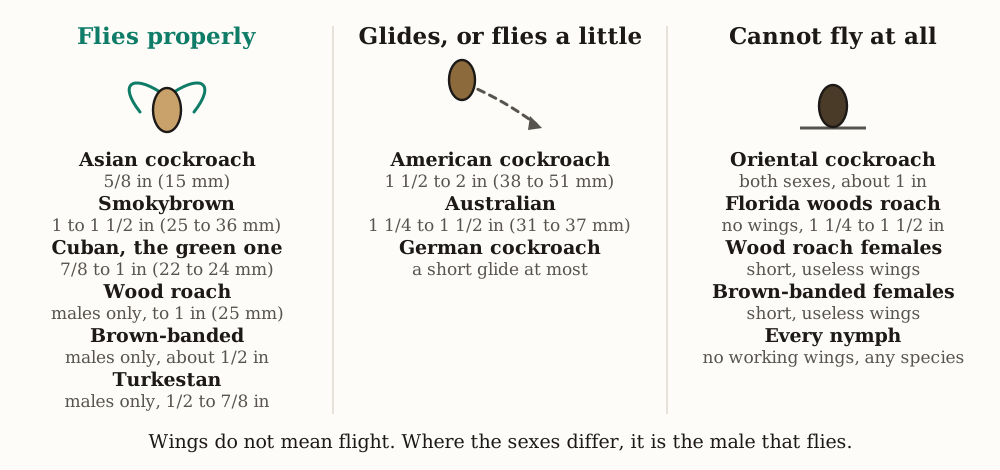
One pattern runs through the whole table, and it is worth holding on to. Where the two sexes differ, the male is the flier. Brown-banded, wood roach and Turkestan males all fly, and their females cannot. That is the opposite of what people usually guess.
The Australian cockroach is the row most pest sites get wrong. Several call it a strong flier. The University of Florida description is more careful. It says the adults have fully developed, working wings, capable of gliding flight, which is not the same claim.
What kind of roach flew at you?
Four facts settle almost every case. How big was it, what colour, where were you standing, and did it really fly or just slide downhill? A dark flying cockroach over 1 inch (25 mm) in the South is one of four species. A tan one around 5/8 inch (15 mm) that flew to a light is a single species, and not the one people fear.
Table 2. What you saw, and what it was
Big, reddish brown, slid downwards from a ceiling or a shelf, in the South
- Most likely
- American cockroach
- What settles it
- A pale ring or figure of eight on the shield behind the head
Big, dark brown to nearly black, flew properly, came from an attic, a woodpile or a porch light
- Most likely
- Smokybrown cockroach
- What settles it
- A plain dark shield with no pale markings, and wings covering the whole body
Big and dark, with a yellow stripe along the front edge of each wing, in Florida
- Most likely
- Australian cockroach
- What settles it
- Yellow wing stripes, plus a yellow border on the shield
Small and tan with two dark stripes, flew to a porch light or a lit screen
- Most likely
- Asian cockroach
- What settles it
- It flew. A German cockroach of the same size runs instead
Up to an inch, tan brown, at a lit window in late spring in the North
- Most likely
- A male wood roach
- What settles it
- They arrive one or two at a time for a few weeks, then stop
Pale green, about an inch, at a light on the Gulf Coast
- Most likely
- Cuban cockroach
- What settles it
- Nothing else in a US house is that green
About half an inch, two pale bands across the wings, took off when disturbed high on a wall
- Most likely
- A male brown-banded cockroach
- What settles it
- The bands run across the wings, not lengthwise down the shield
It did not fly. It ran, and it was shiny and nearly black
- Most likely
- Oriental cockroach
- What settles it
- Neither sex has working wings, and it cannot climb smooth surfaces
Huge, dark, slow, did not fly even when cornered, in Florida
- Most likely
- Florida woods cockroach
- What settles it
- No flight wings, and a foul smell when it is threatened
If the insect is still available and you are unsure, you can upload a photo and let the identifier look. A clear top-down shot of the shield behind the head and the wing tips decides most of these.
Asian cockroach or German cockroach?
This is the single most common mix-up, and it has a clean answer: the German cockroach does not fly. Both insects run about 5/8 inch (15 to 16 mm). Both are tan, and both carry two dark stripes on the shield behind the head. Under a hand lens the Asian one has longer, narrower wings, and the tips reach past the end of the body.
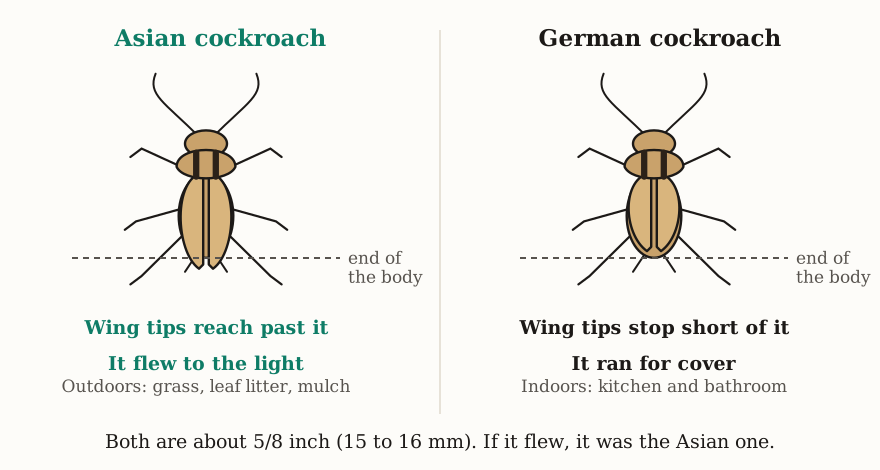
Table 3. Telling an Asian cockroach from a German cockroach
Flight
- Asian cockroach
- Flies well, and flies towards lights
- German cockroach
- Runs. A short glide at most
Wing tips
- Asian cockroach
- Reach past the end of the body
- German cockroach
- Stop level with it, or just short
Where it lives
- Asian cockroach
- Outdoors in grass, leaf litter and mulch
- German cockroach
- Indoors, in kitchens and bathrooms
When you see it
- Asian cockroach
- At dusk, on lit walls, screens and televisions
- German cockroach
- At night, scattering the moment a light comes on
Does it breed indoors?
- Asian cockroach
- No. Survival indoors is poor
- German cockroach
- Yes, all year, and very fast
Nymphs
- Asian cockroach
- White margins along the edges of the abdomen
- German cockroach
- Dark, with a pale gap between two dark bands
The difference matters for what you do next. An Asian cockroach came in from the yard, and it will not build a population inside, so indoor treatment achieves little. A German cockroach indoors is a different problem, and it needs a proper plan for clearing them out.
Do cockroaches have wings?
Adults of most species have two pairs, and the pairs do different jobs. The outer pair, the tegmina, are tough leathery covers that lie flat along the back and protect everything underneath. The thin, folded hind wings beneath them are the ones that actually fly. Nymphs have neither, at any stage.
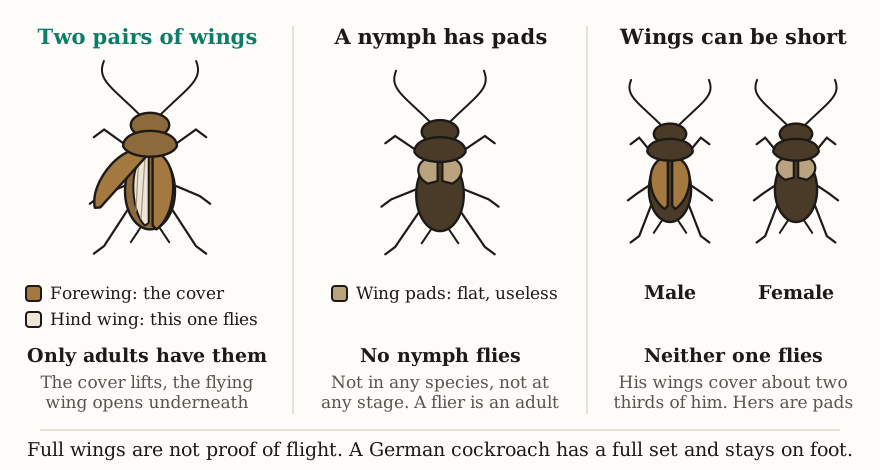
Because the covers are what you see, wings tell you far less than people assume. A German cockroach has a full set and never uses them. An oriental cockroach male has wings that stop two thirds to three quarters of the way down his body, and the female carries rudimentary pads. Neither one leaves the ground.
Wing length is still a useful measurement, as long as you compare it with the body. On a male American cockroach the wing tips extend several millimetres past the end of the abdomen. On a German cockroach they stop level with it. That one comparison separates several species that otherwise look alike.
Do baby cockroaches fly?
Never. Young cockroaches hatch with no wings at all. From about the third or fourth moult they grow flat wing pads, and those pads stay sealed shut until the final moult into an adult. So anything that flew was an adult, however small it looked. To be sure what the small ones in the kitchen are, read how to tell a nymph from a small adult.
Why do cockroaches fly toward you?
Because of light, physics and panic, in that order, and not because of you. No research shows a cockroach aiming at a person. Three ordinary mechanisms explain almost every story about one coming at a face. Two of them have nothing to do with the person at all.
The light is usually behind you. The species that fly indoors steer towards lit surfaces. Asian cockroaches become active at dusk and move towards light reflected off pale walls, doorways and windows. Once inside they settle on lamp shades, screens and televisions, and they follow the light from room to room. Texas A&M puts it plainly: many residents think the insects are attacking them.
A startled roach leaves in a direction you cannot predict. That is deliberate, and researchers have measured it. A 2008 study in Current Biology found that cockroaches escape along one of several preferred routes, each set at a fixed angle to the threat. The pattern keeps a predator guessing. That work timed running escapes rather than flight, so it explains why the direction feels random, not where a flier is heading.
A glider cannot steer much. The big species launch from high up and come down on a long slope. Anything between the launch point and the floor sits in the path, and in a small room that is often a person. Add darkness and a fast insect, and a two-second descent feels personal.
Are roaches attracted to light?
Some are and some run from it, which is why the question gets contradictory answers. The light seekers are the Asian cockroach, the smokybrown, male wood roaches, the Cuban cockroach, and both sexes of the Turkestan. German and American cockroaches ignore lamps, and both scatter for cover when a kitchen light comes on.
Light still matters even for the species that avoid it. A line of light leaking under a door at night draws cockroaches to that spot, and it marks the gap they then walk through. So a porch light over an unsealed door creates the attraction and the entry point together.
When and where cockroaches fly
Flight needs warmth. A flying cockroach is a hot, humid night event, roughly from May to October. Smokybrown cockroaches fly best on warm humid evenings. American cockroaches fly at higher temperatures and only glide at lower ones. They stay active around 70°F (21°C), and freezing conditions kill them.
Geography matters more than the thermometer. Coby Schal, an entomologist at North Carolina State University, told the Christian Science Monitor in 2016: “I live in North Carolina, and the cockroaches here do not fly. But in Charleston, not very far away, you can go out at night and see the American cockroach fly.” Flight muscles cost an insect a great deal to build and keep. A population that has no use for them stops paying.
Rain brings a second wave. Heavy storms flood sewers, drains, tree holes and mulch beds, so the insects living there move up and out. The nearest dry shelter is often a house. That is why sightings spike the night after a downpour rather than during a dry heatwave.
In the South, all of this arrives under one borrowed name. Four big outdoor species answer to palmetto bug: the American, Australian, brown and smokybrown. In Florida the wingless Florida woods cockroach collects the name too. Why that name covers four different roaches explains which one your state usually means.
Is a flying cockroach dangerous?
Not in the way people fear. A flying cockroach has no sting, no venom and no interest in biting, and it cannot hurt you in the air. Two indirect risks do matter, and research backs both. One is the allergens these insects shed. Another is the organisms they carry from drains and bins onto surfaces.
On germs, be clear about the strength of the evidence. Cockroaches pick up organisms such as Salmonella on their legs and bodies, then leave them on surfaces. Laboratory and farm studies show this clearly. Nobody has traced a case of illness in a home back to a cockroach, so treat it as a good reason to wipe a worktop rather than a reason to panic.
As for bites, they are real and very rare. Cockroaches almost never bite, and they do not sting. Our guide to whether a cockroach can actually bite works through the handful of recorded cases, and through what those marks usually turn out to be.
Does a flying cockroach mean you have an infestation?
Usually not. The large species that fly live outdoors, and extension entomologists are blunt about what happens next. Outdoor cockroaches do not survive well indoors, people often overreact, and removing the insect is often the only control a home needs. So one big flying cockroach on a summer night is a visitor, not a population.
The species that breed indoors in numbers are the German and the brown-banded cockroach. Neither one flew at your head, because German cockroaches do not fly and brown-banded females cannot either. That is the quiet reassurance buried in the identification: the flier and the breeder are different insects.
Five findings would change the answer:
- Several sightings a week, especially indoors and in different rooms.
- Small tan roaches in the kitchen with two dark stripes, which points to a German cockroach population rather than a visitor.
- Roaches of several different sizes in one spot, which means something is breeding there.
- Droppings that look like coarse black pepper inside cabinets or behind appliances.
- Any roach out in daylight, which usually means the hiding place has run out of room.
If two or more of those are true, the problem is a resident population and not a flier. Start with the full plan for clearing a cockroach problem. Call a licensed professional if numbers keep climbing after a month of work, or if you rent and the building has shared walls and pipe runs.
What to do about a flying roach in the room
Deal with the insect first, then the gap, then the light, and spend nothing on the first two. One flying cockroach needs a glass and a piece of card, not a spray. The whole job takes about twenty minutes. Most of that is checking the 3 mm gaps around doors and vents afterwards.
Six steps, in order, starting with the ones that cost nothing
Turn on the light next door, then turn this one off
A roach that came in for light will go to the next lit surface it can find. Open the door to the hall, switch that light on, and switch this room off. It costs nothing, it takes ten seconds, and it moves the insect without anyone touching it.
Trap it under a glass, not a shoe
Wait for it to land, put a tumbler over it, then slide a sheet of card underneath. Squashing a large roach on a worktop spreads gut contents over a food surface. That is the one way a harmless visitor turns into a cleaning job.
Or use the vacuum hose
If you would rather not get close, a vacuum hose picks one off a wall or a ceiling in a second. Empty the canister or bag into an outside bin straight away. A big roach can walk back out of a vacuum left in a cupboard overnight.
Put it outside, and wash the surface it landed on
Carry it well away from the door before you release it. Then wipe any worktop it crossed with ordinary detergent and warm water. No special product helps here, and none works better.
Work out how it got in, while you still remember where it came from
Check the gap under the nearest door, the window screen, the soffit or attic vent, and the point where the air conditioning pipes enter the wall. An adult American cockroach fits through a gap 3 mm wide. That is the height of two pennies stacked.
Change the light before you change anything else
Switch the porch light off at night through the warm months, or change the bulb to a yellow bug light or a warm LED. Where you can, move the fixture off the doorway and onto a pole. Then the light that draws them is not sitting over your entrance.
Keeping flying roaches out
Exclusion does more than any product. These species arrive from the yard every night, so the only question is whether they can get in. Work outwards from the wall.
- Seal gaps with caulk around pipe entries, the air conditioning line set, the condensate drain, cable runs and soffit joints. An adult American cockroach fits through 3 mm, the height of two pennies.
- Fit door sweeps and weatherstripping. If light shows under a door at night, so does the gap, and that is exactly where they walk in.
- Repair window screens and put mesh over attic, soffit and dryer vents.
- Keep mulch under 2 inches thick and pull it back from the foundation. Deep damp mulch is prime habitat for the Asian and smokybrown cockroaches.
- Move the woodpile away from the house and keep it off the ground. Firewood carries wood roaches and Florida woods cockroaches straight indoors.
- Trim plants so they do not touch the walls, and clear leaves out of gutters and tree holes.
- Change the outdoor lighting to yellow bug lights or warm LEDs, and move fixtures off the doorway where you can.
If exclusion and basic cleaning do the job, you do not need an insecticide at all. Where the numbers justify one, use only an EPA-registered product and follow the label, because the label is the law. For the large outdoor species, indoor sprays achieve very little anyway. Only a few individuals ever come inside, so the treatment never meets the population. For the full set of options, baits included, see our cockroach control guide.
Flying bugs people mistake for cockroaches
People report several large night fliers as a flying cockroach, and most of them do a house no harm. The fastest check is the shape of the back. A cockroach looks flat, with a shield over the head and long sweeping antennae. A beetle has a domed hard back and short antennae.
Table 4. Other things that fly at you in the dark
Flat and oval, with front legs folded like pincers, and it swims
- What it probably is
- A true giant water bug
- Size
- 2 to 4 in (50 to 100 mm)
- Where you see it
- Ponds and pools, and lit car parks in summer
- Read next
- What people mean by a water bug
A domed hard back, short clubbed antennae, and it keeps crashing into the screen
- What it probably is
- A June beetle or another scarab
- Size
- 3/4 to 1 in (19 to 25 mm)
- Where you see it
- Lawns and lit windows in early summer
Four wings the same size, roughly twice the body length, and a straight waist
- What it probably is
- A termite swarmer
- Size
- About 3/8 in (10 mm) with wings
- Where you see it
- Indoors in spring, usually at a window
- Read next
- Winged termites up close
A pinched waist, bent antennae, and two pairs of wings of different sizes
- What it probably is
- A flying ant
- Size
- 1/4 to 3/4 in (6 to 19 mm)
- Where you see it
- Swarming on a warm, still afternoon
- Read next
- Flying ants and their swarms
Powdery wings held like a tent, no flat shield, and it blunders at the lamp
- What it probably is
- A moth
- Size
- Varies widely
- Where you see it
- Any lit window at night
- Read next
- No action needed
One confusion works the other way round. People often take small Asian cockroaches for little moths when raking mulch puts them up in daylight. They fly in short erratic hops instead of running for cover, which is not what anyone expects a roach to do.
Flying cockroach myths
Seven claims about the flying cockroach come up again and again, on forums and on pest control sites. Here is what the evidence actually supports.
Myth 1
Myth: “Baby cockroaches fly too.”
Truth: No nymph of any species flies. Young cockroaches have flat wing pads instead of wings, and the pads do not open. So a small roach that flew was a small adult. In the Southeast it was most likely an Asian cockroach at about 5/8 inch.
Myth 2
Myth: “The females fly and the males cannot.”
Truth: It is the other way round. Two groups differ by sex: brown-banded cockroaches and wood roaches. In both, the male flies and the female has short wings that do not work. The Turkestan cockroach follows the same pattern.
Myth 3
Myth: “All cockroaches can fly.”
Truth: Oriental cockroaches cannot fly at all, in either sex. The Florida woods cockroach has no flight wings to begin with. German cockroaches carry a full set of wings and still stay on foot.
Myth 4
Myth: “A flying roach is a different kind of insect from a cockroach.”
Truth: Same insect. Flying roach is a description of what one did, not a species. The thing that flew at you has a proper name, and the table above tells you which one it was.
Myth 5
Myth: “It flew at me, so it was attacking.”
Truth: No research shows a cockroach aiming at a person. A startled one leaves fast in a direction you cannot predict. Gliders have very little steering. The light-seeking species are heading for the lamp or the lit screen behind you.
Myth 6
Myth: “Big roaches start flying once it gets above 85°F.”
Truth: Pest sites repeat that figure everywhere, and no study supports it for the large species. UC IPM gives 85°F for brown-banded males only. LSU says American cockroaches fly at higher temperatures and sets no number. Hot and humid is the honest answer.
Myth 7
Myth: “A flying cockroach in the house means an infestation.”
Truth: Usually it means one outdoor roach found a gap. The species that breed indoors in numbers are the German and brown-banded cockroaches, and the German one does not fly. Several sightings a week, or small roaches in the kitchen, is the signal worth acting on.
Pest control disclaimer. Photo-based identification can help, but it is not always perfect. For dangerous spiders, large infestations, or anything you are unsure about, contact a licensed pest control professional.
Frequently asked questions
Do cockroaches jump?
Can a cockroach fly out of an air conditioning vent?
Why do flying roaches turn up at a window three or four floors up?
Why do I see flying roaches after heavy rain?
Do cockroaches fly during the day?
Can dubia roaches fly?
Related guides
American cockroach
The big reddish one that glides down from a height. Two inches long, and almost always an outdoor roach that got in.
Palmetto bug
Not a species. The Southern name for four large roaches, and which one it means depends on your state.
German cockroach
Full wings, no flight, and the only common house roach that really breeds indoors.
Oriental cockroach
The shiny near-black one in basements and drains. Neither sex can fly or climb glass.
Water bug
Indoors it is almost always a cockroach. In a pond it is a true water bug that flies well and bites.
How to get rid of roaches
The full control plan, from finding the harborage to choosing a bait.
Do cockroaches bite?
Rare, but real. What the recorded cases actually involved, and what those marks usually are.
Baby cockroach
Wingless, fast and often mistaken for a different insect. How to tell a nymph from a small adult.
Bug identifier by picture
Upload a photo and get an identification in seconds.
Sources
- UC IPM, Cockroaches (Pest Notes 7467)
- LSU AgCenter, Peridomestic Cockroaches Part 1 (Pub. 3877-A)
- UF/IFAS, Cockroaches and Their Management (ENY-214)
- UF/IFAS, Australian cockroach (EENY-623)
- Texas A&M Urban Entomology, Asian cockroach
- Penn State Extension, Wood Cockroaches
- Christian Science Monitor (2016), Why are cockroaches taking to the skies in New York?