What do cockroach eggs look like?
Cockroach eggs look like one small brown purse, not like eggs. The female packs them into a hard case 5 to 13 mm (3/16 to 1/2 inch) long. A ridged seam runs along one edge of it. Colors go from tan to dark brown or black. Expect 16 to 40 eggs inside, and the count depends on the species.
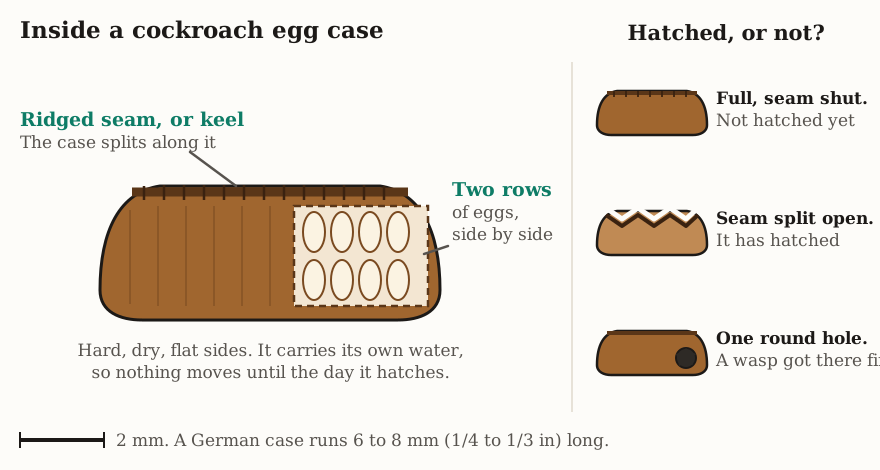
That ridged seam is the whole test. Run a fingernail along the top edge of what you found. A roach case has a raised, finely toothed keel there, and the sides are flat rather than rounded. Nothing else that turns up in a kitchen drawer has one.
The case itself is hard, dry and sealed shut. It carries enough water for the eggs to develop alone, so it does not depend on the surface underneath. Crush a fresh one and you get a cream or yellow paste. That is exactly how people describe squashing one.
For scale, a German case is about as long as a grain of rice. The smallest you will meet is a brown-banded case at 5 mm (3/16 inch), nearer a sesame seed. The largest indoors is a smokybrown case at 10 to 13 mm (3/8 to 1/2 inch). So size alone narrows the species down before you look at anything else.
Is it a roach egg case? Seven checks
Check each clue below to narrow down what you saw.
A raised, finely toothed ridge along one edge
This is the one feature that settles it. Run a fingernail along the top edge. Nothing else in a kitchen drawer has a keel like it.
Purse or bean shaped, with flat sides
Roughly twice as long as it is tall, with squared-off sides. A capsule that is round in cross-section is a fly pupa.
Between 5 and 13 mm long, so 3/16 to 1/2 inch
A grain of rice is about right for most of them. Anything over an inch did not come from a cockroach.
Hard, dry and shut
It keeps its shape under a fingertip. Something that smudges or crumbles is a dropping.
Tan, brown or black
On the large species a fresh case goes black in a day or two. German cases stay tan.
One capsule, not a pile
Droppings come in numbers. A female leaves one case at a time, though brown-banded roaches glue several together.
Nothing on it moves
No legs, no head, no silk and no web. A soft or stringy sac did not come from a cockroach.
Egg case, egg sack, ootheca: three names, one object
Plenty of people call it an egg sack or a pod. Entomologists call it an ootheca, which is just Greek for egg case. All three words mean the same thing: one capsule holding two rows of eggs side by side. There is no soft sac and no webbing, so anything stringy or fluffy came from something other than a cockroach.
Fresh, old, or already hatched
A full case is smooth and shut along the seam, and it feels solid for its size. A hatched one splits wide open along that same ridge. It stays hollow and papery, and it often keeps both halves hinged together. So an empty case tells you the cockroach eggs have already hatched and the nymphs are loose in the room.
One more pattern is worth knowing, because it looks alarming and is really good news. A single small round hole in the side, with ragged edges, is not a hatch. A parasitic ensign wasp cut its way out of that case. Its larva had eaten every egg before it left, so no roaches came out at all.
Color is a weaker clue than people expect. An American case starts brown and turns black within a day or two, so jet black means it has sat there a while. German cases stay tan their whole lives, and dust and light fade an old one.
Cockroach egg cases by species
The case names the roach. A tan 6 to 8 mm purse the female carries around is German. Near black and about 8 mm, glued close to food, means American. Oriental cases run dark red-brown at 8 to 10 mm. The tiny 5 mm one glued under a drawer is brown-banded.
Which roach left it, and what happens next
6 to 8 mm (1/4 to 1/3 in), tan to light brown, purse-shaped
- Which roach
- German
- Eggs inside
- 30 to 40
- What she does with it
- Carries it until 1 to 2 days before hatching, and nymphs often emerge while she still has it
- Hatches after
- About 28 to 30 days
About 8 mm (1/3 in), brown turning black in a day or two
- Which roach
- American
- Eggs inside
- About 16
- What she does with it
- Carries it a few hours to about 6 days, then glues it near food, sometimes under paint or plaster
- Hatches after
- 42 to 56 days, so 6 to 8 weeks
8 to 10 mm (about 3/8 in), dark red-brown
- Which roach
- Oriental
- Eggs inside
- About 16, of which about 14 hatch
- What she does with it
- Carries it 12 hours to 5 days, then drops it in debris or near food
- Hatches after
- 42 to 81 days
5 mm (3/16 in), yellowish to reddish brown, the smallest
- Which roach
- Brown-banded
- Eggs inside
- Up to 18
- What she does with it
- Carries it 24 to 36 hours, then glues it under furniture, in closets, even high on a wall, often in clusters
- Hatches after
- About 70 days
10 to 13 mm (3/8 to 1/2 in), dark brown to black
- Which roach
- Smokybrown
- Eggs inside
- 12 to 24, or 40 to 45: sources disagree
- What she does with it
- Carries it about a day, then drops it
- Hatches after
- 24 to 70 days
13 to 16 mm (1/2 to 5/8 in), with 18 to 24 saw-like teeth along the top ridge
- Which roach
- Florida woods
- Eggs inside
- Not reported
- What she does with it
- Glues it in a log or a sheltered spot outdoors, and drops it early if startled
- Hatches after
- About 48 days in warm weather
Two numbers in that table are not settled, and we would rather show you the argument than pick a side. For the smokybrown case, UC IPM reports 40 to 45 nymphs. Mississippi State puts every large roach case at 12 to 24 eggs. Nobody has reconciled the two, so assume the higher figure when you decide how hard to treat.
In Florida and along the Gulf a much larger case turns up in garages, sheds and woodpiles. The Florida woods cockroach makes one 13 to 16 mm long, with saw-like teeth along the ridge. That roach lives outdoors and does not breed well inside a house. So its case is a different problem from a German case in a kitchen, and it needs a lot less panic.
Each of the three common indoor species has its own guide, with the adult, the young and the other signs. Start with the small striped kitchen roach, the big reddish one that flies, or the near black basement roach. If what hatched is already running around, baby cockroaches covers telling the nymphs apart.
Is it a roach egg, or something else?
Most things photographed as cockroach eggs are not. The usual real answers are fly pupae, mouse droppings, drywood termite pellets, roach droppings and hibernating ladybugs. Only a roach case carries a ridged seam along one edge, with flat sides. Nothing else in that size range has the ridge.
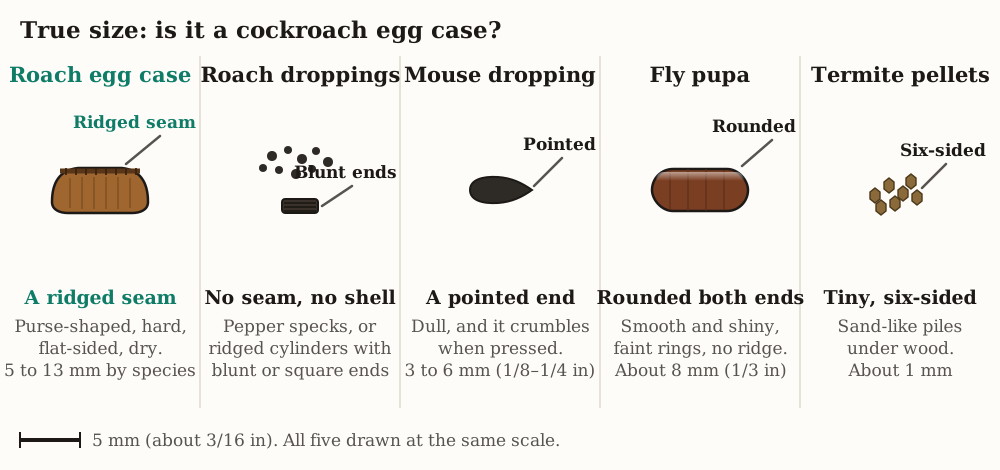
The separating feature, and what each find means
A ridged seam along one edge, flat sides, hard and shut
- What it is
- Cockroach egg case
- Size
- 5–13 mm (3/16–1/2 in)
- What it means
- A female bred in that spot
Smooth and shiny, rounded at both ends, faint rings, no ridge
- What it is
- Fly pupa
- Size
- About 8 mm (1/3 in)
- What it means
- Maggots fed on something within a few feet
At least one pointed end, dull, crumbles when pressed
- What it is
- Mouse dropping
- Size
- 3–6 mm (1/8–1/4 in)
- What it means
- Mice. Do not sweep or vacuum these
Specks like coarse ground pepper, with dark smears, no shell
- What it is
- Small roach droppings
- Size
- Far smaller than any case
- What it means
- Roaches feed and rest right there
Short cylinders with lengthwise ridges and blunt or square ends
- What it is
- Large roach droppings
- Size
- Shorter than a mouse dropping
- What it means
- American, oriental or smokybrown roaches
Six-sided grains in small sand-like piles under wood
- What it is
- Drywood termite pellets
- Size
- About 1 mm
- What it means
- Termites in the wood above
Round, domed, legs tucked underneath, and it moves
- What it is
- Hibernating ladybug
- Size
- 5–7 mm
- What it means
- Harmless beetles sheltering at a window frame
Hairy or bristly, hollow and papery
- What it is
- Carpet beetle shed skin
- Size
- The size of the larva
- What it means
- Carpet beetle larvae in fabric, wool or lint
Foamy, hardened, tan, stuck on a twig or fence outdoors
- What it is
- Praying mantis egg case
- Size
- 25–40 mm (1–1 1/2 in)
- What it means
- A useful predator. Leave it alone
Flat teardrop, pale, crushes to a paste, no ridge
- What it is
- A seed
- Size
- About 3 mm
- What it means
- Nothing at all
Fly pupae cause more trouble than everything else on that list. They turn up in the same rooms and in the same numbers, so our guide to the brown capsules maggots turn into walks through the differences. If your grains are tiny, six-sided and piled under a door frame, read what termite droppings look like instead. Clusters at a window in fall are usually ladybugs settling in for winter. Hollow, bristly shells in a closet point to carpet beetle larvae.
Roach eggs or roach poop?
One is a shell and the other is waste. A roach egg case is a single hard capsule with a ridged seam, and it holds its shape when you press it. Droppings arrive in numbers, with no shell and no seam. They smudge or crumble under a fingertip.
German cockroaches leave specks like coarse ground pepper, usually with dark smears nearby. The large species leave short cylinders with lengthwise ridges and blunt or square ends, shorter than a mouse dropping. Either way you find many of them, piled where the roaches rest.
The two signs also mean slightly different things. A case means a female bred in that exact spot. Droppings mean roaches feed and shelter there, and droppings stay put for months, so old ones prove nothing is alive now. Our guide to roach droppings and how to clean them safely covers that side, because the clean-up is a different job.
Where roaches lay eggs
A female leaves the case where she lives: warm, dark, tight and close to water. In practice that means the kitchen and the bathroom. Look inside appliance housings, under sinks, in cabinet corners and along the backs of drawers. Brown-banded roaches break the pattern and glue cockroach eggs high up, in dry rooms.
- Behind and under the fridge, around the warm motor and the drip tray.
- Inside dishwasher, washing machine and microwave housings, warm and humid at once.
- Under the sink, around the trap and the pipe entry.
- Cabinet corners and hinges, and the undersides and backs of drawers.
- Along baseboards and behind loose trim or a lifted edge of countertop.
- Cardboard boxes, paper bags and stacked magazines, which hold warmth and offer endless edges.
- Under desks and chairs, in closets, even on a ceiling, which is brown-banded behavior.
- Floor drains, tub drains, crawl spaces and basements, where oriental roaches breed.
- Garages, sheds, mulch and woodpiles, which belong to the outdoor species.
Species change where you should look. A German female keeps her case with her almost to the end, so her cases sit wherever she rests. An American female glues hers to a surface near food, sometimes beneath a coat of paint. So hunt for a lump stuck down rather than a loose capsule. A brown-banded female picks dry, warm and high, which is why her cases turn up behind pictures and inside closets.
Second-hand appliances and furniture deserve their own look. A case glued inside a motor housing survives a move, hatches weeks later, and starts the problem in a new kitchen. So check the back panel, the underside and the drip tray of anything you bring home.
How long until cockroach eggs hatch, and how many come out?
Cockroach eggs hatch on a timetable set by the species. A German case takes about 28 to 30 days and lets out 30 to 40 nymphs. American eggs need 6 to 8 weeks for about 16. Oriental eggs run 42 to 81 days, brown-banded about 70, and smokybrown anywhere from 24 to 70. So plan in months, not days.
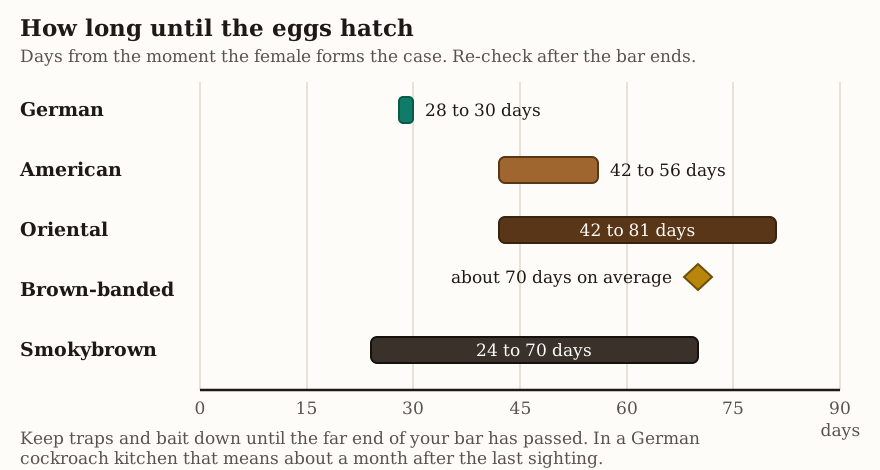
Temperature drives all of it. A warm room speeds the eggs up, while a cold garage stretches them out. That is why one species gives such a wide window. The working rule is simple. Count from the day you found the case, take the far end of the bar for your species, and keep checking until that date passes.
The totals matter more than they look. One German female and her offspring can pass 30,000 insects in a year indoors, which is the figure UC IPM uses. The other species are far slower. The same source counts about 800 in a year from an American female and her young, and nearly 200 from an oriental female.
There are only three stages here: egg, nymph, adult. No grub and no pupa exist in a cockroach. What leaves the case is a small wingless copy of the adult that simply grows. A newly hatched German nymph is about 2.3 mm long and white for its first few hours, then it darkens.
Do cockroaches lay eggs one at a time?
No. A cockroach never drops a single loose egg anywhere. She builds one case and fills it with two rows of eggs, so the smallest batch of cockroach eggs that exists is the whole capsule. That is why a photograph of scattered single specks is almost always droppings, seeds or another insect.
How many eggs can a cockroach lay in a day?
None, in the way the question means it. A female finishes one case, then starts the next one weeks later. A German female produces four to eight cases across a life of a few months. An American female averages one a month for about ten months, though at her peak she can form two cases in a week.
Does finding a cockroach egg case mean an infestation?
Usually, though not always, and the species decides. A loose tan German case indoors means roaches are breeding in that room, because the female carries it almost to hatching. One dark case in a garage can come from an outdoor roach that wandered in. Where you found it matters as much as what it is.
What your find actually tells you, and what to do about it
A loose tan case, 6 to 8 mm
- Where
- Kitchen or bathroom
- What it means
- German roaches breeding in that room, with a hatch days away or just past
- Do this
- Collect it, bin it outside, and start baiting the same day
An empty case, split along the seam
- Where
- Behind an appliance or in a cabinet
- What it means
- A female bred there, and the nymphs are loose
- Do this
- Treat that spot as the center and work outwards from it
A case glued under a drawer or high on a wall
- Where
- A dry bedroom, office or closet
- What it means
- Brown-banded roaches, which spread away from kitchens
- Do this
- Scrape it off, bag it, then check furniture in other rooms
A black case stuck near food
- Where
- Pantry, basement or crawl space
- What it means
- American roaches breeding indoors
- Do this
- Find the damp entry point as well as the case
One large dark case and nothing else
- Where
- Garage, shed, woodpile or mulch
- What it means
- Probably an outdoor roach, and not proof of an indoor problem
- Do this
- Remove it, then monitor with traps for a week before treating
A case with one small round hole in the side
- Where
- Anywhere
- What it means
- A parasitic wasp killed those eggs, but roaches are still breeding nearby
- Do this
- Bin it and keep inspecting
Cases in a used appliance or second-hand furniture
- Where
- Just brought home
- What it means
- A real risk of starting an infestation from scratch
- Do this
- Strip the motor housing and drip tray before it enters the kitchen
Small black wasps at a window are a sign in their own right. The ensign wasp lays one egg inside a roach case. Its larva eats every egg, then cuts a round hole and flies off. These wasps cannot sting you. Finding them at a window or a light means roaches are breeding in the building, which is the part that concerns you.
Plenty of people find cases and never see a roach, and that is normal rather than strange. Roaches spend most of their lives out of sight in cracks. About 80 percent of a German population is nymphs, so the signs show up long before the insects do.
What to do with a pregnant roach
Kill her and the case together, and do it over a trash can. A pregnant roach means a female with a case showing at her rear. The cockroach eggs inside can still hatch after she dies. So crush the case itself, or seal her in a bag and bin it outside. Squashing the body alone is not enough.
Research backs that up, and the numbers are worth seeing. Montada and Guerrero treated pregnant German cockroaches with three different insecticides. Between 33 and 71 percent of the females dropped their cases. Of the dropped cases, 19 to 39 percent still hatched. Of the cases the females kept hold of, 14 to 48 percent hatched as well.
Timing changes the odds. A case knocked loose very early tends to fail, because the mother normally passes water to it while she carries it. Once a case is close to full term it no longer needs her. So treat every case you find as live until you have destroyed it.
How to get rid of cockroach eggs
Nothing you spray reaches the cockroach eggs inside a case. So physical removal comes first, and it is free. Find the cases, vacuum or scrape them up, seal the bag and put it in an outside trash can. Each case you remove is 16 to 40 eggs that never hatch. Then bait for whatever has already come out.
This section deals with the eggs only. For the whole infestation, including baits, traps, dusts and the order to work in, read our guide to clearing roaches out of a home.
Six steps that actually remove the eggs
Find every case before you clean
Pull the drawers out and look underneath them. Lift the fridge drip tray and open the dishwasher kickplate. Then check cabinet corners, hinges and pipe collars with a flashlight and a small mirror. Sticky traps left down three nights show you which corner to search hardest.
Vacuum them up, or scrape them off
A strong vacuum lifts roaches, cases and droppings in one pass. Use a HEPA or triple-filter machine if you can. Roach droppings and shed skins trigger asthma, so the filter matters. Glued cases need a putty knife or an old credit card. Every case you lift is 16 to 40 cockroach eggs that never hatch.
Seal the bag and take it outside
Suction does not crush a full case. One can still hatch inside the canister. Empty the vacuum straight away into a plastic bag and tie it. Put the bag in an outside trash can with a lid. This step costs nothing, and it is the only certain one.
Wash the smears off the surfaces
Hot soapy water lifts the droppings and the scent they carry. That scent is what pulls other roaches to the same corner. Do this after you collect the cases, not before.
Bait for whatever already hatched
Removing cases does nothing about nymphs loose in the room. Put pea-sized dots of gel bait in the cracks nearest your find. Never spray an insecticide over a bait placement, because the residue drives roaches off it. Nymphs feed and die within a few days.
Re-check once the hatch window closes
Write down the date you found the case. For German roaches, check again a month later. With American or oriental cases, allow two to three months. Nymphs appearing weeks after treatment mean a case hatched on schedule.
Do sprays kill roach eggs?
No, and this is the most repeated error on the subject. The case is a hard, sealed shell, and a surface spray sits on the outside of it. Pest pages still claim that a residual insecticide kills the embryos inside. No study we can find supports that for eggs in a formed case.
What a spray really does is hit the mother. Treated females drop their cases early, and a good share of those dropped cases hatch anyway. So a treatment can look successful for two weeks and still have a hatch coming. Oriental roaches make it worse by tucking cases into cracks, where a residue breaks down before the eggs are ready.
Boric acid has the same limit, whatever the label blurb suggests. It kills nymphs that walk through the dust after they hatch, which is genuinely useful. It does nothing to eggs sealed inside a case.
Do IGRs kill cockroach eggs?
Mostly no, and the detail matters. An insect growth regulator stops young roaches maturing and makes adults sterile. That makes it one of the best tools against a population, and it is still not an egg killer. When King and Bennett applied hydroprene directly to German cockroach cases, it had no effect on the eggs at all.
Timing is everything with these products. A growth regulator eaten in bait before a case forms can stop that case hatching. Once she finishes the shell, the eggs inside sit out of reach of anything except heat, cold or your thumb.
There is an upside you can actually see. Roaches exposed to an IGR grow twisted or curled wings, and more of them wander about in daylight. Both are signs the product is working, not signs of something new. Allow four to six weeks before numbers visibly drop.
Does freezing or heat kill cockroach eggs?
Yes, at real temperatures. In the laboratory, heat and cold do kill cockroach eggs. Two-day-old American cases stopped developing at -4F (-20C), or at 118F (48C) and above held for 30 minutes or longer. Tee and colleagues measured that, and nobody has published a tested home schedule.
So use what you can be sure of. Wash fabrics on the hottest setting the material allows, then run a full hot dryer cycle. That is the practical home version of the heat figure. For anything you cannot wash, seal it in a bag and write the date on it. Leave it past the hatch window on the timeline above, because nothing that hatches in a tied bag finds food or water.
Cold outdoors is less reliable than people hope. A case in an unheated garage or a storage unit may well die over winter. It may instead develop slowly and hatch in spring. No one has measured that for a US winter, so treat it as a maybe rather than a method.
Egg cases in clothes, luggage or a used appliance
Treat all three the same way: look, wash what you can, bag what you cannot. German cases in a shoe or a handbag look like little brown rectangular pills, about the size of a grain of rice. They are easy to spot once you know the shape.
A second-hand appliance needs more than a wipe. Take off the back panel and lift out the drip tray before it goes into the kitchen. The motor housing is warm and tight, which is exactly what a female wants. Vacuum it out, wash the surfaces, and keep a sticky trap beside it for two weeks afterwards.
Should I destroy cockroach eggs?
Yes. Destroy cockroach eggs the moment you find them. One German case is 30 to 40 young, so leaving it is the most expensive thing you can do. Crush it firmly, or vacuum it up and bin the sealed bag outside. Either works, and neither costs anything.
One worry comes up again and again: that crushing a case frees live nymphs. A full-term case can hold young that are ready to go. So crush it properly over a trash can or a sheet of paper, rather than nudging it with a shoe. No evidence shows a firm crush releasing viable nymphs, and leaving the case alone guarantees the hatch.
Cockroach egg myths
Myth 1
Myth: “Cockroach eggs hatched inside a woman's tongue.”
Truth: A hoax, rated false by Snopes. Both the envelope story and the Taco Bell version were chain emails from 1998 and 2000. The line about CNN reporting it came later. A roach case is about the size of a dried bean, so nothing works it under a gum line.
Myth 2
Myth: “Spraying the case kills the eggs.”
Truth: The shell seals shut, so the spray stays outside. No study supports a residual insecticide killing the embryos in a formed case.
Myth 3
Myth: “Boric acid destroys roach eggs.”
Truth: It kills nymphs that cross the dust after they hatch. That is worth having. It does nothing to eggs sealed inside a case.
Myth 4
Myth: “Growth regulators kill the eggs.”
Truth: They sterilize adults and stop nymphs maturing. Hydroprene put straight onto German cases had no effect on the eggs.
Myth 5
Myth: “Crushing a case releases live babies.”
Truth: Crush it firmly over a trash can. Leaving a case where it is guarantees 16 to 40 young. That beats any risk from crushing it.
Myth 6
Myth: “Roaches lay loose eggs you can see.”
Truth: They never do. Every egg sits inside one case. Single scattered specks are droppings, seeds or another insect.
Myth 7
Myth: “A neighbor could have planted roach eggs in my apartment.”
Truth: Nobody can time a hatch. A case takes a month to three months, and the young need food and water in that same room. Shared walls, pipe runs and grocery boxes explain almost every case.
Myth 8
Myth: “An empty case means they have gone.”
Truth: It means a female bred there. The young are loose, so treat that spot as the center of the problem rather than as history.
When to call someone
Most cockroach eggs end their story in a tied bag and an outside trash can. Three findings change that, and none of them needs you to wait and see.
Call a pest professional when you still find fresh cases after four weeks of baiting. The same goes for cases in more than one room. A shared building where neighbors have the same problem is the third trigger. A licensed technician can treat wall voids and use products you cannot buy over a counter.
Tell your landlord in writing on the day you find the first case, if you rent. A roach problem in a rented home is normally the landlord's job to fix. A dated written report with photographs is what gets the work scheduled, so check your local housing code or a tenants' advice service if nothing happens.
Speak to a doctor, not a pest company, when someone in the home has asthma that is getting worse. Roach droppings and shed skins are a documented asthma trigger, so the cleaning matters as much as the killing. Still unsure what you are holding? Upload a photo to our bug identifier by picture and check the result against the seven tests above.
Pest control disclaimer. Photo-based identification can help, but it is not always perfect. For dangerous spiders, large infestations, or anything you are unsure about, contact a licensed pest control professional.
Frequently asked questions
Will cockroach eggs hatch in a sealed plastic bag?
Can cockroach eggs survive a vacuum cleaner?
What is the yellow paste inside a fresh egg case?
Do cockroaches lay eggs in food?
Do cockroach egg cases stick to clothes and bedding?
Will a fumigation kill cockroach eggs?
Can I flush egg cases down the toilet?
Do cockroach egg cases smell?
Will cockroach eggs hatch in the fridge or a cold garage?
Related guides
How to get rid of roaches
The whole job in order: monitoring, baits, dusts, sealing up, and what to skip.
Cockroach poop
The specks and smears beside the cases, and how to clean them safely.
Baby cockroach
What comes out of the case, and how to tell a nymph from a beetle.
German cockroach
The small striped kitchen roach that carries its case until it hatches.
American cockroach
The big reddish one that glues its case near food.
Oriental cockroach
The near black basement roach whose cases sit in cracks for weeks.
Fly pupae
The brown capsules people most often mistake for roach eggs.
Termite droppings
Tiny six-sided grains in sand-like piles. The other common wrong answer.
Bug identifier by picture
Upload a photo and get an identification in seconds.
Sources
- US EPA, Pest Control: Resources for Housing Managers (vacuuming roaches and egg cases, HEPA filters)
- UC IPM, Cockroaches (Pest Notes 7467): egg capsules by species, and why sprays miss the harborage
- University of Florida IFAS, German Cockroach (EENY-002): the case carried until hatch, 30 to 40 eggs
- University of Florida IFAS, American Cockroach (EENY-141): about 16 eggs a case, glued near food
- Penn State Extension, German Cockroaches: four to eight egg capsules per female
- Mississippi State Extension, Control Cockroaches In and Around Your Home (P3346): 12 to 24 eggs in a large roach case