What cockroach poop looks like
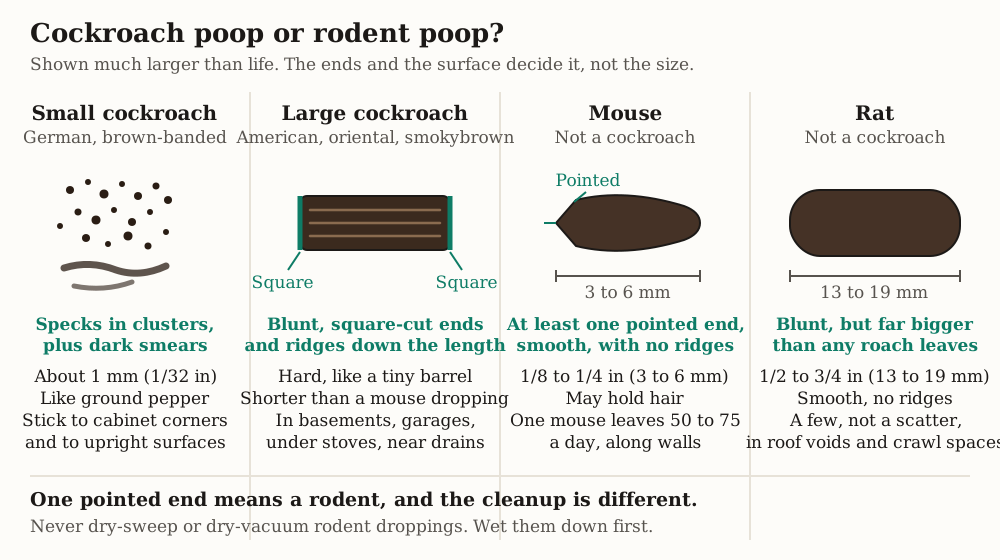
Cockroach poop takes two forms. Small species leave specks about 1 mm (1/32 in) long or smaller, brown to black. They cluster together, like coarse ground pepper or coffee grounds. Large species leave hard cylinders with blunt, square-cut ends and ridges running down the length. Both species also leave dark smears in damp spots.
Yes, roaches poop, and they do it constantly. A cockroach feeds at night, then returns to the same crack to rest. So the droppings build up in the hiding place instead of spreading over a floor. That is useful. A heavy patch of specks is a pointer to where the insects actually live.
Colour runs from mid brown to nearly black. A fresh smear is still soft and comes off in one pass with a damp cloth. Once it dries it sets hard and dull. After that, last night's speck looks the same as one from six months ago.
Is it cockroach poop? Six checks
Check each clue below to narrow down what you saw.
Look at the ends first
Blunt, square-cut ends mean a cockroach. At least one pointed end means a mouse. This single check settles most of the cockroach poop photos people post online, even when the size looks wrong.
Look for ridges along the length
A hard roach pellet has fine grooves running end to end. Rodent droppings are smooth. Use a magnifier, or take a photo on a phone and pinch to zoom.
Put a coin beside it and photograph it
Size alone will not identify it, but you cannot judge size from memory either. A mouse dropping is 1/8 to 1/4 inch, or 3 to 6 mm. Anything half an inch long is from a rat.
Check for hair in it
Rodents swallow hair while grooming, so their droppings sometimes contain it. Cockroach droppings never do.
Wipe one with a damp white cloth
A roach speck stays dark brown or black. A bed bug spot smears rusty red-brown and has usually soaked into fabric. Coffee grounds and dirt break up into powder.
Note exactly where you found it
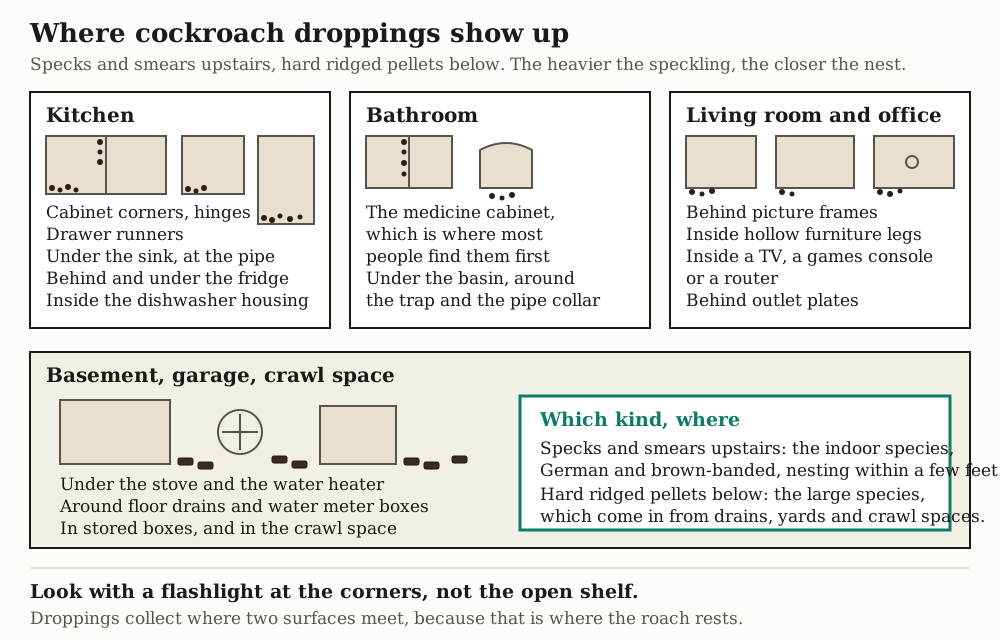
Cabinet corners, hinges, drawer runners and appliance housings point to cockroach poop. Droppings scattered along a wall or inside a stored box point to mice. Pellets near a floor drain point to one of the big outdoor roaches.
Why cockroach droppings have ridges
The ridges are the one feature no rodent dropping has, and there is a reason for them. A cockroach has rectal pads inside its gut. They pull water and nutrients out of the waste before it leaves the body. Those pads press grooves into the surface as the pellet forms. So a hard pellet with lines running end to end came out of an insect, not a mouse.
Smears or pellets, and what that tells you
Humidity decides which one you get. In a humid place, a large cockroach leaves smears of fecal material along the surfaces it crosses. In a drier place, the same species leaves firm pellets. So the streak under a damp sink and the pellet in a dry garage can be the same insect.
The smear is also where people confuse cockroach poop with bed bug spots. Wipe one with a damp white cloth. A roach smear stays dark brown or black. A bed bug spot runs rusty red-brown, because it is digested blood. Our guide to the early signs of bed bugs covers that test in full.
Cockroach poop by species
Which roach left it narrows to two groups. The German and brown-banded cockroaches are the small indoor species. Both leave 1 mm specks and smears up in cabinets and drawers. The American, oriental and smokybrown cockroaches are the large species. They leave hard ridged pellets lower down, often near drains and in basements.
Droppings by species, and where they turn up
German cockroach
- What the droppings look like
- Specks about 1 mm, like coarse ground pepper, in tight clusters, plus dark smears
- Where they turn up
- Kitchens and bathrooms: cabinet corners and hinges, drawer runners, under the sink, behind and under the fridge
Brown-banded cockroach
- What the droppings look like
- The same pepper-like specks, so the dropping alone cannot separate it from a German cockroach
- Where they turn up
- Higher and drier: behind picture frames, inside hollow furniture legs, inside electronics and outlet boxes
American cockroach
- What the droppings look like
- Hard cylinders with blunt, square ends and ridges along the length. Smears instead in humid spots
- Where they turn up
- Basements, garages, crawl spaces, floor drains, water meter boxes, under stoves
Oriental cockroach
- What the droppings look like
- The large-roach type, blunt and ridged. No extension source describes this species' droppings separately
- Where they turn up
- Damp and low: basements, drains, under porches, around water meter boxes
Smokybrown cockroach
- What the droppings look like
- The large-roach type, blunt and ridged
- Where they turn up
- Attics and soffits, then mulch, tree holes and gutters outside, then garages and porches
Palmetto bug
- What the droppings look like
- Not one species, so expect the large-roach type. The name covers several big southern roaches
- Where they turn up
- Southern homes: garages, screened porches, bathrooms and kitchens at night
If the specks are in a kitchen cabinet, the German cockroach is the likeliest source. It is the one species that lives indoors all year. Hard pellets in a basement or garage usually mean an American or oriental cockroach from outside. In the South, the big roach people call a palmetto bug leaves the same pellets.
One widely repeated number deserves a warning. Google’s AI summary and several pest-company pages give a large roach’s dropping as 2 to 3 mm long. No extension or government source we could open prints that figure. The sources that do describe these pellets say only that they are shorter than a mouse dropping. One extension newsletter puts them at about 1/4 inch, which is a mouse dropping's own length. So nobody has settled the length, and size on its own cannot tell you what left the cockroach poop. The ends and the ridges can.
Roach poop vs mouse poop
Look at the ends first. A mouse dropping has at least one pointed end and a smooth surface. It runs 1/8 to 1/4 inch (3 to 6 mm). A cockroach dropping has blunt, square ends with ridges down its length. Rat droppings are blunt too, but 1/2 to 3/4 inch (13 to 19 mm), far bigger than any roach leaves.
Cockroach, mouse and rat droppings compared
The ends
- Cockroach droppings
- Blunt and square-cut, or no ends at all on a speck
- Mouse droppings
- At least one pointed end
- Rat droppings
- Blunt at both ends
The surface
- Cockroach droppings
- Ridges running end to end
- Mouse droppings
- Smooth
- Rat droppings
- Smooth
Length
- Cockroach droppings
- 1 mm specks, or short pellets with no published length
- Mouse droppings
- 1/8 to 1/4 in (3 to 6 mm)
- Rat droppings
- 1/2 to 3/4 in (13 to 19 mm)
Hair in it
- Cockroach droppings
- Never
- Mouse droppings
- Sometimes
- Rat droppings
- Sometimes
How many, and how arranged
- Cockroach droppings
- Dozens or hundreds of specks in one tight patch, with smears
- Mouse droppings
- Scattered along walls and runways. One mouse leaves 50 to 75 a day
- Rat droppings
- A few very large ones, not a scatter
Where you find them
- Cockroach droppings
- Cabinet corners, hinges, appliance housings, drains
- Mouse droppings
- Along walls, in drawers, inside stored boxes
- Rat droppings
- Roof voids, crawl spaces, along walls
How to clean it
- Cockroach droppings
- HEPA vacuum, then a damp wipe
- Mouse droppings
- Never sweep or vacuum. Wet it down first
- Rat droppings
- Never sweep or vacuum. Wet it down first
One correction matters here, because the wrong figure is everywhere. Google’s AI summary has given mouse droppings as 6 to 10 mm, close to double the real size. That figure traces back to a pest-control company page with no source. The National Park Service wrote a guide to tell these droppings apart. It puts mouse droppings at 1/8 to 1/4 inch, with at least one pointed end. Rat droppings are 1/2 to 3/4 inch and blunt. Those are the figures this site uses.
This is also why the arguments in forum threads go nowhere. One commenter says a dropping is too small for a mouse. The next says it is too big for a roach. Both are reasoning from size ranges that overlap. The ends settle it in one look, and the ridges confirm it.
Other things that look like cockroach poop
Six things account for nearly every wrong guess. The list: mouse droppings, bed bug spots, termite pellets, spider poop, coffee grounds, and an egg case. Each one has a single test that settles it in seconds. None needs a lab, and most need only a damp white cloth and a phone camera.
What else it could be, and the test for each
Mouse or rat droppings
- The test that settles it
- At least one pointed end, smooth with no ridges, and may hold hair
- Where it turns up
- Along walls, in drawers, inside stored boxes and roof voids
Bed bug spots
- The test that settles it
- Soak into fabric, and smear rusty red-brown when wiped with a damp cloth
- Where it turns up
- Mattress seams, the bed frame, the headboard. Not the kitchen
Termite pellets
- The test that settles it
- Hard six-sided grains, all the same size, in a cone under a pinhole in wood
- Where it turns up
- Below window frames, skirting and wooden beams
Spider poop
- The test that settles it
- A flat splat with white in it, directly below a web
- Where it turns up
- Walls, window frames and ceiling corners
Coffee grounds or ground pepper
- The test that settles it
- Crush to powder between the fingers, smell of what they are, and show no ridges
- Where it turns up
- Kitchen worktops, the floor under a grinder or a spice rack
Dirt, eraser shavings or plant bits
- The test that settles it
- Rub soft and are not stuck to the surface. One Reddit mystery turned out to be eraser shavings in a bed
- Where it turns up
- Anywhere, which is part of why they fool people
A cockroach egg case
- The test that settles it
- One hard capsule 5 to 10 mm long with a seam along one edge, not a scatter of pieces
- Where it turns up
- Glued in a cabinet corner, under furniture or inside an appliance housing
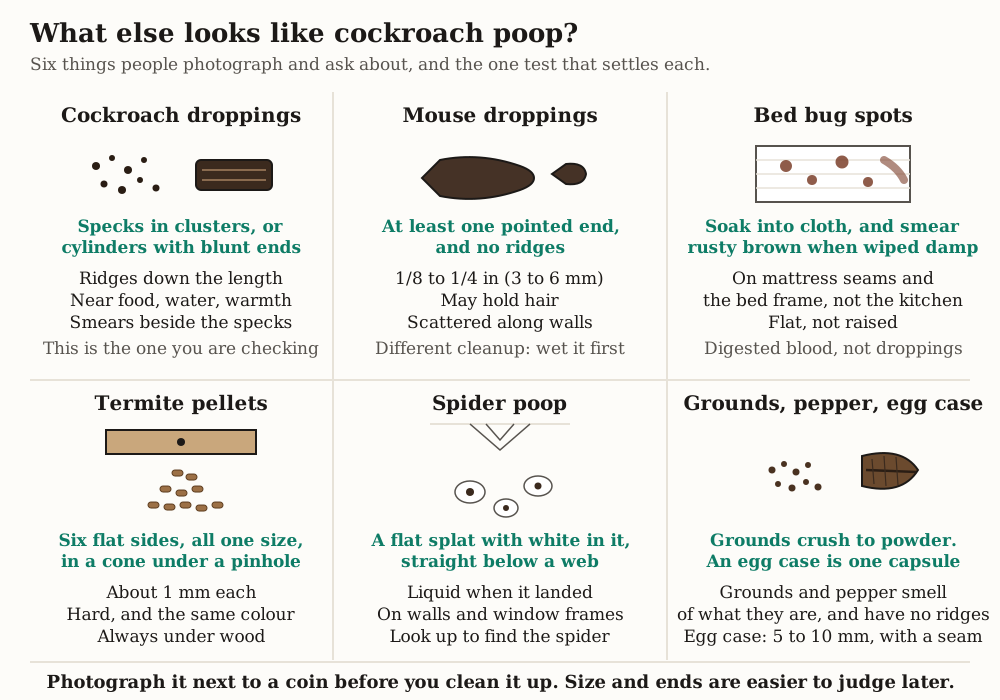
Three of those look-alikes have their own guide here, because each sends people to the same panicked search. Hard six-sided grains in a pile point to termite droppings. A flat white splat on a wall is spider poop. And if the specks turn out to be moving, try our round-up of small black bugs in the house. It sorts them by size and room.
Cockroach eggs vs poop
These two get mixed up because both are dark and both turn up in the same cabinet corner. The difference is the number of pieces. An egg case is one hard capsule, 5 to 10 mm long. It has a seam along one edge and fine ridges across it. Poop is a scatter of specks, or several loose pellets. So count what you are looking at: one capsule means eggs, many pieces mean droppings.
A capsule that is still full and smooth has not hatched. A split, hollow husk means it has, and that a female bred in that exact spot. Our guide to cockroach eggs covers what each one means and what to do about it.
Does cockroach poop mean an infestation?
Cockroach poop proves roaches have been there, not that they are there now. Cockroach feces stay on surfaces for a long time. So a few specks in a cabinet can be months old, left from a problem that is already over. A fresh scatter that comes back within two weeks of a clean is the signal that matters.
What you found, what it probably means, and the first move
A few specks in one cabinet corner
- What it probably means
- Old traffic, or a single roach passing through. Very common in a rental
- What to do first
- Clean it, then put two sticky traps in that cabinet for three nights
Heavy speckling and smears in one patch
- What it probably means
- A hiding place within a few feet, and an active indoor population
- What to do first
- Bait beside the droppings, then clean the surrounding surfaces
Specks in several rooms
- What it probably means
- An established population, or more than one way in
- What to do first
- Trap in every room for three nights, then treat the worst room hardest
Hard pellets in a garage, basement or near a drain
- What it probably means
- A large outdoor species getting in, rather than a kitchen infestation
- What to do first
- Find the gap and seal it, and check that floor drains still hold water
Droppings plus a musty, oily smell
- What it probably means
- A large population. The smell comes from the same chemistry as the droppings
- What to do first
- Treat it as established and start baiting
Droppings plus a roach walking in daylight
- What it probably means
- The hiding place is crowded enough to push them out into the open
- What to do first
- Act now, and plan for weeks rather than days
Why you find droppings but never see a roach
This is the commonest version of the whole question, and three answers cover almost all of it. Roaches are nocturnal, and they spend most of their lives wedged into cracks. So a kitchen can hold them for months without a single sighting.
Then there is the staying power of cockroach poop. Feces remain on surfaces long after the roaches have gone. That is why people who move into a treated flat still find specks in every cabinet.
The third answer is the awkward one: the specks may not be roach at all. Most photos posted online as cockroach poop turn out to be mouse, rat, dirt or something else. So the look-alike table above is worth a second pass before you treat anything.
How much cockroach poop is a lot?
There is no threshold, and anyone who gives you one is guessing. The amount of feces does indicate the size of a population, but it is not a reliable measure. It depends on how long the droppings have been building up, and on whether anybody cleaned in between. Sticky traps give the honest count.
So put one trap in each corner of the room, and one behind each large appliance. Leave them three nights, then count what you caught and where. For scale, a federally funded allergen trial only enrolled homes that trapped 50 to 500 cockroaches in three days. That is what a heavy infestation looks like in numbers.
Heavy droppings in one tight spot are also the closest thing to a nest you will find. Cockroaches do not build nests. What people call a roach nest is really a harborage. That is a crack or void where the insects rest, breed and leave their droppings.
Is cockroach poop harmful?
Dried cockroach poop is an asthma trigger, and that is the real risk. EPA says certain proteins in cockroach feces and saliva can cause allergic reactions or trigger asthma symptoms. A 1997 New England Journal of Medicine study of 476 inner-city children with asthma found 36.8 percent allergic to cockroach. Half of their bedrooms held high allergen levels in the dust.
The rest of the figures from that study are worth knowing. Children who were both allergic to cockroach and living with high allergen levels averaged 0.37 hospital admissions a year. For the other children the figure was 0.11. They also had more unscheduled medical visits, more days of wheezing and more missed school.
How many children are allergic depends on which population you count, and the published figures differ widely. That 1997 study found 36.8 percent. A 2012 review in Allergy, Asthma and Immunology Research gives 60 to 80 percent for inner-city children with asthma. The same review gives 21 percent for one suburban group. Both figures stand, because they count different populations. The exact rate is not settled: it moves with the city, the housing and the test used.
Can cockroach droppings make you sick?
Here is what is shown, and what is not. In laboratory and farm studies, cockroach feces carried live bacteria. One study found verotoxigenic E. coli still viable in German cockroach feces eight days after exposure. The fecal coliform count was close to that of piglet feces. American cockroaches can also pick up Salmonella and Shigella, because they travel through sewers and storm drains.
What no source we found shows is a household illness traced back to cockroach poop. So treat them as a hygiene problem rather than an emergency. Wash your hands, keep droppings away from food and dishes, and do not scrub them dry.
I touched it, or it was near food
Touching cockroach poop is not dangerous. Wash your hands with soap and warm water for 20 seconds and carry on with your day. The same goes for standing on one barefoot, which is how plenty of people meet their first American cockroach pellet.
Food is different. Throw out anything a dropping landed on, and anything in an opened packet beside it. Wash dishes, cutlery and food containers in hot soapy water, or run a dishwasher cycle. Then wipe the shelf itself with hot water and dish soap. A child who put one in their mouth needs a rinse and a hand wash, not a hospital trip. Still, call your doctor if a child with asthma starts wheezing.
Do cockroach droppings attract more roaches?
Yes, though only roaches that are already in the building. Cockroach feces carry an aggregation pheromone, a chemical signal telling other roaches that this spot is safe to gather in. A 2015 study identified 40 of these volatile acids in German cockroach feces. It traced them to the roach’s own gut bacteria. Roaches raised germ-free produced feces that the young ignored.
That finding is useful rather than alarming, because it means the droppings mark the best place to put bait. What the pheromone does not do is draw roaches in from outside. A patch of old specks in an empty cupboard is not summoning anything.
Does cleaning the droppings lower the allergen?
Cleaning helps, and killing the roaches helps more than most people expect. One randomised trial ran in low-income urban housing. Bait, occupant education and professional cleaning together cut the kitchen-floor allergen by 96 percent in six months. In the follow-up year, homes that received the bait alone, with no extra cleaning, saw a 95 percent drop.
A later trial followed 102 children with asthma for 12 months. Bait on its own cut both cockroach numbers and asthma symptoms. So clean the droppings. Just do not expect scrubbing alone to fix the allergen while the roaches live in the wall.
How to clean up cockroach droppings
Cockroach poop comes off with things you already own: gloves, a damp cloth and hot soapy water. Never sweep or dust the droppings dry. A broom or a dry cloth lifts the allergen into the air you breathe. Vacuum with a HEPA filter if you have one, then wipe damp. Stay out of the room for 20 minutes afterwards.
Cleaning cockroach droppings, step by step
Put on gloves and a mask before you start
Any disposable gloves will do. Wear a dust mask or an N95 while you vacuum, because the allergen travels on the dust rather than on the cockroach poop itself. Open a window, and keep children and anyone with asthma out of the room until you have finished.
Bait first if the roaches are still active
The droppings carry the chemical signal that draws other roaches, so they mark the best bait sites. Put pea-sized dots of gel bait into the cracks and corners beside the heaviest speckling, several small dots rather than one blob. Never spray insecticide or cleaner over a bait placement, since the residue puts roaches off the bait.
Vacuum with a HEPA filter, and never sweep
Use a vacuum with a HEPA filter or a double-layered microfilter bag, and run the crevice tool along cabinet corners, hinges, drawer runners and the gap behind the appliances. A broom, a duster and a dry cloth all push the allergen into the air instead. If your vacuum has no HEPA filter, skip this step and go straight to the damp wipe.
Wipe with a damp cloth and hot soapy water
Never use a dry cloth, because it stirs up the allergen. Hot water and dish soap are enough for the droppings themselves. Rinse the cloth often, or use paper towels and bin them in a sealed bag. For a food surface afterwards, use a household disinfectant and leave it wet for the contact time printed on the label.
Soak dried smears, then lift them off
Old cockroach poop sets hard. Lay a wet soapy cloth over the spot for five minutes, then lift the softened residue with the edge of a plastic card or a plastic putty knife. Soak it again rather than scrubbing at it dry. Painted walls and cabinet interiors come up cleanly this way.
Deal with the exposed food, then look again in two weeks
Throw away open packets near the cockroach poop, and wash dishes, cutlery and containers in hot soapy water or a dishwasher cycle. Leave the room for 20 minutes after vacuuming so the dust settles. Then check the same spot in two weeks: fresh specks mean the roaches are still active, and the cleaning was never going to be the fix.
Bait first, then clean
The order matters more than the scrubbing does. Because the feces carry the aggregation signal, a bait placed right beside a patch of droppings gets found quickly. So put the bait down first, and leave the heaviest speckling alone for a few days. Clean once the traps show the numbers falling.
Two rules go with that. Do not spray insecticide or cleaning product over a bait placement, since the residue puts roaches off eating. And use any bait exactly as its label directs, because the label is the law. Control is a job of its own. Our guide to getting rid of roaches covers the traps, baits and exclusion work.
Droppings in outlets, electronics and appliances
Liquid and electricity do not mix, so this part changes. Switch the circuit off at the breaker before you take an outlet cover off. Wipe the cover plate itself, and never put anything damp inside the box. For a TV, a games console or a router, take it outdoors first. Blow the debris out with canned air, then wipe the case with a barely damp cloth.
Anything sealed inside an appliance is a job for an appliance technician, not a cloth. A second-hand water dispenser or coffee machine with droppings inside is a harder call. Keep it only if you can take it apart and wash every part that touches water. With most units you cannot.
What to do after you find cockroach poop
Three findings decide your next move. Do the droppings come back after a clean? Are they the small or the large type? Does anyone in the home have asthma? For most people the answer is clean, then trap for three nights. Bait, a landlord or a licensed professional come in when the droppings keep returning.
What to do, and who to call
A few old specks, nothing seen
- What to do
- Clean the spot, then trap for three nights to be sure
- Who to call
- Nobody yet
Fresh specks returning in a kitchen
- What to do
- Bait beside the droppings, clean weekly, keep the traps down
- Who to call
- Nobody, if the trap counts fall within two weeks
Pellets in a basement, garage or near a drain
- What to do
- Seal the entry gaps, fix the damp, check the drain traps hold water
- Who to call
- A plumber if a drain trap is dry, cracked or missing
Droppings in a rental or a shared building
- What to do
- Report it in writing, and keep dated photos. Treatment has to cover the neighbouring units too
- Who to call
- Your landlord or building manager
Anyone in the home has asthma
- What to do
- Wipe damp, vacuum with HEPA, and get the roaches controlled rather than just the droppings
- Who to call
- Your doctor, or the child's paediatrician
Heavy droppings in several rooms, or any in a food business
- What to do
- Get an inspection and a written treatment plan before you clean everything away
- Who to call
- A licensed pest control professional
Cockroach and rodent signs together
- What to do
- Do the rodent cleanup first, by the CDC method, then deal with the roaches
- Who to call
- A professional if both are established
If you are still not sure, photograph the cockroach poop next to a coin. Then upload the picture to our bug identifier by picture. Small pale roaches in the same cabinet are worth checking against our guide to the baby cockroach. The young are what most people see first.
Pest control disclaimer. Photo-based identification can help, but it is not always perfect. For dangerous spiders, large infestations, or anything you are unsure about, contact a licensed pest control professional.
Myths about cockroach droppings
Myth 1
Myth: “Finding droppings means roaches are in the house right now.”
Truth: Cockroach poop stays on surfaces for months. People who move into a flat that was treated before they arrived still find specks in every cabinet. Fresh droppings that come back after a clean are the signal of an active problem.
Myth 2
Myth: “Mouse droppings are much bigger, so the size tells them apart.”
Truth: The sizes overlap, and no extension source publishes a settled length for a large roach's dropping. Commenters on forums argue both ways, that a dropping is too small for a mouse or too big for a roach, and both arguments fail. Use the ends and the ridges.
Myth 3
Myth: “Roach droppings mean there are eggs nearby.”
Truth: Droppings say nothing about eggs. An egg case is a single hard capsule 5 to 10 mm long with a seam along one edge, so you either find one or you do not.
Myth 4
Myth: “You must never vacuum cockroach poop.”
Truth: That rule belongs to rodent droppings. For cockroach allergen, a vacuum with a HEPA filter or a double-layered microfilter bag is what public health sources recommend, followed by a damp wipe. A broom is the thing to avoid.
Myth 5
Myth: “Leaving the droppings will pull new roaches in from outside.”
Truth: The aggregation signal in the feces works on roaches already in the building. It does not draw them in off the street. So a day's delay in cleaning will not start an infestation, though it is still worth using the droppings to place bait.
Myth 6
Myth: “Only German cockroaches carry germs.”
Truth: Any roach that walks through a drain picks things up on the way. American cockroaches are the ones linked to Salmonella and Shigella, because they travel through sewers and storm drains before they reach a kitchen.
Frequently asked questions
What color is roach poop?
Is it safe to sleep in a room with cockroach droppings?
Is cockroach poop dangerous for a baby or toddler?
Can my dog or cat get sick from eating cockroach poop?
Will spraying Lysol keep roaches away?
Do cockroach droppings smell?
Related guides
German cockroach
The small indoor species behind almost every patch of pepper-like specks in a kitchen cabinet.
American cockroach
The big reddish-brown roach that leaves hard ridged pellets in basements and garages.
Cockroach eggs
One hard capsule rather than a scatter of specks. What a full case and a split husk each mean.
Baby cockroach
Nymphs are what people see first, and they look nothing like the adults.
How to get rid of roaches
Once you know whose droppings they are, this is the control plan.
Termite droppings
Hard six-sided grains in a cone under a pinhole. The other dropping people find in a pile.
Spider poop
Flat white splats below a web, and why they look nothing like an insect pellet.
Early signs of bed bugs
Dark specks on a mattress, and the damp-cloth test that separates them from roach droppings.
Small black bugs in the house
If the specks turn out to be moving, this sorts the candidates by size and room.
Sources
- CDC, How to Clean Up After Rodents
- NIEHS, Dust Mites and Cockroaches
- EPA, Asthma Triggers: Gain Control
- Rosenstreich and others (1997), Cockroach allergy and asthma in inner-city children, New England Journal of Medicine
- UC IPM, Cockroaches (Pest Notes 7467)
- National Park Service, Conserve O Gram 3/12, Identifying Mouse and Rat Damage
- Kim and others (2012), The cockroach and allergic diseases, Allergy, Asthma and Immunology Research