Do opossums eat ticks? The short answer
Wild opossums are not known to eat ticks in any real number. A 2021 study searched the stomachs of 32 wild Virginia opossums from central Illinois under a microscope and found no ticks or tick parts. The authors also reviewed 23 earlier diet studies, and none of them reported ticks either.
So why does everyone say they do? An opossum grooms itself often, and a 2009 lab study suggested it kills most of the young ticks that crawl onto it. That is a claim about ticks dying on an opossum’s body. It never showed that opossums hunt ticks or clear them from a yard.
Do possums eat ticks? That is the same question. In the US, “possum” is everyday shorthand for the Virginia opossum (Didelphis virginiana), the only marsupial native to the United States. It is a gray, pointy-nosed animal 24 to 34 inches (61 to 86 cm) long with its tail, and it weighs 4 to 15 pounds (2 to 7 kg).
Do opossums eat ticks? The evidence at a glance
2009 lab test (Keesing and others)
- What it found
- Six caged opossums let only 3.5% of 100 tick larvae each finish feeding
- What it can tell you
- Ticks do badly on opossums. It did not check what the opossums swallowed
2021 stomach study (Hennessy and Hild)
- What it found
- 32 wild stomachs: no ticks or tick parts, but 3 whole fleas
- What it can tell you
- Ticks are not a regular food
23 diet studies, from 1851 on
- What it found
- Diet data on over 1,280 opossums; none reported ticks
- What it can tell you
- Across the US range, ticks do not show up in the diet
Tick counts on wild opossums (New York)
- What it found
- About 199 fed larvae per opossum in a peak week
- What it can tell you
- Opossums feed plenty of ticks, and some finish their meal
Where the “5,000 ticks” figure came from
The number traces to one paper: Keesing and others, “Hosts as ecological traps for the vector of Lyme disease”, in Proceedings of the Royal Society B in August 2009. The team estimated that each opossum meets more than 5,500 tick larvae in a peak week and kills about 96.5% of them. Note the unit: a week, at the late-summer peak.
What the researchers actually did
In August and early September 2008, the team trapped six kinds of wild animals at the Cary Institute of Ecosystem Studies in Millbrook, New York. Opossums were one of them, with white-footed mice, chipmunks, gray squirrels and two songbirds. Each animal lived in a wire-floored cage over a pan of damp paper towels, so the team could count every tick that dropped off.
Next, they brushed 100 larval blacklegged ticks onto each animal’s head and neck. Larvae are the first stage, under 1 mm across. For four days the team counted the ticks that fell into the pans. On opossums, only 3.5% of the larvae fed and dropped off. On mice, almost half did.
The rest is the key point. A few ticks turned up unfed, but most of the ones placed on opossums never turned up at all. The paper says the missing ticks were “assumed to have been consumed or destroyed during grooming.” No one looked in the opossums’ stomachs or droppings for them.
How 199 ticks became 5,500
The big number is arithmetic, not a count. Wild opossums caught in New York at the larval peak carried about 199 fed larvae each. If those 199 are the 3.5% that survive, the team reasoned, each opossum must have met about 5,700 larvae that week. Take away the 199 that fed, and roughly 5,500 died.
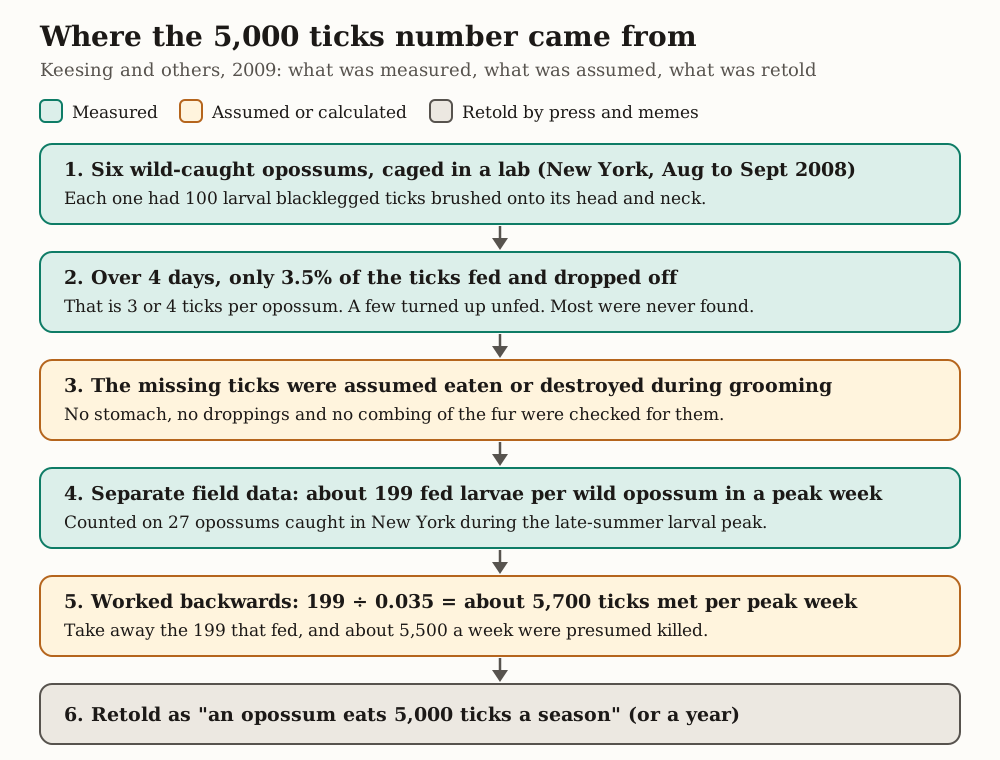
Our reading: the study measured something real. Ticks do badly on opossums, far worse than on mice. What it did not measure is eating. In the retelling, “killed while grooming” turned into “eats”, and “a week at the peak” turned into a season or a year.
What the 2009 study measured, and what people claim it found
Which animals
- What the study measured or said
- Six wild-caught opossums, caged in a lab for about a week
- What the retellings claim
- Opossums everywhere, in the wild
Which ticks
- What the study measured or said
- Larval blacklegged ticks brushed onto the head and neck
- What the retellings claim
- All ticks, of every kind and stage
What happened to them
- What the study measured or said
- Most were never found; assumed eaten or destroyed while grooming
- What the retellings claim
- Eaten, as if opossums seek ticks out
How many
- What the study measured or said
- About 5,500 killed per opossum per week, worked backwards from 199 fed larvae
- What the retellings claim
- 5,000 ticks “a season” or “a year”
When
- What the study measured or said
- Only during the late-summer larval peak
- What the retellings claim
- All year, or all season
Where
- What the study measured or said
- On the opossum’s own body
- What the retellings claim
- Across your whole yard
The retellings do not agree on the details
Even careful sources garble the study. The paper’s own table lists six opossums in the feeding test, yet Wildlife Illinois says four and Illinois Extension says five. Penn State Extension describes the estimate as per year, and Wildlife Illinois as per season. The paper itself says per week, during the larval peak.
What critics say the lab test missed
The 2021 authors raise three problems. First, opossums run cooler than mice and have lower blood pressure, and ticks feed more slowly on such hosts, so some larvae may still have been attached after four days. Second, the opossums went back to the woods without anyone combing their fur. Third, no one checked their stomachs or droppings, where tough tick parts would show.
The 2009 team saw some of this coming. They wrote that lab conditions could bias the results. They also held the animals four days because, in their data, few ticks stayed on any host longer than that. And ticks dropped off opossums no more often than off mice, which argues against ticks simply falling away.
What the 2021 opossum stomach study found
In 2021, Cecilia Hennessy and Kaitlyn Hild of Eureka College in Illinois searched the stomach contents of 32 wild Virginia opossums under a dissecting microscope. They did not sieve or rinse the contents first, so small parts could not wash away. They found no ticks and no tick parts, and they published the results in Ticks and Tick-borne Diseases.
The project began with a student question. Hild asked about the opossum tick meme in a wildlife class, Hennessy later wrote for the Illinois Department of Natural Resources. Road-killed opossums gave them only 11 animals in three seasons. After that, a licensed nuisance trapper supplied carcasses of animals he had euthanized.
The stomachs held the usual opossum mix. Hennessy lists worms, a French fry, broken glass and a mostly undigested shrew. There were also three whole fleas, a hint that opossums do swallow some pests while grooming. Yet not one tick turned up, even though ticks were on the opossums’ bodies, Illinois Extension notes.
Over 1,280 opossums: is that number real?
Yes, with one caveat. Google’s AI answer says studies of over 1,280 wild opossums found no ticks. The figure comes from Hennessy’s 2023 article: across 23 published diet studies, starting with John James Audubon in 1851, she counted results for over 1,280 opossums. None reported ticks anywhere in the gut. The caveat: 4 of the 23 studies looked at droppings, not stomachs.
What the stomach study cannot prove
No single study settles it, and this one has limits too. A stomach holds only the last few hours of meals, and 32 animals from one part of Illinois is a small sample. Readers on Reddit raise a fair point as well: a tick larva is tiny, so could it digest before anyone sees it? Hennessy’s answer is that tick parts are tough and stay recognizable even after passing through the gut.
So, do opossums eat ticks after all? Weighed together, the evidence says they may kill some ticks that try to bite them. But ticks are not a food they seek out, and no study has found them in an opossum’s diet. Penn State Extension adds a simple test. Opossums are common across the deer tick’s range, often in suburbs. If they trapped ticks by the thousand, it argues, tick numbers and Lyme disease there would show an obvious drop.
How the opossum tick myth spread: a timeline
The claim took about 8 years to go viral and 12 years to get tested. It started as one line of arithmetic in a 2009 paper, grew into “unsung heroes” in the press by 2015, and became “5,000 ticks a season” on blogs and memes by 2017. Do opossums eat ticks in the wild? Nobody looked inside one to check until 2021.
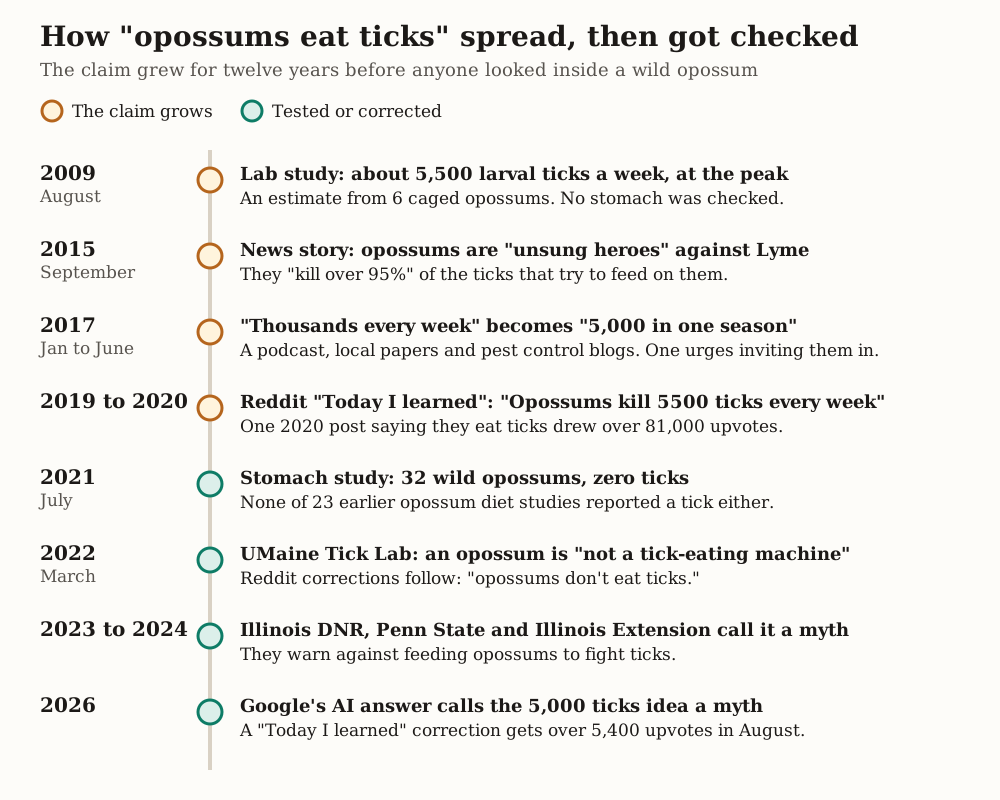
The opossum tick claim, year by year
Aug 2009
- Who
- Keesing and others, Proceedings of the Royal Society B
- What they said
- Opossums kill about 96.5% of larvae that try to feed; each meets over 5,500 a week at the peak
Sept 2015
- Who
- A news story citing the Poughkeepsie Journal, on the Cary Institute site
- What they said
- Opossums are “unsung heroes” that kill over 95% of the ticks trying to feed on them
Jan 2017
- Who
- Cary Institute podcast with Felicia Keesing
- What they said
- The average opossum kills thousands of ticks every week
May 2017
- Who
- A pest control company blog
- What they said
- An opossum could kill about 5,000 ticks in one season; build nest boxes to invite them in
2019 to 2020
- Who
- Reddit r/todayilearned
- What they said
- “Opossums kill 5500 ticks every week”; a 2020 post saying they eat ticks drew over 81,000 upvotes
July 2021
- Who
- Hennessy and Hild, Ticks and Tick-borne Diseases
- What they said
- No ticks in 32 wild stomachs; ticks are not a preferred food
Mar 2022
- Who
- University of Maine Tick Lab, in the Bangor Daily News
- What they said
- Ticks are not part of an opossum’s regular diet
Aug 2023
- Who
- Outdoor Illinois Journal, Illinois DNR
- What they said
- Diet data on over 1,280 opossums, none with ticks
May to June 2024
- Who
- Penn State Extension; Illinois Extension
- What they said
- Opossums probably do not eat ticks at all; do not lure them to your yard
Aug to Oct 2026
- Who
- Reddit r/todayilearned; Google’s AI answer
- What they said
- A correction post tops 5,400 upvotes, and the AI answer calls it a myth
Two things helped it spread. The estimate came from a respected lab, so each retelling felt safe to repeat. And the story was kind to an animal many people dislike. Hennessy points out the cost: people began putting out food to draw opossums in. That food also draws raccoons, rats, stray cats and coyotes.
What do opossums eat?
Opossums eat almost anything, but they prefer animal food. The Missouri Department of Conservation lists insects, carrion, mice, reptiles, frogs, crayfish, birds and their eggs, and earthworms. In fall and early winter they add fruit such as persimmons, grapes and pawpaws. Near homes, they raid open trash cans and pet food left outdoors.
What opossums eat, and what it means for your yard
Insects and worms
- Examples
- Many kinds of insects, plus earthworms
- What it means for you
- Many of these insects are farm and garden pests
Carrion
- Examples
- Dead rabbits, squirrels, mice and roadkill
- What it means for you
- A free cleanup crew
Small animals
- Examples
- Mice, reptiles, frogs, crayfish, birds and their eggs
- What it means for you
- Keep chicken eggs and chicks closed in at night
Fruit
- Examples
- Persimmons, grapes, pawpaws, pokeberries, fallen fruit
- What it means for you
- Pick up windfalls if you do not want visitors
Human food
- Examples
- Open trash, compost, pet food and scraps
- What it means for you
- The usual reason an opossum keeps coming back
Ticks
- Examples
- None found in 32 stomachs or 23 diet studies
- What it means for you
- Not a reason to keep opossums around
Opossums do earn their keep in other ways. Missouri’s field guide notes that they eat many insects farmers count as pests and clean up carrion. Foxes, coyotes, bobcats and owls hunt them in turn. When cornered, an opossum shows its teeth and drools first, then plays dead: it goes limp, shuts its eyes and lets its tongue hang out.
Do opossums carry ticks and Lyme disease?
Yes, opossums carry ticks, often many of them. In the 2009 New York study, wild opossums held about 199 fed larvae each in a peak week. Yet they are poor carriers of the Lyme bacterium. The same paper found that opossums infected only about 3% of the ticks that fed on them, against about 92% for white-footed mice.
That makes the opossum a mixed case. Some ticks finish feeding on it, drop off wherever it wanders, and molt into nymphs, including in your yard. However, those ticks rarely leave an opossum carrying Lyme bacteria. CDC says young ticks usually pick up the bacteria from a rodent, which is why mice matter more than opossums for Lyme risk.
You cannot catch Lyme disease by touching an opossum. CDC says the bacteria reach people through the bites of infected blacklegged ticks. Our deer tick guide covers that tick, its size at each stage and where it lives.
Can opossums get rabies?
Yes, but it is rare. In CDC’s national count for 2013, only 2 of the 5,865 rabid animals reported in the US were opossums, against 1,898 raccoons. So the popular line that opossums are “immune” to rabies is wrong. They simply get it far less often than raccoons, skunks, foxes and bats.
Low odds are not zero, though. If any wild mammal bites or scratches you, call your doctor or local health department the same day. They decide whether you need rabies shots, and that holds for an opossum too.
A risk for horses
Horse owners have one more reason to keep opossums away from feed. Opossum droppings spread Sarcocystis neurona, the parasite behind equine protozoal myeloencephalitis (EPM), a nerve disease of horses. The Merck Veterinary Manual advises keeping feed in closed metal bins, removing fallen fruit and keeping opossums out of feeding areas.
Should you want opossums in your yard?
Leave them be, but do not invite them. An opossum passing through is harmless and does real cleanup work, yet it will not lower your tick numbers. Food or shelter set out for opossums also draws raccoons, rats, stray cats and coyotes, warn Illinois Extension and Wildlife Illinois. It teaches wild animals to link people with food, too.
Do possums keep ticks away, then? No. An opossum that visits every night may even bring a few ticks in on its fur. If ticks are a problem in your yard, the woods edge and the stone walls are where to look, not the wildlife passing through.
Forums show how the myth turns into action. One Reddit post praises an opossum that eats leftover kibble on the porch and “in return keeps my backyard tick-free.” In another, a reader wanted to pull ticks off a wild opossum. Both are kind ideas, and both bring people and wildlife closer than is safe.
What actually lowers ticks around your home
No animal clears ticks from a yard. Penn State Extension concludes that chickens and guinea fowl eat some ticks but not enough, and that opossums probably eat none. What works is yard work at the woods edge, tick tubes or bait boxes where mice are common, and, last, a registered tick spray. On your own body, repellent and a tick check do the rest.
Tick control ideas compared
Inviting opossums
- Does it lower ticks?
- No good evidence
- The catch
- Food left out draws raccoons, rats and cats too
Chickens or guinea fowl
- Does it lower ticks?
- Not enough to matter
- The catch
- Guinea fowl ate adult ticks but did not cut the nymphs (Penn State)
Clearing the woods edge and stone walls
- Does it lower ticks?
- Yes
- The catch
- Most yard ticks live in that narrow band
Tick tubes and bait boxes
- Does it lower ticks?
- Sometimes
- The catch
- They work only where white-footed mice are common
A registered yard spray
- Does it lower ticks?
- Yes
- The catch
- Last, and only exactly as its label says
Repellent, treated clothes and tick checks
- Does it lower ticks?
- They stop the bite itself
- The catch
- Needed every time, even in a treated yard
For the yard, our guide to getting rid of ticks in the yard and house covers the edge work, tick tubes and how to read a spray label. For your body, the tick bite prevention guide compares repellents and explains permethrin clothing. If you want to know which animals do take some ticks, see what eats ticks.
A tick plan that does not rely on opossums
Clear the woods edge
Mow, and clear brush and leaf litter where the lawn meets the woods and around stone walls. That narrow band holds most of the ticks in a yard. It costs nothing but time.
Take away free food
Close trash cans, feed pets indoors and pick up fallen fruit. This keeps mice, raccoons and opossums from making your yard a stop, and mice feed young ticks.
Protect your skin and clothes
Use an EPA-registered repellent on bare skin. Treat clothes and shoes with 0.5% permethrin, never skin. Ask your vet about tick prevention for dogs and cats.
Check within 2 hours of coming in
Shower, then check your whole body by sight and touch, plus children and pets. Dry outdoor clothes on high heat for 10 minutes to kill hidden ticks.
Pull off an attached tick right away
Grip it close to the skin with fine-tipped tweezers and pull straight out. Lyme bacteria usually need more than 24 hours of attachment to pass, CDC says, so sooner is better.
Spray last, and only by the label
If ticks persist after the yard work, a registered tick product used exactly as its label directs is the last step. The label is the law.
Found one already attached? Our guide to removing a tick with tweezers walks through it, including what to do if the mouthparts stay in. For everything else about ticks, start at our tick hub.
Opossum and tick myths, corrected
Search “do opossums eat ticks” and six claims come up again and again on the pages that rank. Each one below sits next to what the research says. Most of them trace back to the same 2009 estimate, retold with the details dropped.
Myth 1
Myth: “An opossum eats 5,000 ticks a season.”
Truth: The only estimate, from 2009, was about 5,500 larvae a week at the late-summer peak. It counted ticks that went missing from six caged opossums, not ticks found in a stomach (Keesing and others, 2009).
Myth 2
Myth: “Opossums hunt ticks in your yard.”
Truth: Even the 2009 study only proposed that opossums groom off ticks that climb onto them. They forage for insects, carrion and fruit (Missouri Department of Conservation).
Myth 3
Myth: “Opossums do not carry ticks.”
Truth: Wild opossums in New York carried about 199 fed larvae each in a peak week (Keesing and others, 2009).
Myth 4
Myth: “Opossums cannot get rabies.”
Truth: They can, but it is rare: 2 of 5,865 rabid animals in the US in 2013 (CDC, Dyer and others, 2014). See a doctor the same day after any bite or scratch from a wild animal.
Myth 5
Myth: “Feeding opossums helps control ticks.”
Truth: It draws raccoons, rats and cats as well, and it will not cut ticks (Illinois Extension; Illinois DNR). Leave wild opossums to find their own food.
Myth 6
Myth: “Opossums spread Lyme disease to people.”
Truth: Lyme reaches people through tick bites, and opossums infect only about 3% of the ticks that feed on them (CDC; Keesing and others, 2009).
Pest control disclaimer. Photo-based identification can help, but it is not always perfect. For dangerous spiders, large infestations, or anything you are unsure about, contact a licensed pest control professional.
Do opossums eat ticks? FAQ
How many ticks can a possum eat in a day?
Do opossums eat fleas?
What does “ecological trap” mean for ticks?
What animal eats the most ticks?
Related guides
Ticks
What a tick is, how it finds you, tick season, and what to do if you find one.
What eats ticks
The birds, insects and other animals that take some ticks, and why none of them controls them.
How to get rid of ticks
Yard work at the woods edge, tick tubes, and sprays used by the label.
Preventing tick bites
Repellents, permethrin clothing and a proper tick check.
Deer tick
The Lyme disease tick: its size at each stage, its range and its season.
Removing a tick
The tweezer method, stuck mouthparts, and what never to put on a tick.
Ticks on dogs
Checks, removal and prevention for dog owners.
Sources
- Keesing and others (2009), Hosts as ecological traps for the vector of Lyme disease, Proceedings of the Royal Society B
- Hennessy and Hild (2021), Are Virginia opossums really ecological traps for ticks? Groundtruthing laboratory observations, Ticks and Tick-borne Diseases
- Hennessy (2023), Debunking the myth: opossums don’t eat ticks, Outdoor Illinois Journal, Illinois Department of Natural Resources
- Penn State Extension (Skvarla, updated 2024), Do chickens, guinea fowl, or opossums control ticks?
- Illinois Extension, Good Growing (Enroth, 2024), Reassessing the opossum-tick relationship
- Missouri Department of Conservation, Virginia opossum field guide
- CDC, How Lyme disease spreads (2024)
- Dyer and others (2014), Rabies surveillance in the United States during 2013, Journal of the American Veterinary Medical Association (CDC)
- Merck Veterinary Manual, Equine protozoal myeloencephalitis (2024)
- Cary Institute of Ecosystem Studies, Lyme disease and opossums (podcast with Felicia Keesing, 2017)
- Cary Institute of Ecosystem Studies, media coverage: opossums and Lyme disease (2015)
- Bangor Daily News, Opossums don’t actually like eating ticks (with the University of Maine Tick Lab)