Does diatomaceous earth kill fleas?
Yes, but slowly, and only where it stays dry. A flea that walks through a dry deposit loses the waxy layer that holds its water in, and then it dries out and dies. Labels on registered products give insects up to 48 hours after contact. So nothing about this is instant.
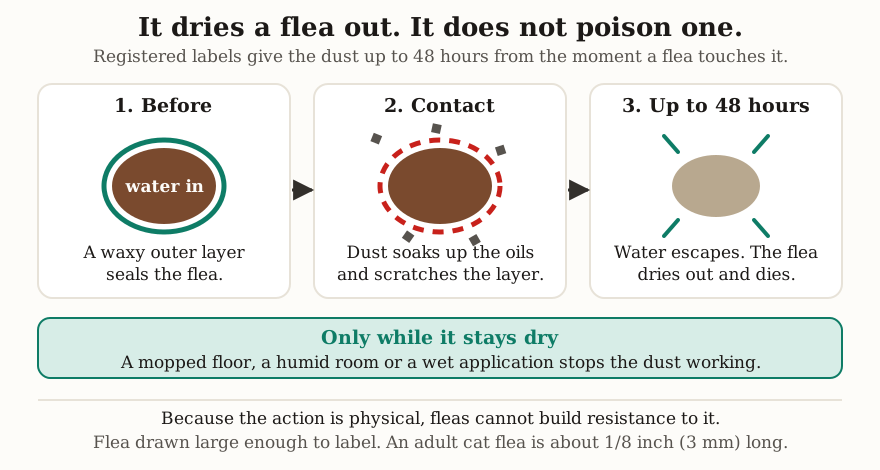
The powder itself is fossil algae, ground fine. Its skeletons are made of silica, and the National Pesticide Information Center explains that the dust soaks up the oils and fats in an insect’s outer shell. Sharp edges speed that up. The same fact sheet is blunt about the limit: it works only while it is kept dry and undisturbed.
That physical action has one real advantage. Because the dust works by drying rather than poisoning, fleas cannot become resistant to it, and registered labels say so on the panel. Bed bug guidance from the EPA makes the same point about desiccants.
Here is the honest part, and most pages about diatomaceous earth for fleas leave it out. We found no published trial against cat fleas at all. A PubMed search for the flea genus with diatomaceous, diatomite or silica returned zero records. What exists instead is extension lab work, and it is not encouraging. Texas A&M AgriLife Extension tested it and reported that the dust is “unlikely to provide practical or satisfactory flea control outdoors”.
Which flea life stages it reaches, and which it misses
It reaches adults, and some larvae in dry spots. It misses the other two stages entirely. Flea eggs are smooth capsules about 0.5 mm across with no waxy layer to strip, and a pupa sits inside a silk cocoon that shields it. Roughly half of a household flea population sits in those two untouchable stages.
What a drying dust can and cannot reach
Adult flea
- Does the dust reach it?
- Yes, on contact, within 48 hours
- Why
- It walks through the deposit and loses water
Larva
- Does the dust reach it?
- Sometimes, in dry sites only
- Why
- Larvae need at least 75% humidity, and they feed deep in carpet where dust rarely lands
Egg
- Does the dust reach it?
- No
- Why
- About 0.5 mm, smooth, and nothing to dry out yet
Pupa in its cocoon
- Does the dust reach it?
- No
- Why
- The sticky silk cocoon blocks dusts and sprays alike
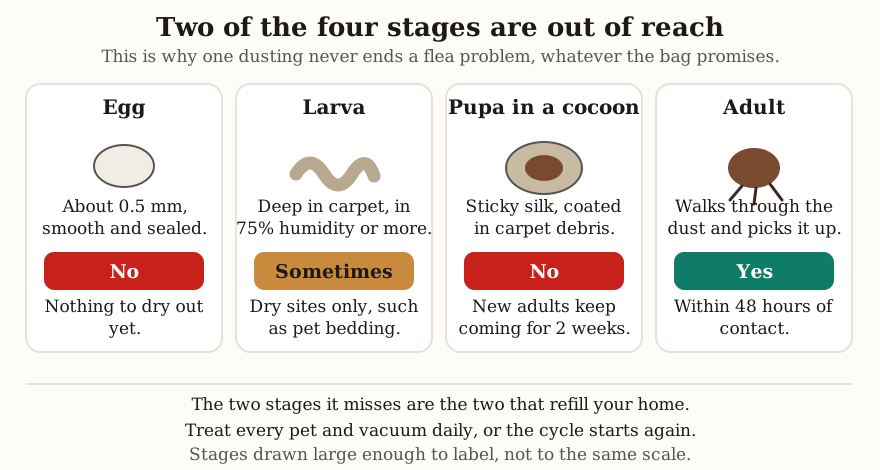
Texas A&M found one use that does hold up: as a dust in dry sites such as pet houses and pet bedding, it can kill flea larvae. Even so, that is one stage in one kind of place.
The cocoon is why people give up on this powder. Adults keep emerging for about two weeks after any treatment, because the cocoon protects the pupa inside. So a reader who dusted the bedroom last Tuesday and found a flea today has not failed. They have met the next wave, which our page on the flea life cycle walks through stage by stage.
Does diatomaceous earth kill flea eggs?
No. An egg is a sealed package with its own water supply, and a drying dust has nothing to pull out of it. Every egg in the carpet hatches on schedule, usually within 2 to 5 days in a warm house. That is the single biggest reason a dusted room refills with fleas.
Food grade or pool grade: which one is actually the pesticide?
Neither phrase answers the question, and that is the trap. “Food grade” is a food additive term from the FDA, not a pesticide approval. “Pool grade” means the powder went through heat treatment for filters, which raises its crystalline silica, the form linked to lung disease. What settles it is an EPA registration number on the bag.
Three things on a bag, and what each one tells you
An EPA registration number, with fleas on the pest list
- What it means
- A registered pesticide the agency has reviewed
- Use it on fleas?
- Yes, exactly as its own label directs
"Food grade", no registration number
- What it means
- A feed and food additive, sold for other jobs
- Use it on fleas?
- No, because it carries no pest directions at all
"Pool grade" or "filter grade"
- What it means
- Heat-treated, high in crystalline silica
- Use it on fleas?
- Never indoors, and never on a pet
University of Maryland Extension puts the distinction plainly. Amorphous powder sold as “natural grade” or “food grade” is the pesticide form when it carries an EPA registration number. Pool filter grade, by contrast, is crystalline, dangerous to breathe, and poor at drying pests out anyway.
There is a wrinkle worth knowing, because the two agencies do not line up. EPA’s do-it-yourself page says pool or food grade diatomaceous earth “should not be used”, since the pesticide version uses a different particle size that lowers the hazard. Meanwhile the top-ranking flea articles all say “use food grade only” and none of them mentions registration. Ask for the number instead of the grade.
What an EPA-registered label actually allows
We read six registered diatomaceous earth labels on 2026-10-30. All six list fleas. Several of them allow more than this site will recommend: three permit a thin coat raked into carpet, and two permit dusting a dog or a cat directly. EPA’s own desiccant guidance is narrower, and we follow the narrow version.
Six registered diatomaceous earth labels, read from EPA's label system
Harris Diatomaceous Earth, EPA Reg. No. 3-18
- What its flea direction allows
- Floor and bedding near where pets sleep, plus cracks, crevices, baseboards and carpeting
- On a pet?
- No pet directions
Concern Crawling Insect Killer, EPA Reg. No. 50932-12
- What its flea direction allows
- The same wording: pet sleeping quarters, cracks, baseboards, carpeting
- On a pet?
- No pet directions
Pure DE, EPA Reg. No. 69261-4
- What its flea direction allows
- A thin coat raked into rugs, left overnight, vacuumed every 3 to 4 days
- On a pet?
- "Do not treat animals with this product"
UrthPet Flea Powder, EPA Reg. No. 63191-17
- What its flea direction allows
- Carpet at 1 to 2 lb per 1,000 sq ft, worked into the nap, vacuumed weekly for 30 to 45 days
- On a pet?
- Yes, dogs and cats over 12 weeks, weekly
Insectigone Crawling Insect Killer, EPA Reg. No. 59913-1
- What its flea direction allows
- Pet sleeping quarters, cracks, crevices, baseboards
- On a pet?
- Yes, dogs, cats, ferrets and horses
Diafil 610, EPA Reg. No. 73729-1
- What its flea direction allows
- Floor and bedding near pets, cracks, crevices, carpeting
- On a pet?
- No home pet directions
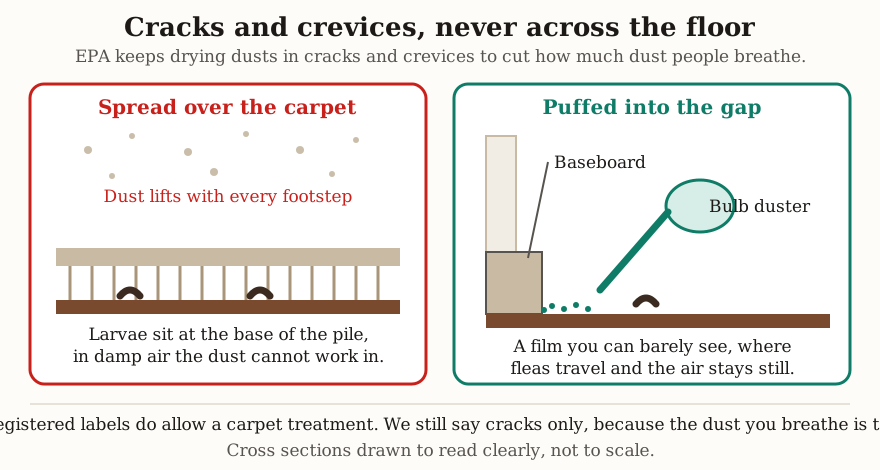
So why not just follow the label? Two reasons. First, EPA’s pesticide guidance limits desiccants to cracks and crevices specifically to cut how much dust people breathe, and that advice covers the same powder. Second, the Harris label itself has a line for living areas: avoid deposits on exposed surfaces, and keep the material out of the air. That is hard to square with raking dust into a rug.
The label is still the law. If you buy a product whose label allows a carpet application, that use is legal, and nobody is breaking a rule by following it. Our position is a safety call rather than a legal one. Airborne dust in your bedroom is the cost, and the benefit is too small to pay it.
How to use diatomaceous earth for fleas, the careful way
Keep the dust out of the air you breathe and in the gaps where fleas travel. A bulb duster and a thin film into cracks is the whole method, and it takes about ten minutes a room. Apply no more than once a week, which is the limit printed on every registered label we read.
The ten-minute method, step by step
Vacuum first, and keep vacuuming daily
EPA calls daily vacuuming the best method for initial control, and it pulls adults, eggs and some larvae out before you add anything. Empty the canister into a bag and bin it outside.
Buy a registered product that lists fleas
The EPA registration number sits near the bottom of the back panel. No number means no pest directions, so put it back.
Read the label before you open the bag
Each one gives its own rate, its own first aid and its own reapply limit. Those details differ between brands.
Wear a dust mask and keep everyone out of the room
An N95 is enough. Children, pets and anyone with asthma stay out until the dust settles.
Puff a thin film into cracks and crevices only
Work along baseboard gaps, floorboard seams, the void under a kickboard and behind the washer. A bulb duster lays a film you can barely see, which is what works.
Never spread it across open floor, carpet or bedding
Broadcasting it raises the dust you breathe without reaching the larvae at the base of the carpet pile.
Keep it dry, and never mix it with water
Texas A&M found that spraying it as a slurry stops fleas picking it up. A mopped floor or a humid bathroom ends its effect.
Vacuum it out and judge the result at two weeks
Then treat every pet with a product your vet chose, because the dust alone will not finish this.
How long does diatomaceous earth take to kill fleas?
Up to 48 hours per flea, and months for a household. Labels on registered products say insects contact or ingest the powder and die within 48 hours of it. Clearing a home is a different clock: veterinary guidance puts a moderate flea problem at 6 weeks to 3 months, whatever you use.
- Hours 1 to 48: adults that cross the dust start dying. You may see more fleas during this stretch, not fewer, because vacuuming and foot traffic pull new ones out of cocoons.
- Days 3 to 14: the next wave emerges on schedule. This is normal and it is not a sign the dust failed.
- Weeks 2 to 6: numbers fall only if every pet carries a vet-chosen product and the vacuuming continues. Diatomaceous earth for fleas is a side player in that stretch, not the engine.
- After 6 weeks: still finding fleas means the gap is in the plan, not in the powder.
Several top-ranking pages promise faster. One says fleas may die in as little as 4 hours; another says the powder starts working within a few hours. No registered label we read claims anything quicker than 48 hours, so treat the faster numbers as marketing rather than measurement.
Is diatomaceous earth safe around children, pets and asthma?
Dust is the risk with diatomaceous earth for fleas, rather than poisoning. Swallowing a little does almost nothing, because the body absorbs very little of it. Breathing it is the real issue, and that risk rises with every ounce you spread across an open floor. Parents of babies and anyone with asthma should pick a different method.
NPIC lists the effects plainly. Inhaled dust irritates the nose and nasal passages, and an extremely large amount can cause coughing and shortness of breath. It also irritates eyes, and it dries skin. Amorphous powder clears the lungs quickly, though the small crystalline fraction can build up in lung tissue instead.
Crystalline silica is where the serious warnings live. Long-term inhalation of that form carries a risk of silicosis and chronic bronchitis. In one study, mice forced to breathe diatomaceous earth for an hour a day for a year developed more lung cancers. By contrast, the amorphous form has not been linked to cancer in people, and pet-grade bags still carry a California warning because they hold traces of the crystalline kind.
NPIC also makes a careful point about children. They may be more sensitive to pesticides in general, yet no evidence shows a stronger reaction to this one. Parents on forums reach the practical version of the same conclusion. One wrote that the powder “ruined my vacuum and gets everywhere”, and that she would never use it around her baby because of the dust.
Diatomaceous earth on dogs and cats
Two of the six registered labels do allow direct application to a dog or a cat, usually weekly and never on an animal under 12 weeks. Most vets still say no. The powder dries skin, irritates eyes and airways, and it does nothing about the eggs dropping off the animal into your floor.
PetMD states that veterinarians do not widely recommend it. A vet quoted by the American Kennel Club goes further: “I’ve never recommended a client use it and don’t plan on doing so in the future.” Our position matches theirs. A vet-chosen flea product works on a schedule, with a known dose and a species on the label.
Three rules apply whatever you decide. Never put a dog product on a cat, because some of them contain permethrin, which kills cats. Never feed diatomaceous earth to a pet for fleas, since nothing on a flea label supports that use. And never guess at an amount: no page, including this one, should give you a dose for an animal.
If your dog is scratching, the signs and the dog flea treatment order matter more than any powder. Cat owners should start with what fleas do to cats and which products are unsafe. Call your vet when a pet is pale, lethargic, losing fur in patches, or when a kitten or puppy is covered in fleas, because heavy infestations cause anemia in young animals.
Diatomaceous earth in the yard
Skip diatomaceous earth for fleas outdoors. Texas A&M AgriLife Extension tested the dust in the lab and concluded it is unlikely to deliver practical or satisfactory flea control outdoors. Dew, rain and humidity switch it off, and a lawn offers more surface than any sensible amount of powder can cover.
The targeting is wrong as well. Flea larvae avoid sun and dry out fast, so they live in shade: under a deck, in a crawl space, in the dirt where the dog lies. Whole-yard treatment of any kind is wasted effort, and that holds for dusts, sprays and granules alike.
If the yard genuinely seeds your house, treat only the shaded spots where pets rest. Then keep the pets on vet-chosen prevention, which breaks the cycle at the point the fleas actually use.
What works better than diatomaceous earth for fleas
A vet-chosen product on every pet, plus daily vacuuming, beats diatomaceous earth for fleas by a wide margin. CDC sets out four steps: treat every pet, treat the home at the same time, clean thoroughly and follow up. Expect 6 weeks to 3 months for a moderate infestation, and two or more follow-up treatments within 5 to 10 days of the first.
Six methods against the flea life cycle, strongest first
Vet-chosen product on every pet
- What it reaches
- Adults on the animal, and eggs through growth regulators
- How fast
- Days, with weeks of cover
- Evidence
- Strongest, and the step every source leads with
Daily vacuuming
- What it reaches
- Adults, eggs, some larvae and pupae
- How fast
- Immediate removal
- Evidence
- One Ohio State study killed 96% of adults it collected
Steam cleaning
- What it reaches
- All stages it touches
- How fast
- Immediate
- Evidence
- Recommended by EPA for carpets and upholstery
Hot wash of bedding
- What it reaches
- Every stage in the fabric
- How fast
- One cycle
- Evidence
- Standard advice everywhere
Indoor spray with a growth regulator
- What it reaches
- Eggs and larvae, not adults
- How fast
- 4 to 6 weeks
- Evidence
- Stops the next generation developing
Registered diatomaceous earth in cracks
- What it reaches
- Adults, some dry-site larvae
- How fast
- Up to 48 hours per flea
- Evidence
- Weakest of the six, and no flea trial exists
Two cheap habits do more than most products. Vacuum every day, including under furniture and along carpet edges, and wash pet bedding hot each week. Our step-by-step plan for clearing fleas from a house puts those in order, and the verdict on every popular home remedy for fleas rates salt, Dawn, vinegar and the rest against the evidence.
Still not sure the jumping speck is a flea? Check the three tells that separate fleas from look-alikes first, or read our full guide to fleas in the home. Treating the wrong insect wastes the weeks that matter.
Claim 1
Claim: Food grade is the safe kind, so you can sprinkle it anywhere.
Reality: Grade and registration are different things. EPA's do-it-yourself page says pool or food grade should not be used, and its pesticide guidance keeps desiccants in cracks and crevices. Look for a registration number, not a grade.
Claim 2
Claim: It kills fleas on contact.
Reality: Registered labels give insects up to 48 hours. A flea that crosses the dust keeps hopping that evening and dies later.
Claim 3
Claim: One good application ends the problem.
Reality: Eggs and cocooned pupae survive it, so new adults keep appearing for about two weeks. Only a plan that covers every stage ends an infestation.
Claim 4
Claim: Raking it into the carpet reaches the larvae.
Reality: Larvae sit at the base of the pile in humid air, which is where this dust performs worst. Raking also puts far more of it into the air you breathe.
Claim 5
Claim: Mix it with water and spray it for even coverage.
Reality: Texas A&M found that applying it wet stops fleas picking the dust up. It works dry or not at all.
Claim 6
Claim: It is natural, so it is fine in a baby's room.
Reality: Natural says nothing about dust in small lungs. Vacuum daily instead, and keep the powder out of rooms where a baby crawls.
Claim 7
Claim: Fleas will build resistance to it.
Reality: They cannot, because the action is physical rather than chemical. That is the one clear advantage this powder has.
Pest control disclaimer. Photo-based identification can help, but it is not always perfect. For dangerous spiders, large infestations, or anything you are unsure about, contact a licensed pest control professional.
Frequently asked questions
Can you sleep in a room with diatomaceous earth?
What happens if a cat licks diatomaceous earth?
Will diatomaceous earth wreck my vacuum?
How long should I leave it on the carpet?
Why am I still finding fleas after a heavy application?
Can fleas live in my bed?
Is there any study of diatomaceous earth on fleas?
Related guides
Fleas
Where they come from, how long they live and what the whole cycle looks like in a house.
How to get rid of fleas
The order that works: every pet first, then the house, then the follow-up two weeks later.
Home remedies for fleas
Salt, baking soda, vinegar, Dawn and essential oils, each rated against the evidence behind it.
Flea eggs
Salt-like specks on the bedding, what hatches from them and how fast the next wave arrives.
Fleas on dogs
Signs in the coat, what a vet will choose and why the house needs treating on the same day.
Fleas on cats
Indoor cats get them too. Which products are unsafe for cats, and when to call the vet.
What do fleas look like
Three checks that separate a flea from a springtail, a carpet beetle larva or a bed bug.
Natural ant repellent
Twenty home remedies for ants rated the same way, including where this dust does earn its place.
Sources
- EPA, Pesticides to Control Bed Bugs (desiccants work physically, and their use is limited to cracks and crevices to reduce inhalation risk)
- EPA, Do-It-Yourself Bed Bug Control (pool or food grade diatomaceous earth should not be used; use only products registered by EPA)
- EPA pesticide product label, Harris Diatomaceous Earth, EPA Reg. No. 3-18 (the flea direction, death within 48 hours, once a week, and the living-area dust rule)
- National Pesticide Information Center, Diatomaceous Earth General Fact Sheet (how it kills, over 150 registered products, inhalation, crystalline silica, children)
- Texas A&M AgriLife Extension, Controlling Fleas, ENT-3001 (the lab finding outdoors, why a wet application fails, and larvae in dry sites)
- University of Maryland Extension, Ask Extension #887902 (which grade is the pesticide form, the registration number test, and why home remedies are not recommended for fleas)
- CDC, Getting Rid of Fleas (the four-step plan, and follow-up treatments 5 to 10 days apart)