Home remedies for fleas fail for one reason more than any other. Adult fleas spend their lives on the pet, but their eggs drop off within hours and land in the bedding and carpet. That is where the larvae hatch and the cocoons form, so the floor holds most of the problem. A remedy that only touches the pet, or only the adults, can never finish the job.
Before you clean anything, make sure it is fleas. Comb the pet over white paper and put the dark specks on a damp paper towel. Flea droppings smear reddish brown, because they are dried blood. Our guide to the paper towel flea dirt test explains the result, and the adult flea at real size shows what you are looking for.
What actually works, for free
Four free home remedies for fleas have real evidence behind them: a flea comb, a vacuum cleaner, a hot wash with a hot dryer, and steam. Together they reach every stage of the flea. None of them needs a product, and all of them work better done daily for several weeks than done hard once.
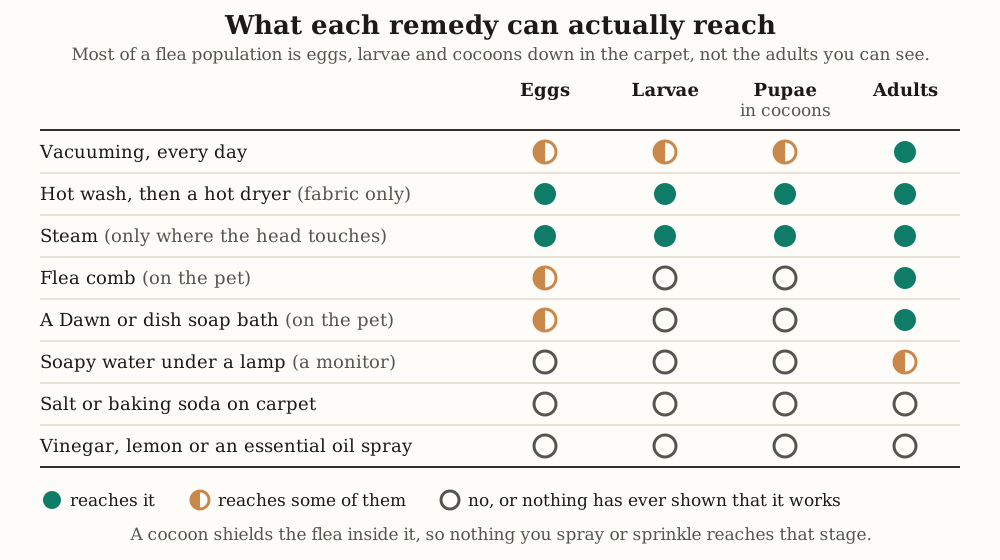
The free methods, and what each one reaches
Flea comb in soapy water
- What it reaches
- Adults, some eggs
- Where
- On the pet
- How often
- Daily
Vacuuming
- What it reaches
- Most adults, some eggs, larvae and cocoons
- Where
- Carpet, rugs, sofa, car
- How often
- Daily
Hot wash, then a hot dryer
- What it reaches
- Every stage
- Where
- Anything that fits in the machine
- How often
- Every few days
Steam cleaning
- What it reaches
- Every stage, cocoons included
- Where
- Wherever the head touches
- How often
- Once or twice in a bad case
A flea comb and a bowl of soapy water
A flea comb is the one remedy that gives a pet relief tonight. Its teeth are close enough to trap adult fleas. The University of Florida estimates a comb removes roughly 10 to 60% of the fleas on an animal. Work from the neck to the base of the tail, against the lie of the hair, and check the belly and the armpits.
Dip the comb in a bowl of water with a squirt of dish soap after every stroke. The soap breaks the surface tension, so the fleas sink and drown instead of jumping off. Combing does not clear a house, but it does tell you whether the numbers are going up or down.
Vacuuming every day
Vacuuming is the most useful free remedy, and there is a study to prove it. In tests at Ohio State, Hink and Needham found that vacuuming killed an average of 96% of adult fleas. It also killed every larva and pupa it picked up, so what goes into the machine dies.
The catch is what stays behind. Texas A&M puts the share a vacuum actually lifts from deep carpet at only 30 to 60% of eggs and 15 to 30% of larvae. Larvae cling to the fibres. That is why one pass is not enough and a daily pass is. The vibration also coaxes adults out of their cocoons, where they meet the next vacuuming instead of hiding.
A hot wash and a hot dryer
Heat kills fleas at every stage, and a washing machine is the easiest way to apply it. Wash pet bedding, your sheets and any throw the pet lies on in water at least 120F (49C), or the hottest the fabric allows. Then dry on high heat, which finishes anything the wash missed.
A cushion or bed that will not fit in the machine can still go in a hot dryer on its own for a full cycle. Bedding that cannot take heat at all is often cheaper to replace than to treat.
Steam cleaning
Steam reaches the stage nothing else does. A flea cocoon shields the adult inside from sprays and powders, but it does not survive heat. The EPA lists steam cleaning alongside vacuuming for flea control. Hire a carpet steamer for a bad case, and work slowly so the heat gets down into the pile.
Vacuum again the next day. The heat and moisture can trigger adults to leave their cocoons, and you want to catch them as they come out.
Light traps and the white sock test
A dish of soapy water under a lamp at night catches adult fleas, and readers use it to find where the fleas are. Treat it as a measuring tool rather than a cure. Lab studies of flea traps found the best ones use an intermittent green-yellow light, which a desk lamp is not. Adults are also only a small part of the problem.
The white sock test is the other free monitor. Pull on white knee socks and walk slowly through the rooms where the pet rests. Adult fleas jump onto the socks and show up clearly. Fewer each week means you are winning.
Home remedies for fleas, rated one by one
Most home remedies for fleas have never been tested against fleas at all, and the few that have mostly failed. This table gives a verdict on each of the common home remedies for fleas, with what decides it and what to do instead. A "no evidence" verdict means we found no study showing it works, not that someone proved it harmless.
Every common home remedy for fleas, rated against the evidence
Flea comb
- Verdict
- Works
- What decides it
- Removes adults from the pet; drowns them in soapy water
- Do this instead
- Comb daily
Vacuuming
- Verdict
- Works
- What decides it
- Kills 96% of adults and all larvae and pupae it collects
- Do this instead
- Vacuum daily
Hot wash and dryer
- Verdict
- Works
- What decides it
- Heat kills every stage on fabric
- Do this instead
- Wash bedding every few days
Steam
- Verdict
- Works
- What decides it
- Heat reaches the cocoons
- Do this instead
- Steam carpets in a bad case
Dawn or dish soap
- Verdict
- Partly
- What decides it
- Kills adults on contact; nothing left after rinsing
- Do this instead
- A first bath, then a vet product
Soapy water light trap
- Verdict
- Monitor only
- What decides it
- Catches some adults, nothing else
- Do this instead
- Use it to count, not to cure
Borax and boric acid
- Verdict
- Partly, larvae only
- What decides it
- Registered borate carpet products killed larvae in lab tests
- Do this instead
- Use a registered product as labelled, or skip it
Diatomaceous earth
- Verdict
- Partly, with rules
- What decides it
- Kills by drying, only while dry; EPA-registered products only
- Do this instead
- Cracks and crevices, never across a floor
Salt
- Verdict
- No evidence
- What decides it
- No study has tested it against fleas
- Do this instead
- Vacuum instead
Baking soda
- Verdict
- No evidence
- What decides it
- No institutional source recommends it
- Do this instead
- Vacuum instead
Vinegar or apple cider vinegar
- Verdict
- No evidence
- What decides it
- No study shows it kills or repels fleas
- Do this instead
- A soap bath
Lemon or citrus spray
- Verdict
- No evidence, unsafe for cats
- What decides it
- Homemade lemon is not the registered d-limonene product
- Do this instead
- Keep away from cats
Essential oils
- Verdict
- Unsafe
- What decides it
- 92% of exposed animals had side effects in one ASPCA study
- Do this instead
- Never on a cat
Coconut oil
- Verdict
- No evidence
- What decides it
- No study shows any effect on fleas
- Do this instead
- A comb
Brewer's yeast or garlic
- Verdict
- Does not work; garlic is toxic
- What decides it
- A 1983 trial on 60 dogs found no effect
- Do this instead
- Ask your vet
Cedar chips or oil
- Verdict
- Short-lived at best
- What decides it
- Fresh chips fade fast; the oil irritates skin
- Do this instead
- Wash bedding instead
Rubbing alcohol
- Verdict
- Unsafe
- What decides it
- The EPA warns it can easily ignite
- Do this instead
- Soapy water
Bleach or Lysol
- Verdict
- No evidence
- What decides it
- Disinfectants, not flea treatments
- Do this instead
- A hot wash
Baby powder or lime
- Verdict
- No evidence
- What decides it
- We found no study or extension source that supports either
- Do this instead
- Vacuum instead
Ultrasonic devices
- Verdict
- Do not work
- What decides it
- Fleas showed no response; 98.6% stayed on test cats
- Do this instead
- Save the money
Nematodes in the yard
- Verdict
- Partly
- What decides it
- Labelled for flea larvae outdoors; not well tested
- Do this instead
- Shaded, damp spots only
Does salt or baking soda kill fleas?
No study shows that salt or baking soda kills fleas at any stage. The idea is that both powders dry fleas out, and several big pest-company and health sites repeat it, but none of them cites any evidence. NPIC, the national pesticide information service, advises against home remedies because most have not been found to work.
"The salt trick" survives because people vacuum afterwards, and the vacuuming does the work. Readers who try it report the same split: it seems to help for a week, then the fleas come back. Keep the vacuuming and skip the powder.
Does vinegar kill fleas?
Vinegar does not kill fleas, and there is no good evidence that it repels them either. White vinegar and apple cider vinegar are both sold as natural flea sprays for dogs. No study has tested either one against fleas, and extension services do not recommend them.
A vinegar rinse is not dangerous for most dogs, but it wastes the time you could spend combing. If you have already tried one and saw fewer fleas, nothing shows the vinegar was the reason.
Essential oils and lemon, and why cats are different
Essential oils are the most dangerous home remedy for fleas, and cats bear most of the harm. A product sold as natural and used exactly as the label says can still poison one. In an ASPCA Animal Poison Control study, Genovese and colleagues found that 92% of 48 animals exposed to "natural" oil-based flea products had side effects. Most were cats, 77% had been treated as the label said, and three died or were put to sleep.
Tea tree oil is the worst offender. A second ASPCA study, by Khan and colleagues, reviewed 443 dogs and cats poisoned by 100% tea tree oil, with signs appearing within 2 to 12 hours. Young and small cats were the most at risk. Pennyroyal, still listed as a flea plant on one top-ranking page, contains a compound that can cause seizures and liver failure.
Lemon is a quieter version of the same problem. The citrus compound d-limonene does kill fleas in the lab, and it is an ingredient in some registered products. That is not the same as a homemade lemon spray, which has never been tested. Texas A&M also notes that some cats react even to registered citrus-oil products.
Does borax kill fleas?
Borax reaches flea larvae and nothing else. In lab tests by Hinkle and colleagues, registered boric acid and borate carpet treatments killed flea larvae at low doses. Borates do not kill adult fleas, and no source has tested ordinary laundry borax on a carpet, which is an off-label use.
The University of Florida advises against borate treatments in homes with infants. If you want one anyway, choose an EPA-registered carpet product and follow its label. Our page on borax for ants explains how borates work on insects in more detail.
What about diatomaceous earth?
Diatomaceous earth kills fleas by drying them out, and only while it stays bone dry. The EPA says pool or food grade products should not be used. Dusts like this belong in cracks and crevices rather than across a floor, because the fine powder gets into lungs. Several of the top pages for this search tell readers to dust their carpets with it anyway. Our guide to whether diatomaceous earth kills fleas covers where it helps and where it does not.
Coconut oil, brewer's yeast and garlic
Coconut oil has no evidence behind it for fleas, and vets who have been asked about it say so. Brewer's yeast was tested properly in 1983: Baker and Farver gave yeast to 60 dogs for seven weeks and found no effect on their fleas. Garlic is often paired with it, and garlic is toxic to dogs and cats, according to the ASPCA. It damages red blood cells, so leave it out of the food bowl.
Rubbing alcohol, bleach and Lysol
These are cleaning products, and none of them is a flea treatment. Rubbing alcohol is the dangerous one: the EPA warns that it can easily ignite, so never spray it on carpet, furniture or a pet. Bleach and Lysol disinfectants are registered to kill germs, not fleas, and we found no study testing either against them.
Does Dawn dish soap kill fleas?
Of all the home remedies for fleas, Dawn is one of the few with a real effect. It kills adult fleas, but only the ones it touches, and only while the pet is wet. Soap breaks the water's surface tension so the fleas drown, and the CDC describes soap as a gentle insecticide for adult fleas. It does nothing to the eggs, larvae and cocoons in your floor, and it leaves no protection behind once you rinse.
No study has tested Dawn by brand. The CDC's advice is about soap in general, so it is the soap, not the brand or the colour of the bottle, that does the work.
The weakness is what happens the next day. Fleas waiting in the carpet jump straight back on a clean pet. In a trial reported by Beugnet and colleagues, a weekly hygiene shampoo never gave better than 79.2% flea control. A vet spot-on gave 99.1% or more, and missing one bath dropped the shampoo to 34.8%. A bath clears the animal for an evening, but it cannot hold a house.
Does Dawn kill flea eggs?
Dawn does not kill the flea eggs in your home, because almost none of them are on the pet. Flea eggs are smooth and dry, and they roll out of the coat within hours. A bath may wash a few loose ones down the drain, but the ones already in the bedding and carpet are untouched. Our guide to flea eggs in bedding and carpet explains why.
How long does Dawn take, and how long does it last?
Dawn works only while the fleas are wet and coated, so the kill happens during the bath itself. The effect ends the moment the soap is rinsed off. Nothing stays in the coat, so the pet can pick up new fleas from the carpet the same night. The comb is the only way to catch them before they bite.
Dish soap can dry out skin and coat, so do not use it every day. A Dawn bath is a sensible first step for a puppy or kitten too young for flea medication. Call your vet first, though: they can tell you the age from which a product is safe.
How to get rid of fleas in the house fast, naturally
The fastest natural way to get rid of fleas in a house is to do the four free methods together, every day, for about four weeks. Wash everything soft on hot, vacuum daily, steam the carpets in a bad case, and comb the pet. Pair that with a vet-recommended product on every pet, which is the step that stops new eggs falling in the first place.
Seven steps, in this order
Confirm it is fleas
Comb the pet over a sheet of white paper, then tip the specks onto a damp paper towel. Flea dirt smears reddish brown within a minute. If nothing smears and nothing jumps, stop here and work out what you have before you clean for a week.
Wash everything soft, hot
Strip the pet's bedding, your sheets and any throw the pet lies on. Wash in hot water, at least 120F (49C) if the fabric allows, then run the dryer on its hottest setting. Heat kills every stage on anything that goes in the machine.
Vacuum every day
Go slowly over carpet, rugs, upholstery, the edges of each room and the gaps between floorboards. Seal the bag or the canister contents in a plastic bag and put it in an outside bin. Do this daily, not weekly.
Steam what you cannot wash
A steam cleaner reaches the larvae and cocoons deep in carpet and sofa cushions, which no spray or powder does. Hire one for a bad case. Vacuum again afterwards, because the heat brings adults out of their cocoons.
Comb the pet every day
Work a fine flea comb from the neck to the base of the tail and dip it in soapy water after every stroke. This gives the pet relief and tells you whether the numbers are falling.
Call your vet for every pet
Every dog and cat in the house needs a vet-recommended flea product, the same week. One untreated animal reseeds the floor. Never use a dog product on a cat.
Keep going for four more weeks
Adults keep leaving their cocoons for about two weeks after you start, so expect a wave in week two or three. Keep vacuuming and combing until a full fortnight passes with no new fleas.
This plan uses no chemicals in the house itself. For the full job, including the yard and the products a licensed professional can use, see our complete flea removal guide.
Why it seems to stop working in week two
Fleas usually come back in week two or three, and that is normal rather than a sign you failed. Adults go on leaving their cocoons for about two weeks after you start, UC IPM notes, and nothing reaches them while they wait. They come out as soon as they sense warmth and movement, so a busy house brings them out fast.
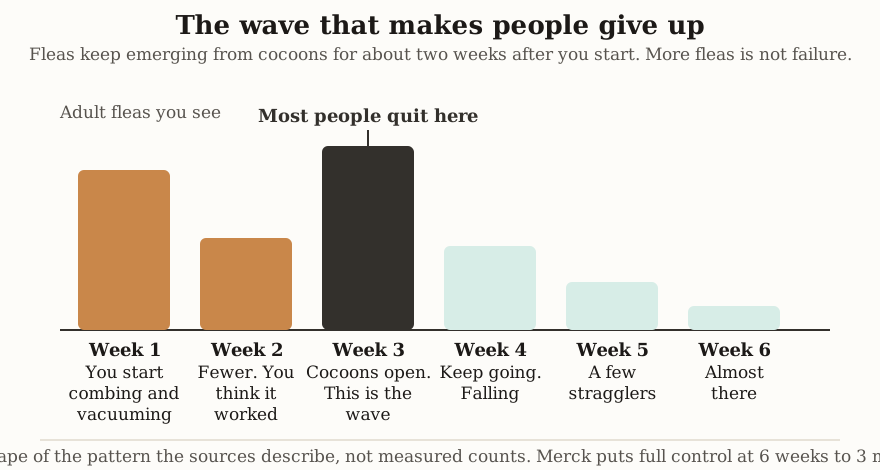
This is the point where readers start asking whether it is ever going to end. It does, if you keep going. Merck puts full control of a home at six weeks to three months, and each week of daily vacuuming empties more of the cocoons. Stopping at the wave hands the carpet back to the fleas.
What to do when a remedy has let you down
Salt or baking soda
- What happened
- It helped for a week, then fleas returned
- Do this instead
- Daily vacuuming, without the powder
A Dawn bath
- What happened
- The pet was clear for a day
- Do this instead
- A vet product on every pet, plus daily combing
An oil or vinegar spray
- What happened
- No change, or a pet reacted
- Do this instead
- Wash it off and call the vet if the pet seems unwell
A flea bomb
- What happened
- Fleas back within weeks
- Do this instead
- Steam and vacuum the carpet edges and under furniture
Diatomaceous earth on the carpet
- What happened
- Dust everywhere, fleas still there
- Do this instead
- Vacuum it up; registered product in cracks only
Natural flea repellents for people and dogs
No natural flea repellent has been shown to keep fleas off people or pets. On your skin, the CDC lists EPA-registered repellents with DEET, picaridin, IR3535, oil of lemon eucalyptus, PMD or 2-undecanone for preventing flea bites. The EPA, however, says most insect repellents do not work against fleas, so pick one whose label lists fleas.
Either way, a repellent on your legs protects your legs and nothing else. It does not clear fleas from a pet or a carpet. Our comparison of picaridin and DEET covers the two most common options. Our guide to whether humans can get fleas explains why they bite you without settling on you.
For dogs, the natural repellents sold online are the same oils and vinegars rated in the table above, and none of them has evidence behind it. We do not give a dilution for any of them, because none is safe enough to guess at. Ask your vet about a product labelled for your dog's age and weight, and read our guide to fleas on puppies and dogs for the full plan.
As for smells fleas hate, fleas find a host by warmth, movement and the carbon dioxide in breath. A strong smell does not hide any of those, which is why scented collars and sprays keep failing.
Nematodes for the yard
Nematodes are the one natural yard treatment with a label behind it. They are microscopic worms, sold as Steinernema carpocapsae, that hunt flea larvae in soil. They work best in sandy soil, and Texas A&M notes that their effect on fleas has not been well tested. Use them only in shaded, damp spots where a pet rests, because flea larvae die in hot, open lawn anyway.
Flea remedy myths
Myth 1
Myth: “Salt and baking soda dry fleas out.”
Truth: Several big health and pest sites say so without a single source. No study has tested either one against fleas, and the vacuuming people do afterwards is what helps.
Myth 2
Myth: “Natural means safe for pets.”
Truth: The ASPCA study by Genovese found side effects in 92% of animals exposed to natural oil-based flea products, most of them cats. Natural describes where a product came from, not what it does to a cat.
Myth 3
Myth: “Food-grade diatomaceous earth is fine to sprinkle on carpet.”
Truth: The EPA says pool or food grade products should not be used. Desiccant dusts belong in cracks and crevices only, because the fine powder gets into lungs.
Myth 4
Myth: “A flea bomb clears the house in an afternoon.”
Truth: A fogger's mist settles on open surfaces. It misses the carpet base, under furniture and inside cracks, which is where the eggs, larvae and cocoons are. Foggers also carry a fire risk near a pilot light.
Myth 5
Myth: “Ultrasonic repellers and herbal collars keep fleas away.”
Truth: In lab tests fleas showed no response to ultrasound, and in a trial on cats wearing ultrasonic collars, 98.6% of the fleas were still there. Extension services say the same of herbal collars.
Myth 6
Myth: “Feeding a dog brewer's yeast or garlic stops fleas.”
Truth: A trial on 60 dogs over seven weeks found brewer's yeast did nothing. Garlic is toxic to dogs and cats and damages red blood cells.
Myth 7
Myth: “If fleas come back after cleaning, the cleaning failed.”
Truth: Adults keep leaving their cocoons for about two weeks after you start. A wave in week two or three is expected, and it fades if you keep vacuuming.
Myth 8
Myth: “A Dawn bath every day will get rid of fleas.”
Truth: A bath kills the fleas on the pet that day and nothing in the carpet. Daily dish soap also dries out the skin. It is a first step, not a plan.
When home remedies are not enough
Home remedies for fleas are not enough when the fleas are still there after four to six weeks of daily cleaning. The same goes for a pet that is unwell, or a house with more than one pet. Free methods reach the floor, but only a vet-recommended product stops new eggs being laid on the animal. Many readers who post "never ending" have skipped that step.
Call your vet the same day if a puppy or kitten has pale gums, seems weak or is covered in fleas, because heavy flea feeding can cause anaemia. Call too if you see rice-grain segments around the tail or in the bedding, which point to tapeworm, or if the pet is scratching itself raw. Each of those needs treatment rather than cleaning.
Call a licensed pest professional when you still see new fleas after about six weeks with every pet treated, or when the fleas came with a rented home or spread through a shared building. If you rent, tell your landlord in writing on the day you find them. Still not sure what you are dealing with? Photograph the insect and run it through our free AI bug identifier, and read the main flea guide for the whole topic. For bites on people, our guide to treating flea bites covers what they look like and when one needs care.
Pest control disclaimer. Photo-based identification can help, but it is not always perfect. For dangerous spiders, large infestations, or anything you are unsure about, contact a licensed pest control professional.
Frequently asked questions
What kills fleas instantly in the house?
What can I rub on my dog to kill fleas?
What do Amish use for fleas?
Does vinegar and Dawn kill fleas?
What smell do fleas hate?
Does rubbing alcohol kill fleas?
Is baking soda safe to put on carpet for fleas?
How long do home remedies take to get rid of fleas?
Are home remedies safe for kittens and puppies?
Related guides
Fleas
The flea, head to toe, and the signs that give it away before you see one.
How to get rid of fleas
The whole job in order: the pets, the floors, the follow-up and what to skip.
Diatomaceous earth for fleas
Where DE helps, where it does not, and the EPA rule on how to apply it.
Flea eggs
What flea eggs look like, where they end up and what actually kills them.
Flea dirt
Black specks that smear red on wet paper, and what that tells you.
What kills fleas on dogs instantly
The fast kills, how fast each one really is, and why fleas come back.
Fleas on cats
Why cats hide the evidence, and the products that can kill them.
Fleas on dogs
Finding and treating fleas on a dog, plus the signs that need a vet.
Natural mosquito repellent
Which plant-based repellents work on mosquitoes, with the evidence for each.
Sources
- US EPA, Controlling Fleas and Ticks Around Your Home (vacuuming, steam cleaning, washing bedding)
- US EPA, Do-it-yourself Bed Bug Control (rubbing alcohol can easily ignite; pool or food grade diatomaceous earth should not be used)
- CDC, Getting Rid of Fleas (soap as a gentle insecticide for adult fleas, follow-up treatments)
- UC IPM Pest Notes 7419, Fleas (adults emerge for about two weeks after treatment; home remedies and devices that do not work)
- Texas A&M AgriLife Extension ENT-3001, Fleas (what vacuuming removes, borates, citrus oils and cats)
- Genovese and others, 2012, adverse reactions to EPA-exempt essential oil flea products in dogs and cats (ASPCA Animal Poison Control Center)
- Khan and others, 2014, tea tree oil poisoning in 443 dogs and cats (ASPCA Animal Poison Control Center)