What do flea bites look like?
A flea bite is a small, raised, itchy spot with a tiny mark at its centre and a ring of colour around it. It stays small, and it rarely swells the way a mosquito bite does. Most fade within a few days, though the itch can run up to 5 days in people who react strongly.
UC IPM describes the bite as a small central red spot surrounded by a red halo, usually without much swelling. Ohio State University Extension adds that the spot is often hard and slightly raised. Cleveland Clinic puts it plainly: flea bites do not swell to the size of mosquito bites.
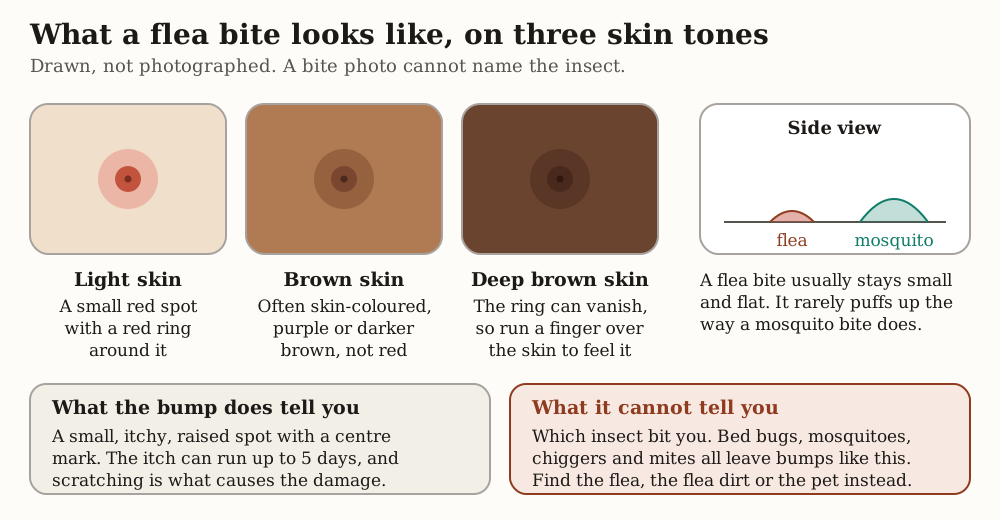
Two honest limits come with that picture. First, the same bite looks different on two people, because the bump is your own reaction to flea saliva rather than a fixed shape. Second, some people show no reaction at all after weeks of bites, so a quiet partner is not proof that you have no fleas.
University of Minnesota Extension says it is very challenging to diagnose flea bites from the lesions alone. That is why this page spends more time on where you were and what you find than on the bump.
Flea bites on black and brown skin
Colour is the first clue to fail. The NHS notes that redness is harder to see on brown and black skin, and Cleveland Clinic simply calls the bite a discoloured bump. On deeper skin tones the spot often looks skin coloured, purple or darker brown instead of red.
So feel for the bite rather than hunting for redness. Run a finger over the area: a flea bite is slightly raised, and it usually sits in a small group low on the leg. Photographs on most bite pages show light skin only. That leaves many readers comparing their own skin with a picture that was never going to match.
Do flea bites come in groups of three?
Not reliably, and the count gets repeated far more often than it is earned. Healthline ranks near the top for this search. It describes flea bites in clusters of three or more in a straight line, and calls the pattern breakfast, lunch and dinner. No medical source we opened gives a count of three.
Here is what the sources actually say. Cleveland Clinic says flea bites may appear in a straight line or a cluster of many bites. The NHS says they are usually found in groups below the knees. Ohio State says bites on sleeping people come in clusters or lines of two or more. CDC names the lower legs and feet, with no pattern at all.
So a tight group of three is possible, common even, and still worth nothing as proof. Bed bugs, mosquitoes and mites all leave groups. Count the bites if you like, then go and check the pet.
Where flea bites appear on your body
Most flea bites land below the knee, on the feet, ankles and lower legs. Fleas live and hatch at floor level, so that is the skin they reach first. CDC names the lower legs and feet, and Cleveland Clinic says bites rarely appear above the knee unless you spend a lot of time sitting or lying down.
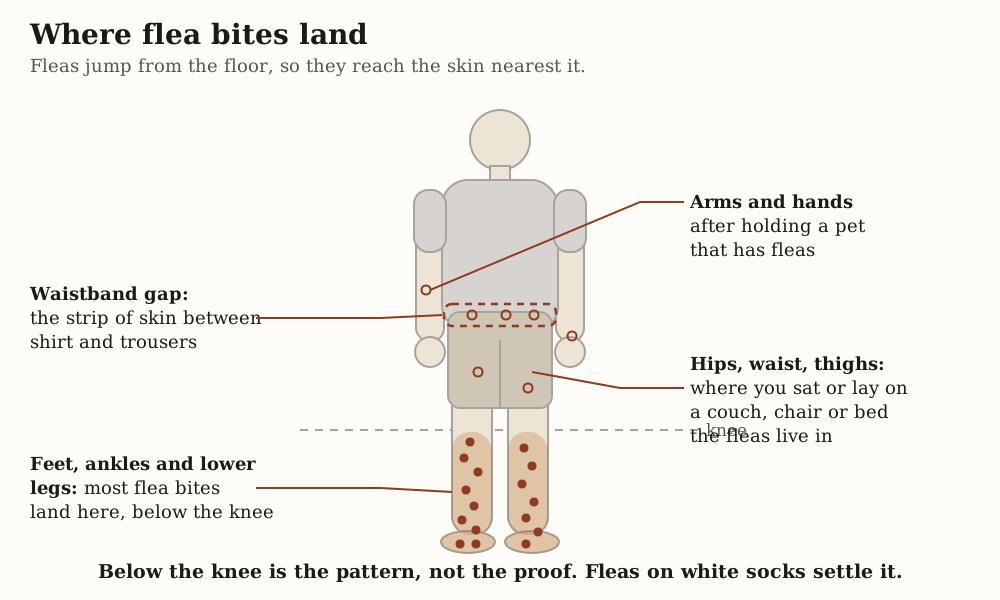
The exceptions follow the same logic. DermNet notes bites at the waistband, where a gap opens between shirt and trousers. Sit on an infested couch and the bites follow your hips and thighs. Sleep on a bed the dog uses, and they follow your back and arms.
Holding a flea covered pet puts bites on the hands and forearms too. In short, fleas bite the skin they can reach, and the pattern on your body is a map of where you have been sitting.
Do fleas bite humans?
Yes, and then they leave. Cat and dog fleas bite people readily, but they do not live on us, because we have too little hair for them to hide in. CDC says most fleas in the US prefer to feed on animals, and that people are bitten when they share space with an infested animal.
The fleas that bite you are usually the hungry new ones. Merck’s veterinary manual points out that newly emerged, unfed adults are the ones that go for people. A flea waits inside its cocoon until warmth, carbon dioxide or the vibration of footsteps tells it a host has arrived.
That is why an empty house can feel like an ambush. Better Health Channel, the Victorian health service, explains it in one line. Vibration such as footsteps prompts adult fleas to emerge from their cocoons. That is why a house standing empty for a while can bite you on the way in.
No pets at all? Fleas still have a source. A previous tenant’s cat, a neighbour’s dog, or wildlife such as opossums and feral cats under a deck will all do it. Our guide to whether humans can get fleas covers the living-on-you question in full.
Why do fleas bite some people and not others?
Usually they bite everyone and only one person reacts. Ohio State says some people show no reaction after repeated bites over weeks or months, while others react severely to the same saliva. So the difference you can see is in the skin, not in the flea.
Blood type is the folk answer, and no study we found tests it for fleas. The blood type research people remember is about mosquitoes, and even there it is thin: our page on what blood type mosquitoes like goes through it. Body heat, movement and breathing are what CDC lists as the things that draw a flea in.
Height plays a part too. Small children get bitten more because they play on the floor, which is where the fleas are.
How long do flea bites last?
One flea bite fades within a few days, and the itch can persist up to 5 days after the bite, according to UC IPM. A strong reaction lasts longer: Texas A&M AgriLife Extension puts those at 12 to 24 hours to appear and a week or more to settle. New bites, though, keep arriving for weeks.
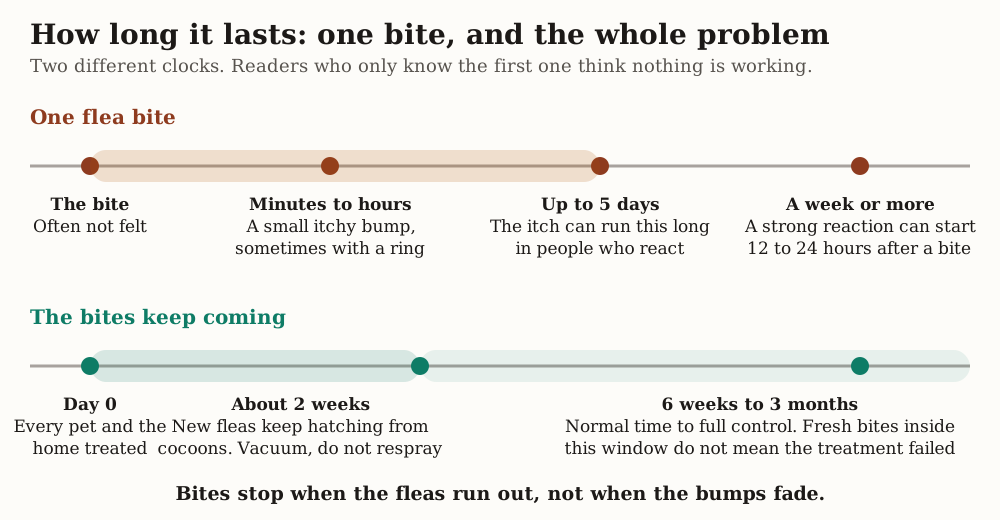
That second clock is the one nobody explains, and it is the reason people think treatment failed. Flea pupae sit inside cocoons that sprays cannot reach. Adults keep hatching out of them for about 2 weeks after a treatment, so fresh bites in that window are normal.
Merck puts full control at 6 weeks to 3 months, and CDC says a moderate or severe infestation takes months. Keep vacuuming through it rather than spraying again. Bites stop when the fleas run out, not when the bumps fade.
How to treat flea bites
Treating a flea bite takes four free steps and no prescription. Leave it alone, wash it with soap and water, then cool it for at least 10 minutes. Add one over-the-counter anti-itch product if the itch keeps you awake. Nearly all bites heal on their own within a few days.
Five steps that help a flea bite
Stop scratching, then keep the nails short
Scratching is what turns an itchy spot into a problem. It breaks the skin and lets bacteria in, and it can rub flea droppings into the wound. Cut everyone's nails, children first, and cover a bite you keep picking at.
Wash the bites with soap and water
Plain soap and water lowers the chance of infection, which is the NHS advice for any insect bite. Do this before you put anything else on the skin.
Cool the bite
Hold an ice pack wrapped in a cloth against the bite. Cleveland Clinic says at least 10 minutes, and the NHS says at least 20 minutes when the area is swollen. Cold slows the blood flow to the spot, which eases swelling and itch for a while.
Use one anti-itch product, by the label
The NHS lists a hydrocortisone cream to reduce itching and swelling, plus antihistamines to relieve the itch. DermNet lists oral antihistamines, soothing anti-itch creams and topical steroids, and Better Health adds calamine lotion. Ask a pharmacist which one suits you, your skin and your child's age, then follow the label.
Treat the fleas, not only the skin
Skin care buys comfort for a few days. It does nothing about the carpet, so new bites arrive tomorrow. Start the pet and the home on the same day you treat the bites.
So both the cream and the tablet sit inside mainstream advice, and this page gives no doses for either. A pharmacist can also spot an infected bite and supply the antibiotic for it.
What to skip is shorter. The NHS says plainly not to use home remedies such as bicarbonate of soda on a bite. Cleveland Clinic does list honey, chamomile tea and oatmeal, offered without evidence behind them, so treat those as comfort rather than treatment. For the whole job on the house, go to how to get rid of fleas at home on the same day you treat the bites.
Allergic reactions to flea bites
Some people react far harder than others, and one bite is enough to start it. UC IPM says a single bite can set off an allergic reaction, with intense itching and reddened skin. Texas A&M puts the delay at 12 to 24 hours, and says such reactions can last a week or more.
The persistent form has a name. DermNet calls it papular urticaria: very itchy red bumps, sometimes with a central blister that breaks, weeps and crusts. Old bite marks can flare again when a new bite happens, and the spots may leave marks on the skin for a while afterwards.
Children get it most, and it eases as they grow. DermNet says the condition settles over months or years as the child becomes less sensitive to the bites. Fleas and mites from cats and dogs are its usual cause, which is a strong hint to check the pet.
One tension is worth stating. DermNet, writing about flea bites, says anaphylaxis has not been reported. Cleveland Clinic still lists hives, rash, shortness of breath and swelling as an allergic reaction to get seen for. Treat those symptoms as an emergency whatever bit you.
Infected flea bites, and when to see a doctor
Infection is the common complication, and scratching causes nearly all of it. Pain, spreading redness, warmth, oozing, crusting or pus at a bite points to a bacterial infection, which usually needs an antibiotic. DermNet lists exactly those signs, and a pharmacist or doctor can treat it.
Fever is the other reason to get seen. Illness carried by fleas is rare in the US, yet it is real, and the timing matters more than the bite does. Tell the clinician that you have fleas at home, where you live, and which animals you have been near.
Cat flea bites: the flea biting almost everyone
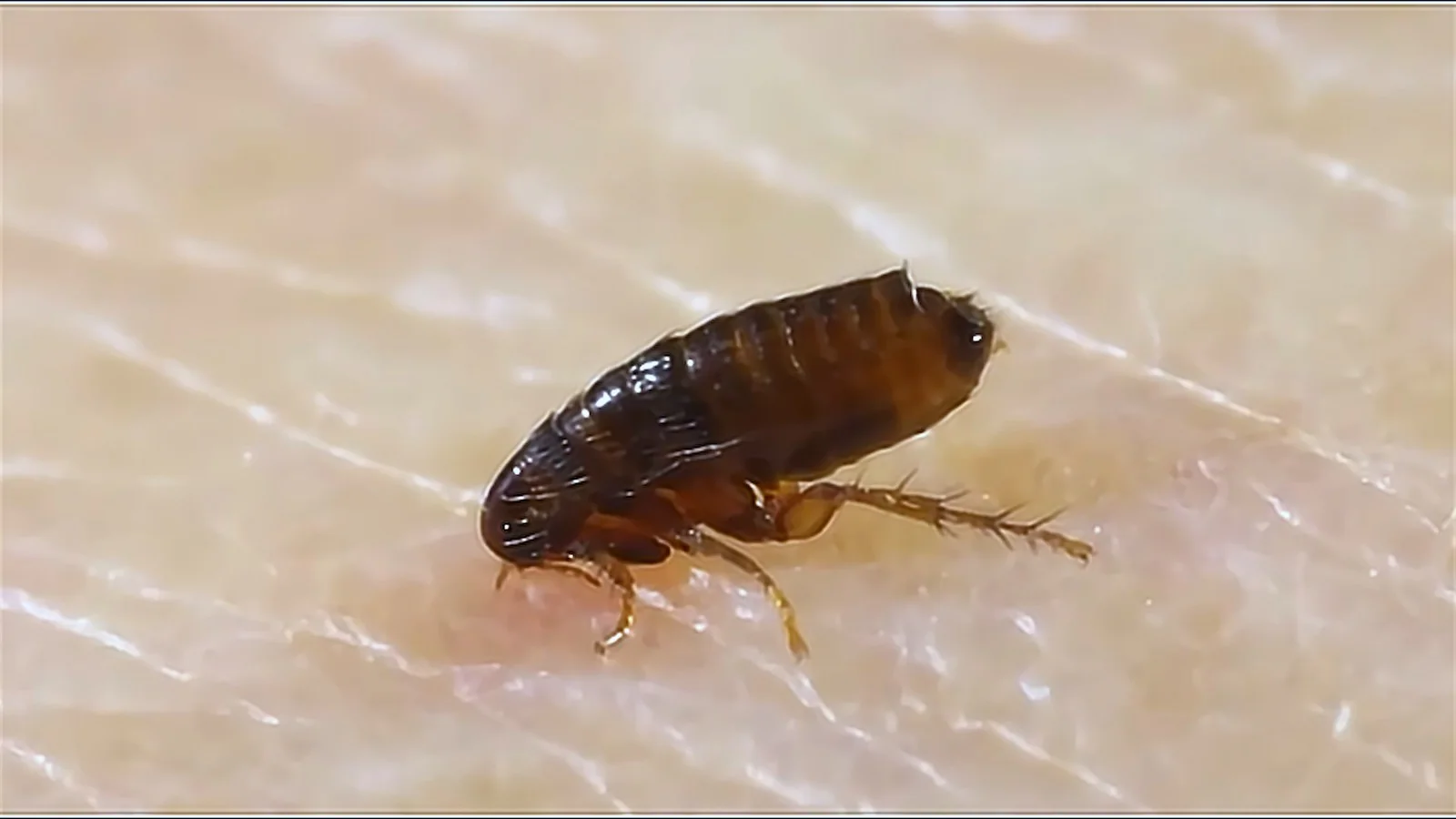
Almost every flea bite in an American home comes from the cat flea, Ctenocephalides felis. It is the usual flea on cats and dogs alike, it grows no bigger than 1/8 inch (3 mm), and it bites people happily when its animal is unavailable. Ohio State says most dogs with fleas have cat fleas.
The dog flea exists, though it is rare in North America, and telling the two apart needs a microscope. The human flea, Pulex irritans, lives mostly near farms and infested animals. For practical purposes, the bites on your ankles came from a cat flea, whether or not you own a cat.
Knowing the species matters for one reason: the cat flea is the one that carries murine typhus and the cat scratch disease germ in flea droppings. Our guide to what fleas look like shows the adult at true size, and signs of fleas on cats and signs of fleas on dogs cover the animal side.
Flea bites on babies and kids
Children collect more flea bites than adults, for two reasons. They play on the floor, where the fleas and the cocoons are, and their skin reacts harder, which is why papular urticaria is most common in childhood. Bites on a baby under 1 year old should be seen by a doctor, the NHS says.
Keep the treatment boring. Wash the bites, cool them, keep the nails short, and ask a pharmacist before putting any medicated cream on a young child. Never put a pet flea product on a person of any age, and never put a dog product on a cat.
There is one extra risk worth knowing about, and it is not the bite. CDC says most human cases of the flea tapeworm are in children, who pick it up by swallowing an infected flea. Flea control on the pet is what prevents it, so a child with fleas at home is a reason to call the vet as well as the pharmacist.
Parents on forums worry most about spraying a house with a baby in it. That worry is reasonable, and the answer is to lead with the free steps. Getting rid of fleas sets out the order: every pet treated by a vet, daily vacuuming, hot washing, and pesticides last and only by the label.
Can fleas live in your bed?
Fleas do not set up home in a mattress, but they do turn up in a bed that a pet sleeps on. Adult fleas live on the animal. Eggs are not sticky, so they roll off onto the sheets within hours, and the larvae then grow in the seams, the rug and the floor beside the bed.
This is the most repeated question in the whole flea topic: it appeared in the People also ask box on 8 of the 29 Google searches read for this silo. The answer people want is usually no, and the honest version is a little longer than that.
What turns up in a bed is eggs, flea dirt and sometimes a larva: tiny white grains, black specks or small pale worms. Our page on flea poop shows the test that settles it. A flea that jumps onto the duvet is a visitor from the carpet, not a resident.
Keep the pet off the bed until the house is clear, wash the bedding hot every few days, and vacuum beside and under the bed. Bites in bed with no pet in the house point at bed bugs or a mosquito in the room instead.
What else could it be?
Six things get mistaken for flea bites most often: bed bug bites, mosquito bites, chigger bites, mite bites, scabies and plain skin conditions such as hives. Nobody can name an insect from a photograph of a bump, so sort it out by where you were and what you find.
Flea bites and the bites they get confused with, and what settles each one
Fleas: a cat or dog in the home, and bites arriving day after day indoors
- Where the bites sit
- Feet, ankles, lower legs, and the waistband
- What settles it
- Fleas on white socks, or black specks that smear red-brown on damp paper
Bed bugs: bites found on waking, on skin left outside the covers
- Where the bites sit
- Arms, shoulders, neck, face and hands
- What settles it
- Live bugs, shed skins or dark spots in the mattress seams
Mosquitoes: time outdoors or an open window, and puffier bumps
- Where the bites sit
- Any bare skin, plus the ankles for the daytime tiger mosquito
- What settles it
- A mosquito in the room, standing water, a torn screen
Chiggers: itch starting hours after tall grass or brush
- Where the bites sit
- Sock line, waistband, behind the knees
- What settles it
- The yard explains it, and nothing bites again indoors
Scabies: itching worst at night, a pimple-like rash, other people itching too
- Where the bites sit
- Between the fingers, wrists, elbows, waist, armpits
- What settles it
- A doctor finds burrows, and it spreads by skin to skin contact
Biting midges at the coast, usually blamed on sand fleas
- Where the bites sit
- Feet, ankles and lower legs after a beach trip
- What settles it
- The location, and whether anything bites indoors
Hives or a skin reaction: welts that move or fade within hours
- Where the bites sit
- Anywhere, often with no exposure to explain it
- What settles it
- New soap, detergent, a medicine, heat or illness
CDC describes scabies as intense itching, especially at night, with a pimple-like rash between the fingers and in the folds of the wrist, elbow, knee or armpit. It spreads by prolonged skin to skin contact, so several people in one household itching at once is a reason to see a doctor rather than a pest controller.
For the two closest look-alikes, we have whole pages: flea bites against mosquito bites and the bugs people mistake for bed bugs. Woke up covered in bites instead? Start with bed bug bite symptoms. After a beach holiday, read sand flea bites, because in the coastal US those are usually biting midges. To compare 20 kinds of bite at once, use our bug bite identification chart.
Flea-borne typhus and the other flea diseases
Serious illness from flea bites is rare in the US, though it is not zero. Flea-borne typhus is the one Americans meet most, and CDC says southern California, Hawaii and southern Texas report most cases. Plague runs at an average of five human cases a year, nearly all in the rural West.
Typhus does not spread through the bite itself. The germ lives in flea droppings, which get rubbed into a scratched bite or into the eyes. Symptoms start 3 to 14 days later: fever, chills, headache and body aches, with a rash in about half of patients around day 5. Deaths are rare, under 1% of cases, and antibiotics clear it.
Plague comes from wild rodent fleas rather than from the cat fleas on your pet. Bubonic plague starts 2 to 8 days after a bite, with fever and a swollen, painful lymph node. CDC treats that pairing as an emergency, so do not wait it out if you live in the rural West.
Two more are worth a line. Cats pick up the cat scratch disease germ from fleas and pass it to people through a scratch, so flea control on the cat is how you prevent it. Children who swallow an infected flea can get a tapeworm, which is unpleasant and treatable. Our page on how dangerous fleas are covers the disease picture in more detail.
Medical disclaimer. This page is for general information only. It is not a medical diagnosis. If you have severe symptoms, trouble breathing, swelling of the face or throat, fast spreading redness, fever, severe pain, pus, or signs of infection, contact a doctor or your local emergency number.
How to be sure it is fleas, and clear them out
Three free checks settle it in about ten minutes. Walk the carpet in white knee socks, comb the pet over damp white paper, and look where the pet sleeps. Black specks that smear red-brown on the damp paper are flea dirt, and they confirm fleas even when you never catch one.
The white sock test comes from UC IPM, which uses it to check pet resting areas before anyone sprays anything. Fleas jump at the pale, moving target and show up as dark dots. The damp paper test works because flea dirt is dried blood, so it dissolves into a red-brown smear while ordinary grit stays black.
Once you know, the plan is always the same three jobs at once. Treat every pet in the home with a product your vet recommends, vacuum daily and empty the vacuum outside, and wash pet bedding hot. Our guides to what fleas look like, flea dirt and getting rid of fleas take each step in turn, and flea home remedies grades the tricks you have read about.
Repellent is a fair question with an awkward answer. CDC lists EPA-registered repellents with DEET, picaridin or IR3535 for preventing flea bites, along with long socks and trousers. EPA says most insect repellents do not work against fleas. So check that the label names fleas, use it for a trip through an infested room, and remember it protects skin only.
Flea bite myths, corrected
Myth 1
Myth: “Flea bites always come in threes.”
Truth: No medical or extension source gives a count. Cleveland Clinic says a line or a cluster of many, and Ohio State says two or more.
Myth 2
Myth: “Fleas live on people.”
Truth: Cat and dog fleas feed on us and leave, because our skin gives them nowhere to hide. In the laboratory, cat fleas fed human blood did survive and lay eggs, so the honest version is that they will not stay on you rather than that they cannot feed on you.
Myth 3
Myth: “Only one person has bites, so it cannot be fleas.”
Truth: Reactions differ wildly, and Ohio State says some people show none at all after weeks of bites.
Myth 4
Myth: “New bites after treatment mean the treatment failed.”
Truth: Adults keep hatching from cocoons for about 2 weeks. Full control takes 6 weeks to 3 months.
Myth 5
Myth: “A photo of the bite can name the bug.”
Truth: It cannot, and Minnesota Extension says as much. Catch the insect instead, then use our bug identifier by picture.
Myth 6
Myth: “Baking soda or vinegar on a bite heals it.”
Truth: The NHS says not to use home remedies such as bicarbonate of soda. Wash, cool and leave it alone instead.
Caught the insect itself? Set it on white paper and upload a photo to our bug identifier by image. A photograph of the bug answers the question. A photograph of the bite never does.
Pest control disclaimer. Photo-based identification can help, but it is not always perfect. For dangerous spiders, large infestations, or anything you are unsure about, contact a licensed pest control professional.
Flea bite FAQ
Can fleas bite through clothes?
How long after a flea bite does it show up?
Do flea bites spread if you scratch them?
Will showering get rid of fleas on me?
Do flea bites leave scars?
Can fleas bite your face or scalp?
Related guides
Fleas
The hub: what fleas are, where they come from, and every flea guide on the site.
What do fleas look like?
An adult at true size, the jump, and the bugs that get mistaken for one.
Flea dirt
Black specks on the pet or the bed, and the damp paper test that proves it.
How to get rid of fleas
Pets, carpet and follow-up in the order that actually breaks the cycle.
Can humans get fleas?
Whether fleas live on people or in hair, and what to do if you think they do.
Flea bites vs mosquito bites
Two bumps that look alike, and the clues that separate them.
Home remedies for fleas
Dawn, salt, vinegar and the rest, each graded against the evidence.
Sand flea bites
Itchy ankles after the beach are usually biting midges, not fleas.
Bed bug bites
Woke up with bites on your arms and neck? This is the other suspect.
Bug bite identification
A chart of 20 bites by look, place and timing.
Sources
- CDC, Preventing Fleas and flea bites (June 2024)
- CDC, About Flea-borne (Murine) Typhus
- Cleveland Clinic, Flea Bites: what they look like, symptoms and treatment
- NHS, Insect bites and stings (reviewed June 2023)
- DermNet, Flea bite: papular urticaria, secondary infection and treatment
- UC IPM Pest Notes 7419, Fleas: the bite, the halo and the 5-day itch
- Ohio State University Extension HYG-2081, Fleas: reactions, bite pattern and the cat flea