Can humans get fleas, and can fleas live on humans?
Can humans get fleas living on them? No. The flea in almost every American home is the cat flea, and a cat flea does not stay on a person. It jumps on, feeds, and goes. Our skin offers no fur to shelter in, so it cannot settle, mate or leave its eggs anywhere useful. Adults live on a furred animal instead.
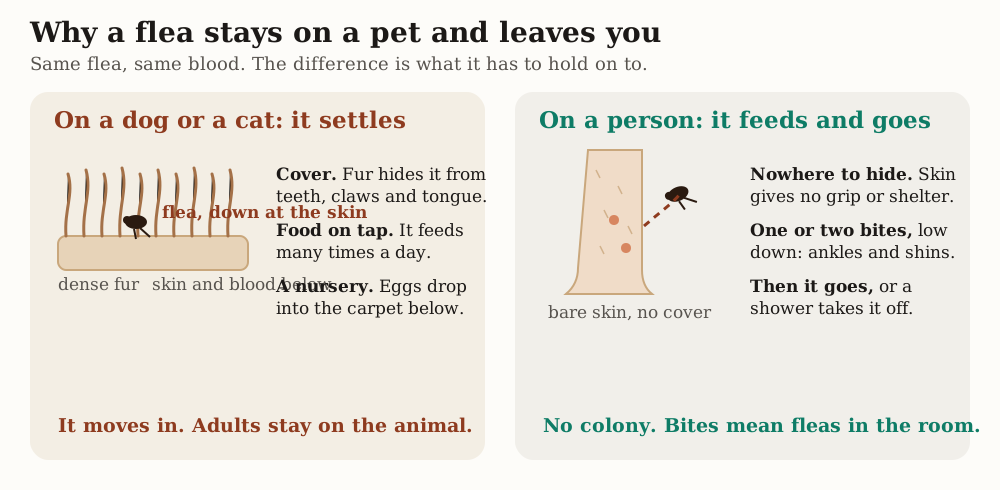
A flea is built for fur, and that is the whole answer. Its body is flattened from side to side, so it slides between hairs like a letter through a slot. Backward spines then stop a tongue or a claw from dragging it out.
On a dog or a cat, that body plan works beautifully. On an arm or an ankle, it has nothing to hold. The flea takes its meal and drops back to the carpet, where the rest of its family already lives.
Adult fleas are permanent passengers, which is the part most pages skip. Once a flea settles on a pet, it stays there, feeds many times a day and mates on the animal. It leaves only when grooming knocks it off. Nothing on a person offers that, so the flea moves on.
The same cat flea, in three places
On a cat or a dog
- Can it hide?
- Yes, down at the skin under dense fur
- Can it breed there?
- Yes. It mates on the animal and the eggs drop into the carpet
- What happens next
- It stays for the rest of its life, feeding many times a day
On your leg or arm
- Can it hide?
- No. Bare skin gives no cover at all
- Can it breed there?
- No. Nowhere to settle, and loose eggs fall straight off
- What happens next
- One or two bites low down, then it leaves or you wash it off
On your clothes
- Can it hide?
- Briefly, in a seam or a fold
- Can it breed there?
- No
- What happens next
- A ride of hours, not weeks. A hot wash and dryer end it
In your carpet
- Can it hide?
- Yes, deep in the pile and under furniture
- Can it breed there?
- This is where eggs, larvae and cocoons already are
- What happens next
- The real infestation, which is why the room gets treated, not you
Expect bites low down, too. Fleas reach you from the floor, so feet, ankles and shins take nearly all of them. Our page on flea bites on humans covers what the marks look like and how to ease them.
Can fleas breed on human blood?
In a laboratory, yes. In your house, no. Pullen and Meola fed cat fleas human blood through a membrane in 1995, and the fleas survived and laid fertile eggs, about three or four per female a day. So human blood is food.
What stops an infestation on you is behaviour, not nutrition. That difference matters, because many pages insist human blood cannot feed a flea at all. It can. The honest sentence is that fleas do not stay on people, and the honest reason is fur.
How long does a flea stay on a person?
Minutes, as a rule. A flea that lands on your leg takes a meal and leaves, or you brush it off without noticing. Even a flea riding on your clothes is short of time, because a newly emerged adult survives only one to two weeks with no blood meal.
Can fleas live in human hair?
Can humans get fleas in their hair? They can land in it, and they cannot live in it. No research we could open shows fleas breeding in human scalp hair, and the pest pages that answer yes walk the answer back a paragraph later. Hair on a head is far thinner than fur, so a flea finds no shelter and loose eggs simply fall out.
Something moving in your hair is far more likely to be a head louse. A louse is built for this one job, and its claws close around a hair shaft. It crawls slowly, and it never jumps. A flea cannot grip a hair at all, and a flea vanishes the instant you reach for it.
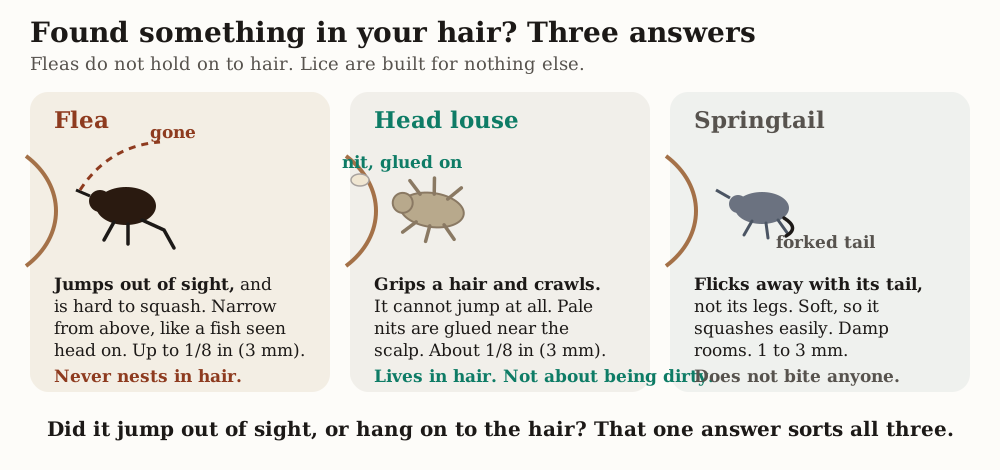
What is actually in your hair, and the one feature that settles each
Jumps out of sight the moment you reach for it, and resists a fingernail
- What it is
- Flea
- Size
- Up to 1/8 in (3 mm)
- Does it live in hair?
- No. It feeds and leaves
Clings to a hair shaft and crawls slowly, never jumps; pale nits glued near the scalp
- What it is
- Head louse
- Size
- About 1/8 in (3 mm)
- Does it live in hair?
- Yes. Its whole life happens there
Flicks away with a forked tail folded under the body, and squashes easily
- What it is
- Springtail
- Size
- 1 to 3 mm
- Does it live in hair?
- No, and it does not bite anyone
Slides freely off the hair and crumbles between your fingers
- What it is
- Dandruff or hair product
- Size
- Flakes, no fixed size
- Does it live in hair?
- Not alive at all
Black grit that smears rust red on damp paper
- What it is
- Flea dirt, carried up from the floor
- Size
- Specks under 1 mm
- Does it live in hair?
- No, but it proves fleas in the room
Shame deserves an answer here as well. Neither insect cares how clean you are, and neither one says anything about your housekeeping. Our guide to lice in hair covers nits, combing and treatment, if the table above points that way.
Human fleas: the species behind the name
Human fleas are real. Pulex irritans is a separate species, 1 to 4 mm long, with no combs of spines on its head. It bites people, pigs, dogs and wildlife. Even so, it is uncommon across the United States, and most records sit west of the Mississippi. It also lives in nests and bedding rather than on a body.
The name causes more confusion than the insect ever does. A reader who meets the phrase assumes it names the flea biting them, when the flea in an American apartment is nearly always a cat flea. Cat fleas feed on cats, dogs, opossums and raccoons, then bite whoever walks past.
Telling the two apart needs magnification. A cat flea wears two combs of dark spines, one under the cheek and one behind the head, while Pulex irritans wears neither. Under a hand lens, that is the check. Our guide to what fleas look like shows the shape and the size beside a ruler.
Signs fleas are on you or in your home
Three free checks settle it in one evening. Pull white socks up to your knees and walk where animals rest. Comb any pet over damp white paper and watch for specks that spread rust red. Then look at where your bites sit, because fleas bite below the knee.
The white sock test comes from UC IPM, and it works because a flea jumps up at a passing leg. Dark specks on white cotton are easy to spot. Walk slowly over carpet, pet beds and the shaded ground outside where animals lie.
Flea dirt is the second proof, and it is simply dried blood. Black grit that smears rust red on damp paper is flea droppings, so fleas are there even if you never catch one. Grit that stays black came from something else, and our page on what flea dirt looks like runs through the test.
One thing you will not find is a flea inside your skin. Nothing about a cat flea burrows, tunnels or embeds itself. The one true flea that does burrow is the chigoe flea, and it lives in the tropics, not in a US living room. Sand fleas at the beach are a different story again.
Can fleas live in your bed?
Fleas visit a bed. They do not colonise a mattress the way bed bugs do. Where a cat or a dog sleeps on the covers, eggs and flea dirt do land on the sheets. Larvae then grow in the seams and in the carpet beside the bed. A hot wash deals with all of it.
Bites that appear overnight, in a home with no pet and no flea on a sock, point somewhere else. Bed bugs are the usual answer, and the bugs people confuse with bed bugs shows how the two differ.
Black fleas on humans: what it usually turns out to be
Usually, not a flea. People search for black fleas on humans after seeing a tiny dark speck on skin or clothing. The real answer is often a springtail, a carpet beetle larva, a louse, a thrips or a crumb of flea dirt. An adult flea runs reddish brown to nearly black, up to 1/8 inch, and it resists a fingernail.
Dark specks people find on themselves, and the test for each
Jumps far, hard to squash, narrow seen head on
- What it is
- Flea
- Size
- Up to 1/8 in (3 mm)
- Does it bite people?
- Yes, mostly below the knee
Jumps with a forked tail, soft, bursts when pressed, loves damp
- What it is
- Springtail
- Size
- 1 to 3 mm
- Does it bite people?
- No
Crawls, hairy and bristly, often beside a shed skin in a closet
- What it is
- Carpet beetle larva
- Size
- 2 to 5 mm
- Does it bite people?
- No, though its hairs can irritate skin
Clings to a hair and crawls, with pale nits glued near the scalp
- What it is
- Head louse
- Size
- About 3 mm
- Does it bite people?
- Yes, on the scalp only
Slim, tapered, often on a plant or near one, and it crawls
- What it is
- Thrips
- Size
- 1 to 2 mm
- Does it bite people?
- It can nip, but it does not feed on blood
Does not move at all; smears rust red on damp paper
- What it is
- Flea dirt
- Size
- Under 1 mm
- Does it bite people?
- No, but it proves fleas nearby
Two quick checks do most of the sorting. First, did it jump out of sight? Fleas and springtails both leap, while lice and beetle larvae only crawl. Second, did it squash easily? A flea shrugs off a fingernail, whereas a springtail bursts at once.
Catch one before you decide, rather than guessing from a glimpse. Press clear tape over it, or seal it in a bag, and set it on white paper. Our round-up of small black bugs in the house lines up the usual suspects, and the bug finder will read a photo in seconds.
How to get rid of fleas on humans
Start in the shower. Soap and warm water take a flea off skin in seconds, and nothing survives on a washed body. Then wash everything you wore at the hottest setting the care label allows, and run a full hot dryer cycle. After that, the real job is the house and every pet in it.
Five steps that clear fleas off you
Shower with soap and warm water
Warm water and ordinary soap take a flea off skin in seconds, and you can wash your hair as well if something was in it. No special product helps here, and a pet flea shampoo is never one of them.
Wash and dry what you were wearing
Put the clothes straight into the washer at the hottest setting the care label allows, then run a full hot dryer cycle. Heat in the dryer does most of the work.
Check the room in white socks
Pull white knee socks on and walk slowly across the carpet and past any spot where an animal rests. Dark specks on the white cotton show you where the fleas are living.
Treat every pet through your vet
Ask for a flea product for each dog and cat in the home, not only the one that scratches. One untreated animal keeps the whole cycle running.
Vacuum daily and wash the bedding hot
Vacuum carpets, rugs and under furniture every day, then empty the machine into a bag and put it in an outside bin. Keep going for several weeks, because cocoons carry on hatching.
Nothing on your body needs a pesticide, and that is worth repeating twice. You are not the host, so there is no infestation on you to kill. Treating your skin while the carpet goes untouched is how people lose a month.
The full plan for the house, including vacuuming, washing and what a spray can and cannot reach, lives on our guide to how to get rid of fleas at home. If you would rather try the kitchen-cupboard route first, home remedies for fleas says which ones hold up.
Can fleas live on clothes?
Clothes carry fleas for a journey, not for a season. An adult on a jacket has no blood meal and little time, since a newly emerged flea lives one to two weeks at most without feeding. Hot water and a hot dryer finish it, and a sealed bag handles anything you cannot wash.
Can you carry fleas to another house?
It happens, though far less often than people fear. A flea can ride in on clothing, a bag or a pet bed, and a single fed female is enough to start something in a clean home. Shower and change before you visit, and never move a used pet bed or floor rug out of an infested house.
Does repellent keep fleas off you?
Only a little, and it fixes nothing. EPA notes that most insect repellents do not work well against fleas or lice. CDC does list repellents containing DEET, picaridin or IR3535 among the steps for flea bites, with long socks and pants, so one can spare your legs for an evening outdoors. It still does nothing about the fleas breeding in your carpet.
Fleas but no pets: where they came from
Something fed them, even if nothing lives with you now. Four sources explain nearly every case: a pet that lived there before you did, wildlife nesting in the structure, a neighbour’s animal, or fleas you carried in yourself. So can humans get fleas with no pet in the house? Yes, and the reason is always another animal.
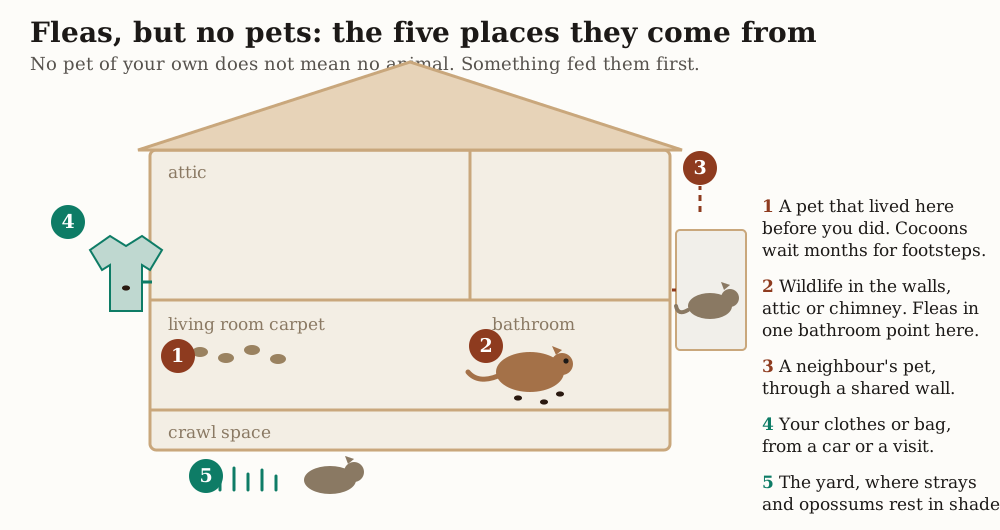
A previous tenant’s pet is the common answer. Flea pupae sit in carpet inside a sticky cocoon, and a fully formed adult can wait in there for months, up to about a year in cool conditions. Warmth, breath and the pressure of footsteps then call it out.
An empty house does not starve fleas out, so much as store them. That is why people walk into a place they have not used for weeks and get swarmed at the door. One Reddit poster came back after two months and was covered before they got two feet inside.
Fleas in one bathroom, on hard floors, with no pet anywhere, nearly always mean an animal inside the building. Raccoons, opossums, squirrels, rats and bats all carry their own fleas, and a nest in a wall void, a chimney or a ceiling vent drops them into the room below. People who open the wall find the nest.
Get the animal out first, because treating a carpet under an occupied nest never ends. After that, neighbours are the next candidate, since shared walls, hallways and yards move fleas between homes easily. Our guide to fleas in a home without pets covers the life cycle behind all of this.
Why only one person in the house gets bitten
You are not being singled out. Everybody in the room is probably getting bitten, and only some people react to it. Skin answers flea saliva at wildly different strengths, and extension sources record people who show nothing at all after weeks of bites.
So one covered partner and one unmarked partner is the normal pattern, not a clue about the fleas. Blood type does the rounds on forums and explains nothing here, because no flea study supports it.
Children often react hardest of all. Repeated bites can set off papular urticaria, a hypersensitivity rash of very itchy bumps that lasts days to weeks and settles over months as the skin gets used to them. Only a doctor can confirm that, and a web page certainly cannot.
Fleas, babies and pregnancy
Keep the first week free of chemicals, because the steps that work best cost nothing anyway. Vacuum every day, wash bedding at the hottest setting its label allows, and get every pet onto a flea product your vet chooses. Those three jobs break the cycle. If a product goes down later, the label decides where it may be used.
Show a baby’s bites to a doctor rather than matching them against a photograph. Nobody can name an insect from a bite, and this page will not try.
Two things stay off the floor while a child crawls on it. Diatomaceous earth belongs in cracks and crevices as an EPA-registered product, never spread across open floors, because loose dust gets breathed in. Flea collars, shampoos and spot-on treatments belong on the animal named on the label, and never on a person.
Pregnancy changes nothing about the plan, though it does change who you ask. Vacuuming, hot washing and the vet still do the work, and your doctor or midwife is the person to check with before any product goes down.
One real risk is worth naming. A child who swallows an infected flea can pick up a tapeworm, which is another reason to treat the pets rather than the carpet alone. Our pages on dog fleas and cat fleas cover the pet side.
Can fleas make you ill?
Rarely, in the United States. Nearly all flea bites are itch and nothing more. Fleas can carry flea-borne typhus, reported mainly from southern California, Texas and Hawaii, and plague, which averages about five human cases a year in the rural West. Cat scratch disease and tapeworm also travel through flea droppings or swallowed fleas.
Flea-borne illness in the United States, for reference only
Flea-borne (murine) typhus
- How it reaches a person
- Infected flea droppings scratched into a bite or a wound
- Where it turns up
- Mainly southern California, Texas and Hawaii
- How common
- Uncommon, and rising. Symptoms start 3 to 14 days after exposure
Plague
- How it reaches a person
- Mostly wild rodent fleas, not cat fleas
- Where it turns up
- Rural West: northern New Mexico, northern Arizona, southern Colorado
- How common
- About five human cases a year across the whole country
Cat scratch disease
- How it reaches a person
- A scratch from a cat carrying flea droppings in its coat
- Where it turns up
- Anywhere cats and fleas are, more in the Southeast
- How common
- Most cases in children, in fall and winter
Flea tapeworm
- How it reaches a person
- Swallowing an infected flea
- Where it turns up
- Anywhere
- How common
- Mostly young children. Flea control is the prevention
Scratching is the part you can control. Flea droppings carry the typhus germ, and scratching rubs them into broken skin, so short nails and a cold pack beat picking at a bite.
Treat all of that as reference, not as a diagnosis. Only a doctor can say what a fever after bites means, and mentioning the fleas, the pets and any wild animals helps them answer.
Medical disclaimer. This page is for general information only. It is not a medical diagnosis. If you have severe symptoms, trouble breathing, swelling of the face or throat, fast spreading redness, fever, severe pain, pus, or signs of infection, contact a doctor or your local emergency number.
Pest control disclaimer. Photo-based identification can help, but it is not always perfect. For dangerous spiders, large infestations, or anything you are unsure about, contact a licensed pest control professional.
Myths about fleas on people
Myth 1
Myth: “Fleas live on people the way lice do.”
Truth: Can humans get fleas living on them, the way lice live on a head? They cannot. Fleas feed and leave, while a louse spends its whole life in hair.
Myth 2
Myth: “Fleas cannot feed on human blood.”
Truth: They can, and cat fleas fed human blood in a 1995 study laid fertile eggs. Behaviour keeps them off you, not your blood.
Myth 3
Myth: “Fleas lay eggs in your hair.”
Truth: No source we opened supports it. Flea eggs are not sticky, so they drop within hours wherever the flea was.
Myth 4
Myth: “A flea can jump 13 inches, so one reached my head.”
Truth: Measured cat flea jumps average about 8 inches, with a record of 19 inches. The 13-inch figure is closer to the dog flea, which is rare here.
Myth 5
Myth: “You cannot have fleas without a pet.”
Truth: Fleas with no pet are one of the most common situations people describe, and the source is a past pet, a neighbour or wildlife.
Myth 6
Myth: “Flea shampoo for humans will sort it out.”
Truth: There is no such product. A pet flea shampoo is labelled for that animal only.
Myth 7
Myth: “If only one person is bitten, it is in their head.”
Truth: Reaction varies between people, so one person covered in bites and one with none is ordinary.
Fleas on humans FAQ
Will showering get rid of fleas on humans?
How do you know if a human has fleas?
Can humans get fleas from dogs or cats?
Can people wear a flea collar?
Do fleas get in your hair at night?
Fleas but no pets: will they die off on their own?
Can fleas live on humans if the house is infested?
Related guides
Fleas
The hub guide covers what they are, how the life cycle runs, and every flea page on the site.
Flea bites
What the marks look like, where they land, and how to settle the itch.
What do fleas look like?
Size, shape and colour beside a ruler, with the look-alikes that fool people.
Flea dirt
Black specks that smear rust red on damp paper, and what that proves.
How to get rid of fleas
The whole job in order, from vacuuming to what a spray can reach.
Home remedies for fleas
Dawn, salt, vinegar and the rest, each with the evidence behind it.
Fleas on dogs
Signs in the coat, the vet conversation, and why the house matters as much.
Fleas on cats
Indoor cats get them too, and one dog product can kill a cat.
Head lice
If it clings to a hair and crawls, this is the page you want next.
Sources
- CDC, About Fleas: the US species, how fleas find hosts, and flea-borne disease
- CDC, About Flea-borne (Murine) Typhus: how flea droppings spread it, and where US cases are
- CDC, Plague Maps and Statistics: about five US cases a year, and which states
- UC IPM Pest Notes 7419, Fleas: the white sock test, the cocoon, and control that works
- US EPA, Introduction to Pesticide Labels: why the label is the law
- Cleveland Clinic, Flea Bites: where bites land, and when to call a provider
- DermNet, Papular Urticaria: the hypersensitivity rash behind an extreme reaction, mostly in children