The four animals called sand fleas
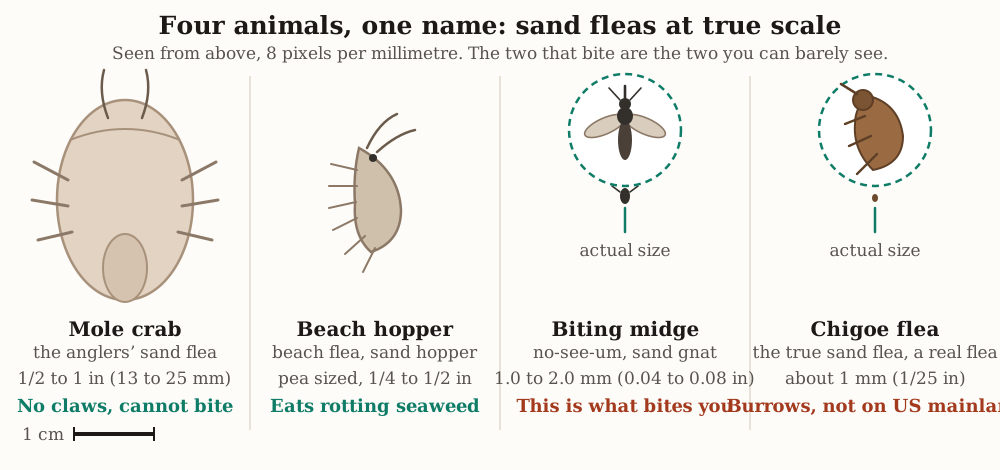
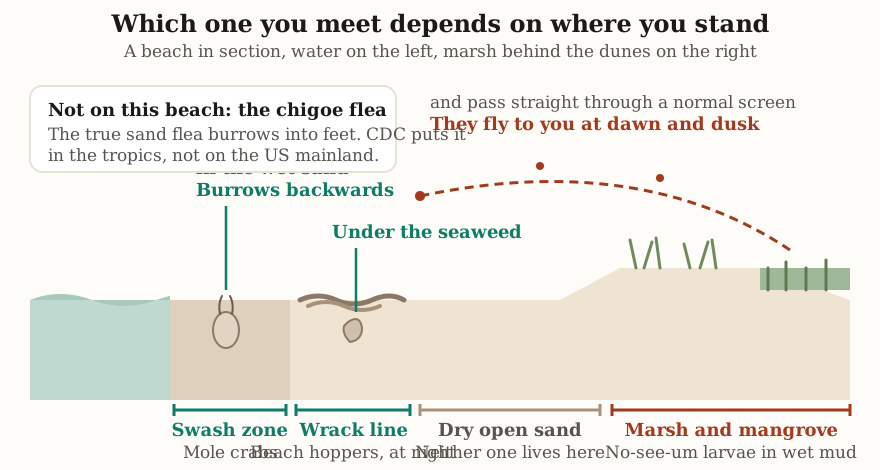
Four animals share the name sand fleas, and the separating feature is where you met it. Mole crabs sit in the wet sand where waves break. Beach hoppers live under the seaweed higher up. Biting midges fly in at dusk and bite. The chigoe flea burrows into feet, though not in the mainland US.
Which sand flea you met, and what it can do to you
Wet sand in the swash zone, digging backwards as a wave drains
- What it really is
- Mole crab, also called a sand crab (Emerita)
- Size
- 1/2 to 1 in (13 to 25 mm)
- Does it jump or fly?
- Neither. It burrows
- Does it bite?
- No. It has no claws and cannot bite or pinch
Under seaweed at the high tide line, at night
- What it really is
- Beach hopper, also called a beach flea or sand hopper (Talitridae)
- Size
- About pea sized, 1/4 to 1/2 in
- Does it jump or fly?
- Jumps, which is where the nickname came from
- Does it bite?
- No record of it feeding on blood, though the evidence is thin
You never saw it. Ankles and feet itch after dawn or dusk
- What it really is
- Biting midge, called a no-see-um, sand fly or sand gnat (Culicoides)
- Size
- 1.0 to 2.0 mm (0.04 to 0.08 in)
- Does it jump or fly?
- Flies, and passes through a normal window screen
- Does it bite?
- Yes. This is the one biting people at US beaches
A growing lump on a foot after travel in the tropics
- What it really is
- Chigoe flea, the true sand flea or jigger (Tunga penetrans)
- Size
- About 1 mm, swelling to about 1 cm once embedded
- Does it jump or fly?
- Jumps, like any flea
- Does it bite?
- Yes, and the female burrows into the skin and stays
Only the last two feed on blood. Because the first two cannot, a reader who saw an animal and a reader who has itchy ankles are usually talking about different species. That is the whole confusion in one sentence.
So start with what you saw rather than what you feel. If you dug it up, it was a crustacean and it was harmless. If you never saw anything and your legs itch, you were bitten by something small enough to pass through a window screen.
Which one did you meet? Six quick checks
Check each clue below to narrow down what you saw.
You dug it out of wet sand near the waves
That is a mole crab. Barrel shaped, grey-white, 1/2 to 1 inch long, with no claws anywhere on it.
Something jumped out of a pile of seaweed
That is a beach hopper, about the size of a pea. Hoppers live in the wrack line and eat the rotting weed.
You never saw anything, but your ankles itch
Biting midges, the no-see-ums. They are 1.0 to 2.0 mm long and fit through a standard window screen.
It was dawn or dusk, or a still, overcast day
That is the midge biting window. Mole crabs and hoppers do not change behaviour with the light in a way you would feel.
There is a growing lump on your foot after tropical travel
That can be the chigoe flea, which burrows. See a doctor, and do not dig at it.
It is jumping in your carpet, miles from any beach
Then it is an ordinary cat flea, not a beach animal. Dark, flat, wingless and about 1/8 inch long.
Do sand fleas bite?
Mostly no. Mole crabs and beach hoppers, the two animals Americans dig up and call sand fleas, do not feed on blood. Bites people blame on sand fleas at a US beach come from biting midges, the no-see-ums, which are 1.0 to 2.0 mm long. Only the true sand flea bites, and it is a tropical species.
Our guide to what sand flea bites look like covers the marks themselves, how long they last, and when a bite needs a doctor. This page stays on the animals, because naming the animal is what decides the rest.
Mole crabs, the sand flea anglers dig for
A mole crab is the barrel-shaped crustacean that burrows backwards as the waves run out. Florida extension agents call it the sand flea, and it measures 1/2 to 1 inch long, or 13 to 25 mm. It has a rounded grey-white shell, two feathery antennae and no claws at all.
That last detail matters. University of Florida extension in Escambia County puts it plainly: mole crabs are clawless, so they cannot bite or pinch, which makes them harmless to humans. Hand one to a child and nothing happens.
They live in the swash zone, the strip of wet sand where each wave runs up and drains away. As the water pulls back, they dig in backwards and put their antennae up to filter food out of the water. Dozens can wash up in a single wave, then vanish in seconds.
Anglers want them because pompano want them. On the Gulf coast people catch them with a sand flea rake and keep them in a bucket. Redfish, shorebirds and surfperch eat them too, so a healthy beach usually has plenty.
Mole crab, sand crab, sand flea: all three names point at the same animal. Scientists call the common Gulf and Atlantic ones Emerita. If you want the version a child remembers, it is the one that tickles your palm and digs its way out.
The sand flea rake
A sand flea rake is a basket on a handle, part rake and part sieve, and it is fishing gear rather than pest control. You drag it through the wet sand between the breaking waves and the high-water mark, then dip it to rinse the sand out. Whatever stays in the basket is bait.
Can you eat sand fleas?
Yes, people do eat mole crabs, and they are eaten boiled or fried in several countries. One caution is worth more than the recipe, though. Sand crabs concentrate a natural algal toxin, and that is exactly why researchers use them to monitor it.
Ferdin and colleagues measured domoic acid in Pacific sand crabs at Santa Cruz in 2002. Levels reached 13.4 micrograms per gram of crab, while mussels collected at the same beach stayed below the detection limit. Their point was monitoring, not dinner, but the number tells you something useful.
So treat them like any other shellfish you gather yourself. CDC advice on harmful algal blooms is to check and follow local fishing and shellfish advisories before you eat what you collect. Call your state shellfish program if nothing is posted at the beach.
Beach hoppers, the ones in the seaweed
Beach hoppers are the small jumping crustaceans that scatter when you turn over a pile of seaweed. They are about the size of a pea, and the National Park Service also calls them sand fleas. Unlike mole crabs, they stay above the waterline, in the band of weed and debris called the wrack line.
They are decomposers, so their job is eating the dead seaweed and other wrack that washes up. Park Service material from Point Reyes describes them doing exactly that, and it adds that they are most active at night. During the day they stay buried or hidden under the weed.
Here honesty matters more than a tidy answer. No extension sheet or government page we opened says plainly that beach hoppers do not bite people, even though several describe them feeding only on rotting plant matter. South Carolina Public Radio’s Nature Notes does say it directly: these amphipods are not true fleas and do not bite people.
Our own reading agrees with that, and we would rather tell you how strong the evidence is. Nothing we found records a beach hopper feeding on blood. If something bit you near the wrack line at dusk, the midges below are the better suspect.
No-see-ums, the thing that actually bites you at the beach
If your ankles itch after a beach trip, a biting midge is the likely culprit. These are tiny flies, 1.0 to 2.0 mm long, and the Florida average is about 1.5 mm. University of Florida entomologists call them no-see-ums, sand flies or sand gnats. Plenty of beachgoers call them sand fleas instead.
They breed in wet mud rather than in dry sand. Salt marsh and mangrove are the classic sites, which is why they are worst on beaches with marsh behind them. Florida alone has about 47 species in the genus Culicoides, though only about seven are serious pests.
Biting is mostly a dawn and dusk business, and a feed takes two to five minutes. On cool or heavily overcast days with calm wind, however, coastal species will bite in broad daylight. That is why “it was the middle of the afternoon” does not rule them out.
The bite itself feels like a sting or a burn, and it leaves a defined red area. Discomfort usually lasts minutes to hours. In people who are hypersensitive, though, the itch can run two to three days, which matches the vacationers who post that they are still itchy a week later.
One practical fact surprises people. A standard window screen does not stop them, because they fit through the mesh, and no-see-um screen is a finer product you have to buy on purpose. So a screened porch is not automatically a safe porch.
Sand fleas in Florida, Texas and the Gulf
Gulf and Florida beaches give you all three American meanings at once. Mole crabs sit in the swash, beach hoppers sit in the wrack, and the midges arrive from the marsh behind the dunes. Locals often use one name for all of them, which is how the confusion spreads.
Reddit threads about Florida beaches land on the same answer. A top reply in one r/florida thread puts it bluntly: they are no-see-ums, basically biting midges, while the real sand fleas live in the sand and have no interest in human flesh. The community sorted this out before the articles did.
The chigoe flea, the only true sand flea
One animal on this page really is a flea. Tunga penetrans goes by chigoe, jigger or true sand flea, and a mated female burrows into skin, usually between the toes or under a toenail. Once embedded she swells until her abdomen reaches about 1 cm.
Where it lives is the part that matters to most readers. CDC places it in tropical and subtropical regions, from Mexico through South America, the West Indies and Africa. The World Health Organization adds sub-Saharan Africa and the Caribbean. Neither puts it on the US mainland.
The infestation is called tungiasis, and it starts quietly. Burrowing is usually painless, so itching and irritation appear later, once the female is fully engorged. She then sheds about 100 eggs over roughly two weeks and dies in place.
Secondary bacterial infection is the real danger, and CDC says tetanus and gangrene are not uncommon. WHO reports that 99% of lesions sit on the feet. Most cases happen where people walk barefoot on earth floors and sandy soil.
Travellers pick it up barefoot, so shoes do most of the prevention. Walking shod on beaches, farms and dirt floors in affected countries cuts the risk sharply. WHO also reports that a coconut oil based repellent, applied to the feet twice a day, prevents the fleas from penetrating the skin.
Sea fleas, sea lice and the other names
Sea fleas is a third nickname, and it usually means the same beach hoppers. Sometimes it means something quite different. People who come out of the water with a rash under their swimsuit have met sea lice, which are not lice, fleas or crustaceans at all.
That rash has a name: seabather’s eruption. On the east coast of the Americas the usual cause is the larval stage of the thimble jellyfish, Linuche unguiculata. Those larvae get trapped under a swimsuit, and pressure fires their stinging cells into the skin.
Timing separates it from everything else here. The rash shows up a couple of hours after swimming, and it sits under the costume rather than on bare ankles. On average it lasts one to two weeks.
If you suspect it, get the swimsuit off quickly and rinse in clean seawater. Do not rub yourself with a towel, and do not rinse with fresh water while the suit is still on, because both can set off more stinging cells. Then wash the swimsuit properly before you wear it again.
Sand fleas versus the fleas in your house
House fleas and beach animals are not the same problem, and the tells are easy. A cat flea is a dark reddish-brown insect up to about 1/8 inch long, flattened side to side, with no wings. It lives on pets and breeds in carpet, not in sand.
A beach sand flea against the flea that gets into a house
What it is
- Beach sand fleas
- A crustacean, or a tiny fly
- Cat flea (the household flea)
- An insect, and a true flea
Where it lives
- Beach sand fleas
- Wet sand, seaweed or marsh mud
- Cat flea (the household flea)
- On pets, and breeding in carpet and bedding
Size
- Beach sand fleas
- Pea sized down to 1 mm
- Cat flea (the household flea)
- Up to about 1/8 in (1 to 3 mm)
Colour and shape
- Beach sand fleas
- Grey, tan or sand coloured, shelled or winged
- Cat flea (the household flea)
- Dark reddish-brown to black, flattened side to side
Can it live indoors?
- Beach sand fleas
- No. It dies within hours away from the beach
- Cat flea (the household flea)
- Yes, and that is the whole problem
Does it bite you?
- Beach sand fleas
- Only the midges do
- Cat flea (the household flea)
- Yes, usually on the ankles and lower legs
What to do
- Beach sand fleas
- Nothing. Change your beach timing
- Cat flea (the household flea)
- Treat every pet and the house together
People do get this backwards. One Reddit poster asked whether the “big brown fleas” infesting her boyfriend’s dogs and house were sand fleas, which they were not. A flea problem indoors needs the pet treated and the house treated together.
If that sounds like your situation, start with what a flea actually looks like and then work through our guide to fleas. Neither mole crabs nor beach hoppers will ever set up in a carpet.
Can you bring sand fleas home from the beach?
No, and this is the question readers ask most. None of the four animals breeds in a house the way cat fleas do. Mole crabs and beach hoppers need damp sand or wet seaweed and die quickly away from it. Biting midges breed in marsh mud, not in your carpet.
A hitchhiker in a beach bag is possible, but it is a dead animal rather than an infestation. Shake out towels, rinse chairs and coolers with fresh water, and empty the sand out of shoes outside. Then stop worrying about it.
Sand fleas on dogs
A dog that rolls in the wrack line can carry a beach hopper or two home in its coat. Those do not live on dogs. Persistent scratching, black specks in the fur or fleas you can see point at ordinary cat fleas instead, which is a vet question and a house question. Our guide to telling if your dog has fleas covers that side.
How to avoid them at the beach
Timing beats everything else, because midges bite hardest at dawn and dusk. Go mid-morning or mid-afternoon instead, and pack up before the light goes. A breezy stretch of beach is better than a sheltered one near marsh, since these are weak fliers.
Use a repellent whose label lists biting midges or biting flies, and follow that label. The label is the law, and a product that only lists mosquitoes has not been tested for this job. University of Florida entomologists name DEET-based repellents as the main option against midges.
Cover the skin they go for, which is mostly ankles, feet and lower legs. Long, loose trousers in the evening do more than any lotion. On a screened porch, a high velocity fan helps, because midges struggle in moving air.
Leave the sand itself alone. There is nothing to spray and nothing to treat, and the biters are not coming from the sand under your chair anyway.
How to get rid of sand fleas at a beach house or yard
Identify first, because nothing else works until you do. Nine times out of ten the animal in a beach house is not a sand flea at all. It is either an ordinary cat flea from a pet, or a midge that flew in from the marsh, and the two need opposite treatments.
Catch one and look at it. A hard-shelled crustacean that hops is a beach hopper, and it will die indoors within hours, so a dustpan ends it. A dark, flat, wingless insect that jumps off a pet is a cat flea, so read how to recognise one and then treat the pets and the house together.
If tiny flies are getting in instead, screens are the lever. Standard mesh does not stop biting midges, so a finer no-see-um screen on the porch or windows is the fix that lasts. Fans and good door seals help on top of that.
Do not treat the beach, and do not spray the yard for sand fleas. Midge larvae live in marsh mud rather than in lawn, and that mud is usually wetland nobody may treat. Save the money for screens.
Myths about sand fleas
Myth 1
Myth: “Sand fleas burrow into your skin at an American beach.”
Truth: The burrowing species is Tunga penetrans, and CDC places it in the tropics and subtropics, from Mexico south, the West Indies and Africa. It is not listed for the US mainland. An itchy foot after a Florida weekend is not tungiasis.
Myth 2
Myth: “Sand fleas are a kind of flea.”
Truth: Three of the four are not even insects or are not fleas. Mole crabs and beach hoppers are crustaceans, and no-see-ums are flies. Only the chigoe is a true flea.
Myth 3
Myth: “Bug spray does not work on sand fleas, so use oil instead.”
Truth: A beach blog says this. University of Florida entomologists name DEET-based repellents as the main product used against biting midges. Pick one whose label lists biting midges or biting flies, and follow the label.
Myth 4
Myth: “The bites come out of the sand.”
Truth: Biting midge larvae develop in wet mud, mostly salt marsh and mangrove behind the beach. The adults fly to you. Treating sand achieves nothing.
Myth 5
Myth: “A window screen keeps no-see-ums out.”
Truth: They pass straight through standard mesh, which is why they are called no-see-ums in the first place. Finer no-see-um screen is a separate product.
Myth 6
Myth: “You can bring sand fleas home and get an infestation.”
Truth: Nothing on this list breeds indoors. A jumping speck in your carpet a week after the beach is a cat flea from a pet, and that is a different job.
Myth 7
Myth: “Sand fleas and sand flies are the same thing.”
Truth: In Florida, sand fly and sand gnat are local names for the biting midges. Elsewhere sand fly means a different family of flies. Neither name belongs to a crustacean.
When to see a doctor
Most beach itching settles by itself within a few days. Some findings should go to a clinician instead, and they are worth knowing before a trip.
See a doctor if a lump on your foot grows, darkens or develops a black dot after travel in the tropics. The same goes for spreading redness, pus, a fever, or a wound that is not healing. Trouble breathing or swelling of the face or throat is an emergency.
Our guide to sand flea bite treatment sets out the bite side in more detail, and our page on cat and dog flea bites covers the household kind.
Pest control disclaimer. Photo-based identification can help, but it is not always perfect. For dangerous spiders, large infestations, or anything you are unsure about, contact a licensed pest control professional.
Medical disclaimer. This page is for general information only. It is not a medical diagnosis. If you have severe symptoms, trouble breathing, swelling of the face or throat, fast spreading redness, fever, severe pain, pus, or signs of infection, contact a doctor or your local emergency number.
Frequently asked questions
Are sand fleas actually fleas?
Can sand fleas get in your bed?
What do sand fleas eat?
How long do sand fleas live out of water?
Do sand fleas jump like real fleas?
Are sand fleas dangerous to dogs?
Why do sand flea bites itch for days?
Is a sand flea the same thing as a sand fly?
Related guides
Sand flea bites
What the marks look like, how long they last, and the red flags that need a doctor.
Fleas
The household flea, start to finish: species, life cycle, disease and control.
What do fleas look like
Size, colour and shape of a real flea, next to the bugs people mistake for one.
Flea bites
Bites from the fleas that live with pets, and how to tell them from other bites.
Can humans get fleas
Whether fleas live on people, or only visit for a meal.
Fleas on dogs
Signs on a dog, what the vet can do, and why the house matters too.
Bugs that look like ticks
Sea ticks, mole crabs and the other beach finds people send us.
Bug bite identification
A chart of every common biter, by what the mark looks like and where it is.
Sources
- CDC DPDx, Tungiasis: where Tunga penetrans occurs, how the female burrows, and the infection risk
- World Health Organization, Tungiasis fact sheet: 99% of lesions on the feet, and why extraction needs a trained clinician
- University of Florida IFAS, Biting Midges, No-See-Ums (EENY-349): size, biting times, screens and repellents
- University of Florida IFAS Escambia County, Sand fleas (mole crabs): clawless, and cannot bite or pinch
- National Park Service, Point Reyes: beach hoppers in the wrack line, and mole crabs in the swash zone
- Ferdin et al. 2002, Toxicon 40:1259: domoic acid measured in sand crabs at up to 13.4 micrograms per gram
- CDC, Harmful Algal Blooms: follow local fishing and shellfish advisories before eating what you collect