What actually bites you at the beach
Five animals go by the name sand flea, and only three of them can bite a person. In the coastal US the biter is nearly always a biting midge, a fly 1 to 2 mm long that most people call a no-see-um. Beach hoppers and mole crabs are not your problem.
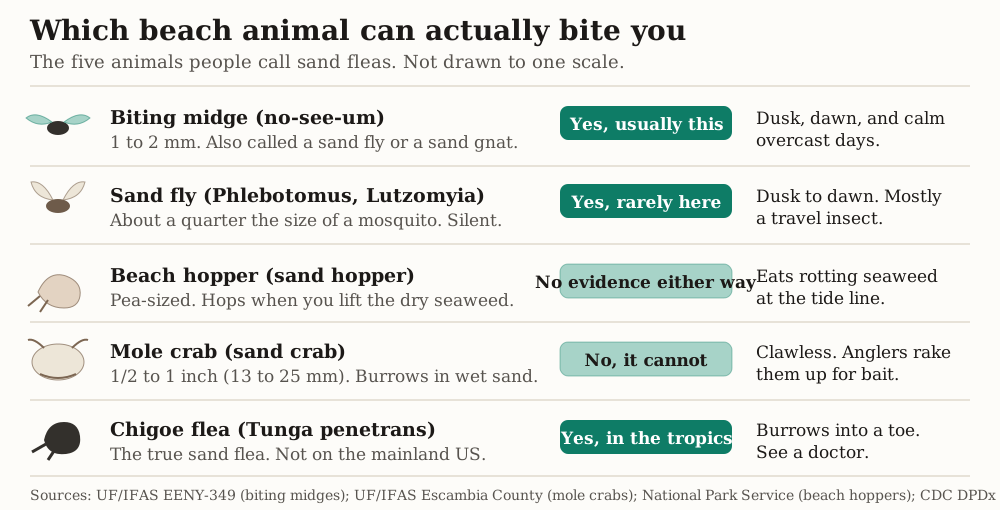
Table 1. The five animals called sand fleas, and which of them can bite you
Biting midge (no-see-um), 1 to 2 mm
- Can it bite you?
- Yes, and it is usually this one
- Where you meet it
- Coastal beaches, salt marsh and mangrove edges, screened porches
- What it leaves
- Small bumps with a red area, below the knee, several at once
Sand fly (Phlebotomus, Lutzomyia), about a quarter the size of a mosquito
- Can it bite you?
- Yes, though rarely in the US
- Where you meet it
- Mostly abroad. CDC reports locally acquired cases in Texas and rarely a few other states
- What it leaves
- Small bumps, often painless at the time
Beach hopper, pea-sized
- Can it bite you?
- Not known to, though no government page settles it
- Where you meet it
- Jumping in the dry seaweed at the high-tide line
- What it leaves
- Nothing anyone has documented
Mole crab (sand crab), 1/2 to 1 inch
- Can it bite you?
- No. It is clawless
- Where you meet it
- Burrowing backwards in the wet swash zone, raked up for bait
- What it leaves
- Nothing. It cannot bite or pinch
Chigoe flea (Tunga penetrans), the true sand flea
- Can it bite you?
- Yes, by burrowing in, and only in the tropics
- Where you meet it
- Sandy ground in Mexico through South America, the West Indies and Africa
- What it leaves
- One swelling with a black dot, usually on a foot
Sizes and biting behaviour from UF/IFAS (biting midges and mole crabs), the National Park Service (beach hoppers), and CDC (sand flies and the chigoe flea). Our guide to the animals people call sand fleas covers each one properly.
The name itself causes most of the confusion. Gulf Coast anglers say sand flea and mean the mole crab they rake out of the wet sand for bait. Vacationers say sand flea and mean whatever left their ankles covered in bumps. So two people can use one word for animals that are not even in the same phylum.
A biting midge is small enough to explain why you never saw it. UF entomologists put Florida’s species at about 1.5 mm on average, inside a range of 1 to 2 mm. Only the female bites, and she feeds for 2 to 5 minutes before leaving. About 50 species live in Florida, though just seven bother people much.
When they come out: dusk, dawn and still air
Most biting midges feed at dusk, at night and in the morning. However, coastal species also bite in broad daylight when the sky is heavily overcast and the winds are calm, UF reports. So a grey, still afternoon beside a salt marsh can be worse than a breezy evening.
Readers describe exactly that window. One visitor on r/florida wrote that the bugs attacked whenever the family tried to go out at dusk, and that everyone was still itching two days after the drive home to Missouri.
Mole crabs and beach hoppers
Mole crabs cannot bite you. They have no claws at all, as UF/IFAS states plainly, so they cannot bite or pinch. A mole crab runs 1/2 to 1 inch (13 to 25 mm) long, pale grey and oval, and it burrows backwards the moment the wave pulls back.
Beach hoppers are the pea-sized jumpers under the dry seaweed at the tide line. National Park Service pages describe where they live and what they eat, yet none of them says whether a beach hopper can bite. Rather than guess, we will say how thin the evidence is: no government or extension page we opened settles it, and nothing we found records one feeding on blood. Our guide to the four sand fleas digs into that gap.
What sand flea bites look like, and where they appear
Sand flea bites look like small raised bumps with a defined red area around them, and they land below the knee. UF describes the feeling at the moment of the bite as a local sting or burn. Most people find several at once on the ankles, feet and lower legs.
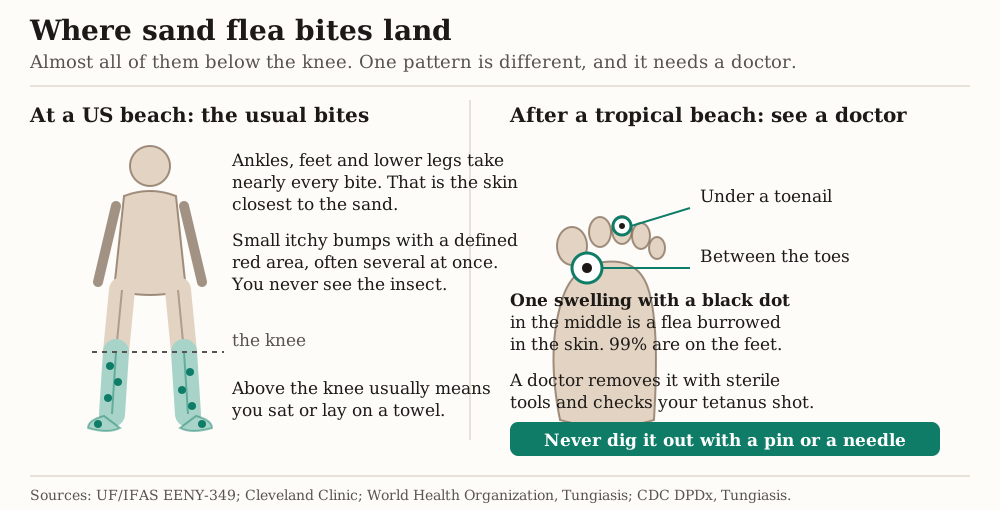
Why the lower legs? Because that is the skin nearest the sand and the grass where the midges wait. Bites above the knee usually mean you sat or lay down on a towel. On brown and Black skin the red ring is harder to see, though the raised bump still feels obvious under a fingertip.
Some bites blister. One Florida reader was attacked daily for four weeks, and after the first week a few bumps turned into blisters that outlasted the itch by weeks. That is a strong reaction rather than a different insect. Still, any blister that opens needs the care in the red flags below.
Can a picture of the bite tell you what bit you?
No, and that is worth saying plainly, because sand flea bites pictures is a popular search. Midge, mosquito, flea and chigger bites all overlap, and one bite looks different on two people. So this page uses drawings rather than photographs of skin.
Timing and place settle it far better than any photo. Bumps that appear at dusk, outdoors, on uncovered skin below the knee, near a marsh or mangroves, fit a biting midge. If you ever do catch the insect, photograph it on white paper and run it through our bug identifier for photos instead.
How long sand flea bites last
Most sand flea bites stop bothering people within minutes to hours. UF adds that anyone who is hypersensitive to them may itch for 2 to 3 days. A mark often lingers for several days after the itch goes. Bites that keep getting worse after day 2, though, are a different matter.
Table 2. What to expect after sand flea bites, hour by hour and day by day
As it happens
- What you notice
- A local sting or burn, often with no insect in sight
- What to do
- Move out of the damp sand, into moving air, and cover your legs
First few hours
- What you notice
- Small raised bumps with a defined red area, several at once
- What to do
- Wash, then cool the skin for at least 10 minutes
Day 1 to day 2
- What you notice
- Itching at its worst. Hypersensitive people itch for 2 to 3 days
- What to do
- One anti-itch product, used as labeled. Keep nails short
Day 2 onward
- What you notice
- A normal bite is fading, though a mark can linger for days
- What to do
- Check it. Anything growing after day 2 needs a pharmacist or doctor
A week or more
- What you notice
- Blisters or scabs where bites were scratched open
- What to do
- Keep them clean and covered. See someone if they leak or spread
Any time, after a tropical beach
- What you notice
- One swelling with a black dot in the middle, on a foot
- What to do
- See a doctor. Do not dig it out
Itch duration from UF/IFAS EENY-349. Care and escalation points from the NHS and Cleveland Clinic. We give no doses, and this table is reference information rather than a diagnosis.
Scratching is what stretches a few days into a few weeks. Every scratch restarts the inflammation, and broken skin invites bacteria. So the fastest way to be done with a bite is to stop touching it.
Why they bite you and not your friend
People react differently, and they also attract insects differently. A Florida local put it bluntly on Reddit: the no-see-ums go after fresh meat first, so visitors suffer while residents barely notice. Some people never develop much of a reaction at all, while others swell for days after one bite.
None of this reflects how clean you are, or anything you did wrong. Still, if you are the one everybody jokes about, the prevention steps matter more for you than for the person beside you.
How to treat sand flea bites
Wash the bite, hold something cold against it for at least 10 minutes, then use one over-the-counter anti-itch product. Cleveland Clinic lists cold packs, calamine lotion and antihistamines for mild bites, and adds a rule worth repeating: topical or oral, not both. After that, leave it alone.
Sand flea bite relief, step by step
Wash it with soap and water
Soap and water on the bite and the skin around it lowers the chance of infection, the NHS says. It also takes sand and sunscreen off before anything else goes on.
Cool it, properly
Hold an ice pack wrapped in a cloth, or a clean cloth soaked in cold water, against the bite. The NHS advises at least 20 minutes if the area has swollen. Repeat whenever the itch comes back.
Use one anti-itch product, not several
Cleveland Clinic lists calamine lotion, creams that reduce itching, and antihistamines, topical or oral but never both together. Follow the label, and ask a pharmacist which product suits you or your child.
Keep nails short and cover any broken skin
Scratching is how a harmless bite becomes an infected one. Cut a child's nails that evening, and cover a bite that has already opened.
Skip the home remedies
The NHS says not to treat a bite with home remedies such as bicarbonate of soda. Rubbing alcohol turns up in every beach thread too, yet it has no evidence behind it, it stings opened skin, and EPA warns that it ignites easily.
Check the bite again after 2 days
A normal bite is fading by then. Pain, heat, pus or redness that spreads after day 2 means a call to a pharmacist or a doctor.
No cream erases a bite, because only time does that. What these steps do is stop an itch from turning into weeks of scratched, scabbed skin.
Red flags: when a bite needs a doctor
Call 911 for swelling of the lips, mouth, tongue or throat, for trouble breathing, or for sudden confusion or fainting. See a doctor within a day for spreading redness, heat, pus or a fever with swollen glands. Those signs point to an allergic reaction or an infection, not to an ordinary bite.
Infection comes from scratching rather than from the insect. Your own skin bacteria get in once the surface breaks. So the signs to watch are pain and redness that grow after day 2, not anything about how the bite looked on the first evening.
A pharmacist can handle most of this. The NHS sends you to one for a bite that feels hot, looks swollen, hurts or leaks fluid, and pharmacists can supply the same antibiotics a doctor would. For a baby under 1 year old, though, call a doctor instead.
Medical disclaimer. This page is for general information only. It is not a medical diagnosis. If you have severe symptoms, trouble breathing, swelling of the face or throat, fast spreading redness, fever, severe pain, pus, or signs of infection, contact a doctor or your local emergency number.
Sand flea eggs in your skin: tungiasis after a tropical trip
One swelling with a black dot in the middle, on a foot, after barefoot time on a tropical beach, is not an ordinary bite. It is a chigoe flea burrowed into the skin, and WHO reports that 99% of these sores sit on the feet. See a doctor, and never dig it out.
The chigoe flea, Tunga penetrans, is the only true sand flea. CDC’s parasite laboratory describes what she does: a mated female claws into the skin, usually between the toes or under a toenail, leaving only her rear end exposed to the air. She feeds there, swells to about 1 cm, sheds roughly 100 eggs over two weeks, then dies and falls away.
It starts painlessly. Itching and irritation arrive as she swells, so the sore is often days old before anyone notices it. WHO describes the live flea as a whitish disc with a dark point in the middle, and that point darkens over time until the whole thing is black.
Where does it live? CDC puts it in tropical and subtropical regions: Mexico through South America, the West Indies and Africa, in sandy ground such as beaches, stables and farms. So for US readers this is a travel problem, never a Gulf Coast one.
How to stop sand flea bites before they start
Use an EPA-registered repellent whose label lists biting flies or no-see-ums, stay off the shoreline at dusk and dawn, cover your lower legs, and sit where the air moves. CDC’s Yellow Book names six registered ingredients: DEET, picaridin, IR3535, oil of lemon eucalyptus, PMD and 2-undecanone.
Table 3. Preventing sand flea bites: what works, and what only sounds like it does
An EPA-registered repellent labeled for flies, biting flies or no-see-ums
- Does it work?
- Yes. Start here
- What the source says
- CDC's Yellow Book lists the six registered ingredients; UF names DEET-based repellents as the main one used against biting midges
Staying off the shoreline at dusk and dawn
- Does it work?
- Yes
- What the source says
- Biting midges feed mostly at dusk, night and morning (UF)
Treating a still, overcast day as risky too
- Does it work?
- Yes
- What the source says
- Coastal species bite in broad daylight when the sky is heavily overcast and the winds are calm (UF)
Sitting in moving air, or running a high-velocity fan on a porch
- Does it work?
- Yes, and it is free outdoors
- What the source says
- UF's coastal biting midge sheet recommends high-velocity fans on screened porches
Long, loosely woven trousers and socks
- Does it work?
- Yes
- What the source says
- CDC advises long sleeves, long trousers and tucking clothing in; thin tight fabric gives little protection
20 by 20 mesh on windows and porches
- Does it work?
- Yes, for the house
- What the source says
- Ordinary insect screen does not exclude biting midges; CDC recommends 20 by 20 mesh
Ordinary window screen
- Does it work?
- No
- What the source says
- The holes are too big for the insect (UF, with a photo of a midge beside a screen)
Skipping repellent because it supposedly makes them worse
- Does it work?
- No. This one is backwards
- What the source says
- Published on a page that ranks for this search. UF and CDC both say registered repellents work on biting midges
Scented soaps, vanilla, dryer sheets and bracelets
- Does it work?
- No evidence
- What the source says
- Nothing registered, and nothing tested for biting midges
To pick an ingredient by how long its label protects, read our guide to choosing a repellent, and for the two most common ones, our picaridin and DEET comparison. Follow the label on any product.
One beach-brand article on this very topic tells readers to toss out the bug spray, claiming that traditional sprays only make sand fleas friskier. Ignore that. UF names DEET-based repellents as the main repellent used against biting midges, and CDC says products labelled for flies, biting flies or no-see-ums repel them.
Screens, fans and 20 by 20 mesh
Ordinary window screen does not stop a biting midge, because the insect is smaller than the holes in it. CDC recommends 20 by 20 mesh to keep them out of a house. Florida readers reach that conclusion the hard way: one wrote that a screened porch letting them through must not have tight enough holes.
Moving air works too, and it costs nothing on a windy day. UF’s coastal midge sheet recommends high-velocity fans on screened porches, and Florida residents swear by them. They won’t battle wind, as one reader put it. So a chair in the breeze beats a towel in a still, damp hollow every time.
Sand flea bites vs mosquito, bed bug, chigger and flea bites
The bumps look much alike, so the question that settles it is where you were and when the itch started. A midge bites outdoors at dusk, below the knee. Bed bugs feed indoors overnight. Fleas go for the ankles in a home with pets, and chiggers bite where clothing presses against skin.
Table 4. The clue that separates sand flea bites from the bites they get confused with
Outdoors at dusk or on a still, overcast day, near the coast, and you saw nothing
- What bit you
- Biting midge, the usual sand flea bite
- Where on the body
- Ankles, feet and lower legs
Itching within minutes outdoors, often with the insect still around
- What bit you
- Mosquito
- Where on the body
- Any uncovered skin, including arms, neck and face
Found on waking, night after night, often in a line
- What bit you
- Bed bug
- Where on the body
- Skin left uncovered in bed: face, hands, arms, legs
A home with a cat or a dog, and bites that keep coming indoors
- What bit you
- Flea
- Where on the body
- Ankles and lower legs
Intense itch starting hours later, after grass or brush
- What bit you
- Chigger
- Where on the body
- Sock line, waistband, cuffs, collar
One swelling with a black dot, after barefoot time abroad
- What bit you
- Chigoe flea, burrowed in
- Where on the body
- Feet, between the toes, under a toenail
Each of these has its own guide: how long mosquito bites last, what bed bug bites look like, and flea bites on humans. To compare 20 kinds of bite at once, use our bug bite identification chart.
Can sand fleas come home with you or get in your bed?
No, with one exception. Biting midges do not infest houses, mole crabs die away from the surf, and beach hoppers stay in the seaweed. A burrowed chigoe flea does travel home in your skin, though she dies within about 2 weeks and falls out.
Google shows that question under sand flea bites, and the worry behind it is genuine. People who get home still itching assume something rode back in the suitcase. In nearly every case the bumps are simply slow to settle.
Bites that keep appearing night after night in your own bed point somewhere else entirely. Fleas and bed bugs both do that, and fleas favour the ankles too. So if new bumps turn up a week after the beach, start looking at home rather than at the shore, beginning with our guide to fleas and where they come from and the bugs that get mistaken for bed bugs.
Sand flea bite myths, corrected
Six beliefs about these bites turn up again and again, and two of them are published on pages that rank for this search. Each one below is checked against CDC, UF/IFAS or EPA.
Myth 1
Myth: “Bug spray does not work on sand fleas, so skip it.”
Truth: False, and this one is published on a page that ranks for the search. UF names DEET-based repellents as the main repellent used against biting midges, and CDC's Yellow Book says products labelled for flies, biting flies or no-see-ums repel them.
Myth 2
Myth: “Rubbing alcohol is the best thing for the itch.”
Truth: Beach threads repeat it, yet nothing supports it. Alcohol stings broken skin, and EPA warns that rubbing alcohol ignites easily, so it is a poor thing to carry to a beach barbecue.
Myth 3
Myth: “Toothpaste takes the itch out.”
Truth: No published study backs toothpaste on insect bites. Cold does the cooling part without the mess, and it costs nothing.
Myth 4
Myth: “Sand fleas burrow into your skin at American beaches.”
Truth: Only the chigoe flea burrows, and CDC puts it in the tropics and subtropics, not on the mainland US. What bit your ankles in Florida stayed on the outside.
Myth 5
Myth: “A screened porch keeps no-see-ums out.”
Truth: Not an ordinary one. CDC says the usual insect screen has holes too big for a biting midge, and recommends 20 by 20 mesh instead.
Myth 6
Myth: “Sand fleas are harmless, because they are just little crustaceans.”
Truth: Half right, and that half causes the confusion. Mole crabs and beach hoppers are crustaceans, yet the biting midge that people blame is a fly, and the true sand flea is a flea.
Sand flea bite FAQ
Are sand flea bites contagious?
Why do my bites look worse the next morning?
Can they bite through clothes?
What smell do sand fleas hate?
Do sand flea bites need antibiotics?
Are these bites more serious for young children?
For the animals themselves, from the mole crab to the chigoe flea, start at our guide to what a sand flea actually is. For bites that keep arriving at home instead of at the beach, read what flea bites look like and how to treat them.
Related guides
Sand fleas: which animal is it?
Mole crab, beach hopper, no-see-um or chigoe flea, told apart.
Flea bites on humans
Ankle bites in a home with pets, and what actually stops the itch.
How long mosquito bites last
The timeline of a normal bite, and the signs of an infected one.
What bed bug bites look like
Bites found on waking, and how to check the mattress.
Bug bite identification chart
Twenty kinds of bite by look, place and timing.
Choosing a mosquito repellent
All six CDC ingredients by label hours, age limits and feel.
Fleas: the complete guide
The hub: what fleas are, where they come from, and what they do.
Bugs that look like bed bugs
Fourteen look-alikes drawn to scale, with the one check for each.
Sources
- CDC DPDx, Tungiasis (Tunga penetrans)
- World Health Organization, Tungiasis fact sheet
- CDC Yellow Book, Mosquitoes, Ticks, and Other Arthropods (April 2025)
- NHS, Insect bites and stings (reviewed June 1, 2023)
- Cleveland Clinic, Sand Flea Bites (last updated November 16, 2022)
- UF/IFAS, Biting Midges, No-See-Ums, Culicoides spp. (EENY-349, revised September 2025)
- UF/IFAS Escambia County Extension, Sand Fleas and Mole Crabs (September 1, 2021)