What is the best mosquito repellent?
The best mosquito repellent is any EPA-registered product with one of the six ingredients CDC recommends, at a strength that lasts as long as you will be outside. Neither CDC nor the EPA ranks one ingredient above the others. So choose by the hours you need, who will wear it and how it feels, not by the brand.
Two lines on the label settle most of it. First, look for an EPA registration number, printed as EPA Reg. No. That number means the company gave the EPA data on how well the product works, CDC explains. Second, find the active ingredient and its percentage. Brand names come and go, but those two lines tell you what is in the bottle.
Here are the six. DEET and picaridin are what the EPA calls conventional repellents. The other four are biopesticides, which CDC’s Yellow Book describes as made from natural materials or as lab-made versions of them. Only two of the six are plant-derived, CDC says: oil of lemon eucalyptus and 2-undecanone.
Table 1. The six mosquito repellent ingredients CDC recommends
DEET
- What it is
- The oldest; lab-made; more than 500 products
- Typical label hours, mosquitoes
- 8 at 16 to 25%; 10 at 85 to 98%
- Youngest age
- No EPA limit. Mayo Clinic: not under 2 months
- Good to know
- Can damage some plastics and synthetic fabrics
Picaridin (icaridin)
- What it is
- Lab-made; about 40 products, up to 20%
- Typical label hours, mosquitoes
- 8 at 16 to 20%
- Youngest age
- No EPA limit. Mayo Clinic: not under 6 months
- Good to know
- Colorless, with little odor
IR3535
- What it is
- Lab-made biopesticide; about 45 products
- Typical label hours, mosquitoes
- 2 at 7.5%; 8 at 10 to 20%
- Youngest age
- No age limit, CDC says
- Good to know
- Half its labels are sunscreen combinations
Oil of lemon eucalyptus (OLE)
- What it is
- Refined from lemon eucalyptus leaves; 6 products
- Typical label hours, mosquitoes
- 6 at 30 to 40%
- Youngest age
- Not under 3, CDC says, except some OLE-only labels
- Good to know
- Not the same as lemon eucalyptus essential oil
PMD
- What it is
- The active compound in OLE, made in a lab; 6 products
- Typical label hours, mosquitoes
- 2 at 8 to 10%
- Youngest age
- Not under 3, CDC says
- Good to know
- Short-lived at the strengths sold
2-undecanone
- What it is
- First found in a wild tomato; 1 product
- Typical label hours, mosquitoes
- 5 at 7.75%
- Youngest age
- No age limit, CDC says
- Good to know
- Works, but hard to find
Product counts are the EPA’s. Hours are our count of the EPA repellent database (last updated by the EPA in June 2019): the typical label claim, read October 26, 2026.
How long does mosquito repellent last?
Most mosquito repellent lasts 2 to 10 hours on the label, and the strength decides where a product falls in that range. A typical 20% DEET, picaridin or IR3535 product claims about 8 hours against mosquitoes, and 30% to 40% oil of lemon eucalyptus claims 6. Many products under 10% last only 1 to 2 hours, CDC’s Yellow Book notes.
To compare all six on the same footing, we went through the EPA’s repellent search tool, which lists the hours the EPA approved for each label. The chart shows the range for each ingredient and the typical product. Keep in mind that these times come from tests the makers ran and the EPA reviewed.
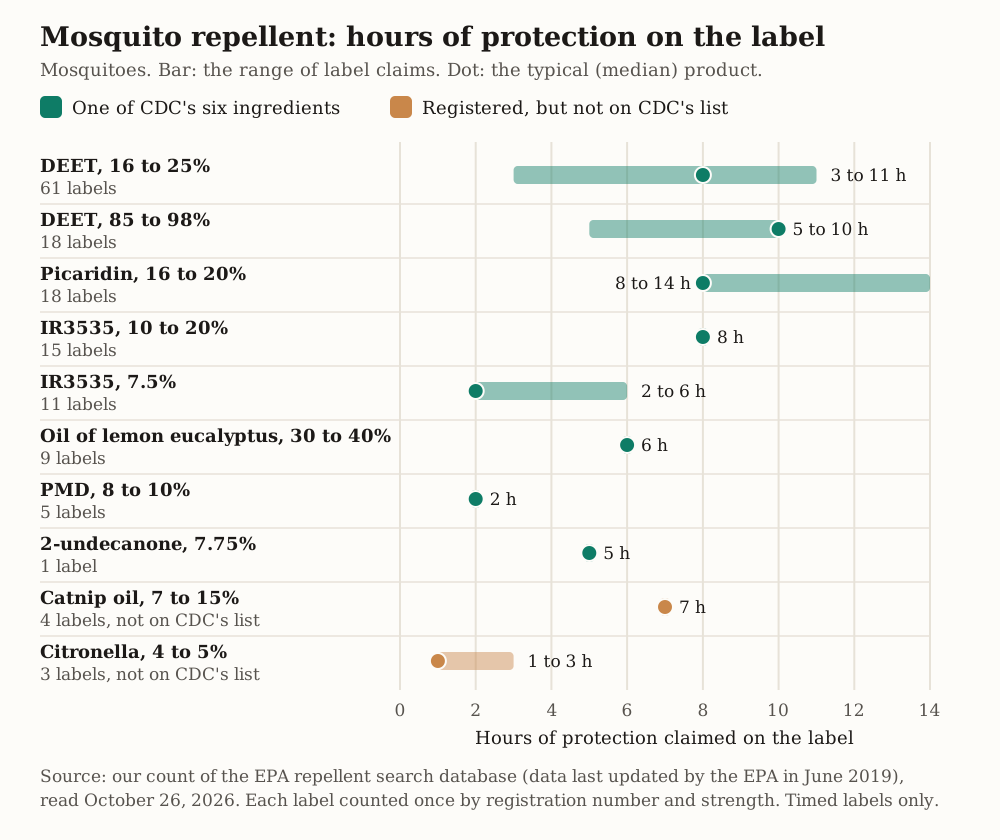
Three patterns stand out. First, strength matters more than the ingredient. IR3535 at 7.5% typically claims 2 hours, yet at 20% it claims 8, the same as DEET or picaridin. Second, more is not always better. DEET at 85% or more claims about 10 hours, only 2 more than at 20%, and CDC’s Yellow Book says its effect tends to peak at about 50%.
Third, the plant-derived options sit lower. Registered oil of lemon eucalyptus claims 6 hours, the PMD products 2, and the one 2-undecanone product 5. Two plant ingredients the EPA registers but CDC leaves off its list, catnip oil and citronella, claim 7 hours and 1 to 3 hours.
Pediatricians use rounder numbers, and they run a little shorter than the labels. The American Academy of Pediatrics gives these:
Table 2. Strength and protection time, in round numbers
DEET, 10%
- About how long against mosquitoes
- About 2 hours
- Source
- AAP
DEET, 30%
- About how long against mosquitoes
- About 5 hours
- Source
- AAP
DEET, over 50%
- About how long against mosquitoes
- Little or no extra time
- Source
- AAP says none; the Yellow Book says no marked increase; EPA labels claim about 2 hours more than at 20%
Picaridin, 5%
- About how long against mosquitoes
- 3 to 4 hours
- Source
- AAP
Picaridin, 20%
- About how long against mosquitoes
- 8 to 12 hours
- Source
- AAP
Oil of lemon eucalyptus, 8% to 10%
- About how long against mosquitoes
- Up to 2 hours
- Source
- AAP
Oil of lemon eucalyptus, 30% to 40%
- About how long against mosquitoes
- About 6 hours
- Source
- AAP
Any ingredient under 10%
- About how long against mosquitoes
- Often only 1 to 2 hours
- Source
- CDC Yellow Book
For DEET and picaridin strength by strength, and the field trials that pit them against each other, see our picaridin vs DEET comparison.
Why repellent wears off sooner than the label says
Think of the label time as a best case. The EPA lists what shortens it: sweat and exercise, swimming or rain, hot weather, and how attractive you are to mosquitoes, since every person is different. Rubbing it off on a towel or clothes counts too, the Yellow Book adds. So if bites start before the label time is up, reapply, but not more often than the label allows.
Some people really do get bitten more than others. Our guide to why mosquitoes pick some people explains what draws them, and why blood type matters less than you have heard.
Which mosquito repellent should you use? A pick for every situation
Match the product to the outing. For an hour in the yard, a low strength of any of the six is enough. For a long day outside, use about 20% or more. In woods and tall grass, add permethrin on clothes, since ticks are there too. For travel where dengue, Zika or malaria spread, choose a long-lasting product and cover up. Each row below rests on a CDC or EPA statement.
Table 3. Picking a mosquito repellent for the situation
An hour or two in the yard at dusk
- What to use
- Any of the six at a low strength, such as about 10% DEET
- Why, from CDC, the EPA or the AAP
- Pick a protection time that fits your activity (EPA). About 10% DEET protects for about 2 hours (AAP)
A full day of hiking, fishing or yard work
- What to use
- About 20% to 30% DEET, or 20% picaridin or IR3535
- Why, from CDC, the EPA or the AAP
- Higher strengths last longer, up to about 50% for DEET (CDC Yellow Book). These claim about 8 hours on the label
Woods, tall grass or tick country
- What to use
- Permethrin-treated clothes, plus a skin repellent labeled for ticks
- Why, from CDC, the EPA or the AAP
- 0.5% permethrin on clothing repels and kills ticks and mosquitoes (CDC Yellow Book). Treated clothing protects only the skin it covers (EPA)
Travel where dengue, Zika or malaria spread
- What to use
- A long-lasting product, ideally bought before you go, plus permethrin clothes and nets
- Why, from CDC, the EPA or the AAP
- Buy repellent before leaving the US and look for the same ingredients abroad (CDC Yellow Book). Mosquitoes bite day and night (CDC)
A child 3 or older
- What to use
- Any of the six, applied by an adult
- Why, from CDC, the EPA or the AAP
- Do not apply to a child's hands, eyes or mouth (CDC)
A child under 3
- What to use
- DEET, picaridin, IR3535 or 2-undecanone, not OLE or PMD
- Why, from CDC, the EPA or the AAP
- No OLE or PMD under 3 (CDC), except some OLE-only labels (EPA)
A baby under 2 months
- What to use
- Netting over the stroller or carrier, and clothes that cover arms and legs; ask your pediatrician about repellent
- Why, from CDC, the EPA or the AAP
- CDC points to netting and covering clothes for babies. Mayo Clinic advises no DEET under 2 months
Pregnant or breastfeeding
- What to use
- Any EPA-registered product, used as labeled
- Why, from CDC, the EPA or the AAP
- Proven safe and effective, even for pregnant and breastfeeding women (CDC)
You hate greasy, smelly sprays, or you carry synthetic gear
- What to use
- Picaridin, as a lotion or pump spray
- Why, from CDC, the EPA or the AAP
- Colorless with little odor (NPIC). DEET can damage some plastics and synthetic fabrics (NPIC)
A swim or a sweaty day
- What to use
- Any of the six; carry it and reapply
- Why, from CDC, the EPA or the AAP
- Sweat and water shorten protection; reapply as the label directs (EPA)
Mosquitoes biting in daylight
- What to use
- Repellent in the day, not just at dusk
- Why, from CDC, the EPA or the AAP
- Mosquitoes bite day and night (CDC). Yellow fever mosquitoes peak after sunrise and around sunset (CDC Yellow Book)
Daytime bites in a backyard often come from the Asian tiger mosquito, which breeds in small containers around homes. Whatever the species, a repellent is one layer. Long sleeves, screens and dumping standing water do the rest.
When the choice matters most
The stakes rise with disease. The AAP says a natural or other short-acting repellent may be fine when there is no worry about a serious insect-borne illness. However, when there is, it advises DEET, picaridin or another approved, effective product. In Massachusetts, for example, the state health department tests mosquitoes for West Nile and eastern equine encephalitis every summer.
Your own state or county health department posts the same kind of warning when a virus turns up. On those days, a registered repellent with a long label time is the one to reach for. For what a bite looks like and when it needs a doctor, see our guide to mosquito bites and the warning signs.
The six mosquito repellent ingredients, one by one
The six differ in age, strength, smell and feel, not in whether they work. DEET has the longest record and the strongest products. On the label, picaridin and IR3535 match it at 20%. Oil of lemon eucalyptus is the main plant-based choice, while PMD and 2-undecanone are short-acting or rare. Each one is covered below in a few lines.
DEET
DEET is the oldest of the six. The US Army developed it in 1946, and the public has used it since 1957, the National Pesticide Information Center says. The EPA counts more than 500 products, with strengths for skin up to about 98%. Protection tends to peak at about 50%, so the very strong products are mainly for long, heavy exposure.
It has two practical downsides. DEET can damage some plastics, vinyl and synthetic fabrics, NPIC notes, although not cotton or wool. Applied over sunscreen, it also cuts the sunscreen’s SPF by about a third, the Yellow Book says. Our comparison page covers its safety record in full.
Picaridin
Picaridin, called icaridin outside the United States, is a lab-made repellent first made in the 1980s. It has been sold in the US only since 2005, though longer in Europe and Australia. About 40 products carry it, at up to 20%. A typical 20% label claims 8 hours against mosquitoes and about 12 against ticks.
Many hikers prefer it because it is colorless, has little odor and feels light. In addition, it does not damage certain fabrics and finishes that other repellents can, the American Mosquito Control Association notes. The EPA sets no age limit, but Mayo Clinic advises against it for babies under 6 months.
IR3535
IR3535 is a lab-made repellent that the EPA treats as a biopesticide. Its full name is 3-[N-butyl-N-acetyl]-aminopropionic acid, ethyl ester, and about 45 products contain it. CDC sets no age limit for it. Strength makes a big difference here: in our count, 7.5% labels typically claim 2 hours, while 10% to 20% labels claim 8.
The catch is how it is sold. In the EPA’s database, 13 of the 26 IR3535 labels are sunscreen and repellent combinations. The Yellow Book and the AAP both advise against those, since sunscreen needs reapplying more often than repellent. So buy IR3535 on its own, at about 20%, and use a separate sunscreen.
One state fact sheet calls IR3535 plant-derived. It is not: it is made in a lab, and CDC marks only oil of lemon eucalyptus and 2-undecanone as plant-derived.
Oil of lemon eucalyptus (OLE) and PMD
Registered OLE is a refined product from the leaves of the lemon eucalyptus tree. PMD is a lab-made version of its active compound, the Yellow Book explains. On the labels, OLE at 30% to 40% claims 6 hours, and the PMD products, at 8% to 10%, claim 2. Do not use either on children under 3, CDC says.
Pure lemon eucalyptus essential oil is a different thing. CDC does not recommend it as a repellent, because it has not been tested for safety or for how well it works. Our guide to natural mosquito repellents that pass lab tests compares OLE with the essential oils, test by test.
2-undecanone
2-undecanone was first taken from a wild tomato plant, and the EPA registered it as a repellent in 2007. In a 2008 study, a 7.75% spray matched 7% DEET against Asian tiger mosquitoes over 6 hours. In field trials, it did as well as 25% DEET. Its one registered product claims 5 hours against mosquitoes and 2 against ticks.
Catnip oil and citronella: registered, but not on CDC’s list
The EPA lists 4 catnip oil products and 3 citronella products. Even so, CDC leaves both off its recommended list. On the labels, the catnip oil products claim 7 hours against mosquitoes, while citronella claims 1 to 3.
That gap matters, because Google’s AI Overview for this search lumps the two together as needing frequent reapplication. The labels say otherwise for catnip. Still, catnip oil has had far fewer independent tests on human skin than the six on CDC’s list.
Mosquito repellent for kids and babies
Most mosquito repellent is fine for children when an adult puts it on. The EPA and CDC set no age limit for DEET, picaridin, IR3535 or 2-undecanone, but CDC says no OLE or PMD under 3. For young babies, advice differs. Mayo Clinic says no DEET under 2 months and no picaridin under 6 months, so ask your pediatrician.
Table 4. Youngest age for each ingredient, by source
DEET
- EPA and CDC
- No age or strength limit
- Mayo Clinic
- Not under 2 months
- American Academy of Pediatrics
- Use sparingly until age 2; take extra care with newborns and premature babies
Picaridin
- EPA and CDC
- No age limit
- Mayo Clinic
- Not under 6 months
- American Academy of Pediatrics
- No age given; 5% lasts 3 to 4 hours, 20% lasts 8 to 12
IR3535
- EPA and CDC
- No age limit
- Mayo Clinic
- No age given
- American Academy of Pediatrics
- Not covered
Oil of lemon eucalyptus
- EPA and CDC
- Not under 3, except some OLE-only labels at 30% or less
- Mayo Clinic
- Check the label; some are not for under 3
- American Academy of Pediatrics
- Not under 3
PMD
- EPA and CDC
- Not under 3
- Mayo Clinic
- Not under 3
- American Academy of Pediatrics
- Not under 3
2-undecanone
- EPA and CDC
- No age limit
- Mayo Clinic
- No age given
- American Academy of Pediatrics
- Not covered
Why the split? For DEET, the EPA points to animal tests that found no difference between young and adult animals, and to a lack of incidents that would justify a limit. Mayo Clinic and the AAP take a more careful line for the youngest skin. For a baby, all of them agree on the first step: netting over the stroller or carrier, and clothes that cover the arms and legs.
One number online is out of date. A few state and association pages still say children over 2 months can use DEET up to 30%. The AAP’s current page for parents gives no percentage. Instead, it says to use the lowest strength that covers your time outside.
- Apply it for them. Put repellent on your own hands, then spread it on the child.
- Skip their hands, eyes and mouth. Children rub their eyes and put their hands in their mouths.
- Choose a stick, lotion or pump spray. The AAP advises against aerosols a child might breathe in.
- Skip sunscreen combinations. Sunscreen needs reapplying far more often than repellent.
- Avoid repellent candles near a child with breathing problems, the AAP adds.
- Wash or bathe the child when you come in, and store every repellent out of reach.
Parents on Reddit ask about this every summer. One parent of a 5-month-old asked what was safe because the pediatrician was slow to reply. The most useful answer came from another parent, whose pediatrician said to use the lowest DEET that does the job. That matches the AAP. Bracelets came up too, but CDC lists repellent wristbands among the things that do not work.
For a child whose bites swell up badly, our guide to skeeter syndrome, the mosquito bite allergy explains the warning signs and why prevention matters more for them.
Mosquito repellent during pregnancy and breastfeeding
You can use mosquito repellent while pregnant or breastfeeding. CDC says EPA-registered repellents are proven safe and effective for pregnant and breastfeeding women when used as directed. The EPA asks for no extra precautions beyond the label, the Yellow Book notes. That covers all six ingredients, plus permethrin on clothes.
There is a real trial behind it for DEET. Pregnant women used 20% DEET on their arms and legs every day during the second and third trimesters, to prevent malaria. There was no rise in birth defects, NPIC reports. For permethrin-treated clothing, the EPA found no evidence of reproductive or developmental effects to mother or child.
Pregnant readers on Reddit ask this often, and the replies show how confusing the advice can be. One newly pregnant woman asked her OB/GYN office and was told to look it up. Another planned to put DEET only on her clothes. Neither needs to happen: a registered skin repellent, used as labeled, is the advice. One national association page still tells pregnant and nursing women to minimize use, but CDC’s current guidance does not.
How to apply mosquito repellent, with sunscreen
Put sunscreen on first, then mosquito repellent, as two separate products. Spread a thin, even coat over all bare skin, never under clothing, and do your face from your hands. Reapply only as the label allows, and wash it off when you come in. Skip combination products, because sunscreen needs reapplying far more often than repellent.
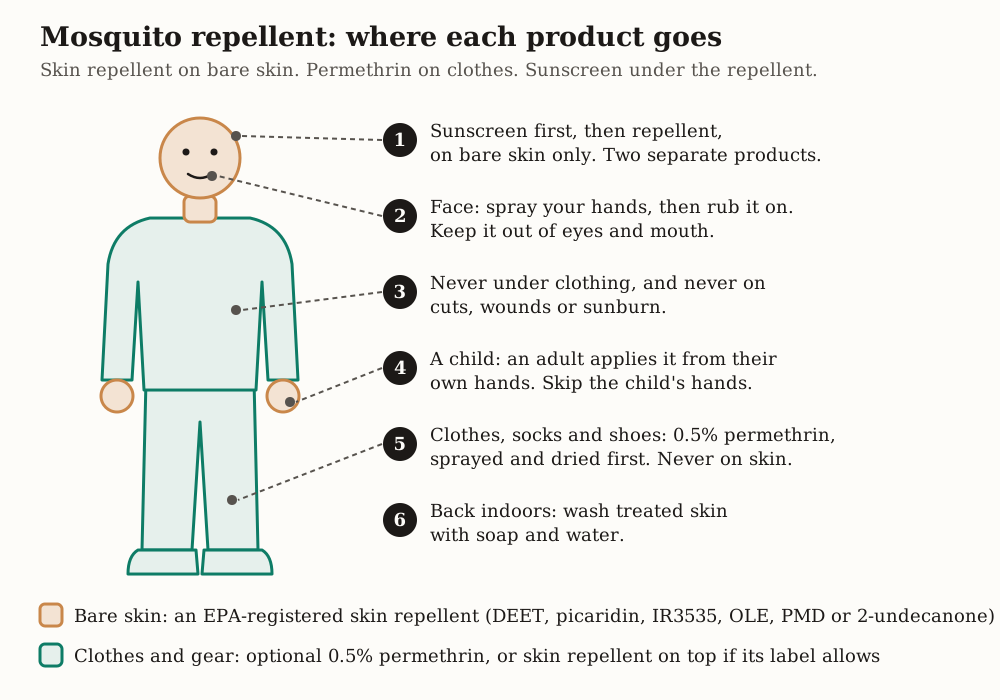
Putting on mosquito repellent, step by step
Match the label to your time outside
Check for an EPA Reg. No., the active ingredient, its percentage and, if shown, the hours for mosquitoes. Pick a product that lasts as long as you will be out.
Put on sunscreen first
Use two separate products. Sunscreen goes on first and repellent second, CDC says. Mayo Clinic suggests giving the sunscreen about 20 minutes before the repellent goes on.
Cover every bit of bare skin
Spread a thin, even coat over all exposed skin, the way you would with sunscreen. A missed patch of skin is where the bites land. If a thin film does not stop them, add a little more.
Do your face from your hands
Spray or squeeze it onto your palms, then rub it on. Keep it out of your eyes and mouth, and go light around the ears.
Keep it off covered and broken skin
Never put repellent under clothing, or on cuts, wounds, sunburn or a rash. Wash your hands once you are done.
Reapply only as the label allows
Sweat, swimming and rubbing wear it off sooner. If bites start, put on more, but not more often than the label says.
Wash it off back inside
Wash treated skin with soap and water once you are in for the day, and wash treated clothes before you wear them again.
Follow the EPA’s safe-use rules for sprays as well. Do not spray in enclosed areas, avoid breathing the spray, and keep it away from food. Check for a flammability warning before you use an aerosol near a grill or a lit cigarette.
Why you still get bitten with repellent on
Usually, the repellent was not where the mosquito landed. In the r/camping thread that ranks second on Google for “best mosquito repellent,” a Florida worker sprayed 100% DEET mostly on their clothes and was still bitten through them. Repellent on fabric does not protect the skin under it. That is also why CDC advises loose-fitting long sleeves and pants.
The other common causes are simple. A product under 10% may last only 1 to 2 hours. Sweat and swimming wear it off early. And a single missed patch of skin is enough. One reply in a 2026 thread put it well: use it like sunscreen, not perfume.
Permethrin: mosquito repellent for clothes, not skin
Permethrin goes on clothes, shoes and gear, never on skin. At 0.5%, permethrin-treated clothing repels and kills ticks, chiggers and mosquitoes, CDC’s Yellow Book says. Treat items 24 to 48 hours before a trip so they dry. Spray-on treatments last through several washes, and factory-treated clothing lasts through many.
Clothing works best as a second layer. Permethrin protects only the skin the fabric covers, the EPA notes, so put a skin repellent on everything else. You can also spray some skin repellents onto clothing if the label allows, but DEET on fabric washes out the first time.
Use it with care around pets and water. Cats are far more sensitive to permethrin than dogs or people, because their bodies are slow to break it down, NPIC says. Permethrin is also highly toxic to fish and bees. So spray outdoors, away from pets and ponds, and let everything dry before anyone wears it.
Our page on tick repellents and treated clothing covers the full routine for tick country, including the tick check afterward.
Coils, candles and outdoor repellent devices
Coils, candles, torches, heated-mat devices and clip-on fans are spatial repellents: they release a repellent into the air around you. Some are EPA-registered. They work best in a small area with little wind, and they are for outdoor use only unless the label says they can be used indoors, the EPA notes. None replaces a repellent on your skin.
The EPA’s overview of repellent types lists what to read on the label first: the area a device covers, how wind affects it, and whether the repellent has to build up before it works. Campers on Reddit say the same thing in plain words. A heated device worked well at a still, wooded campsite, while others found it useful only when there was no breeze.
The evidence for disease protection is thin. CDC’s Yellow Book says coils, vaporizing mats and sprays with ingredients such as metofluthrin or allethrin have not been well tested for preventing disease. So it advises using them alongside a skin repellent, and avoiding breathing the smoke or spray. Citronella candles are weaker still than repellent on the skin, the AMCA says.
Do ultrasonic repellers, bracelets and patches work?
No. The EPA does not register devices that rely on sound waves, so no one has shown they work. CDC’s Yellow Book calls sound devices and repellent wristbands ineffective, and the AAP agrees. For the yard itself, our guide to getting rid of mosquitoes around the house starts with standing water.
Natural mosquito repellent: what counts
Two natural mosquito repellent ingredients carry CDC’s backing: oil of lemon eucalyptus and 2-undecanone. Most other plant oils are sold without any EPA review of how well they work. The EPA exempts low-risk oils such as citronella, cedar, geranium, peppermint and soybean oil from registration, and says plainly that those products have not been evaluated for effectiveness.
CDC puts it just as simply: nobody knows how well unregistered repellents work. So a “natural” label is fine if the bottle also lists OLE, PMD or 2-undecanone and an EPA number. If you are after scents mosquitoes dislike or a homemade spray, our guide to which plant-based repellents work rates each oil against the tests. For what a garden can do, see plants sold to repel mosquitoes.
Mosquito repellent myths, corrected
At least six common claims about mosquito repellent are wrong or out of date. Some come from Google’s AI Overview and some from official pages that have not caught up. Each one below is checked against CDC, the EPA or the AAP.
Myth 1
Myth: “A higher percentage keeps mosquitoes off better.”
Truth: A higher percentage makes it last longer, not work harder. The AAP says 10% DEET protects for about 2 hours and 30% for about 5. CDC's Yellow Book adds that DEET's effect tends to peak at about 50%.
Myth 2
Myth: “Oil of lemon eucalyptus is the only plant-based registered repellent.”
Truth: Google's AI Overview for this search says so, but CDC marks two of its six ingredients as plant-derived: oil of lemon eucalyptus and 2-undecanone. The EPA also registers catnip oil and citronella, which CDC does not list.
Myth 3
Myth: “Pregnant and nursing women should cut back on repellent.”
Truth: The American Mosquito Control Association's repellent page still says this. CDC's current advice is the opposite: registered repellents are proven safe and effective for pregnant and breastfeeding women when used as directed.
Myth 4
Myth: “Spray your clothes and the skin underneath is covered.”
Truth: Repellent works where it is. Treated clothing protects only the skin it covers, the EPA says, so bare skin needs its own coat. Repellent also never goes on skin under clothing.
Myth 5
Myth: “Children over 2 months can use DEET up to 30%, and no higher.”
Truth: That cap still appears on some state and association pages. The EPA sets no age or strength limit for DEET. The AAP's current page gives no percentage, and instead asks for sparing use until age 2.
Myth 6
Myth: “Wristbands, sound devices and vitamin B keep mosquitoes away.”
Truth: CDC's Yellow Book calls repellent wristbands, sound devices and taking vitamin B or garlic ineffective. The EPA does not register sound devices, so no one has checked that they work.
For everything else about the insect itself, from where it breeds to the diseases it carries, start at our complete guide to mosquitoes.
Pest control disclaimer. Photo-based identification can help, but it is not always perfect. For dangerous spiders, large infestations, or anything you are unsure about, contact a licensed pest control professional.
Not medical advice. This page is general information about mosquito repellents. It is not a diagnosis or a treatment plan. Ask your doctor or pediatrician which repellent is right for a baby, a pregnancy or a skin condition, and follow every product label.
Mosquito repellent FAQ
Does mosquito repellent work on ticks too?
What is the best indoor mosquito repellent?
Does mosquito repellent work on gnats and no-see-ums?
Can I put my mosquito repellent on my dog or cat?
Do lotions and wipes work as well as sprays?
Related guides
Picaridin vs DEET
Hours at the same strength, feel, gear damage and safety, side by side.
Natural mosquito repellent
Which plant-based options carry EPA registration, and how long the rest lasted in tests.
Keeping ticks off you
Permethrin clothing, skin repellents and the tick check routine after a walk.
Repellent plants
What citronella, lavender and other plants can and cannot do on a patio.
Getting rid of mosquitoes
Standing water, screens and when a yard treatment is worth it.
Mosquito bites
What a normal bite looks like, how long it lasts, and when to see a doctor.
Skeeter syndrome
Big, swollen bites in children: the allergy, the warning signs and prevention.
All about mosquitoes
The full guide: how they find you, where they breed and the diseases they carry.
Mosquitoes and dogs
Bites, emergency signs, heartworm and dog-safe repellents.
Sources
- CDC, Preventing Mosquito Bites (August 2024)
- CDC Yellow Book, Mosquitoes, Ticks, and Other Arthropods (April 2025)
- US EPA, Find the Repellent that is Right for You (repellent search database)
- US EPA, Using Insect Repellents Safely and Effectively
- US EPA, Skin-Applied Repellent Ingredients
- US EPA, What is an Insect Repellent? (spatial and clip-on repellents)
- American Academy of Pediatrics, HealthyChildren.org, How to Choose an Insect Repellent for Your Child
- Mayo Clinic, Mosquito bites: symptoms and causes