Do mosquitoes bite dogs? Yes, and here is why
Do mosquitoes bite dogs? They do, just as they bite people. A dog breathes out carbon dioxide and gives off body heat, and a female mosquito follows both to find a meal. Fur slows her down but does not stop her. She lands where the hair is thin, usually on the ears, the face or the belly.
Only females bite, because they need blood to make eggs. The Merck Veterinary Manual calls mosquitoes possibly the most voracious of the blood-feeding flies. They annoy dogs, take a little blood, and spread disease. In veterinary medicine, they are best known for spreading heartworm to dogs and cats.
Some owners wonder if dogs are immune. One reader on Reddit’s r/dogs asked exactly that about a newly adopted dog whose old owner let it sleep in a yard full of mosquitoes. The answer is no. A dog feels the itch, and every bite is a small chance of heartworm. So a dog left outside all night in mosquito season is a dog that gets bitten many times.
Where do mosquitoes bite dogs?
Do mosquitoes bite dogs through fur? Rarely. They bite where the skin is easy to reach: the ear tips and edges, the bridge of the nose and the muzzle, the armpits, the belly, and the groin and inner thighs. Dogs with short or thin coats get bitten in more places. A thick coat protects the back and sides, but not these thin-fur zones.
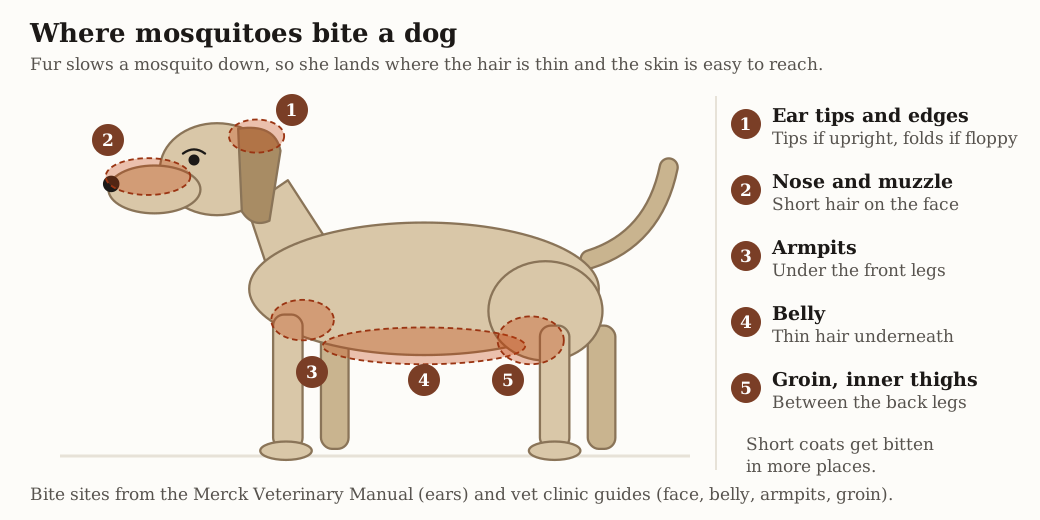
The ears are a common target. In dogs with upright ears, insect bites show up on the tip of the ear, the Merck Veterinary Manual notes. In dogs with floppy ears, they show up on the folded surfaces instead. The neck, head and belly are also common bite sites.
Short-haired breeds make bites easier to spot, too. On a long-haired dog, you may notice the scratching and licking before you ever see a bump. Part the hair on the belly and the inside of the ears to look.
What does a mosquito bite look like on a dog?
A mosquito bite on a dog is a small, raised, pink or red welt, usually under 3/8 inch (1 cm) across. It looks much like a bite on a person. Unless the dog has scratched or chewed it, there is no scab or open sore. Most dogs have one or a few bites, not a tight cluster.
That description comes from PetMD’s vet-written guide, which ranks first on Google for this question. It adds that the welt usually has a flat, pinkish surface. Some dogs react more than others. A dog with allergies may get a bigger, puffier welt, or a patch of hives instead of a single bump.
How long do mosquito bites on dogs last?
Most bites fade in 1 to 2 days without treatment. The itch is usually shortest of all, lasting a few hours to a day, according to PetMD. If the itch goes on longer, or the spot gets bigger, something else may be going on. It could be an infection from scratching, or a different kind of bite.
Hives follow their own clock. They are raised, red, itchy patches, and insect bites are one of the most common causes in dogs. They appear within minutes or hours and often disappear within a few hours, the Merck Veterinary Manual says.
Mosquito bite or something else?
A bump on its own cannot tell you which bug made it. Many things cause small red bumps on a dog, and some need a vet. So look for the bug and the pattern, not just the bump. The table lists the usual suspects and the clue that points to each.
Table 1. A red bump on your dog: the clue that points to each cause
One or a few welts on thin-fur skin after time outside at dusk
- Likely cause
- Mosquito bites
- What to do
- Home care; check the heartworm date
Many raised patches that appear fast, often on the back, flanks, neck or eyelids
- Likely cause
- Hives, an allergic reaction
- What to do
- Call your vet; go now if the face swells or the dog vomits
Crusty bites on the tips of upright ears, near horses or barns
- Likely cause
- Stable flies
- What to do
- Ask your vet; Merck says they favor pointed ears
A bug with legs attached at the skin
- Likely cause
- A tick
- What to do
- Ticks on dogs
Tiny jumping bugs or black specks in the fur
- Likely cause
- Fleas
- What to do
- Flea or tick?
A wet, raw, spreading sore the dog keeps licking
- Likely cause
- A hot spot or infection
- What to do
- See your vet
Bumps that last for weeks, or hair loss
- Likely cause
- Allergy, mites or another skin problem
- What to do
- See your vet
From the Merck Veterinary Manual (hives, stable flies), PetMD and VEG ER for Pets.
What to do if your dog has a mosquito bite
A plain mosquito bite on a dog needs no treatment. It heals on its own in a day or two. Your jobs are to stop the scratching, keep the spot clean, and check that your dog’s heartworm preventive is up to date. Do not use human creams or pills unless your vet tells you to.
Caring for a mosquito bite on your dog
Check the heartworm date
Look at when your dog last had its heartworm preventive. If a dose is late or your dog takes none, call your vet this week. That matters more than the bump.
Look the dog over
Check the ears, the bridge of the nose, the belly and the groin. Count the bumps, and note any swelling around the eyes or lips.
Stop the scratching
A loose T-shirt over the belly or a cone around the neck keeps paws and teeth off the bite while it heals.
Cool it down
Hold a cool, damp cloth on the spot for a few minutes. Keep the skin clean and dry afterward.
Skip human creams and pills
Do not put a human anti-itch cream on the bite or give an antihistamine unless your vet says so and tells you how much. Dogs lick creams off.
Watch for 2 days
A normal bite fades in a day or two. Call your vet if it grows, oozes, smells or turns into a raw patch. Go now for any sign in the red box below.
Why no human creams? A dog licks off whatever you put on its skin. Also, the right medicine and amount depend on the dog. VEG ER for Pets, an emergency vet group, tells owners to call their vet before they use any over-the-counter product. If your dog does swallow a cream or a pill, call your vet or the ASPCA Animal Poison Control Center at (888) 426-4435.
Scratching is the main thing that turns a small bite into a problem. Constant licking and chewing damage the skin, which can lead to a bacterial infection or a hot spot. As a result, a cone or a T-shirt for a day can save a trip to the vet.
When a mosquito bite on a dog needs a vet
Call your vet the same day if a bite oozes, smells, scabs over, or keeps growing, or if your dog has rubbed it raw. Go to an emergency vet now for a swollen face or eyelids, hives that spread, vomiting, diarrhea, weakness, pale gums or trouble breathing. Those are signs of a serious allergic reaction.
A severe allergic reaction, called anaphylaxis, is rare but life-threatening. In dogs, it shows up differently than in people. The Merck Veterinary Manual explains that a dog’s liver, not its lungs, takes the main hit. So vomiting, diarrhea and drooling are the main signs, along with pale gums and a fast, weak pulse.
Signs usually start within seconds to minutes. Merck calls anaphylaxis an extreme emergency, and a vet can treat it with an injection. Hives alone, on the other hand, often fade within hours and may not need treatment. Still, Merck notes that severe hives can be a first step toward anaphylaxis, so call your vet even for mild hives after bites.
My dog’s eye swelled up after a mosquito bite
One owner on r/dogs described this: a mosquito in the bedroom, then a swollen eyelid and hives on a young boxer. The swelling went down before the vet visit. That is a common story, and the right move was to call the vet. Swelling near the eyes, nose or throat needs a vet the same day, and an emergency vet if the dog also vomits, weakens or struggles to breathe.
Not veterinary advice. This section is general reference for dog owners. It is not a diagnosis and gives no doses. If your dog seems unwell after bites, call your vet.
Heartworm: the real risk of mosquito bites on dogs
Heartworm is the most serious thing mosquitoes give dogs, and the reason “do mosquitoes bite dogs” is worth asking. One bite from an infected mosquito can leave worm larvae in a dog. In about 6 months, they grow into worms up to a foot long that live in the heart, lungs and blood vessels. It is preventable with a vet-prescribed medicine, but treatment is hard on the dog.
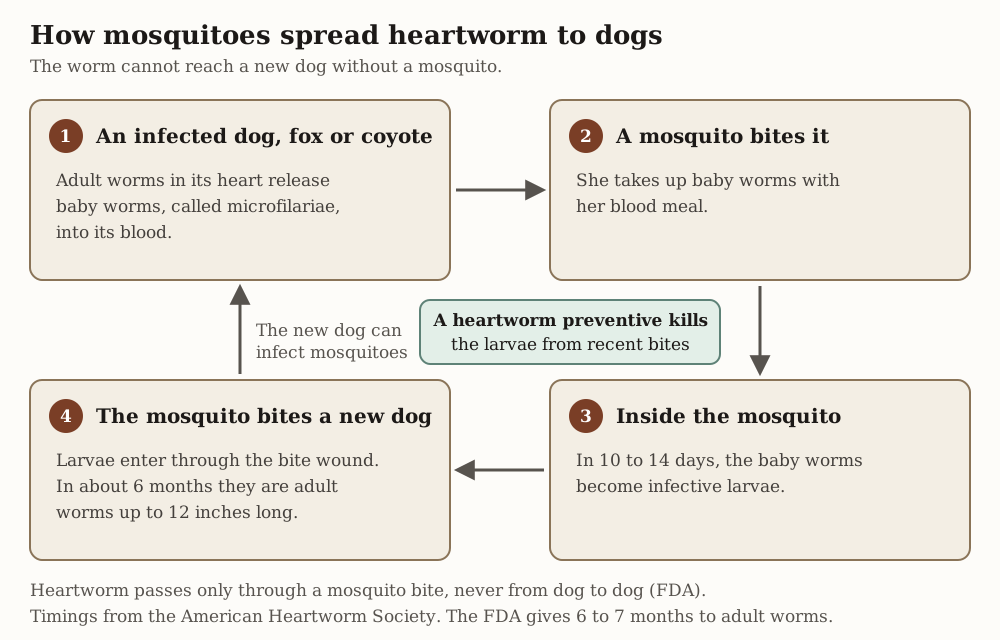
The worm is called Dirofilaria immitis, and it cannot move from dog to dog without a mosquito. Adult female worms in an infected dog, fox or coyote release baby worms called microfilariae into the blood. A mosquito picks them up when it bites. Then, over 10 to 14 days, they become infective larvae inside the mosquito, the American Heartworm Society explains.
When that mosquito bites another dog, it leaves the larvae on the skin, and they enter through the bite wound. Inside the dog, they take about 6 months to become adults. The FDA gives 6 to 7 months. Adult females reach 10 to 12 inches long, and the average infected dog carries about 15 worms, though some carry up to 250.
Sources differ on how long the worms live. The American Heartworm Society and the FDA both say 5 to 7 years in a dog. The Merck Veterinary Manual says 3 to 5 years. Either way, every month without prevention adds worms that stay for years.
Heartworm is found in all 50 states. It is most common along the Atlantic and Gulf coasts and the Mississippi River, the FDA says. Merck counts at least 70 kinds of mosquitoes that can carry it. Heartworm is not contagious, however: a dog cannot catch it from another dog, only from a mosquito.
Signs of heartworm disease in dogs
Early on, many dogs show few signs or none at all. That is why vets test for it. As the disease goes on, signs include a mild, lasting cough, not wanting to exercise, tiring after moderate activity, a poor appetite and weight loss. Later, heart failure can make the belly swell with fluid.
Dogs with many worms can suddenly collapse when the worms block blood flow in the heart. The American Heartworm Society calls this caval syndrome. Its signs are sudden hard breathing, pale gums and dark, bloody or coffee-colored urine. It is an emergency, and few dogs survive it without surgery to remove the worms.
Year-round heartworm prevention: what the American Heartworm Society recommends
The American Heartworm Society asks owners to “think 12.” Test your dog every 12 months, and give a heartworm preventive 12 months a year. It recommends year-round prevention even in cold states, because mosquito seasons vary and some mosquitoes survive the winter indoors. Indoor dogs need it too, since infected mosquitoes get inside.
Every heartworm preventive in the US needs a vet’s prescription. The FDA label says so, and before prescribing one, a vet usually tests the dog first. Giving a preventive to a dog that already has adult worms can cause a rare but serious reaction. The FDA and the society both advise testing dogs 7 months or older before they start.
Preventives come as a monthly chew or tablet, a monthly liquid applied to the skin, or an injection your vet gives every 6 or 12 months. Your vet sets the product and the dose by your dog’s weight. Puppies should start as early as the label allows, and no later than 8 weeks old, the society says.
Schedule matters. A preventive kills the young larvae a mosquito left behind in the past weeks. In as little as 51 days, though, those larvae can grow past the stage the medicine can stop. So a late or missed dose can leave a gap. If you miss one, call your vet rather than doubling up.
Does heartworm medicine stop mosquito bites?
No. A heartworm preventive does not keep mosquitoes off your dog. It kills the larvae after a bite. In a ranking r/hikingwithdogs thread, one owner asked whether a monthly chew stopped bites. The reply was right: it “just kills the larvae.” So a dog on a preventive still gets itchy bumps, but the bites do not turn into heartworm.
My dog got bitten and is not on a preventive. What now?
Call your vet and start prevention, but there is no test that can check for that bite yet. Heartworm tests look for adult worms. The earliest a test can find them is about 5 months after the bite, the FDA says. So your vet will test before starting an adult dog, then test again about 6 and 12 months later.
Not every mosquito carries heartworm, so one bite is far from a sure infection. Still, a dog with no preventive in mosquito season is likely getting bitten often. Starting now protects against the next bite. For a puppy under 7 months, the society says prevention can start without a test.
If a dog does test positive, most can be treated. Treatment uses a series of injections, strict rest for weeks, and many vet visits, so it costs far more than prevention. Your vet will plan it. The American Heartworm Society is clear on one point: use only heartworm preventives the FDA has tested and proven effective. No natural product has earned that.
Can dogs get West Nile virus or other diseases from mosquitoes?
Do mosquitoes bite dogs and give them West Nile virus? They can, but dogs rarely get sick from it. CDC says West Nile disease in dogs is rare and that vaccinating dogs has not been recommended. Eastern equine encephalitis (EEE) is rarer still in dogs, and it has been reported only in puppies. Heartworm is the mosquito risk to plan around.
Some pages list West Nile and EEE beside heartworm as common dog diseases. They are not. In its West Nile surveillance guidelines, CDC notes that dogs and cats do get infected. Yet there is no evidence they carry enough virus in their blood to pass it on. In other words, a dog is not a source of West Nile for you or for mosquitoes.
EEE is serious when it happens. A 2018 report of three cases in Michigan and New York found that EEE is rare in dogs and has only been reported in puppies. The signs began with fever, a poor appetite and diarrhea, then quickly became seizures. In an earlier Georgia study, all 12 dogs found with EEE over 12 years were under 6 months old.
One correction is worth making. A vet clinic page that ranks for this search lists leishmaniasis among the mosquito diseases. Leishmaniasis is spread by sand flies, the Merck Veterinary Manual says, not by mosquitoes. For the diseases mosquitoes give people, see our guide to mosquitoes.
Mosquito repellent for dogs: what is safe
Use only a repellent whose label says it is for dogs, at your dog’s weight and age. Never use DEET or any human bug spray on a dog. Some dog spot-ons with permethrin list mosquitoes on the label, but they are dangerous to cats. Natural sprays are mostly untested, and no repellent replaces heartworm prevention.
Table 2. Mosquito repellents and dogs
DEET bug spray made for people
- On your dog?
- No
- Why
- Merck: DEET has caused weakness, paralysis, liver disease and seizures in pets
Any other repellent made for people, such as picaridin
- On your dog?
- No
- Why
- EPA: use nothing on a pet unless the label says it is for animals
EPA-registered dog spot-on or spray that lists mosquitoes, often with permethrin
- On your dog?
- Yes, if your vet agrees and you follow the label
- Why
- Labeled for dogs; many are highly toxic to cats
Natural dog spray with essential oils and no EPA Reg. No.
- On your dog?
- Not proven
- Why
- EPA has not checked these products for effectiveness
Homemade oil, vinegar or garlic mixes
- On your dog?
- No
- Why
- ASPCA: never apply essential oils directly to a pet; no test shows they work
Heartworm preventive
- On your dog?
- Yes, by prescription
- Why
- Does not repel; it stops the infection a bite can cause
Can I put human bug spray or DEET on my dog?
No. The Merck Veterinary Manual says DEET is the most effective repellent for humans, but in pets it has caused weakness, paralysis, liver disease and seizures. It should not be given to dogs or cats. Picaridin and the other human repellents are not labeled for pets either. The EPA’s rule is simple: use no product on an animal unless the label clearly says it is for animals.
The same goes for sharing in the other direction. A dog product is not a repellent for you. To pick one for yourself, see our guide to choosing a mosquito repellent, or compare the two most common in picaridin vs DEET.
Permethrin dog products, and why they can kill cats
Some dog spot-ons and sprays contain permethrin, and many list mosquitoes on the label along with fleas and ticks. These are made and labeled for dogs. For cats, though, permethrin can be highly toxic, causing muscle twitching and seizures, the Merck Veterinary Manual says.
The EPA has found this to be a real problem. When its veterinarians studied pet spot-on incidents, they found that cats were being harmed when dog products were misused on them or reached them by accident. Cats are more sensitive to certain pesticides. The team also found that label warnings against using dog products on cats were not working well enough. So read every word on the box.
Are natural mosquito repellents for dogs safe?
Not automatically. Many natural pet sprays carry no EPA registration number. Those sold under the EPA’s minimum-risk exemption, known as FIFRA 25(b), have not been evaluated for effectiveness, the EPA says. Nobody has checked that they keep mosquitoes off. The EPA does not review their labels either.
Google’s AI answer for this search calls plant-based sprays with lemongrass and geraniol safe for dogs. The ASPCA’s own plant list is less sure. It lists lemongrass as toxic to dogs and cats, and it names geraniol and linalool as the toxic compounds in geraniums. A spray at a low strength may be fine, but “plant-based” does not mean tested or safe.
Concentrated oils are the real hazard. The ASPCA Animal Poison Control Center warns that pets can be poisoned by oils on their coat or paws. As few as 7 or 8 drops of concentrated tea tree oil can cause problems, and it advises never applying essential oils directly to a pet. Cats are at even greater risk, as the cat section below explains.
Homemade mosquito repellent for dogs
We found no test showing that a homemade spray keeps mosquitoes off a dog. Recipes online mix essential oils, vinegar, lemon or garlic. The oils carry the poisoning risk above, and garlic is toxic to dogs, the ASPCA says. Meanwhile, a dog that smells of vinegar still gets bitten.
For people, our guide to natural mosquito repellents covers which plant oils were tested and how long they lasted. For the garden, see which mosquito plants are safe around pets. Citronella geraniums, sold as the mosquito plant, are on the ASPCA’s toxic list for dogs and cats.
How to protect your dog from mosquitoes at home
The steps that work best cost nothing. Walk your dog outside the early morning and early evening, when most mosquitoes bite. Keep it indoors at night in mosquito season, behind screens. Then tip out standing water in the yard every week, including pet bowls. Add a heartworm preventive, and your dog is well covered.
- Time the walks. The Merck Veterinary Manual suggests not walking your dog in the early morning or early evening, when mosquitoes are most active. The Asian tiger mosquito is the exception, since it bites in the daytime.
- Bring the dog in at night. Do mosquitoes bite dogs indoors? Some get in, but screens keep most out. Merck advises keeping puppies and sensitive dogs in closed or screened buildings. Fix torn screens and keep doors shut.
- Empty standing water weekly. Tip out buckets, saucers, toys, tarps and birdbaths. Refill outdoor water bowls with fresh water every day.
- Avoid marshy spots and wet ground on walks, where mosquitoes are thickest.
- Put a fan on the porch where your dog lies. A breeze scatters the carbon dioxide and scent that lead mosquitoes to a body.
- Skip the bug zapper. Mosquitoes are not drawn to light, Merck notes, so zappers do not help and kill the insects that eat mosquitoes.
Wrigglers in a water bowl are mosquito larvae, and they become biting adults within days. Our guide to mosquito larvae shows how to spot them. They will not hurt a dog that drinks them, but the bowl needs fresh water.
If you treat the yard, a spray labeled “pet safe” is still a pesticide. Follow the label for how long to keep your dog off the grass, which is usually until it dries. Our guide to getting rid of mosquitoes in the yard covers which treatments are worth it and when pets can go back out.
Do mosquitoes bite cats too?
Yes, mosquitoes bite cats, usually on the nose and ear tips. Some cats are allergic to the bites, a problem vets call feline mosquito bite hypersensitivity. Cats can get heartworm too, and it has no approved treatment in cats, so prevention matters even more. Never use a dog repellent on a cat.
In allergic cats, the bites cause crusty, sometimes open sores on the ear flaps and the nose. Less often, the footpads, eyelids, chin and lips are affected, the Merck Veterinary Manual says. The sores itch, and a badly affected cat can run a fever. Merck’s first step is simple: keep the cat indoors at dusk and dawn.
Heartworm works differently in cats. The cat is an unusual host, so most worms do not reach adulthood, and a cat often has only one to three. Even so, the young worms damage the lungs, and the American Heartworm Society says the dog treatment cannot be used in cats. So for cats, indoor ones included, prevention is the only protection. Ask your vet about a monthly cat preventive.
Cats are also more sensitive to essential oils than dogs. They lack a liver enzyme that breaks down some of the compounds in oils, the Merck Veterinary Manual explains, and grooming adds to the dose. A mosquito-repelling insecticide that can be used on dogs is not safe for cats, Merck adds. For tick products and cats, see our guide to ticks on cats.
Myths about mosquitoes and dogs, corrected
Several of these ideas appear on pages that rank well for this search. Here is what the vet sources say instead.
Myth 1
Myth: “A thick coat keeps mosquitoes off a dog.”
Truth: Fur helps, but mosquitoes go for the ears, nose, belly and groin, where hair is thin. Dogs with thick coats still get bitten there.
Myth 2
Myth: “An indoor dog does not need heartworm prevention.”
Truth: Infected mosquitoes come inside, so indoor and outdoor pets are both at risk, the American Heartworm Society says. It recommends prevention for every dog, all year.
Myth 3
Myth: “Heartworm pills are only needed in summer.”
Truth: The American Heartworm Society now recommends a year-round program even where winters are cold. Mosquito seasons vary, and some mosquitoes survive the winter indoors.
Myth 4
Myth: “A natural spray or a mosquito repellent can replace heartworm medicine.”
Truth: No repellent stops every bite, and one bite can be enough. The American Heartworm Society says to use only heartworm preventives tested and proven effective by the FDA.
Myth 5
Myth: “Plant-based mosquito sprays are always safe for pets.”
Truth: Not always. The ASPCA lists lemongrass as toxic to dogs and cats, and names geraniol as a toxic compound in geraniums. Concentrated oils are the bigger risk.
Myth 6
Myth: “Mosquitoes spread leishmaniasis to dogs.”
Truth: A Huntsville vet page says so, but the Merck Veterinary Manual names sand flies as the carrier of leishmaniasis, not mosquitoes.
Mosquitoes are not the only biters on a summer walk. Ticks carry their own diseases, so check your dog with our guide to ticks on dogs, and see which tick products work on dogs. If you are the one with the bites, our guide to mosquito bites on people covers relief and warning signs.
Pest control disclaimer. Photo-based identification can help, but it is not always perfect. For dangerous spiders, large infestations, or anything you are unsure about, contact a licensed pest control professional.
Veterinary disclaimer. This page is general information for dog and cat owners. It is not veterinary advice, a diagnosis or a treatment plan, and it names product types, not brands. Ask your veterinarian which heartworm preventive and which repellent are right for your pet, and call them if your pet seems unwell after bites.
Mosquitoes and dogs: FAQ
Is my bug spray safe if my dog licks it off me?
My dog ate a mosquito. Is that dangerous?
Can my dog give me heartworm or West Nile virus?
Can I use my dog's mosquito repellent on myself?
What mosquito repellent can I use on a puppy?
Related guides
Mosquitoes
How mosquitoes find a host, where they breed and the diseases they carry.
Ticks on dogs
Where ticks hide on a dog, tick or skin tag, and the signs that need a vet.
Getting rid of mosquitoes
Standing water, screens, and when a yard treatment is worth it with pets.
Choosing a repellent
The six ingredients CDC recommends for people, and how long each lasts.
Plants and pets
Which mosquito plants are toxic to dogs and cats, from the ASPCA list.
Asian tiger mosquito
The striped daytime biter that also carries dog heartworm.
Mosquito larvae
Wrigglers in a water bowl: what they are and how to stop them.
Ticks on cats
Safe removal for cats, and why dog products can poison them.
Mosquito dunks
Treat a pond or trough the dog drinks from, and what the label says about pets.
When is mosquito season?
The months mosquitoes are out where you live, and when they finally go away.
Sources
- American Heartworm Society, Heartworm Basics
- US FDA, Keep the Worms Out of Your Pet's Heart! The Facts about Heartworm Disease
- Merck Veterinary Manual, Flies and Mosquitoes of Dogs (dog owners)
- Merck Veterinary Manual, Ectoparasiticides Used in Small Animals (DEET, permethrin)
- CDC, Guidelines for West Nile Virus Surveillance and Control (dogs and cats)
- US EPA, Regulation of Skin-Applied Repellents (products exempt from registration)
- US EPA, Evaluation of Pet Spot-on Products: Analysis and Plans for Reducing Harmful Effects
- ASPCA Animal Poison Control Center, essential oils and pets