What are mosquito dunks?
A mosquito dunk is a small, beige, donut-shaped ring that floats on standing water. As it slowly dissolves, it releases Bti, short for Bacillus thuringiensis subspecies israelensis. That is a bacterium found in soil. Its toxins kill the larvae of mosquitoes, black flies and fungus gnats. EPA says they affect only those larvae.
“Mosquito Dunks” is a brand name, a trademark of Summit Chemical. Readers also call them mosquito donuts or pucks. What matters is on the back of the package. The current label lists one active ingredient, a Bti strain at 10.31%, and EPA Registration No. 6218-87. Any EPA-registered Bti briquet does the same job, as long as you follow its own label.
How do mosquito dunks work?
Larvae eat the Bti as they filter food from the water. Inside the larva, the gut is alkaline, at a pH of about 9 to 10.5, and that switches the toxin on. The toxin breaks down the gut lining, and the larva stops feeding and dies, the National Pesticide Information Center explains. A human stomach is acidic, so the same toxin is simply digested.
That is why Bti is so narrow. It has to be eaten, and it needs the right gut. Adult mosquitoes feed on nectar and blood, not on the bits larvae filter from water, and pupae do not eat at all. Neither one is touched. EPA also reports no documented resistance to Bti, even in mosquitoes treated with it for decades.
Bti or methoprene? Check the active ingredient
Two kinds of larvicide sit side by side in stores, and readers mix them up. One popular Reddit thread shows a dunk bucket full of wigglers. Its top replies said dunks do not kill larvae, only stop them from becoming adults. That describes methoprene, an insect growth regulator. A Bti dunk kills the larvae themselves.
The two common mosquito larvicides
How it works
- Bti (mosquito dunks)
- A bacterial toxin that kills larvae that eat it
- Methoprene
- A growth regulator that stops larvae from becoming adults
What you see
- Bti (mosquito dunks)
- Wigglers gone within about 2 days
- Methoprene
- Larvae keep swimming, then fail to emerge
Other water life
- Bti (mosquito dunks)
- Practically nontoxic to fish; can affect midge larvae
- Methoprene
- Very highly toxic to freshwater invertebrates, NPIC says
Best for
- Bti (mosquito dunks)
- Ponds, birdbaths, barrels, anywhere with wildlife
- Methoprene
- Read its label for the sites it allows
Do mosquito dunks work?
Yes, on the larvae in the water you treat. EPA says Bti has been shown to reduce mosquito larvae. New York’s health department adds that a dunk starts killing them within hours, with a clear difference in about 48 hours. In a test in Thailand, dunks in 200-liter water jars still gave over 80% control of yellow fever mosquito larvae 11 weeks later.
Whether you notice fewer bites is a different question. A dunk only stops new mosquitoes from growing up in that one spot. So it helps most when the treated water is the main source near you, and least when gutters, saucers and a neighbor’s pond keep breeding them.
How long does it take for mosquito dunks to work?
On the larvae, about 2 days. The label says to allow at least 48 hours, and NPIC puts death at 1 to 5 days after a larva eats Bt. Some larvae that hatch later may grow a little before they die, the label adds.
In the yard, expect weeks. Adult mosquitoes usually live about 2 to 4 weeks, and the dunk does nothing to them. In Good Housekeeping’s two-week test, the writer saw no surge but could not call it proof. Southern Living’s tester noticed a difference after about three weeks. Our guide to how long mosquitoes live explains why the adults fade slowly.
What mosquito dunks cannot do
- Kill adults. Biting mosquitoes never eat Bti. For tonight, use a repellent such as picaridin or DEET.
- Kill pupae. Tumblers do not feed, so a few may still hatch after you treat.
- Reach water you did not treat. A clogged gutter next to a treated pond keeps breeding.
- Work on a lawn. Larvae live only in water, so soaking a dunk and spraying grass does nothing.
- Repel anything. A dunk has no smell that keeps mosquitoes away.
Do dunk buckets cut mosquitoes by up to 90%?
Google’s AI answer for “do mosquito dunks work” says dunks can cut local mosquitoes by up to 90% in a bucket trap. It cites The Woodlands Township in Texas. We read that page. It says the opposite: dunk buckets do not solve the problem, because adults keep breeding in other standing water.
We found no study that measured a 90% drop from homeowner dunk buckets. The closest real number comes from a different trap. CDC’s egg-laying traps, which kill the females that enter them, were placed at about 85% of homes in Puerto Rico neighborhoods. They cut female yellow fever mosquitoes by more than 80%. Those traps catch the female herself, which a Bti bucket does not.
Why are there still larvae in my dunk bucket?
Live larvae after 2 days usually have a simple cause. Check them in this order before you add more.
Live wigglers after a dunk: what it usually means
Comma-shaped tumblers that rest at the surface
- Likely cause
- Pupae, which do not eat
- What to do
- Wait. Pupae hatch within a few days, and the next larvae die
Thin red worms on the bottom
- Likely cause
- Non-biting midge larvae (bloodworms)
- What to do
- Nothing. They are not mosquitoes
Wigglers hanging head down, still lively
- Likely cause
- The dunk is used up, flushed out or washed away by changed water
- What to do
- Add a fresh piece; tie it if rain overflows the container
Many wigglers in dense plants or very foul water
- Likely cause
- More larvae than a slow dunk can clear at first
- What to do
- The label suggests a fast Bti granule first, then the dunk
A briquet that names methoprene, not Bti
- Likely cause
- A growth regulator, not a dunk
- What to do
- Normal. Larvae swim, then fail to emerge
Not sure what you are looking at? Our mosquito larvae guide shows wigglers, tumblers and the look-alikes side by side.
How to use mosquito dunks
Use mosquito dunks only on water you cannot dump, and measure the surface first. The label is the law here. On the current label, one dunk treats 75 to 100 square feet of water surface, and smaller areas get a half or a quarter. Summit says depth does not change the amount, and it lists a dunk at 30 days or more.
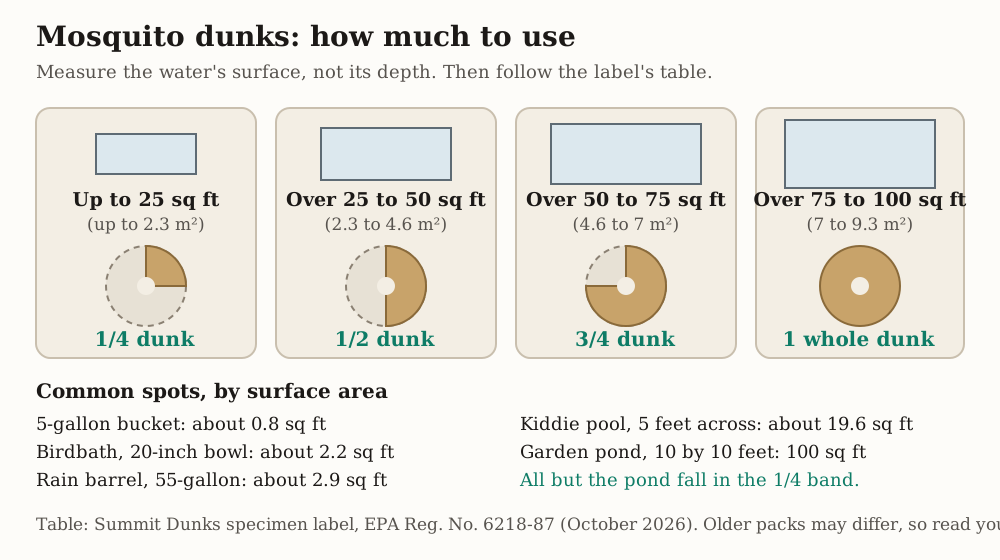
The dosage table on the current mosquito dunks label
Up to 25 sq ft (2.3 m²)
- Amount
- 1/4 dunk
- Examples
- Bucket, birdbath, rain barrel, plant saucer, kiddie pool
Over 25 to 50 sq ft
- Amount
- 1/2 dunk
- Examples
- A small water garden
Over 50 to 75 sq ft
- Amount
- 3/4 dunk
- Examples
- A larger water garden
Over 75 to 100 sq ft
- Amount
- 1 whole dunk
- Examples
- A 10 by 10 foot pond
Summit Dunks specimen label, EPA Reg. No. 6218-87, October 2026. A 1993 label used smaller bands, so an older package may differ. Follow the label on the package you own.
Two label lines are worth knowing. In water heavy with organic matter, such as a sewage pond, the label allows up to four times the normal amount. And where larvae are already thick, it suggests a quick-acting Bti granule first, then the dunk. The full specimen label is two pages.
Using mosquito dunks, step by step
Find the water you cannot dump
Walk the yard after rain. Dump, cover or fix everything you can first. Dunks are for what is left, such as a pond, a rain barrel, a fountain or a low spot that floods.
Measure the surface, not the depth
Multiply length by width in feet. For a round container, a 12-inch bucket is under 1 square foot and a 5-foot kiddie pool is about 20.
Break off the amount the label gives
On the current label, a quarter dunk treats up to 25 square feet and a whole dunk treats 75 to 100. Break it outdoors, and do not breathe the dust.
Float it, and tie it if water moves
Drop the piece on the water. Where rain or a pump could flush it out, tie a string through the center hole or stake it with a small stick, as the label suggests.
Check after 2 days
The label says to allow at least 48 hours. Wigglers should be gone by then. Tumblers, the comma-shaped pupae, do not feed, so a few may still hatch.
Replace it about every 30 days
A dunk releases Bti for about 30 days. When it has dissolved, or the water has overflowed or been changed, add a fresh piece.
Store the rest closed and dry
Keep unused dunks in a closed container in a cool, dry place, away from children and pets. Wash your hands after handling them.
How long does a mosquito dunk last?
About 30 days in the water. The label says mosquito dunks release effective levels of Bti for 30 days under typical conditions. North Carolina State Extension puts it at 3 to 4 weeks in a bucket. Replace it sooner if the dunk has dissolved, if rain overflowed the container, or if you changed the water.
Bti breaks down quickly in the environment, Washington’s health department notes, so hot sun and moving water shorten its life. A covered rain barrel is the easy case. A shallow birdbath in full sun is the hard one, and changing that water every few days works without a dunk at all.
Do mosquito dunks expire?
The label gives no expiration date. It says to store dunks in a closed container in a cool, dry, ventilated place. Summit says unused, dry dunks keep their strength indefinitely, and one Reddit user reports 3-year-old dunks still working in livestock tanks. We found no independent test. If wigglers survive 2 days with an old dunk, try a fresh one.
Where to use mosquito dunks, and where not to
Use mosquito dunks in contained water on your own property that you cannot dump. The label lists flower pots, tree holes, rain barrels, roof gutters, old tires, unused swimming pools and animal watering troughs. Keep them out of streams, storm drains, wetlands and water people drink.
Where a dunk belongs
Rain barrel, cistern you do not drink from
- Use a dunk?
- Yes
- Why
- Listed on the label; screen the top as well
Ornamental pond or fountain
- Use a dunk?
- Yes
- Why
- The label allows fish habitats; NY DOH names ponds and fountains
Animal watering trough
- Use a dunk?
- Yes
- Why
- Listed on the label
Tree hole, old tire, clogged gutter
- Use a dunk?
- Yes, if you cannot fix it
- Why
- Listed on the label; fixing it is better
Unused pool or a pool cover holding rain
- Use a dunk?
- Yes
- Why
- Listed on the label and by NY DOH
A spot that floods after rain
- Use a dunk?
- Yes, even while dry
- Why
- The label allows treatment before it floods
Birdbath or pet bowl
- Use a dunk?
- Usually not needed
- Why
- Fresh water every few days stops mosquitoes for free
Water people drink
- Use a dunk?
- No
- Why
- The label bars treated drinking water reservoirs; CDC keeps larvicides out of drinking water
Stream, ditch to a creek, storm drain or wetland
- Use a dunk?
- No
- Why
- State rules apply; leave it to your mosquito control program
A wildlife pond
- Use a dunk?
- Think first
- Why
- Fish, frogs and dragonfly larvae eat wigglers; Bti can also cut midges
Why not streams, drains and wetlands?
Partly the law, and partly the wildlife. In New York, the label limits mosquito dunks to containers with no outflow to the natural environment. In Washington, the health department says only a licensed applicator may treat water that can reach the state’s surface waters, likely with a permit. Rules differ by state, so check yours.
Wetlands also have their own mosquito predators. Washington’s Department of Ecology does not recommend treating most wetlands for that reason. If a ditch or marsh near you breeds mosquitoes, call your county mosquito control program. Our guide to getting rid of mosquitoes around the yard explains how to find yours.
Can I water my vegetable garden from a rain barrel with a dunk in it?
Yes. EPA says Bti poses no risk to food crops or water supplies and can be used in organic farming. Bt is also exempt from EPA limits on food residues because its toxicity is so low, NPIC notes. Rain barrels and flower pots are both on the dunk label.
Mosquito dunks in a pond with fish or frogs
The label says dunks can be used in fish habitats, and New York’s health department recommends them for ponds with fish, frogs and tadpoles. Still, a healthy pond often needs no dunk. Goldfish and other small fish eat wigglers, and so do dragonfly nymphs. A small pump or fountain also helps, since moving water breeds fewer mosquitoes.
Are mosquito dunks safe for pets, birds and fish?
Yes, at label rates. EPA says Bti has no toxicity to people and minimal toxicity to honey bees. Studies found it practically nontoxic to birds and fish, NPIC reports. The label still carries a CAUTION: the dust is harmful if inhaled and causes moderate eye irritation, so break dunks outdoors and wash your hands.
Mosquito dunk safety, by who drinks or swims in the water
People
- What the evidence says
- No toxicity found; mild skin or eye irritation possible from direct contact
- Source
- EPA; Washington DOH
Dogs and cats
- What the evidence says
- Unlikely to have any effect from treated water
- Source
- Washington DOH
Birds
- What the evidence says
- Practically nontoxic to quail and mallard ducks at very high doses
- Source
- NPIC
Fish
- What the evidence says
- Practically nontoxic to trout, bluegill and minnows
- Source
- NPIC; dunk label
Honey bees
- What the evidence says
- Minimal to low toxicity
- Source
- EPA; NPIC
Frogs and tadpoles
- What the evidence says
- No harm to growth in most tests, but few studies exist
- Source
- NPIC; Empey and others, 2021
Plants
- What the evidence says
- Safe; flower pots are on the label
- Source
- Dunk label; EPA
Are mosquito dunks safe for birds?
Yes. NPIC reports that Bti was practically nontoxic to bobwhite quail and mallard ducks, even at very high doses. Birds also lack the alkaline insect gut that switches the toxin on. A dunk in a birdbath is safe, though it is rarely needed. Changing the water every few days does the same job.
Are mosquito dunks safe for dogs?
Drinking treated water is safe, and the label lists animal watering troughs. Eating a dunk is another matter, and readers report dogs and raccoons doing it. In lab animals, Bti showed very low toxicity by mouth. New York’s health department notes only minimal irritation when a dunk is eaten. Still, take the rest away and call your vet if your dog seems unwell.
Are mosquito dunks safe for plants and bees?
Yes. Bti does not harm plants, and the label lists flower pots. Bees drink from birdbaths and pond edges, so this matters too. EPA says Bti has minimal toxicity to honey bees, and NPIC rates the israelensis type low in toxicity to bees.
Do mosquito dunks kill other insects?
Mostly not, with one real exception. Bti targets mosquito, black fly and fungus gnat larvae. Washington’s health department adds that it has some toxicity to certain other flies, including midges. Non-biting midges are the group to watch, because their larvae feed fish, frogs and birds in ponds and wetlands.
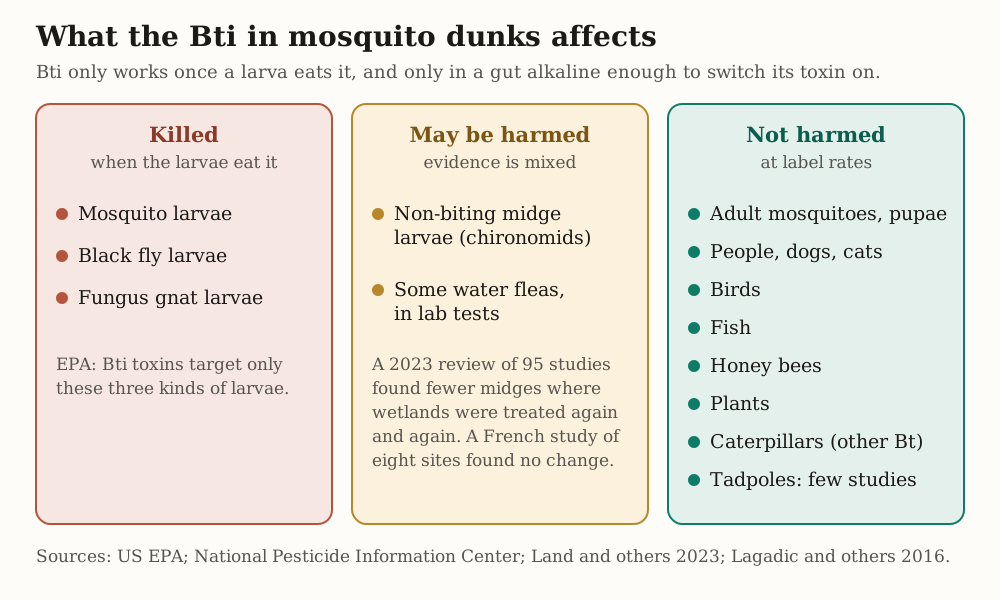
The wildlife pond worry, checked against the research
A post titled “Why I can’t recommend mosquito dunks and other Bti pesticides” ranks second on Google for this search. It comes from Reddit’s r/WildlifePonds. The writer argues that Bti also kills non-biting midge larvae, which feed many animals, and that it may harm amphibians. Part of that holds up, and part does not.
The midge concern is real. A 2023 systematic review of 95 studies found a consistent drop in midge larvae (Chironomidae) and small crustaceans where Bti was used for mosquito control. In German pond tanks, Bti cut midge larvae by 50 to 87%. In those tanks, midges made up more than half of what young newts ate.
The evidence is not all one way, though. A four-year French study of eight wetland sites found no detectable effect on midges or other water insects at normal rates. Overall, the review’s authors said the risk “should not be discounted,” but that few studies were rigorous enough to say how common it is.
Two claims in the thread go too far. It lists tussock moth caterpillars among Bti’s victims, but caterpillars are the target of a different type, Bt kurstaki. On amphibians, a 2021 review found only a few studies. They ranged from few effects to harm at high doses. NPIC adds that tadpoles exposed at field levels grew normally.
How sure are we, and what should you do?
We are fairly sure that treating wetlands with Bti again and again thins out midges. We are much less sure what one dunk does in a backyard pond, since no study we found measured that. A rain barrel or bucket is a different case, because it holds no midge population worth protecting.
- Containers: barrels, buckets, tires, gutters and troughs are the right place for dunks.
- A wildlife pond: try predators, a small pump and skimming egg rafts first. Treat only when you see wigglers.
- Wetlands, streams and vernal pools: leave them alone and call your mosquito control program.
The mosquito dunk bucket, or bucket of doom
A mosquito dunk bucket turns breeding into a trap. You set out a bucket of leafy water that egg-laying females prefer, and add a piece of dunk. The larvae that hatch there die. North Carolina State Extension calls it a larval trap and gives the recipe below.
- Fill a dark bucket about halfway with water, and add a handful of straw, hay or dried leaves.
- Let it steep for about 3 days. The rotting plants give off the smell females look for.
- Add a piece of dunk. A quarter is the label amount for any bucket.
- Cover it with chicken wire, or a lid with very large holes, to keep children and pets out. Add a stick so small animals can climb out.
- Drill holes near the rim so rain cannot overflow it and wash the Bti out.
- Set it away from where you sit, in shade.
- Add a fresh piece every 3 to 4 weeks, and write the date on the lid. Without Bti, the bucket breeds mosquitoes.
Do not add soap, oil, bleach, acetone or diesel, as some forum posts suggest. None of these is a registered mosquito product, and the label is the law. The old water can go on the garden, NC State says.
Does a mosquito dunk bucket work?
For some mosquitoes, somewhat, and no study has measured it in a yard. The bucket has a known weakness. The two container mosquitoes that bite by day, the Asian tiger and yellow fever mosquitoes, spread one batch of eggs over several containers. Scientists call this skip oviposition. So only part of each female’s eggs ends up in your bucket.
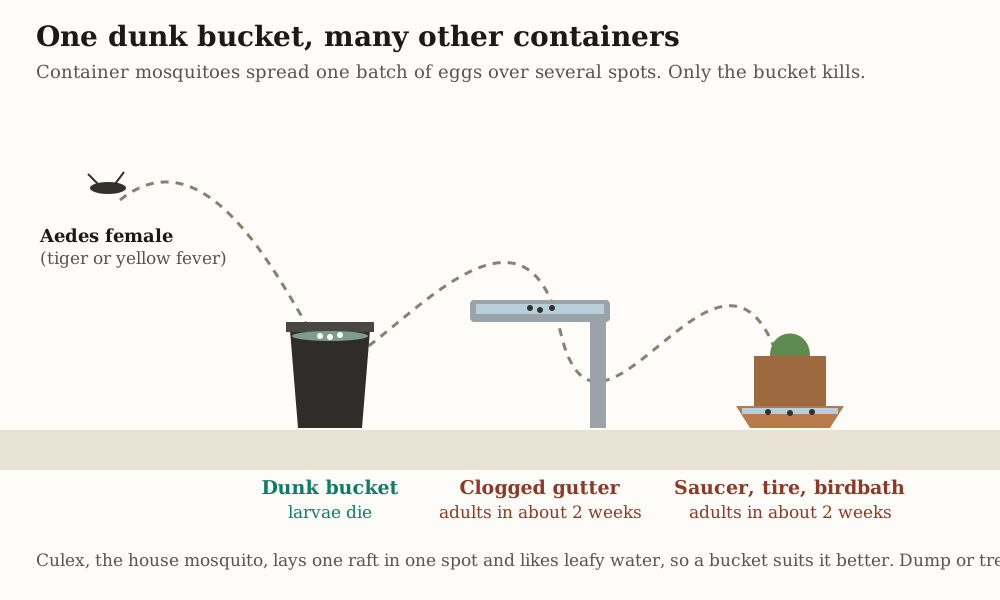
A 2003 genetic study in Trinidad found the same yellow fever mosquito families spread across several containers. In a 2021 North Carolina lab test, Asian tiger and yellow fever females both spread their eggs among cups. They did put more eggs in leafy water than in tap water, which is the bucket’s one advantage.
The bucket suits a different mosquito better. Culex, the house mosquito that spreads West Nile, lays one raft of eggs in one place. In field tests, hay and grass soaked in water drew egg-laying Culex strongly, which is why mosquito surveillance traps use it. One r/MosquitoHating reply says buckets attract “mainly all Culex.”
So use the bucket as an extra, not the plan. Readers who report success put out several buckets and also treat their gutters. Readers who report failure have found the real source elsewhere, such as a planter or a neighbor’s yard. Our Asian tiger mosquito guide covers the striped daytime biter that a bucket handles worst.
Will the bucket draw mosquitoes to me?
It draws egg-laying females to the bucket, so place it away from the patio, as NC State advises. The mosquitoes looking for blood follow your breath and body heat, not the bucket. A spot in a shady corner works well for both reasons.
Mosquito Dunks vs Mosquito Bits
Both are Bti from the same maker. The difference is speed and how long each lasts. Dunks release Bti slowly for about 30 days. Mosquito Bits are granules that release their Bti right away, so they kill fast but need reapplying every 7 to 14 days, as their label says.
Dunks, Dunk Chunks and Bits compared
Form
- Mosquito Dunks
- Floating ring
- Dunk Chunks
- Smaller floating piece
- Mosquito Bits
- Corn cob granules
Water treated
- Mosquito Dunks
- Up to 100 sq ft per dunk
- Dunk Chunks
- Up to 25 sq ft per chunk
- Mosquito Bits
- By teaspoon or tablespoon, as the label gives
How fast
- Mosquito Dunks
- Within hours; allow 48
- Dunk Chunks
- Within hours; allow 48
- Mosquito Bits
- Within 24 hours
How long
- Mosquito Dunks
- About 30 days
- Dunk Chunks
- About 30 days
- Mosquito Bits
- Up to 14 days; reapply every 7 to 14
Best for
- Mosquito Dunks
- Barrels, ponds, troughs, buckets
- Dunk Chunks
- Smaller containers
- Mosquito Bits
- Heavy larvae, scattered puddles, hoof prints, soil
The granules are also the form people use on houseplants, because the Bti washes into the soil. For that use, see our fungus gnat guide. For standing water, the dunk is the set-and-forget choice.
Are mosquito dunks organic?
Bti is allowed in organic farming, but EPA registration is not organic certification. EPA registers a pesticide as safe and effective when used as labeled. Organic rules come from the USDA National Organic Program, and groups such as OMRI check individual products against them.
The difference matters here. Google’s AI answer for “bti mosquito” says Bti is “approved for organic gardening by the US EPA.” EPA’s own page says only that Bti is approved for use in organic farming operations. In May 2026, Summit announced OMRI listing for Mosquito Bits and its Bti granules. That announcement did not name Dunks, and we could not confirm a Dunks listing in OMRI’s database. Summit’s own page says Dunks are approved for organic production.
Mosquito dunks myths, corrected
Myth 1
Myth: “Mosquito dunks kill the mosquitoes that are biting you.”
Truth: They do not. Bti works only when a larva eats it, so adults and pupae are untouched. The adults already flying live out their weeks. The drop comes as no new ones replace them.
Myth 2
Myth: “Dunks stop larvae from turning into adults, so live wigglers mean they work.”
Truth: That describes methoprene, a different larvicide. Bti kills the larvae themselves, usually within 2 days. If wigglers are still lively after that in Bti-treated water, something is wrong.
Myth 3
Myth: “Bti kills caterpillars and every other insect that eats it.”
Truth: Each type of Bt targets one group. The israelensis type in dunks targets mosquito, black fly and fungus gnat larvae. Caterpillar products use a different type, kurstaki.
Myth 4
Myth: “A dunk bucket cuts mosquitoes in your yard by up to 90%.”
Truth: We found no study behind that number. The town page Google cites for it says the buckets do not solve the problem, because adults keep breeding in other water.
Myth 5
Myth: “More dunk works better.”
Truth: The label sets the amount by water surface. A quarter dunk covers any bucket or birdbath. Extra adds cost, not protection.
For the rest of the plan, from dumping water to screens and fans, see our guide to how to get rid of mosquitoes. For how the insect lives and breeds, start at our complete guide to mosquitoes.
Pest control disclaimer. Photo-based identification can help, but it is not always perfect. For dangerous spiders, large infestations, or anything you are unsure about, contact a licensed pest control professional.
Mosquito dunks FAQ
Can I put a mosquito dunk in my dog's water bowl?
Can you put mosquito dunks in a swimming pool?
When should I put out mosquito dunks?
Do mosquito dunks work on fungus gnats?
Will a dunk hurt the koi or goldfish in my pond?
Related guides
Getting rid of mosquitoes
The full yard and house plan: water first, screens and fans next, sprays last.
Mosquito larvae
Wrigglers, tumblers and egg rafts, and the harmless look-alikes in a bucket.
Mosquitoes
The hub: how mosquitoes live, where they breed and every guide on the site.
Asian tiger mosquito
The striped daytime biter that lays in saucers, tires and buckets.
Fungus gnats
Bti granules soaked into potting soil, and the rest of the houseplant plan.
How long mosquitoes live
Why bites fade slowly after you treat the water.
Sources
- US EPA, Bti for Mosquito Control (updated June 2, 2026)
- Summit Dunks specimen label, EPA Reg. No. 6218-87 (October 2026, PDF)
- New York State Department of Health, Guidance when using Mosquito Dunks (PDF)
- National Pesticide Information Center, Bacillus thuringiensis (Bt) General Fact Sheet (2022, PDF)
- Washington State Department of Health, Mosquito Larvicide: Bti
- Land M and others. Effects of mosquito control using Bti on aquatic and terrestrial ecosystems: a systematic review. Environmental Evidence (2023)
- Reiter P. Oviposition, dispersal, and survival in Aedes aegypti. Vector-Borne and Zoonotic Diseases (2007)
- CDC, Mosquito Control at Home