When is mosquito season?
In most of the US, mosquito season runs from about May to October, with the peak from July to September. CDC describes it as starting in summer and lasting through fall, typically June through October. In our count of 34,340 sightings, July, August and September each held about 16% of the year’s records. Together, they made up 49%.
The edges of the season depend on where you live. Temperature sets the start, rain sets the size, and frost sets the end. That is why the Gulf Coast can see mosquitoes in February, while Minnesota sees few before June.
A mosquito is a small fly whose females bite to get the blood they need for eggs. If you want the basics first, start with our complete guide to mosquitoes. This page is about timing: when they show up, when they are worst, and where they go when they disappear.
Mosquito season by region and state
Mosquito season is shortest in the North and longest along the Gulf and in Florida, Hawaii and California. In the Northeast, Midwest and Mid-Atlantic, 78 to 82% of sightings fall between June and September. In Florida, by contrast, mosquitoes turn up in every month, and 8% of sightings come from December to February.
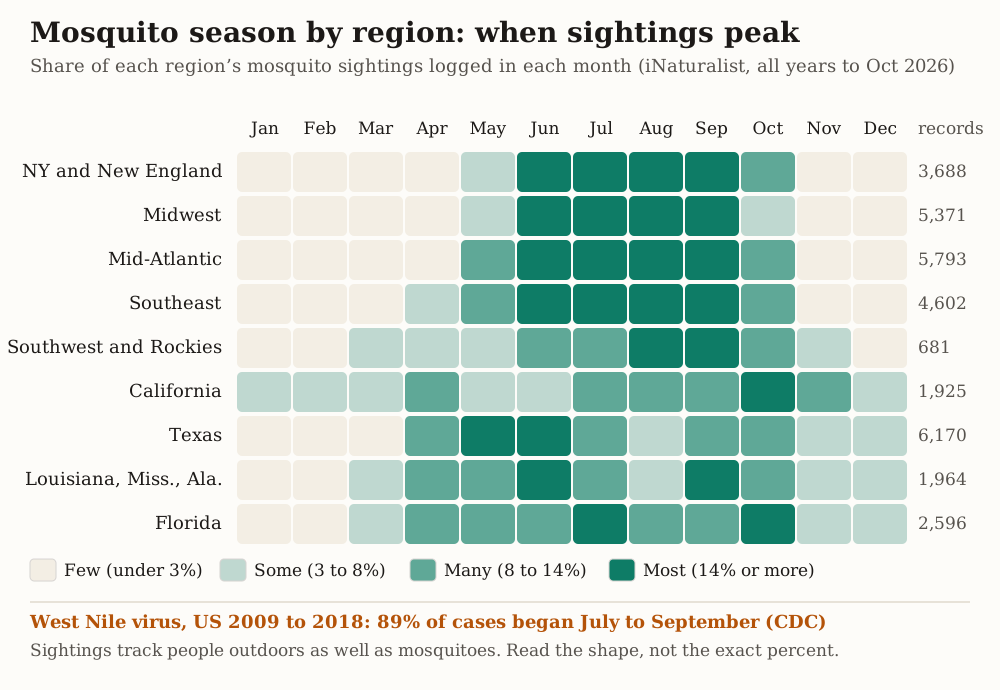
Table 1. Mosquito season by region, from our count of iNaturalist sightings
New York and New England
- Season (months with 5% or more of sightings)
- June to October
- Busiest months
- August (25%), then July
- Winter (Dec to Feb)
- 1%
Midwest
- Season (months with 5% or more of sightings)
- May to October
- Busiest months
- July (24%), then August
- Winter (Dec to Feb)
- 1%
Mid-Atlantic
- Season (months with 5% or more of sightings)
- May to October
- Busiest months
- August (23%), then September
- Winter (Dec to Feb)
- 1%
Southeast
- Season (months with 5% or more of sightings)
- April to October
- Busiest months
- August (20%), then September
- Winter (Dec to Feb)
- 2%
Southwest and Rockies
- Season (months with 5% or more of sightings)
- May to November
- Busiest months
- August (19%), then September
- Winter (Dec to Feb)
- 3%
Texas
- Season (months with 5% or more of sightings)
- April to November
- Busiest months
- May (17%) and June, then September and October
- Winter (Dec to Feb)
- 7%
Louisiana, Mississippi, Alabama
- Season (months with 5% or more of sightings)
- April to November
- Busiest months
- June (16%), then September
- Winter (Dec to Feb)
- 9%
Florida
- Season (months with 5% or more of sightings)
- March to November
- Busiest months
- July (14%), October and September
- Winter (Dec to Feb)
- 8%
California
- Season (months with 5% or more of sightings)
- March to November
- Busiest months
- October (19%), then September
- Winter (Dec to Feb)
- 11%
Our analysis of research-grade iNaturalist records of the mosquito family, counted by month through the public API on October 26, 2026. Each percentage is that month’s share of the region’s sightings.
How we measured it
Every pest company publishes a mosquito season chart by state. None of them says where the months come from. So we used iNaturalist, where people post photos that other users check. We counted every research-grade mosquito record in each state by month, then grouped the states into regions.
There is one honest catch. A sighting needs a person outdoors with a phone, so the counts also track when people are outside. For that reason, we checked the mosquito curve against all insect photos in the same places. In California, mosquito sightings peak in October, even though insect photos peak in spring. That gap is real mosquito activity, not just busy photographers. Read the shape of each row, not the exact percent.
The records come from 10,979 people, and no single person posted more than about 1% of them. Most date from 2020 on. We left out regions with too few records to trust, and we flag the thin ones below.
Texas and the Gulf: two peaks, with an August lull
In Texas, mosquito season has two humps. Sightings jump in May and June, drop in August, then climb again in September and October. August had fewer sightings than September in every year from 2017 to 2025. Louisiana, Mississippi and Alabama show the same pattern.
The likely reason is heat and drought. Mosquitoes do best in warm, wet weather, and very hot, dry weeks cut them back. A runner in Houston noticed the same thing in August 2024. “The mosquitoes seem to have disappeared literally overnight,” they wrote on Reddit, and the top reply blamed the dry heat. Then the fall rains bring them back.
Mosquito season in Florida
Florida’s mosquito season never fully stops. In our data, sightings rise from March, stay high from June through October, and drop only in winter. Even January and February held about 2.5% of the year each. Winter slows Florida mosquitoes down, but it does not stop them.
Mosquito season in California
California is the surprise. Its sightings peak in October, which was the busiest month in 7 of the 9 full years from 2017 to 2025. California’s health department also warns that mosquitoes stay active as the weather cools. Some kinds even breed in winter there, including a large “winter mosquito” that the Contra Costa district says is most active in the cold months.
Mosquito season in Arizona and the Southwest
In Arizona, the season follows the summer monsoon. August alone held about 25% of the state’s sightings, and July to October held 70%. After October, sightings fall off fast, and by December they almost vanish. Arizona had only 251 records, though, so treat this as a rough guide.
Mosquito season in Alaska
Alaska’s season is short and intense. The large snow mosquitoes come out first, often while snow is still on the ground, because they spent the winter as adults. Of 508 Alaska records, including some not yet confirmed, 61% came in June and July. Very few appear after August.
When does mosquito season start?
Mosquito season starts when daily temperatures stay above about 50°F (10°C). Below that, mosquitoes are largely inactive, the University of Maryland Extension and Rhode Island’s health and environment agencies agree. In the South that can be February or March. In the far North, sightings pick up only in late May or June.
The first biters of spring are not new mosquitoes. They are females that hid through the winter, such as Culex house mosquitoes and Anopheles mosquitoes. Once it warms up, each one takes a blood meal and lays the eggs that start the year’s first generation.
Then the spring rains arrive. Aedes eggs that sat dry all winter on the walls of buckets, tires and tree holes hatch once water covers them. The young spend about a week or two in the water as mosquito larvae and pupae, then fly off as biting adults. From that point, each warm, wet week adds another generation.
What temperature do mosquitoes come out?
Mosquitoes start flying when it is above about 50°F, and they get busier above about 58°F (14°C). They are at their most active in warm, humid weather. One large review found that mosquito-borne diseases spread best between about 73 and 84°F (23 to 29°C). So a warm spring tends to bring an early season.
What month is worst for mosquitoes?
July and August are the worst months for mosquitoes in most of the US, with September close behind. In our count, July held 16.5% of the year’s sightings and August 16.4%. For disease, late summer is worse still: in a CDC review of 21,869 West Nile cases from 2009 to 2018, 89% began between July and September.
CDC says the number of people diagnosed with West Nile usually peaks in late August and early September. Timing is the likely reason. Mosquitoes pick up the virus from infected birds, and that cycle repeats all summer. So by August, more mosquitoes carry it than in May, and a bite carries more risk.
Table 2. When West Nile illness began, US cases 2009 to 2018
January to March
- Cases
- 29
- Share of all cases
- Less than 1%
April to June
- Cases
- 592
- Share of all cases
- 3%
July to September
- Cases
- 19,477
- Share of all cases
- 89%
October to December
- Cases
- 1,769
- Share of all cases
- 8%
From CDC’s West Nile surveillance summary for 2009 to 2018, Table 2. Two cases had no onset date.
Most people who catch West Nile never feel sick. CDC says about 8 in 10 have no symptoms, about 1 in 5 get a fever, and fewer than 1 in 100 develop a severe illness. Symptoms usually start 2 to 6 days after the bite.
Why are mosquitoes so bad this year?
Usually because of rain, then heat. Floodwater mosquito eggs can wait in dry ground for months, so a week of storms hatches them all at once. In August 2026, a New Jersey Reddit thread asked if mosquitoes were worse this year. The top answer was simple: “Bunch of rain the last couple weeks.”
A mild spring can also start the season early. On the other hand, a hot, dry spell can thin them out, as the Texas lull shows. Your local mosquito control district is the best guide to a given year, since it traps and counts them every week.
When do mosquitoes go away?
Mosquitoes go away when nights stay below about 50°F, and the adults left in the open die at the first hard frost. In most of the North that happens in October. Rhode Island, for example, says its first hard frost usually comes in mid-October. In the South, the season often runs into November.
A cool snap is not the end, though. Mosquitoes that slowed down on a cold night fly again on the next warm afternoon. So a few bites in late October are normal until the frost comes. The University of Maryland Extension answered just this question for a walker in September 2022: mosquitoes stay active in fall while the weather is warm.
Some mosquitoes leave before the cold does. In the northern house mosquito, shorter days and cooler nights in late summer set a winter program while the young are still in the water. In a 2005 study, these females stopped seeking blood and fattened up on plant sugar. They showed up in caves, culverts and unheated basements as early as August.
What temperature kills mosquitoes?
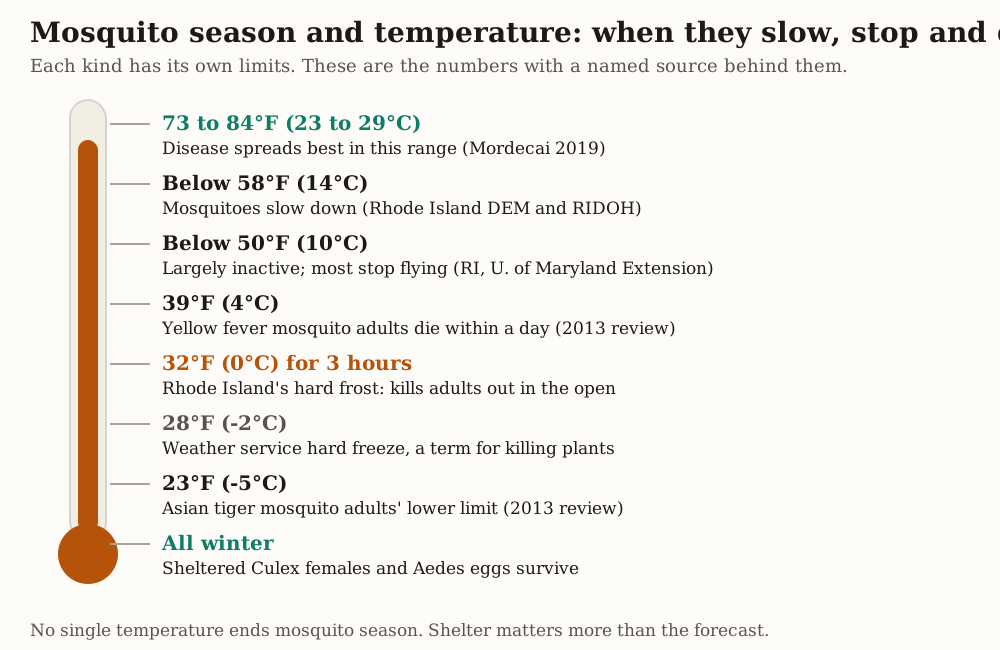
No single temperature kills every mosquito. Rhode Island’s health and environment departments say adult mosquitoes die in a hard frost. They define it as three hours in a row below 32°F (0°C). Exposed adults of some southern kinds die sooner. A 2013 review put the limit near 39°F (4°C) for the yellow fever mosquito, and near 23°F (-5°C) for the Asian tiger mosquito.
You will often read that mosquitoes die after two hours below 28°F. Several pest company pages say so. That figure, however, is the National Weather Service’s hard freeze, a cold that kills most plants. Local weather offices even disagree on how long it has to last. It is a fair sign that the season is over, but no mosquito study set the number.
Shelter matters more than the thermometer. A female resting in a storm drain, a woodpile or a basement stays far warmer than the air outside. That is how mosquitoes survive winters far below 28°F.
Do mosquitoes die in the winter?
Most adults out in the open do, and males die in the fall. But mosquitoes as a group do not die off. Each kind leaves something behind to restart the season: a dormant female, a batch of eggs or a slow-growing larva.
Where do mosquitoes go in the winter?
Mosquitoes do not migrate. Instead, each kind waits out the winter in place, in a dormant state called diapause. Culex and Anopheles females hide in caves, culverts, storm drains, sheds and basements. Aedes mosquitoes leave eggs that wait for spring rain. A few kinds spend the winter as larvae, some frozen in ice.
Table 3. How each kind of mosquito gets through winter
Culex house mosquitoes (they spread West Nile)
- Winter stage
- Mated adult female, not biting
- Where it waits
- Caves, culverts, storm drains, sheds, unheated basements
- When it comes back
- First warm spells of spring; late February or March in California
Anopheles mosquitoes
- Winter stage
- Mated adult female
- Where it waits
- Sheltered spots like caves and buildings
- When it comes back
- Among the first to bite in spring
Aedes, including the Asian tiger mosquito
- Winter stage
- Eggs
- Where it waits
- Walls of buckets, tires and tree holes, and floodplain soil
- When it comes back
- When spring rain covers the eggs
Tree hole mosquito (California)
- Winter stage
- Larva
- Where it waits
- Rain-filled tree holes
- When it comes back
- Adults in April or May
Pitcher plant mosquito
- Winter stage
- Larva, frozen in ice
- Where it waits
- Inside pitcher plants in bogs
- When it comes back
- Pupates in May, flies by June
A dormant female is not just sleeping. Her eggs stop developing, and she lives on fat she stored in the fall. Purdue Extension says she needs a long spell of cold before her eggs can mature. So a warm day in January may stir her, but it will not make her lay eggs. Our page on how long mosquitoes live through the winter covers these long-lived females.
The eggs are just as tough. Floodwater eggs often need a long cold spell before they will hatch, Purdue says, and some wait several years. A Reddit user on r/explainlikeimfive asked how mosquitoes return each year if they all die. The top reply pointed to eggs, which is only half the story. In much of the country, the first biters of spring are the females that hid as adults.
A few mosquitoes even overwinter as larvae. The pitcher plant mosquito spends the winter frozen in a block of ice inside its plant, Rutgers says, and the young survive the thaw. In California, the tree hole mosquito, which carries dog heartworm, grows slowly as a larva all winter.
Is that a mosquito in winter?
Probably not, if it is flying in freezing weather. In one r/whatsthisbug thread, a reader filmed a “mosquito” after weeks below freezing. It was a winter crane fly, a harmless look-alike that does not bite. Midges and winter crane flies are the usual suspects, and our crane fly guide shows how to tell them apart.
A real mosquito can turn up in a warm basement, garage or old house, though. Overwintering females rest there, and heat can wake them up. A bite in the middle of a hard freeze outdoors, however, is unlikely to be a mosquito. If you find bites in winter, our bug bite identification guide lists the other usual causes.
Where is mosquito season year-round?
Mosquito season never fully ends in Hawaii, Florida, the Gulf states, Texas and California. In our data, mosquitoes turned up in every month there, and 7 to 11% of sightings came from December to February. In the Northeast and Midwest, that share was about 1%.
Hawaii is the clearest case. Every month had at least 42 records there, and no month stands out once you remove one survey project that logged a burst of records in June. Even in these places, winter brings fewer bites, because cooler nights slow mosquitoes down. Still, it does not end the season, so keep emptying standing water all year.
What time of day are mosquitoes most active?
Most mosquitoes bite from dusk to dawn, but it depends on the kind. Culex mosquitoes, which spread West Nile, are most active from dusk to dawn. Anopheles mosquitoes bite late in the evening or at night. Aedes mosquitoes, such as the Asian tiger mosquito, bite in the daytime as well.
During the heat of the day, most mosquitoes rest in cool, shady, damp places, such as tall grass, shrubs and under decks. That is where they go during the day. CDC sums it up simply: mosquitoes can bite day and night.
Do mosquitoes go away at night?
Only when the night gets cool. On a warm summer night, house mosquitoes keep biting until dawn. Once evening temperatures fall below about 58°F, they slow down, and below about 50°F most stop flying. That is why spring and fall evenings often feel bite-free after sunset.
Mosquitoes do not need light to find you, either. They follow the carbon dioxide you breathe out, your body heat and your skin odor. Our page on what draws mosquitoes to some people explains how they home in.
Getting ready for mosquito season
The best time to prepare for mosquito season is before it starts. Clear standing water in fall and late winter, then check the yard after the first spring rains. Once evenings pass 50°F, empty anything that holds water every week. That one habit breaks the life cycle, which EPA says can take as little as 4 days.
Seven steps before and during the season
In fall or winter, clear the places that hold water
Army public health entomologists call fall and winter good times to find breeding spots. Clean gutters and downspouts, drain tarps, and flip buckets and toys. Scrub the insides, since Aedes eggs stick to container walls.
In early spring, walk the yard after the first rains
California's health department starts its calendar here: dump water that collects from spring rains. Aedes eggs on container walls hatch once water covers them.
Fix screens before you open the windows
Patch holes in window and door screens, and close gaps around doors. CDC lists screens among the first ways to keep mosquitoes out of a home.
Once evenings pass 50°F, dump water every week
Empty and scrub, turn over, cover or throw out anything that holds water, once a week, as CDC advises. EPA says egg to adult can take as little as 4 days.
Stock an EPA-registered repellent
Buy it before you need it. CDC recommends six active ingredients, including DEET and picaridin. Follow the label, and put sunscreen on first.
Check again after every heavy rain
A storm can hatch a big batch of floodwater mosquitoes at once. Walk the yard a day or two later and tip out anything that filled up.
Keep protecting yourself until a hard frost
Late summer is when most West Nile cases begin. Wear repellent at dusk and dawn, and keep it handy on warm fall days until a hard frost.
For the full yard checklist, read our guide to getting rid of mosquitoes in the yard and house. To choose a repellent, see how picaridin and DEET compare. And if a bite looks unusual, our mosquito bite guide lists the warning signs.
Mosquito season myths, corrected
Myth 1
Myth: “All mosquitoes die in the winter.”
Truth: Many survive. Culex and Anopheles females hide as adults, Aedes mosquitoes wait as eggs, and a few kinds spend winter as larvae, some frozen in ice. That is how the same yard fills up again each spring.
Myth 2
Myth: “A temperature of 28°F for two hours kills mosquitoes.”
Truth: That number is the weather service's hard freeze, a term about killing plants. No mosquito study set it. Rhode Island counts three hours below 32°F as the frost that kills adults in the open. Females in a culvert or basement survive much colder nights.
Myth 3
Myth: “Mosquitoes fly south for the winter.”
Truth: They do not migrate. Each kind waits out the cold in place, as a dormant adult, an egg or a larva.
Myth 4
Myth: “The hotter the summer, the worse the mosquitoes.”
Truth: Only up to a point. Disease spreads best between about 73 and 84°F (23 to 29°C), and very hot, dry weeks cut mosquito numbers. In Texas, August is a lull every year in our data.
Pest control disclaimer. Photo-based identification can help, but it is not always perfect. For dangerous spiders, large infestations, or anything you are unsure about, contact a licensed pest control professional.
Not medical advice. This page is general information about mosquito seasons. It is not a diagnosis. If you feel ill after mosquito bites, call your doctor, and follow every repellent label.
Mosquito season FAQ
Is it mosquito season right now?
Is there a mosquito forecast for my area?
Is tick season the same as mosquito season?
Related guides
Mosquitoes
The full guide: what they are, where they breed and the diseases they carry.
How long mosquitoes live
Summer adults, short-lived males, and the females that last all winter.
Mosquito larvae
Wigglers in standing water, how fast they grow, and what to do about them.
Getting rid of mosquitoes
Standing water, screens and when a yard treatment is worth it.
Asian tiger mosquito
The striped daytime biter whose eggs wait out winter on container walls.
Picaridin vs DEET
Protection hours, safety for kids, and which repellent to pack.
Crane fly
Big, harmless look-alikes, including the winter crane flies seen in the cold.
Preventing ticks
Tick season starts earlier. Clothing, repellent and the tick check routine.
Sources
- CDC, About West Nile (mosquito season, peak of cases)
- CDC, Surveillance for West Nile Virus Disease, United States, 2009 to 2018 (MMWR Surveillance Summaries, 2021)
- CDC, Mosquito Control at Home
- Purdue Extension, Mosquitoes (how mosquitoes survive winter)
- Contra Costa Mosquito and Vector Control District, Where Do Mosquitoes Go in Winter?
- Robich and Denlinger, Diapause in the mosquito Culex pipiens, PNAS (2005)
- iNaturalist, Mosquitoes (family Culicidae): the records behind our season counts
- National Weather Service, Glossary: hard freeze