What do fleas look like?
What do fleas look like? Tiny, shiny, reddish brown seeds that jump. An adult is 1/16 to 1/8 inch long, so a small one is half a sesame seed and a large one is a whole seed. What does a flea look like up close? A narrow, hard body, six legs with a much bigger hind pair, and no wings at any stage of its life.
Shape is the feature that settles it. A flea's body is flattened from side to side, the opposite of a bed bug, which is flat from top to bottom. So from above a flea is a thin sliver, and from the side it is tall and oval. That shape lets it slip between a pet's hairs and between carpet fibres.
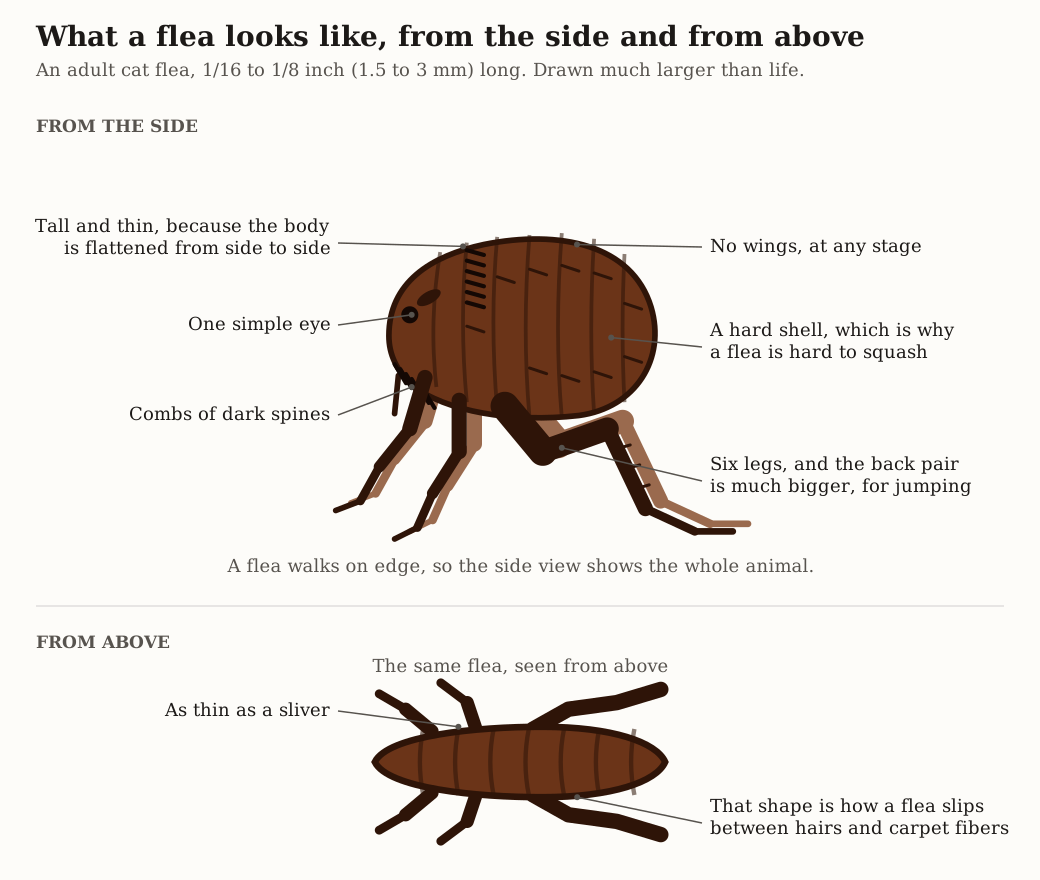
The flea in your home is almost certainly the cat flea, Ctenocephalides felis. It lives on dogs as well as cats, and every extension guide we checked names it as the flea on nearly all US pets. Under a magnifier, it has two rows of dark spines, called combs, along the cheek and behind the head. They point backwards and help the flea hold on when a pet grooms.
Is it a flea? Five checks
Check each clue below to narrow down what you saw.
Sesame-seed size or smaller
An adult is 1/16 to 1/8 inch (1.5 to 3 mm). Anything as big as a grain of rice is something else.
Reddish brown to nearly black, and shiny
Never green, never white as an adult, never striped or spotted.
Thin from above, tall from the side
The body is flattened side to side. A bug that is flat and oval from above, like a bed bug, is not a flea.
It jumps, and it has no wings
A flea vanishes in one leap. Fleas never fly, and they never just crawl away slowly.
Hard to squash
The shell is hard and slick. A soft bug that smears at a touch is more likely a springtail or a gnat.
Why are fleas so hard to squish?
Fleas are hard to squish because their bodies are armoured. The shell is tough and slick, and the narrow, side-flattened shape slides out from under a fingertip. Readers say the same thing in their own words: a flea has to be pressed down with real force before it breaks.
That toughness is a useful test. A tiny jumping bug that smears at the lightest touch is not a flea, and it is most likely a springtail. To keep a flea for a photo, trap it under tape rather than trying to crush it.
What a dead flea looks like
A dead flea looks like a living one that has stopped moving: the same dark, shiny, seed-shaped body, often lying on its side because of its flat shape. You will find them in bath water, on a flea comb, in a light trap or on a windowsill.
Dead fleas on a treated pet are a good sign rather than a bad one. Many vet products kill fleas after they bite, so dead fleas on a treated pet are expected for the first few weeks.
How big is a flea?
How big are fleas? An adult cat flea is 1/16 to 1/8 inch (1.5 to 3 mm) long, from a pinhead to a sesame seed. Almost every extension service puts adults at or under about 1/8 inch. The two outliers are the CDC's laboratory guide, at 3 to 4 mm for the genus, and Penn State's looser "under 1/4 inch".
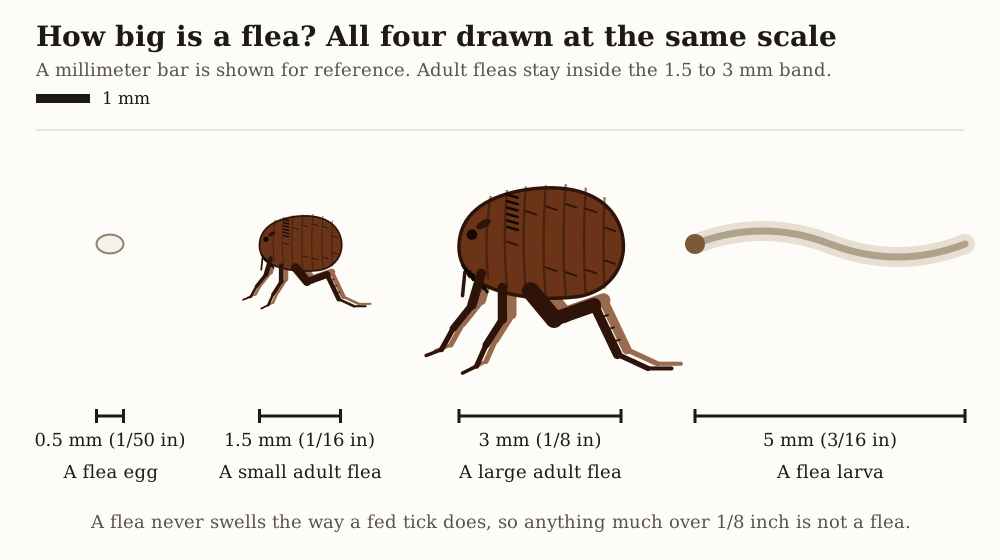
Tiny fleas are not young fleas. An adult comes out of its cocoon at full size and never grows after that, so a small flea is simply a small adult. The pale worm in the carpet, up to about 3/16 inch (5 mm), is the larva, and it looks nothing like an adult.
"It's too big to be a flea"
If the bug is bigger than a sesame seed, it is probably not a flea. Fleas do not swell up after a blood meal the way ticks do, so there is no such thing as a fat, engorged flea the size of a pea. A swollen grey or tan bug on a dog is almost always a tick, and our flea vs tick comparison draws both to scale.
In a bed, a flat, apple-seed-sized brown bug is more likely a bed bug. A rice-grain shape near a pet's tail is a tapeworm segment, which means the pet swallowed an infected flea and needs a vet, not a flea spray.
What color are fleas?
What color are fleas? Reddish brown to nearly black. Sources describe the same insect anywhere from reddish-brown to brownish-black, and much of the difference is the light you see it in. Against a pale pet or a white sock they look black. Under a phone torch they look dark red-brown and glossy.
Several pest-control guides add that a flea looks a shade darker just after feeding, but it never balloons. Are fleas black, then? Tiny black fleas and black fleas are the same cat flea seen in poor light. Are fleas red? Only in the sense of a red tint. Are fleas white? Never as adults.
White or pale specks are a different stage or a different thing. Smooth white ovals that roll are flea eggs, pale wriggling worms are larvae, and white flakes stuck to the hair are dandruff.
Can you see fleas with the naked eye?
Yes, you can see fleas with the naked eye. An adult flea is large enough to spot as a moving dark speck, and DermNet, the dermatology reference, says adults are easily seen without help. What you cannot see without a magnifier are the details: the legs, the combs and the shape of the head.
One WebMD page says fleas are hard to see without a microscope. That is true of the features that tell a cat flea from a dog flea, but not of the flea itself. What do fleas look like to the human eye? A dark fleck, about the size of a pinhead or a sesame seed, that disappears in a jump.
Background decides whether you see them. A flea is easy to spot on a white sock, a pale sheet or a light pet, and almost invisible in dark fur or patterned carpet. Flea eggs are a different story: the University of Florida notes that the white eggs are nearly impossible to see against carpet or bedding.
Do fleas fly or jump?
Fleas jump. They do not fly, and they do not have wings at any stage of their lives. A flea leaps with its long hind legs, and the jump is so fast that the flea seems to vanish. It has not flown away. It has jumped farther than your eye could follow.
So if the tiny bug flew, it was not a flea. Small flying insects mistaken for fleas are usually fungus gnats, fruit flies or drain flies, all of which have wings. A tiny dark bug that jumps but cannot bite is usually a springtail.
How high and how far can fleas jump?
A cat flea's average long jump is about 7.8 inches (19.9 cm), and its longest recorded jump is 18.9 inches (48 cm). Those are the figures Cadiergues and colleagues measured in a 2000 laboratory study. In height, half the fleas cleared 5.2 inches (13.2 cm) and the best reached 6.7 inches (17 cm).
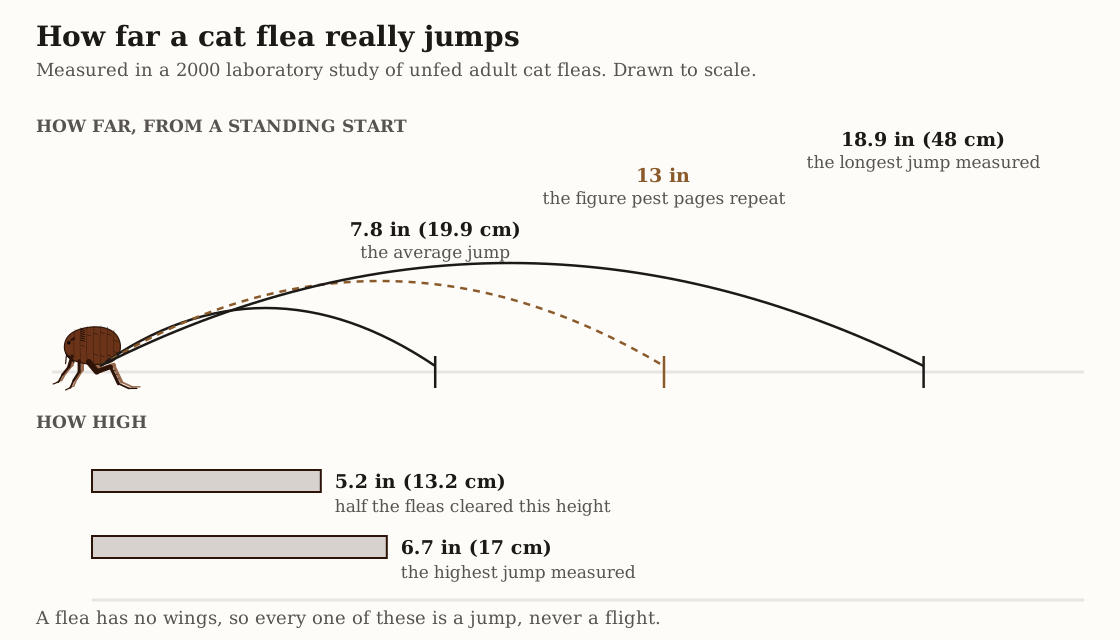
Many pages say fleas jump 7 inches high and 13 inches across. That figure comes from an Ohio State fact sheet, and only half of it matches the measurements. The 7 inches is close to the cat flea's record height. The 13 inches is not a typical cat flea jump at all, and it sits close to the dog flea's average of 12 inches.
In body lengths, an average jump is roughly 100 times the flea's own length. That is how fleas reach a pet, or a person's ankles, from the floor. Can fleas jump on humans? They can and do, which is why flea bites cluster on the feet and lower legs.
What fleas look like at each life stage
So what do fleas look like before they are adults? Only the adult looks like a flea. The egg, the larva and the cocoon each look like something else, and all three live in the carpet and bedding rather than on the pet. This table puts the four side by side, with the detail that identifies each one.
The four stages of a flea, and what each looks like
Egg
- Size
- 0.5 mm (1/50 in)
- What it looks like
- Smooth white oval that rolls, like a grain of salt
- Where you find it
- Pet bedding, carpet, sofa
Larva
- Size
- Up to 5 mm (3/16 in)
- What it looks like
- Pale legless worm, brown head, dark gut line, wriggles from light
- Where you find it
- Deep in carpet and floor cracks
Pupa in a cocoon
- Size
- About 5 mm
- What it looks like
- Sticky silk case covered in dust and fibre, hard to see
- Where you find it
- Same places as the larvae
Adult
- Size
- 1.5 to 3 mm (1/16 to 1/8 in)
- What it looks like
- Hard, shiny, reddish brown to black, thin from above, jumps
- Where you find it
- On the pet, and jumping onto socks and ankles
The black specks you find with the adults are not a stage at all. They are flea dirt, the droppings of adult fleas, made of dried blood. Our guide to flea eggs, larvae and cocoons covers the young stages in full, and the flea dirt test shows how to confirm the specks.
What fleas look like on pets, people and beds
What do fleas look like on a pet, a person or a bed? The flea is the same, but what you notice changes with the background. On a pet you see movement in the fur and black specks of dirt. On a person you see a dark dot on a sock that jumps away. In a bed you mostly see the droppings and eggs left by a pet that sleeps there.
On a dog
On a dog, fleas look like small, fast, dark brown specks that run through the fur when you part it. Part the coat at the base of the tail, the lower back and the belly, and look for the fleas and the black specks of dirt. Our guide to fleas on dogs covers the full check and the treatment.
On a cat
On a cat, you may see fleas only rarely, because cats groom many of them away. Check the chin, the neck and the base of the tail, and look for flea dirt on the cat's bedding. Our guide to fleas on cats explains why a clean-looking cat can still have them.
On people
On people, fleas look like dark specks on the ankles, lower legs or socks that jump away the moment you move. Cat and dog fleas bite people but do not stay on them. Our page on whether humans can get fleas explains what they do instead, and our guide to flea bites shows what the bites look like.
In a bed
In a bed, you are more likely to see what fleas leave than the fleas. Look for black specks that smear red on a damp tissue, tiny white eggs and, in the folds, pale larvae. Fleas end up in a bed because a pet sleeps on it, and they do not live in mattresses the way bed bugs do.
Cat flea, dog flea, human flea
There are many kinds of flea, but you will meet very few of them. The CDC counts more than 2,500 kinds worldwide and more than 300 in the US. For a US home, the answer is almost always the cat flea, on cats and dogs alike.
The fleas you might meet, and how to tell them apart
Cat flea (Ctenocephalides felis)
- Size
- 1.5 to 3 mm
- What sets it apart
- Has combs; the usual flea on US cats and dogs
- Where it lives
- On the pet
Dog flea (Ctenocephalides canis)
- Size
- Similar
- What sets it apart
- Looks almost identical; told apart only under magnification by head shape
- Where it lives
- Rare in the US
Human flea (Pulex irritans)
- Size
- 1 to 4 mm
- What sets it apart
- Lighter brown and has no combs
- Where it lives
- Animal nests and burrows, not on the body
Oriental rat flea (Xenopsylla cheopis)
- Size
- 1.5 to 4 mm
- What sets it apart
- No combs; the main plague flea worldwide
- Where it lives
- On rats
Cat fleas and dog fleas look the same to the naked eye. The CDC's lab guide separates them by the head, which is longer on the cat flea and more rounded on the dog flea. You do not need to know which you have, because the treatment is the same.
The human flea is real but uncommon, and it bites people and animals alike. In the US, plague is spread mostly by fleas on wild rodents such as ground squirrels, not by pet fleas. Our main flea guide covers the diseases fleas can carry.
Bugs that look like fleas
Most bugs that look like fleas fail one of three checks: they are the wrong shape, they fly, or they cannot jump. Springtails are the exception, because they are the right size and they jump. This table gives the one check that separates each look-alike, with where to read more.
Bugs that look like fleas, and the one check for each
Flea
- Size
- 1.5 to 3 mm
- The one check
- Hard, thin from above, jumps, bites
- Read next
- Fleas
Springtail (snow flea)
- Size
- 1 to 3 mm
- The one check
- Soft, jumps with a tail spring, lives in damp places, never bites
- Read next
- Tiny white bugs
Bed bug
- Size
- Adults 4 to 5 mm
- The one check
- Wide flat oval, apple-seed brown, crawls, never jumps
- Read next
- Bed bugs
Carpet beetle
- Size
- 1.5 to 3 mm
- The one check
- Round, often speckled, with hard wing covers; crawls
- Read next
- Carpet beetles
Carpet beetle larva
- Size
- 2 to 5 mm
- The one check
- Hairy and bristly, crawls slowly
- Read next
- Carpet beetles
Head louse
- Size
- 2 to 3 mm
- The one check
- Tan, grips hair, cannot jump
- Read next
- Head lice
Tick nymph
- Size
- About 1.5 mm
- The one check
- Eight legs, round and flat, crawls, swells when fed
- Read next
- Flea vs tick
Flea beetle
- Size
- Tiny
- The one check
- Hard beetle on plant leaves, chews small holes, does not bite
- Read next
- Black beetles
Fungus gnat
- Size
- 1.5 to 3 mm
- The one check
- Has wings and flies, hovers over potting soil
- Read next
- Fungus gnats
Drain fly
- Size
- Small
- The one check
- Fuzzy, moth-like, flies, sits on bathroom walls
- Read next
- Drain flies
Springtails vs fleas
Springtails are the bugs most often mistaken for fleas. They are 1 to 3 mm long, dark or grey, and they jump by snapping a forked tail against the ground. They gather by the hundreds in damp spots: tub drains, potted plants, patios, and on snow in late winter, where they are called snow fleas.
The test is bites. Readers who post springtails nearly always add that nobody has been bitten. Fleas bite, and they come with a pet. A springtail is also soft and squashes easily, while a flea does not.
Fleas vs gnats, fruit flies and drain flies
If it flew, it was not a flea. Fungus gnats, fruit flies and drain flies are all small and dark enough to be confused with fleas, and readers search for every one of them alongside fleas. All three have wings, and none of them bites. A fungus gnat hovers over house plants, a fruit fly circles fruit and drinks, and a drain fly rests on bathroom walls.
Bed bugs or fleas?
Bed bugs and fleas both bite at night and both turn up in beds, so the confusion is understandable. A bed bug is much wider, flat from top to bottom like a seed, and it crawls. A flea is narrow and jumps. Our guide to bugs mistaken for bed bugs works through the other possibilities.
Signs of fleas when you cannot find one
The signs of fleas are often easier to find than the fleas. Look for black specks of flea dirt in a pet's coat or bedding, a pet that scratches, licks or chews at the base of the tail, and small itchy bites on your feet and lower legs. Any one of them is worth a closer look, and two together almost settle it.
- The paper towel test. Put black specks from the pet or its bed on a damp white paper towel. Flea dirt smears reddish brown, because it is digested blood.
- The white sock test. Walk slowly through the rooms the pet uses in white knee socks. Fleas jump on and show up clearly against the white.
- The comb test. Comb the pet over white paper with a fine flea comb and look at what falls.
- Bites on people. Small, itchy red bumps, most often on the ankles and lower legs. Our guide to flea bites shows what they look like.
- Rice-grain segments. Small, pale segments near a pet's tail or in its bedding are tapeworm, which pets catch by swallowing fleas. Call your vet.
Finding flea dirt but no fleas is common. Pets groom many fleas away, and a treated pet may carry droppings for days after the fleas that left them have died. Fresh dirt that keeps coming back still means live fleas.
How to catch a flea and get a usable photo
The best way to identify a flea is to trap it under clear tape and photograph it on white card with something for scale. That takes about ten minutes and beats chasing it across a carpet. Many people who ask "what do fleas look like" have already lost the bug once, and most blurry phone photos fail because the bug jumped, the background was dark, or nothing showed its size.
Six steps to a photo anyone can identify
Find it on something white
Walk slowly through the room the pet uses in white socks, or comb the pet over a sheet of white paper. A flea shows up as a dark speck that moves or jumps.
Trap it with clear tape
Press a strip of clear sticky tape straight down onto the flea. Do not try to pick it up or squash it: it will jump, and it is too hard to crush cleanly anyway.
Fold the tape onto white card
Stick the tape, flea and all, onto a white card or a sheet of paper. The flea stays flat and still, and the white background makes the shape and colour easy to see.
Add something for scale
Lay a ruler, a coin or a grain of rice beside the tape. Size is the first thing anyone identifying it will ask, and a photo without scale cannot answer it.
Photograph it close and in good light
Use your phone's close-up or macro mode near a window, held straight above the card. A taped flea lies on its side because of its flat body, so this shot already shows its profile and the big hind legs.
Check it, then keep it
Compare the photo with the look-alikes table on this page, or run it through our bug identifier. Keep the card: a vet or a pest professional can confirm it in seconds.
What to do once you know it is a flea
Once you know it is a flea, treat every pet in the house through your vet and start cleaning the floors the same week. A flea you can see is one of many: most of the problem is eggs, larvae and cocoons in the carpet. Our guide on how to get rid of fleas gives the whole plan in order.
If you want to start with what costs nothing, our verdicts on home flea remedies show which ones work, including what Dawn dish soap does and does not do. Call your vet the same day if a kitten or puppy seems weak or has pale gums.
Still not sure? Use your photo to identify the bug. Something that came off a beach is a different animal entirely, and our page on sand fleas and beach hoppers explains which one.
Five myths about what fleas look like
Myth 1
Myth: “Fleas jump 13 inches across.”
Truth: A cat flea's measured average is 7.8 inches, and its record is 18.9 inches. The 13 inches comes from an Ohio State fact sheet and sits near the dog flea's average.
Myth 2
Myth: “You need a microscope to see a flea.”
Truth: Adult fleas are easily seen with the naked eye as dark, moving specks. You need a magnifier only for the legs and combs.
Myth 3
Myth: “A big, swollen bug on a dog is a fed flea.”
Truth: Fleas do not swell when they feed. A swollen bug is almost always a tick.
Myth 4
Myth: “Small fleas are baby fleas.”
Truth: Adult fleas come out of the cocoon at full size and never grow. The young stage is a pale worm in the carpet.
Myth 5
Myth: “Snow fleas are fleas.”
Truth: Snow fleas are springtails. They jump like fleas, but they are soft, live in damp places and never bite.
Pest control disclaimer. Photo-based identification can help, but it is not always perfect. For dangerous spiders, large infestations, or anything you are unsure about, contact a licensed pest control professional.
Frequently asked questions
How do you tell if it's a flea or not?
What bug can be mistaken for a flea?
Do I have bed bugs or fleas?
Can fleas live in your bed?
What do flea larvae look like?
Are tiny black bugs that jump always fleas?
What does a flea look like on a human?
How many kinds of flea are there?
Related guides
Fleas
The flea, head to toe, and the signs that give it away before you see one.
Flea eggs
What flea eggs look like, where they end up and what actually kills them.
Fleas on dogs
Finding and treating fleas on a dog, plus the signs that need a vet.
Flea dirt
Black specks that smear red on wet paper, and what that tells you.
Bites from fleas
What flea bites look like on people, and when one needs care.
Fleas on cats
Why cats hide the evidence, and the products that can kill them.
Flea vs tick
The two drawn to scale, with the bites and the risks side by side.
How to get rid of fleas
The whole job in order: the pets, the floors, the follow-up and what to skip.
Sources
- CDC, About Fleas (species counts, how fleas find a host, the fleas that affect health in the US)
- CDC DPDx, Fleas (laboratory identification: size, combs, cat, dog, human and rat fleas)
- UC IPM Pest Notes 7419, Fleas (adult size, colour, body shape and life stages)
- University of Florida IFAS EENY-011, Cat Flea (size, the dog flea in the US, eggs on carpet)
- Cadiergues, Joubert and Franc, 2000, a comparison of jump performances of the dog flea and the cat flea
- Ohio State University Extension HYG-2081, Fleas (the source of the 7 inches high, 13 inches across figure)
- DermNet, Papular urticaria (adult fleas are easily seen with the naked eye)