What do flea eggs look like?
Flea eggs look like tiny grains of salt. Each one is a smooth oval, dull white or slightly pearly in color, and about 0.5 mm long. That is roughly 1/50 inch, or half the thickness of a credit card. You will almost never find one on its own, because a single female drops dozens a day.
Shape is the quickest check. A flea egg is a plain oval with rounded ends, and it has no texture at all under a phone camera. Nothing on it moves, and nothing on it bends.
The surface matters even more, though it sounds like a detail. Flea eggs are dry and smooth, so they cannot cling to anything. UC IPM and the University of Florida both describe them falling straight out of the coat. If your speck is stuck to a hair and will not shake loose, it is not a flea egg.
Colour sits in a narrow band. A fresh egg is translucent white, and it turns a flatter chalky white as it dries. There is no dark version, no stripe and no spot.
Is it a flea egg? Six checks
Check each clue below to narrow down what you saw.
A smooth oval, not a flake
Rounded at both ends, with no ragged edge and no texture. Anything shaped like a torn sheet of paper is skin scale.
About 0.5 mm, so half a grain of salt
Hold a grain of table salt beside it. A flea egg is a little smaller and clearly longer than it is wide.
Dull white, never dark
Black or reddish specks in the same fur are flea dirt, which is droppings rather than eggs.
It rolls, and it will not stick
Tip the bedding and watch. Flea eggs are dry and smooth, so they move. A speck glued to a hair is not one.
Nothing about it moves
No legs, no head and no wriggle. Something that crawls is a larva, a mite or a tapeworm segment.
Many of them, where the pet sleeps
A female drops dozens a day, so eggs arrive in numbers. One lone speck on a worktop is usually something else.
Are flea eggs white or black?
They are white, always. Black specks in the same fur are flea dirt, which is adult flea droppings made of dried blood. People find the two together and assume one is the older version of the other, but they are different things entirely.
The test for the dark specks takes ten seconds. Put a few on a damp paper towel and wait. Flea dirt bleeds a rusty red stain, because it is digested blood; ordinary grit does nothing at all. Our guide to flea poop in a pet's coat walks through that test and what the result means.
Can you see flea eggs without a magnifier?
Yes, barely, and the background decides it. Against a dark bedspread or a black cat's fur, a 0.5 mm white oval shows up well. Against carpet, pale upholstery or a tiled floor, you will walk past thousands of them.
A phone helps more than a magnifying glass. Switch the camera to its macro or close-up mode, rest the phone on the surface, and shoot straight down. Sticky tape pressed onto the bedding and held up to a window works too.
Flea eggs, dandruff, salt or flea dirt?
Most white specks are not flea eggs. In the Reddit threads where people post photographs, the usual answers are dandruff, tapeworm segments, tracked cat litter and plain lint. Each has one feature that settles it, and none of them needs equipment.
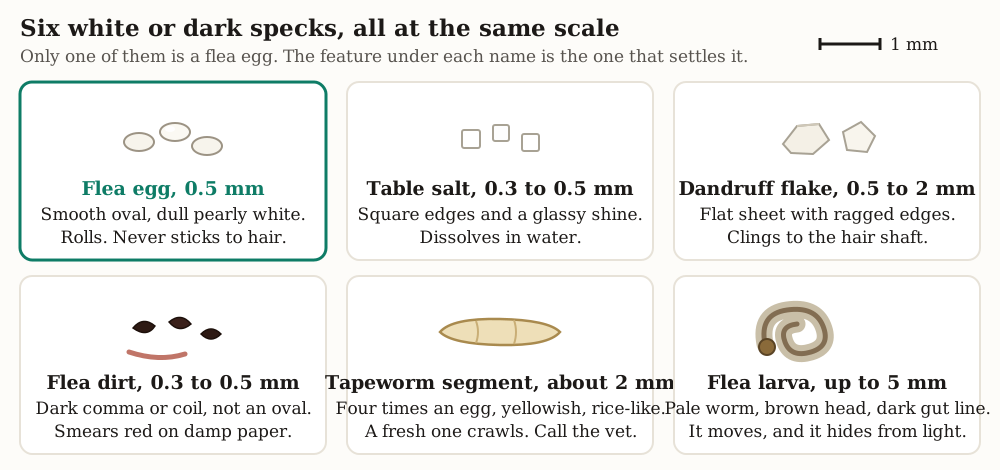
The separating feature, and what each find means
Smooth white oval, rolls loose, never stuck to a hair
- What it is
- Flea egg
- Size
- 0.5 mm (1/50 in)
- What it means
- A flea fed on an animal in that spot, today or yesterday
Square edges and a glassy shine, dissolves in water
- What it is
- Table salt or grit
- Size
- 0.3 to 0.5 mm
- What it means
- Nothing at all
Flat ragged sheet that stays stuck to the hair shaft
- What it is
- Dandruff or skin scale
- Size
- 0.5 to 2 mm
- What it means
- Dry skin, or a skin problem worth a vet visit
Dark comma or coil that smears rusty red on damp paper
- What it is
- Flea dirt
- Size
- 0.3 to 0.5 mm
- What it means
- Adult fleas are feeding there now
Yellowish rice grain, four times an egg, may crawl when fresh
- What it is
- Tapeworm segment
- Size
- About 2 mm dry
- What it means
- The pet swallowed an infected flea. Call the vet
Pale worm with a brown head and a dark gut line, and it wriggles
- What it is
- Flea larva
- Size
- Up to 5 mm (3/16 in)
- What it means
- Eggs already hatched nearby, so the problem is weeks old
Hairy or bristly, banded, stiff bristles at the tail
- What it is
- Carpet beetle larva
- Size
- Up to 6 mm (1/4 in)
- What it means
- Not fleas. Check wool, stored fabric and lint
Fibrous, irregular, squashes flat between two fingers
- What it is
- Lint or litter dust
- Size
- Any size
- What it means
- Nothing. The commonest answer on forum photographs
Tapeworm segments deserve a closer look, because they are the one answer that changes what you do next. A dried segment is about 2 mm long, yellowish, and shaped like a grain of rice, so it is four times the length of a flea egg. A fresh one can crawl. The CDC records these as the usual sign of a flea tapeworm, which pets pick up by swallowing an infected flea while grooming. If that is what you are looking at, call your vet rather than the hardware store.
Dandruff has its own twist. Flakes that appear to move are not flea eggs either: they can be mites riding on the skin scale, which vets call walking dandruff. Your vet can see that under a microscope in a few minutes.
The test that does not work
One test circulates widely on forums, and we are not going to repeat it as fact. People say a flea egg pops when you roll a thumbnail over it, while litter and grit crush instead. No veterinary or university source we opened describes that test, so we cannot tell you what a pop or a crush actually proves.
Use the look-alike table instead, and then use time. A flea egg left in a warm room turns into a tiny pale worm within a week or two, which is the one thing no grain of salt will ever do.
Where flea eggs end up, and why
Flea eggs end up wherever your pet lies down. The female lays them in the coat, but their smooth shells give them nothing to grip, so most fall out within a few hours. Merck's veterinary manual and UC IPM both put the heaviest concentrations in the animal's bedding and in the carpet beside it.
That changes how you search. Shaking out the dog is a poor way to find eggs, because the dog is a delivery route rather than a nest. Check these places first, in this order:
- The pet's bed, blanket or cushion, including the seams and the underside.
- Your own bed, if the animal sleeps on it.
- The sofa or armchair the pet favours, especially down the back of the cushions.
- Carpet within about a metre of any of those spots.
- Cracks between floorboards and the gap under the baseboard.
- The car, if the pet rides in it.
- Any crate, kennel or cat tree.
Sunlight and traffic thin them out. Larvae need shade and damp, so a sunny hallway holds far fewer than the dim corner behind an armchair. UC IPM makes the same point about the yard: the shaded crawl space matters, the open lawn does not.
Is there such a thing as a flea nest?
No. Fleas build nothing, and the phrase "flea nest" does not describe anything real. Several pest-company pages use it anyway, which leaves readers hunting for a structure that was never there.
What exists instead is a hot spot. Eggs, droppings, larvae and cocoons pile up in the few square feet where the pet sleeps, and that patch behaves like a nest without being one. Treat the patch, and you have treated most of the problem.
Flea eggs on dogs
Flea eggs on a dog are hard to see and easy to miss, because they are already falling out as you look. Part the coat over the lower back, the base of the tail and the belly, and work against the direction of the hair. White ovals that slide off are eggs; dark commas that stay put are droppings.
A flea comb beats your fingers. Comb over a sheet of white paper, then tip the debris onto a damp paper towel. Our full guide to fleas on a dog covers the treatment side and the signs that need a vet.
Flea eggs on cats
Cats hide the evidence, and they do it by grooming. A cat swallows a share of its own fleas and most of the dirt, so you may find eggs on the duvet while the cat itself looks spotless. That is normal and it does not mean you imagined the problem.
Check the chin, the neck, the back and the base of the tail. Never put a dog flea product on a cat: permethrin, which is common in dog spot-ons, can kill a cat. Our guide to fleas on a cat carries that warning in full.
Flea eggs on bed sheets, clothes and in the car
Flea eggs turn up on bed sheets for one reason: the pet sleeps there. Fleas do not live in a mattress the way bed bugs do, and they are not interested in you as a home. Still, eggs and droppings fall into the bedding every night that the animal spends on it, and larvae then hatch in the folds.
Clothes left on the floor collect them too, while clothes hanging in a wardrobe almost never do. The car is the forgotten one. A back seat that carries a dog twice a week holds the same eggs as the sofa, so vacuum it on the same schedule.
How many eggs does a flea lay?
A single female lays somewhere between 15 and 50 eggs a day, and sources disagree about where in that range the truth sits. Ohio State Extension gives 15 to 20 a day and up to 600 in a lifetime. UC IPM says 20 to 50 a day. Merck's veterinary manual says up to 50 a day and about 2,000 in a lifetime.
The gap has a cause, and it is worth knowing. The highest figures come from laboratory cats that were stopped from grooming, such as the 1,745 eggs in 50 days that Dryden measured in 1989. On a normal cat that grooms itself, a review by Rust puts the real number nearer 38 eggs a day, because grooming removes a share of the fleas before they finish laying.
Either way the arithmetic is uncomfortable. Ten fleas on a dog for a fortnight puts thousands of eggs into your floor, which is why treating the animal alone rarely ends it. Laying starts fast, too: a female begins within a day or two of her first blood meal.
How long flea eggs take to hatch
Flea eggs hatch in 1 to 10 days, and the room decides where you land in that window. The CDC gives that range. UC IPM and the University of Minnesota narrow it to 2 to 5 days in good conditions, while Ohio State stretches it to 2 to 14 days when conditions are poor.
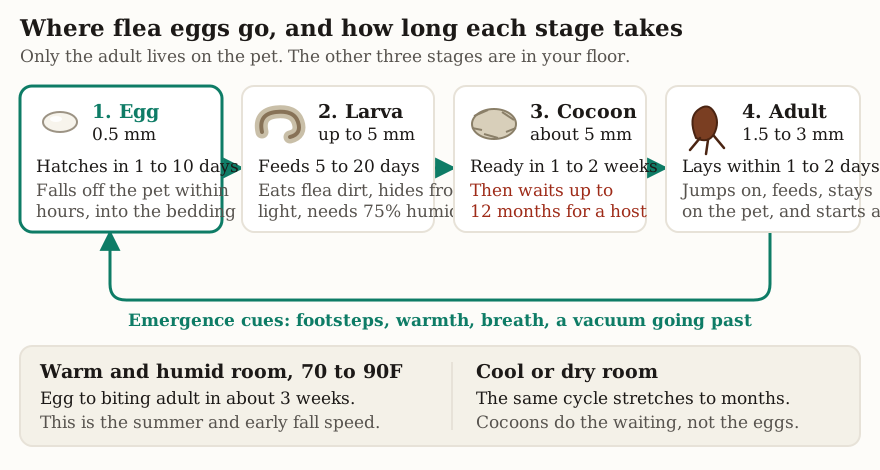
Warmth and damp speed everything up. Larvae do best between 70 and 90F (21 to 32C) and need humidity above about 75%. That is why fleas explode in a muggy August and stall in a dry, heated winter room. Below 50% humidity the larvae die rather than develop.
The four stages, how long each takes, and where it happens
Egg
- Size
- 0.5 mm (1/50 in)
- How long
- Hatches in 1 to 10 days
- Where it is
- Bedding, carpet, sofa, car
- What reaches it
- Washing, vacuuming, steam, an IGR
Larva
- Size
- Up to 5 mm (3/16 in)
- How long
- 5 to 20 days feeding
- Where it is
- Deep in carpet pile and floor cracks
- What reaches it
- Steam, an IGR, some of your vacuuming
Pupa in a cocoon
- Size
- About 5 mm
- How long
- Ready in 1 to 2 weeks, then waits up to 12 months
- Where it is
- Same places, camouflaged with dust
- What reaches it
- Steam and vacuum vibration only
Adult
- Size
- 1.5 to 3 mm
- How long
- Lays within 1 to 2 days of feeding
- Where it is
- On the pet, almost all the time
- What reaches it
- A vet-prescribed product on the animal
One point gets garbled on almost every page about this. Flea eggs do not lie dormant for months, and vibration does not "activate" them. Eggs hatch within days or they fail. It is the adult flea inside the cocoon that waits, sometimes for the best part of a year. That distinction explains nearly everything people find strange about flea timing.
Flea larvae: the tiny worms in the carpet
A flea larva is a pale, legless worm up to about 5 mm long, so 3/16 inch. It has no eyes, a small brown head, and a dark line running through it that is the gut showing through the skin. People describe them as tiny white threads, and they do wriggle.
Here is the correction that matters most on this topic. Flea larvae do not live on your pet. One pest-company page, ranking in the top five for this very search, tells readers that larvae often turn up on cats and dogs. UC IPM, Merck and the University of Florida all place them off the host instead, deep in carpet pile and floor cracks, actively avoiding light. If a worm is on the animal, think tapeworm segment or another parasite, and ask your vet.
Light is the giveaway. Shine a torch on larvae and they thrash their way down into the pile within seconds. They can travel about a metre, so they spread outward from the pet's bed rather than staying in one spot.
What flea larvae eat
Larvae eat flea dirt. The adult flea passes blood that is barely digested, and that dried blood is the larva's main food. So heavy flea dirt in the carpet predicts a heavy hatch. They also take skin flakes and other debris.
They eat flea eggs too. Rust's review records larvae consuming more than 20 eggs each while they grow, so the stages are not neatly separate. The practical point is simple: remove the flea dirt and you starve the next generation.
Flea larvae on a bed
Larvae on a bed are unusual, and they almost always mean the pet sleeps on it. A larva needs flea dirt and shade, so it turns up in the folds of a duvet or under a pillow rather than out in the open.
Something else is far more likely, though. The commonest real answer for a small worm in a bed is a carpet beetle larva, which is hairy or bristly, banded, and up to about 1/4 inch long. Carpet beetle larvae look nothing like a flea larva once you see both, and our diagram above puts them at the same scale.
Baby fleas: what people actually mean
There is no such thing as a baby flea in the way people imagine it. Searches for baby fleas usually mean one of three things, and each has a different answer. Fleas go through complete metamorphosis, so a young flea does not look like a small adult at all.
Most of the time the asker has found a larva, the pale worm described above. Sometimes they have found a newly emerged adult, which is already full size at 1.5 to 3 mm but looks paler until it feeds. Occasionally they have found a springtail, which jumps like a flea but is harmless and lives in damp places.
So a very small jumping insect is not a young flea. Adults emerge from the cocoon at adult size, and they never grow after that. Our guide to the adult flea at real size shows what you are looking for.
Pupae, cocoons, and the second wave
The cocoon is why your flea problem is not over. A larva spins a sticky silk case about 5 mm long, then rolls dust and carpet fibre onto it until it disappears into the floor. Inside, a fully formed adult waits, and no household spray reaches it there.
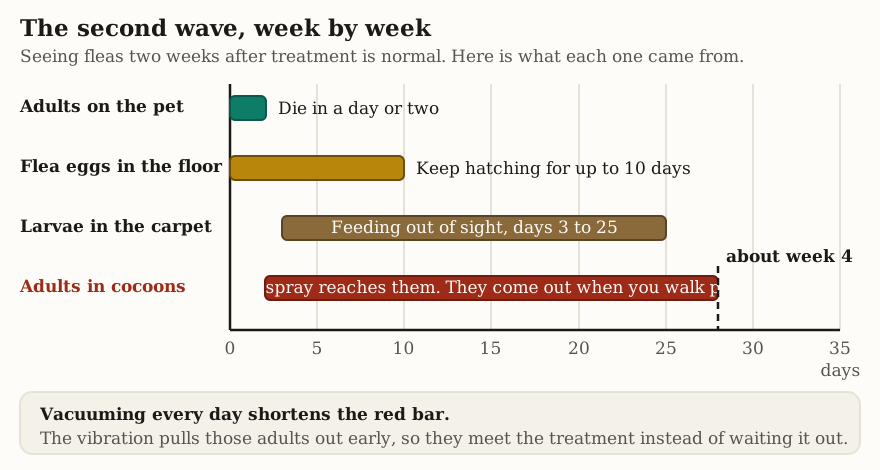
That is the reason fleas keep appearing after treatment. UC IPM states plainly that adults go on emerging for about two weeks after a spray, because the spray does not kill pupae. The CDC advises two or more follow-up treatments within 5 to 10 days of the first for the same reason.
So a wave of fleas at week two is expected rather than a failure. Pest professionals say the same thing on forums when owners panic: it is not worse, it is just more visible. Knowing that in advance stops people re-bombing the house, or giving up a pet over it.
Vacuuming is the lever here. Warmth, footsteps, breath and the vibration of a vacuum all tell the waiting adult that a host has arrived. Running the machine daily pulls them out early and into whatever treatment is down. That is why "vacuum every day" appears on every extension page about fleas.
How long can a flea cocoon wait?
Published figures run from five months to a year, and the honest answer is that it depends on the temperature. UC IPM, Merck and the University of Minnesota all give up to 12 months at cool temperatures. The measured numbers are shorter: CAPC reports up to 30 weeks at 52F, and a study by Metzger and Rust found some adults emerging 155 days after the egg was laid at 60F.
In an ordinary heated home, the wait is much shorter. Cocoons finish in one to two weeks when it is warm and humid, and the stored-up adults come out as soon as someone walks past. A house standing empty for a month is the classic case: the family returns, and fleas swarm the hallway within seconds.
Dead flea eggs and empty shells
An unhatched egg and a hatched one look much the same to the naked eye, which frustrates people who want to know whether they are winning. A hatched shell is thinner and often collapsed, but at 0.5 mm you will not reliably tell.
Judge the trend instead of the shell. Comb the pet over white paper twice a week and count what you collect. Falling counts over three weeks mean the treatment is working, whatever any individual speck looks like.
How to kill flea eggs
Nothing you spray on a carpet kills flea eggs reliably, so physical removal comes first and it costs nothing. Vacuum daily, wash the bedding hot, steam what you can, and treat every pet in the house through your vet. Eggs that leave in a vacuum bag never hatch.
This section covers the eggs only. For the whole job, including the pets, the yard and the order to work in, read our guide to clearing fleas out of a home.
Six steps that actually remove the eggs
Strip and wash everything soft
Pull the pet's bedding, your own sheets and any blanket from the sofa. Wash them in hot, soapy water and dry on the hottest setting the fabric allows. This one step removes the densest patch of flea eggs in the house.
Vacuum every day, not every week
Work slowly over carpet, rugs, upholstery, the edges of the room and the cracks between floorboards. Vacuuming kills what it collects: an Ohio State study by Hink and Needham measured 96% of adults and all the larvae and pupae dead after one pass.
Empty the vacuum outside each time
Research suggests the contents die anyway, so this is a cheap precaution rather than a rule. Seal the bag or canister contents in a plastic bag and put it in an outside bin.
Steam the places you cannot wash
Steam reaches every stage, including the cocoon, which is more than any home spray manages. The EPA lists steam cleaning of carpets alongside vacuuming, and it is worth hiring a machine for a bad case.
Treat every pet in the house, through your vet
One untreated animal reseeds the floor, so the cat that seems fine still needs covering. Never use a dog product on a cat, and follow the label for species, age and weight, because the label is the law.
Keep going for four more weeks
Adults go on leaving their cocoons for about two weeks after any treatment, and stopping early hands the floor back. Mark a date four weeks out and keep vacuuming until it passes.
Does Dawn or flea shampoo kill flea eggs?
Soap kills adult fleas on contact, and the CDC describes it as a gentle insecticide. It does nothing for the eggs already in your carpet, and it leaves no protection, so a flea bath is a first step rather than a treatment.
Flea shampoo has the same limit: it clears the animal on the day and then stops working. Our guide to the kitchen-cupboard flea remedies gives the evidence on each one, including salt, baking soda and vinegar, none of which has research behind it for fleas.
What an insect growth regulator does
An insect growth regulator, or IGR, is the one product class that truly targets the eggs. Methoprene and pyriproxyfen stop eggs and larvae from developing, though neither kills an adult flea. Extension services agree that the indoor sprays that work best contain one.
They are slow by design, so plan for 4 to 6 weeks before numbers really drop. Some vet-prescribed pet products carry one as well, which stops the eggs a flea lays on a treated animal from ever hatching. Ask your vet which product suits your pet, and read the label before anything goes down.
Flea egg myths
Myth 1
Myth: “Flea eggs are sticky and cling to carpet fibres.”
Truth: They are dry and smooth, which is exactly why they fall off the pet in the first place. UC IPM and the University of Florida both describe eggs dropping straight out of the coat. A speck glued to a hair is dandruff or scurf.
Myth 2
Myth: “Flea eggs can lie dormant for months.”
Truth: Eggs hatch within about 1 to 10 days, or they die. The stage that waits months is the adult inside its cocoon, and mixing up the two is the single commonest error on this topic.
Myth 3
Myth: “Vacuuming activates flea eggs and makes them hatch.”
Truth: Vibration brings fully formed adults out of their cocoons, not eggs out of their shells. That is still a good reason to vacuum daily, because an adult that emerges early meets your treatment instead of waiting it out.
Myth 4
Myth: “Flea larvae live on cats and dogs.”
Truth: Larvae feed on flea dirt in carpet and floor cracks, and they avoid light. Only the adult stays on the animal. A worm on your pet is more likely a tapeworm segment.
Myth 5
Myth: “A flea lays 50 eggs a day, every day.”
Truth: That is the top of a range measured on cats that could not groom themselves. Ohio State puts it at 15 to 20 a day, and grooming removes a share of the fleas before they finish laying.
Myth 6
Myth: “Bombing the house gets the eggs.”
Truth: Foggers settle on open surfaces and miss the base of the carpet, under furniture and inside cracks, which is where every immature flea is. UC IPM, Ohio State and several state health departments all say so, and foggers carry a fire risk too.
When to call a vet or a pro
Most flea egg finds end with a vacuum, a hot wash and a vet-prescribed preventive. Three findings change that, and none of them should wait.
Call your vet when the specks look like rice grains rather than salt, when a kitten or puppy has pale gums and seems weak, or when a pet is chewing itself raw. Those point to tapeworm, to anaemia from blood loss, and to a flea bite allergy, and each needs treatment rather than cleaning. A vet can also prescribe a product safe for the age and weight of your animal, which matters most for very young kittens.
Call a pest professional when you still see new fleas after about six weeks of daily vacuuming and treated pets, or when the problem spans a shared building. Licensed technicians can treat wall voids and use products you cannot buy. If you rent, tell your landlord in writing on the day you find the first eggs.
Still not sure what you are holding? Photograph it against something white and run it through our online bug identifier, then check the answer against the table above. For the bites themselves, our guide to flea bites on people covers what they look like and when a bite needs care, and the main flea guide pulls the whole topic together.
Pest control disclaimer. Photo-based identification can help, but it is not always perfect. For dangerous spiders, large infestations, or anything you are unsure about, contact a licensed pest control professional.
Frequently asked questions
Will vacuuming alone get rid of flea eggs?
Does freezing kill flea eggs?
Does bleach kill flea eggs?
Can fleas lay eggs on people or in human hair?
Does diatomaceous earth kill flea eggs?
Why do I keep finding flea eggs on a pet that is being treated?
How long until the eggs stop appearing?
Do flea eggs mean an infestation?
Related guides
Fleas
The flea, head to toe, and the signs that give it away before you see one.
Flea dirt
Black specks that smear red on wet paper, and what that tells you.
How to get rid of fleas
The whole job in order: the pets, the floors, the follow-up and what to skip.
Home remedies for fleas
Salt, Dawn, vinegar and baking soda, each weighed against the evidence.
Fleas on dogs
Finding and treating fleas on a dog, plus the signs that need a vet.
Fleas on cats
Why cats hide the evidence, and the products that can kill them.
Pupa
Cocoons, chrysalises and the resting stage every flea passes through.
Bug identifier by picture
Upload a photo and get an identification in seconds.
Sources
- US EPA, Controlling Fleas and Ticks Around Your Home (daily vacuuming, steam cleaning, washing bedding)
- US EPA, Controlling Fleas and Ticks on Your Pet (the label is the law, species and weight, never a dog product on a cat)
- CDC, Flea Lifecycles: eggs hatch in 1 to 10 days, and the cocoon protects the adult from insecticides
- UC IPM Pest Notes 7419, Fleas: egg size, larval humidity, the cocoon, and the two weeks of emergence after a spray
- Merck Veterinary Manual, Fleas of Dogs: eggs per day and per lifetime, where eggs and larvae gather
- University of Florida IFAS EENY-011, Cat Flea: the smooth egg that falls from the coat, and what vacuuming does not reach
- Ohio State University Extension HYG-2081, Fleas: 15 to 20 eggs a day, and a 2 to 14 day hatch