What is flea dirt?
Flea dirt is the poop of adult fleas, and it is almost entirely your pet's own blood. Fleas feed fast once they land. About 25 in every 100 fleas on a cat had already fed within 5 minutes, and nearly all of them within an hour. The blood passes through barely digested, then dries into dark grains.
Vets also call it flea frass. Merck's veterinary manual describes the grains as reddish black, cylindrical, and pellet or comma shaped. That color comes from old blood, so it is the one speck on your pet that soil cannot copy.
Those grains do a job, which is why cleaning them up is not just tidying. Flea larvae eat them. Dried adult flea poop is the main food of a flea larva living deep in your carpet.
The evidence is quite specific. In lab work gathered by a 2017 review in the journal Insects, only 13 in 100 larvae reached adulthood on flea dirt alone. Feed them that plus flea eggs and 90 in 100 made it. So every speck you vacuum up is food taken off the table.
Finding it also tells you something about timing. A flea has to feed before it can leave waste behind. If the specks are there, fleas have been on your pet long enough to drink, and probably long enough to lay eggs in the carpet.
What does flea dirt look like?
Flea dirt looks like ground black pepper scattered through the coat. The grains are much smaller than an adult flea, which runs up to about 1/8 inch (3 mm) long. Colors go from near black to dark reddish brown. Shapes vary too: short pellets, commas and tight coils all turn up.
Here is one honest limit. No veterinary or university source we opened puts a measurement on a single speck, so nobody can tell you a speck is exactly half a millimetre across. Pest company pages that print a number are guessing. Use the color test instead, because color is the part the evidence supports.
Location is your other clue. The specks sit down at the base of the fur against the skin, not on top of the coat. On a dark dog you often feel the grit with your fingertips before you ever see it.
The grains also rub off onto you. A grey sweatshirt after a cuddle, or a white sheet in the morning, shows the specks better than the animal does.
Is it flea dirt? Seven checks
Check each clue below to narrow down what you saw.
It runs red or rust brown on damp white paper
The one check that settles it. Crush the speck rather than waiting for it to melt, and give it a full minute.
Specks like ground black pepper, not powder
Separate grains you can count. A fine even dust across the whole coat is usually skin flakes.
Down at the base of the fur, against the skin
Flea dirt sits where the flea fed. Grit on top of the coat is more likely to be garden soil.
Short pellets, commas or tight coils
Merck describes the shapes as cylindrical, pellet or comma shaped. Nothing on a pet is perfectly round at that size.
Near black to dark reddish brown
Grey, tan or sandy grains are soil. Pure white ovals are flea eggs, which is a different find.
Concentrated at the tail base, belly or neck
Those are the feeding spots. Specks spread evenly over the back and nowhere else point away from fleas.
Nothing in the sample moves
Flea dirt is dry waste and never moves on its own. Anything crawling needs a vet, not a paper towel.
The wet paper towel test, step by step
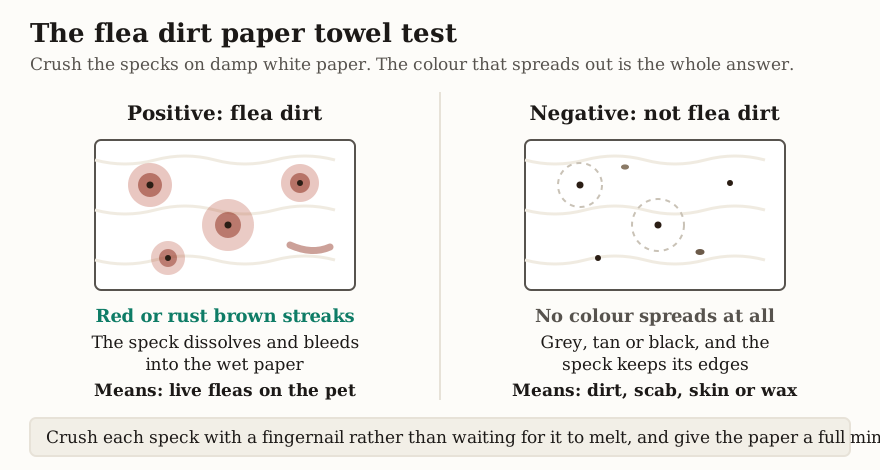
The wet paper towel test is the only home check that settles this. Comb a few specks onto plain white paper towel, add two or three drops of water, then crush them. Flea dirt dissolves and leaves red or rust brown streaks within seconds. Ordinary dirt stays grey, brown or black.
Both Merck and the Companion Animal Parasite Council describe this same check. Ohio State's extension sheet puts it even more plainly: the dark pellets turn the water bright red.
Six steps that settle it
Stand the pet somewhere white
A white sink, an empty bathtub or a white towel on the floor. Anything that falls out of the coat lands where you can see it. Good light matters more than anything else here, so open a blind or bring a lamp.
Comb against the skin, not over the coat
Use a fine flea comb and part the fur down to the skin. Work the base of the tail, the lower back, the belly and the neck. Dunk the comb in a bowl of soapy water between strokes, which drowns any adult fleas it lifts.
Tip what you collect onto plain white paper towel
Plain white, with no pattern and no printing, because colour is the thing you are about to read. A few specks are plenty. Kitchen roll, a coffee filter or a white tissue all work.
Add two or three drops of water
Damp, not soaking. A puddle washes the specks away before they can stain anything. Tap water is fine and nothing needs to be warm.
Crush each speck with a fingernail
Press firmly and drag very slightly. This is the step most people skip, and it is why some tests look negative at first. Pet owners on forums describe specks that sat unchanged until a nail pressed them, then ran red.
Read the colour within a minute
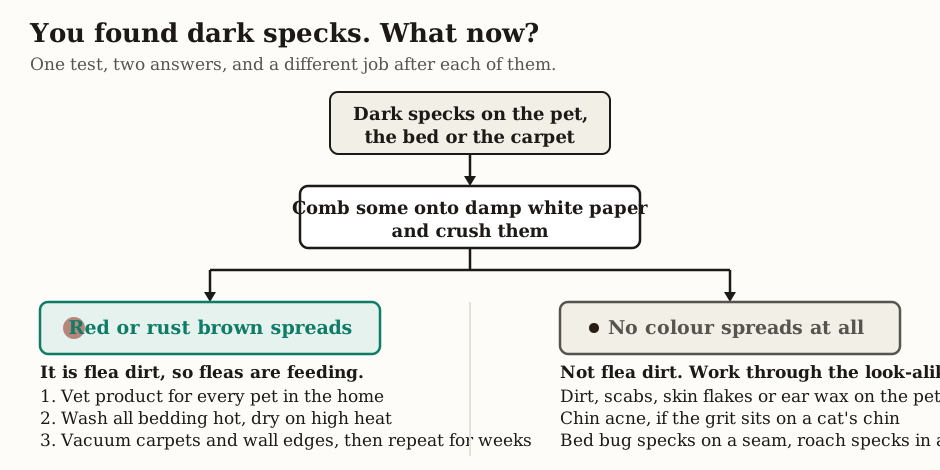
Red or rust brown spreading into the paper means flea dirt, so fleas are feeding on your pet. Grey, tan or black with no spread means something else, and the look-alike table below sorts out what. Test a second batch if you only had one or two specks.
What a negative result means
A negative test is a real answer, not a failure. If the specks sit on wet paper and leave no red at all, they are not flea dirt. Ordinary soil, sand, loose scab, dried skin and ear wax all stay their own color when wet.
One warning, though, because this trips people up. Crush the specks rather than waiting for them to dissolve on their own. Readers on pet forums report specks that look inert until a fingernail presses them, then run red. Press firmly with the back of a spoon or your nail, and give it a full minute.
Where to look on a dog and on a cat
Part the fur where fleas actually feed. On both animals that means the base of the tail, the lower back, the belly, the neck and the inner thighs. Cornell's feline health center reports that cats get bitten mostly on the back of the neck and the top of the tail head. Fleas on cats also gather around the head and neck rather than the underside.
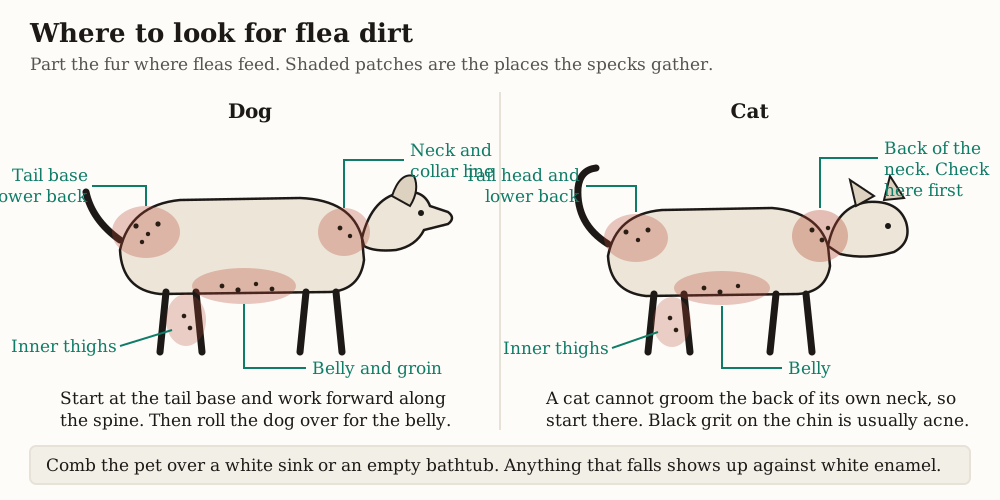
On a dog, start at the base of the tail and work forward along the spine. Then roll the dog over and check the belly and the groin, where the fur is thin and the skin shows through. Ears and the backs of the legs are worth a look as well. Our guide to how to get rid of fleas on dogs covers what to do once you find them.
On a cat, the neck comes first, because a cat cannot groom the back of its own neck. Work down the spine to the tail head after that. A short white comb and good light do more than any amount of staring at dark fur, and how to get rid of fleas on cats covers the treatment side.
Ohio State suggests a trick that costs nothing. Stand the pet in a white sink or an empty bathtub and comb. Grains that fall are easy to see against white enamel, and nothing escapes across the floor.
Specks on a cat's chin
A cat with black grit on its chin is usually not a flea case. Chin acne is the common answer. VCA describes it as a dirty looking chin with blackheads in the hair follicles, often linked to plastic food bowls.
The test still decides it. Flea dirt on a damp towel runs red, while the plugs of an acne breakout do not. Acne also sticks to the skin and needs gentle pressure to lift, whereas the grains comb out loose. See your vet if the chin looks swollen, sore or infected.
Flea dirt on bedding, carpet and furniture
Flea poop does not stay on the animal. It falls wherever your pet sleeps, so pet beds, sofas, rugs and your own sheets collect it. The grains gather deepest in the spots your pet uses most, and fleas keep breeding in exactly those places.
Check the pet bed first, because it concentrates everything. Shake it over a white sheet and look at what lands. Then check the sofa cushion seam, the rug beside the bed and the carpet edge along a wall.
Beds are worth their own look if your pet sleeps with you. Specks on a white sheet, close to where the animal lies, usually mean flea poop rather than anything else. A quick damp test on the sheet itself works fine, and if the specks sit along a mattress seam instead, read the early signs of bed bugs on a mattress rather than this page.
One oddity surprises people. Ohio State reports blood pellets from infested cats turning up on the tops of refrigerators, tables and bookcases, because that is where the cat goes.
Flea dirt but no fleas
Finding the specks and no fleas is normal, and it does not mean you are imagining things. Adult fleas are fast, dark and good at hiding in fur. Cats also groom a large share of them away: a lab study put it at 4.1 to 17.6 percent of the flea burden every day.
Recent treatment explains many cases too. A product that killed the adults leaves the dirt behind, since the waste in the coat does not disappear on its own. So the grains can outlast the insects that made them by days or weeks.
A small number of fleas is the third explanation. One or two fleas on a long haired dog leave plenty of specks and are almost impossible to spot. That is why vets treat confirmed flea dirt as proof of fleas even with nothing moving in the comb. If you want to be sure what a caught insect is, compare it against what a flea looks like up close.
Still finding flea dirt after treatment
Give it time, and keep combing. A spot on treatment can take up to 36 hours to spread and reach full strength, Merck notes. Fleas may still show up on a treated pet in an infested home for up to 8 weeks.
Two more things keep the specks coming. Old waste stays in the coat until a comb or a bath removes it, so some of what you find is simply history. New fleas also keep hatching: adults emerge from cocoons for about two weeks after a house treatment, UC IPM says, and sprays never reach a pupa.
Call your vet instead of adding a second product if fresh specks keep appearing beyond that window. Doubling up on flea products is how pets get hurt.
Is flea dirt harmful to pets and people?
Flea dirt itself is harmless to touch, and no source treats a speck of dried blood as dangerous. The fleas that made it are a different matter. Flea waste carries the bacteria behind flea borne typhus. CDC says it can get into a bite or another wound, into the eyes, or into the lungs.
Typhus is rare, and most US cases come from southern California, Hawaii and southern Texas. Symptoms begin 3 to 14 days after contact with infected fleas or flea dirt, and about half of patients get a rash. Deaths are rare, under 1 percent of cases.
Cat scratch disease works in a similar way. The bacteria travel from flea poop into a scratch, so a cat with fleas and a child with a scratch are the risky combination. Up to 1 in 3 healthy cats carry the germ, and most cases happen in children under 15.
Tapeworm is the one people get wrong. You do not get tapeworm from flea dirt. Both pets and people get it by swallowing a whole infected flea, which is why most human cases are young children.
For your pet, the dirt is a sign rather than an illness. Fleas cause itching, and some dogs and cats react badly to flea saliva. Heavy infestations drain blood, and a kitten or puppy can become dangerously anemic.
Flea dirt vs regular dirt and other black specks
Most black specks on a pet are not flea dirt. Regular soil, scabs, ear wax, skin flakes and chin acne all look similar in fur, and so do bed bug and cockroach droppings on fabric. One feature separates each of them, and the damp paper towel sorts out most in a minute.
The separating feature, and what each find means
Crushes red or rust brown on damp white paper
- What it is
- Flea dirt
- Where you find it
- Base of the tail, belly, neck, pet bedding
- What to do
- Treat every pet and the home
Stays grey, tan or brown when wet, with sand or leaf bits
- What it is
- Ordinary dirt
- Where you find it
- Anywhere a pet lies down or digs
- What to do
- Nothing. A bath if you want
Blackheads stuck in the skin of the chin and lips
- What it is
- Cat chin acne
- Where you find it
- Chin and lower lip only
- What to do
- Swap plastic bowls, ask a vet
Dark waxy or crusty gunge inside the ear canal
- What it is
- Ear mite debris or wax
- Where you find it
- Inside the ears, not the coat
- What to do
- Vet visit, because mites need treatment
Small crusty bumps attached to the skin
- What it is
- Scabs, often from flea allergy
- Where you find it
- Lower back, tail base, neck
- What to do
- Vet visit for the itch
White ovals about 0.5 mm, not dark at all
- What it is
- Flea eggs
- Where you find it
- Pet bedding, carpet, the coat
- What to do
- Same plan as flea dirt
Rice grain pieces near the tail, sometimes moving
- What it is
- Tapeworm segments
- Where you find it
- Around the pet's rear, in bedding
- What to do
- Vet visit for deworming
Smears rusty brown, but on a mattress seam
- What it is
- Bed bug specks
- Where you find it
- Beds and furniture, never on a pet
- What to do
- Check the bed, not the pet
Stays dark brown or black when wiped damp
- What it is
- Cockroach specks
- Where you find it
- Kitchen corners, cabinets, behind appliances
- What to do
- A roach problem, not a flea one
Specks that move on their own
- What it is
- Mites, lice or live insects
- Where you find it
- Skin and coat
- What to do
- Vet visit, since flea dirt never moves
Two of those rows deserve a note. Bed bug droppings and flea dirt both run rusty brown on a damp cloth, because both are digested blood. Location separates them: bed bug specks cluster along a mattress seam and never appear on an animal.
Cockroach specks fool people in the other direction. They stay dark brown or black on a damp cloth, so a speck that refuses to run red in a kitchen may well be a roach. Our guide to cockroach droppings covers that test and the clean-up, which is a different job from this one.
How to clean up flea dirt
Start with the free steps, and do the pet and the home on the same day. Bathe the pet in plain soap and water, then comb with a flea comb. Soap acts as a gentle insecticide against adult fleas, CDC says. After that, wash all the bedding and vacuum everywhere your pet rests.
Six steps, cheapest first
Bathe the pet, then comb
Warm water and ordinary soap, or a shampoo labelled for your pet's own species. Soap acts as a gentle insecticide against adult fleas, CDC says. Comb afterwards while the coat is damp, because the specks lift more easily then.
Wash every fabric the pet uses
Pet beds, blankets, throws, car seat covers and your own sheets. Use the hottest wash the care label allows, then a full hot dryer cycle. Fabric you cannot wash goes in a sealed bag until you can deal with it.
Vacuum the floors properly
Carpets, rugs, under furniture and along the edge of every wall. Vacuuming lifts the waste that feeds flea larvae, so this step does real work rather than just tidying. Go slowly over the spots where your pet sleeps.
Empty the vacuum outside
Seal the bag or the canister contents in a plastic bag and put it in an outdoor bin. It costs nothing and takes a minute. Vacuuming kills most of what it collects, so this is a cheap precaution rather than a rule.
Treat every pet in the home
Ask your vet for a product for each dog and cat, chosen for the species and the weight on the label. One untreated animal keeps the cycle running. Never use a dog product on a cat.
Repeat for several weeks, then test again
Keep vacuuming and washing while the last fleas finish emerging from their cocoons. After a few weeks, comb the coat and run the paper towel test again. Fresh specks mean the job is not finished yet.
Three cautions matter more than any product choice. Never put a dog flea product on a cat, because some of them kill cats. Read the label and follow it exactly, since the label is the law for any pesticide. Skip rubbing alcohol altogether, which EPA warns can easily ignite.
What to do next
Treat flea dirt as a confirmed flea problem and work from there. The pet needs a vet chosen product, the house needs vacuuming and washing, and both have to happen together or the fleas simply return.
Three guides pick up where this page stops. Our guide to dog fleas covers the dog side. The one on cat fleas carries the permethrin warning in full. For the carpets, the cocoons and the follow up, read getting fleas out of a house.
Still not sure what you are holding? If the specks are white ovals rather than dark grains, read what flea eggs look like. For everything else about these insects, start at our guide to fleas, or upload a photo to our bug identifier by photo.
Pest control disclaimer. Photo-based identification can help, but it is not always perfect. For dangerous spiders, large infestations, or anything you are unsure about, contact a licensed pest control professional.
Myths about flea dirt
Myth 1
Myth: “The specks are only dirt, so a bath fixes it.”
Truth: They are dried blood, and a bath removes the mess without touching the fleas that made it. Treat the pet and the home the same day.
Myth 2
Myth: “No fleas in the comb means no fleas on the pet.”
Truth: Cats groom away 4.1 to 17.6 percent of their fleas every day, and one flea on a long coat is easy to miss. Confirmed flea dirt is proof enough.
Myth 3
Myth: “Flea dirt turns black on a wet towel.”
Truth: It runs red or rust brown, which is the whole point of the check. Merck, CAPC and Ohio State all describe the same red result.
Myth 4
Myth: “You can catch a tapeworm from flea dirt.”
Truth: Both people and pets get tapeworm by swallowing a whole flea, not from the waste. CDC is explicit about it, and most human cases are young children.
Myth 5
Myth: “A bug bomb clears the house once specks appear.”
Truth: Foggers miss the larvae at the carpet base and under furniture, and several state health agencies warn that they are flammable.
Myth 6
Myth: “Food grade diatomaceous earth is safe to sprinkle everywhere.”
Truth: EPA allows registered products only, into cracks and crevices. Dusting a pet or a carpet with it is not an approved use.
Myth 7
Myth: “Specks on a cat's chin always mean fleas.”
Truth: Chin acne looks much the same from a distance, so run the towel test before you treat anything. Acne plugs do not run red.
Frequently asked questions
Can flea dirt get on me, my clothes or my bed?
Does flea dirt stain fabric?
Can an indoor only cat have flea dirt?
Do I have to treat my house if I only found a few specks?
Can flea dirt itself make my pet itchy?
Does flea dirt attract more fleas?
How long does flea dirt stay in a carpet?
Related guides
Fleas
The hub: what fleas are, where they come from, and how the whole cycle works.
Flea eggs
White ovals like salt, and the other half of what falls out of a coat.
What fleas look like
Size, color and the features that tell a flea from everything else that jumps.
How to get rid of fleas
Carpets, cocoons and follow up, in the order that actually breaks the cycle.
Fleas on dogs
Signs on a dog, what a vet will suggest, and when the itch needs a visit.
Fleas on cats
Cat flea treatment, with the permethrin warning that keeps cats alive.
Flea bites
What the bites look like on people, where they land, and how long they last.
Early signs of bed bugs
Rusty specks on a mattress seam, the other stain that runs brown.
Cockroach poop
Specks in a kitchen that stay dark on a damp cloth. A different problem.
Sources
- CDC, Flea-borne (murine) typhus: flea dirt carries the bacteria into a wound, the eyes or the lungs
- CDC, About Cat Scratch Disease: a scratch contaminated with flea feces, and up to 1 in 3 healthy cats
- CDC, About Dipylidium: tapeworm comes from swallowing an infected flea, not from flea dirt
- CDC, Getting Rid of Fleas: bathe with soap and water, comb, wash bedding, vacuum
- Merck Veterinary Manual, Fleas of Dogs: reddish black, pellet or comma shaped, and dissolves reddish brown on a damp paper towel
- Companion Animal Parasite Council, Fleas: flea feces on a wet towel dissolve and turn red
- Ohio State University Extension HYG-2081, Fleas: the pellets turn the water bright red, and where they collect indoors