Fleas on dogs come from the dog's surroundings, not usually from other dogs. A flea that has settled on an animal tends to stay there for life, so the new ones your dog brings home have just hatched in a yard, a kennel or your own carpet. That is why dog fleas are a household problem, and why treating the dog alone rarely ends them.
Signs your dog has fleas
The signs of fleas on dogs are scratching and chewing, black specks of flea dirt in the coat, and sometimes a small, fast, dark insect in the fur. Check the base of the tail and the hips first, because fleas and their droppings collect there. Two minutes with a flea comb over white paper settles it.
How to tell if your dog has fleas
Check each clue below to narrow down what you saw.
Scratching, licking or chewing, especially at the back end
The base of the tail, the hips and the back of the thighs are where flea-bitten dogs chew first.
Black specks in the coat or the bed
Flea dirt looks like ground pepper. On a damp paper towel it smears reddish brown.
A small, fast, dark insect in the fur
Part the coat against the lie of the hair. A flea runs through the fur rather than crawling slowly.
Thinning hair, red skin or scabs
Over the hips, the tail base and the thighs, this is the flea allergy pattern.
Itchy bites on the people in the house
Small red bumps on the ankles and lower legs often show up at the same time.
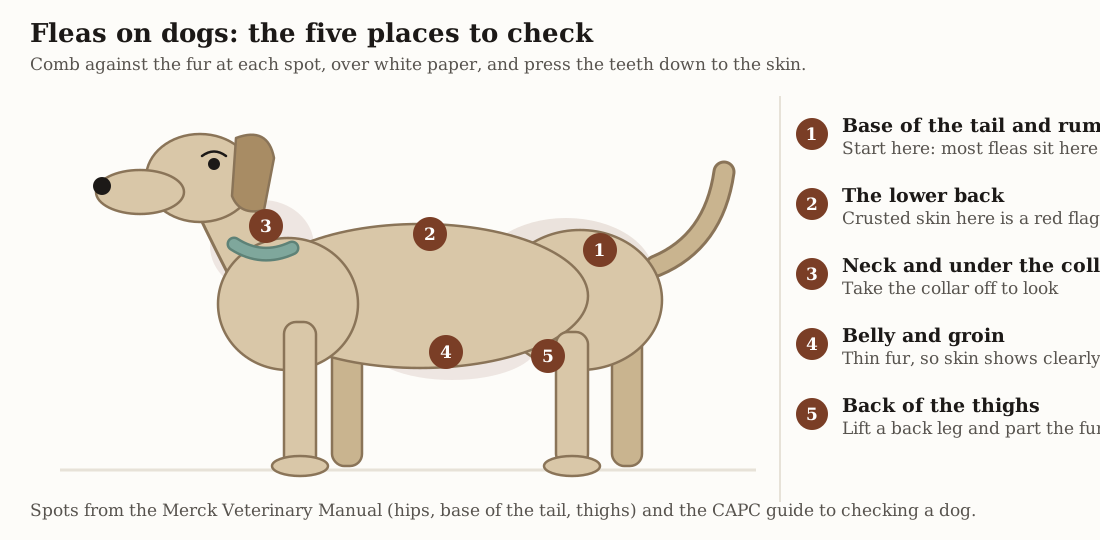
Part the coat against the lie of the hair at each spot in the diagram. Under the collar and in the groin are easy to miss. On a dark or thick coat, the comb test below finds far more than your eyes will.
The comb check, and fleas or dry skin?
Stand your dog on a sheet of white paper or in a white bathtub, and draw a fine flea comb from the neck to the tail. Then look at what fell out. A flea comb brings up four things, and three of them mean fleas.
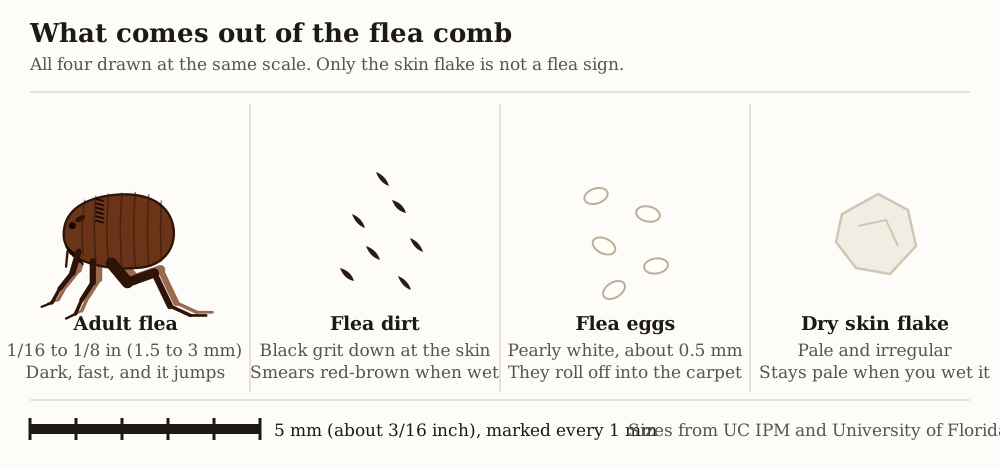
Tip the dark specks onto a damp paper towel and wait a minute. Flea dirt dissolves into reddish brown smears, because it is the dried blood fleas pass. Ordinary dirt stays black, and dry skin flakes stay white. Our guide to flea dirt on dogs and the paper towel test shows the result step by step.
One flea, or scratching but no fleas
One flea on your dog usually means more, because a flea that has fed starts laying eggs within a day or two. Treat it as a small infestation rather than waiting to see more. The fleas you can find are a small share of what is in the home.
A dog that scratches with no fleas on the comb can still have them. Dogs that are allergic to flea bites often groom most fleas away, Merck notes, so you may find only flea dirt. If there is no flea dirt either, other causes such as allergies, mites or a skin infection are likely, and your vet is the next step.
What fleas look like on dogs
On a dog, fleas look like small, shiny, reddish brown to nearly black insects about the size of a sesame seed, 1/16 to 1/8 inch long. They are thin from above, have no wings, and run quickly through the fur when you part it. Our guide to flea size and colour shows one at real size, with the bugs people mistake for one.
A bigger, rounded bug that is stuck in place is not a flea. Ticks attach and swell as they feed, while fleas never do. If that is what you found, our flea vs tick comparison and our guide to engorged ticks on dogs cover what to do.
How dogs get fleas
Dogs get fleas by walking through a place where young fleas have just come out of their cocoons. That might be a shaded spot in the yard where wildlife rests, a kennel, a groomer's, or your own carpet. Newly emerged fleas jump onto the first warm animal that passes, and your dog carries them home.
Other animals are the usual source. Opossums, raccoons, feral cats and squirrels shed flea eggs wherever they rest, and a pet cat that goes outside can bring fleas in for the dog. People can carry fleas into a home on their clothes, too, though fleas do not stay on people.
Direct dog-to-dog spread is less common than people think. A review by Rust found that once cat fleas had settled on a host, only 3.7% moved to another animal. So a dog that played with a flea-ridden dog is less of a worry than the yard that dog lives in.
Why does my dog keep getting fleas?
A dog keeps getting fleas when the source is still there. The commonest reason is the home itself: cocoons in the carpet go on hatching for weeks. Others are an untreated pet in the house, a gap in monthly treatment, or wildlife living under a deck or in a crawl space. Fix the source, and the repeat infestations stop.
Flea bites on dogs and flea allergy
Flea bites on dogs are small red bumps, usually hidden by the coat, and most dogs only scratch for a while. Some dogs are allergic to flea saliva, and in them one bite can set off days of intense itching. Vets call that allergy flea allergy dermatitis.
What flea bites look like on a dog with the allergy is a pattern, not a single bump. Merck describes crusted, itchy skin over the hips, the base of the tail and the back of the thighs, often with thinning hair. Most cases show up in late summer, when fleas peak.
Constant chewing can break the skin and lead to hot spots and skin infections. A dog with raw patches, a smell, or hair loss across its back end needs a vet visit, not just a flea product. For bites on the people in the house, see our guide to flea bites.
Can fleas make a dog sick?
Fleas rarely make a healthy adult dog seriously ill, but they can. Heavy infestations drink enough blood to cause anaemia, and puppies are most at risk. Fleas also pass on tapeworm, and an allergic dog can suffer badly from a handful of bites.
Tapeworm shows up as small, pale segments like grains of rice around the tail or in the bedding. A dog catches it by swallowing an infected flea while grooming, so it often appears alongside fleas. Your vet treats the worm, and flea control stops it coming back.
How to get rid of fleas on dogs
To get rid of fleas on dogs, treat every pet in the house the same day with a product your vet chooses, then clean the home daily for several weeks. The product stops new eggs. The cleaning removes the eggs, larvae and cocoons already in your floor. Skip either half and the fleas come back.
Budget first: the cleaning steps cost nothing, and they matter as much as the product. For the fastest kill on the day, see our page on what kills fleas on dogs.
Clearing fleas from your dog and your home
Call your vet and treat every pet the same day
Ask your vet for a flea product chosen for your dog's age, weight and health, and cover every dog and cat in the house at once. One untreated animal keeps the cycle going. Never use a dog product on a cat.
Bathe and comb the dog
A bath with mild soap kills the fleas on the dog on contact, and a flea comb dipped in soapy water picks up more. Check the product label first, because some spot-ons should not be applied right before or after a bath.
Wash the bedding hot
Wash the dog's bed, blankets and anything it lies on in hot, soapy water, then dry on high heat. Heat kills every flea stage on fabric.
Vacuum every day
Vacuum carpets, rugs, furniture, the car and the edges of each room daily, and empty the vacuum outside. The EPA calls daily vacuuming the best method for initial control.
Steam the carpets in a bad case
Steam reaches the cocoons, which no spray does. Vacuum again afterwards to catch the adults the heat brings out.
Treat only the shaded parts of the yard
Flea larvae survive in shade, under decks and in dog runs, not on sunny lawn. Clear debris there and ask a professional before spraying anything.
Keep going for three months
Keep every pet on its product and keep vacuuming. Fleas keep coming out of cocoons for weeks, and a home can take six weeks to three months to clear.
Our guide to getting fleas out of a house covers the carpets, growth regulators and the yard in more detail. Skip flea bombs: they settle on open surfaces and miss the carpet base and the underside of furniture, where the young fleas are, and they carry a fire risk.
The bath and the comb
A bath with mild soap, including dish soap, kills the fleas on your dog on contact, and the CDC describes soap as a gentle insecticide for adult fleas. A fine flea comb dipped in soapy water catches more, though the University of Florida puts a comb at only 10 to 60% of the fleas on an animal.
Neither leaves any protection behind, so they are a first step rather than a treatment. Our verdicts on home remedies for fleas on dogs cover Dawn, salt, vinegar and the rest, and which of them are unsafe.
Flea products for dogs, by type
Your vet chooses the product, and the label decides how it may be used. Use it only on the species, age and weight the label names, because, as the EPA puts it, the label is the law. Many of the most effective oral products and some spot-ons are prescription veterinary drugs.
Flea product types for dogs, and what each one does
Spot-on applied to the skin
- What it does
- Kills adult fleas; some also stop eggs developing
- The catch
- Can take up to 36 hours to spread; keep cats away from a treated dog
Oral tablet or chew
- What it does
- Kills fleas that bite the dog, monthly or longer
- The catch
- FDA has linked the isoxazoline class to tremors and seizures in some dogs
Fast-acting oral tablet
- What it does
- Kills the adults on the dog within hours
- The catch
- No lasting protection, so the carpet refills the dog
Collar
- What it does
- Some work well and last months
- The catch
- Quality varies, and some irritate the skin
Shampoo, powder, spray or dip
- What it does
- Kills what is on the dog at that moment
- The catch
- UC IPM calls these less effective and more hazardous
Two safety notes. The FDA has flagged that isoxazoline flea products have been linked to muscle tremors, stumbling and seizures in some dogs, including dogs with no history of seizures, while still considering them safe and effective. Tell your vet about any past seizure. The EPA's review of spot-on products found that small dogs were affected more by some of them, which is why the weight range on the label matters.
Why your dog still has fleas after treatment
Seeing fleas on your dog after treatment is expected. A spot-on can take up to 36 hours to spread, Merck notes, and most products kill a flea only after it jumps on and bites. Meanwhile the cocoons in your carpet keep opening for about two more weeks, so new fleas arrive every day.
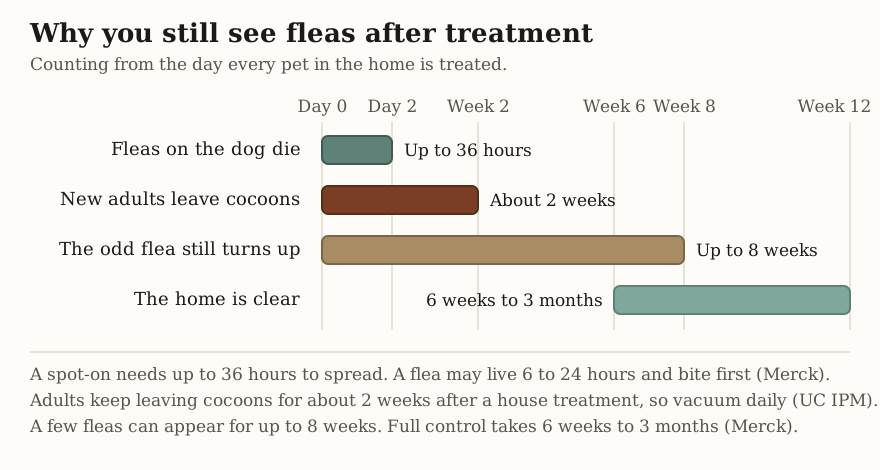
A few fleas can still turn up for up to eight weeks. Do not double up the dose or switch products early. Keep vacuuming instead, and judge progress by the comb: falling numbers week on week mean it is working. VCA advises keeping every pet on flea control for three to six months after an infestation.
If you also have a cat
If you have a cat, your dog's flea product can kill it. Many dog spot-ons contain permethrin, and cats break it down far too slowly to survive a dog dose. A cat does not need to be treated with it to be poisoned: grooming a freshly treated dog, or sleeping against one, can be enough.
The cat needs its own flea treatment too, because it shares the same fleas. Our guide to cat flea treatment explains why cats hide them and which products are safe.
Fleas on puppies
Fleas on puppies are more serious than fleas on an adult dog, because a small body loses blood faster. Call your vet before you use any flea product on a puppy. Every product label sets a minimum age and weight, and many products are not allowed on young puppies at all.
Until you can reach the vet, careful combing with a flea comb is the safe option at any age, and your vet can tell you whether a bath is safe for a puppy that young. Wash the puppy's bedding hot and vacuum daily. A puppy that seems weak or has pale gums needs a vet that day.
Can you get fleas from your dog?
You can get flea bites from your dog's fleas, but you will not get fleas living on you. Cat and dog fleas bite people when there are animals in the home, then go back to the floor or the pet. Bites usually show up on the ankles and lower legs.
So yes, dog fleas bite humans, and touching your dog is still fine. Our page on whether fleas live on humans explains why fleas do not stay on people, and what helps.
How to prevent fleas on dogs
The best way to prevent fleas on dogs is a vet-recommended product on every pet, used without gaps. Fleas survive year round indoors wherever there is an animal to feed on, the CDC notes, so many vets advise protection all year rather than only in summer. Ask your vet what suits your dog and your area.
- Keep every dog and cat in the house on its product, on schedule.
- Wash your dog's bedding in hot water every week or two.
- Vacuum often, especially where the dog sleeps.
- Keep shaded spots in the yard, under decks and in dog runs, clear of debris.
- Close off crawl spaces and decks so wildlife cannot nest there.
- Comb your dog every week or two in summer and fall, so you catch fleas early.
Dog fleas or cat fleas?
The flea on your dog is almost certainly a cat flea, Ctenocephalides felis. Despite the name, it is the flea on nearly all US dogs as well as cats. The true dog flea, Ctenocephalides canis, looks almost identical and is rare in the US. UC IPM, Ohio State and the University of Florida all name the cat flea as the flea on most dogs, and Ohio State calls the dog flea relatively rare in North America.
You do not need to know which one you have. They are told apart only under a microscope, and the treatment is the same. The practical point is the one above: the same flea lives on your dog and your cat, so both need treating. Our main flea guide covers the other kinds.
Myths about fleas on dogs
Myth 1
Myth: “If the treatment worked, I would not see any more fleas.”
Truth: Most products kill fleas after they bite, and the cocoons in your home keep opening for weeks. New fleas for a few weeks are expected.
Myth 2
Myth: “My dog caught fleas from another dog at the park.”
Truth: Settled fleas rarely change hosts: only 3.7% did in one review. Most new fleas jump on from places where they have just hatched.
Myth 3
Myth: “Indoor dogs do not need flea protection in winter.”
Truth: Fleas survive year round indoors wherever there is an animal to feed on. Keep the product going unless your vet says otherwise.
Myth 4
Myth: “A flea bomb will clear the house.”
Truth: Foggers miss the carpet base and the underside of furniture, where the eggs and larvae are. They also carry a fire risk.
Myth 5
Myth: “A dog flea product is fine for the cat if I use less.”
Truth: Many dog spot-ons contain permethrin, which can kill a cat even from contact with a treated dog. Cats need their own product.
Myth 6
Myth: “Natural remedies are safer for my dog.”
Truth: Garlic is toxic to dogs, and essential oils have caused poisonings. None of the common remedies has been shown to work.
Still not sure what you found on your dog? Photograph it on white paper and run it through our bug identifier tool. For the eggs and larvae in the home, see our guide to where fleas lay eggs.
Pest control disclaimer. Photo-based identification can help, but it is not always perfect. For dangerous spiders, large infestations, or anything you are unsure about, contact a licensed pest control professional.
Frequently asked questions
How do I know if my dog has fleas?
Do I need to treat my house if my dog has fleas?
Can I touch my dog if he has fleas?
What can I bathe my dog with to kill fleas?
Why does my dog still have fleas after treatment?
Can I give a second dose of flea medicine?
Do flea collars work on dogs?
How long does it take to get rid of fleas on a dog?
My dog is scratching but I see no fleas. Is it fleas?
Related guides
Fleas
The flea, head to toe, and the signs that give it away before you see one.
What kills fleas on dogs instantly
The fast kills, how fast each one really is, and why fleas come back.
Fleas on cats
Why cats hide the evidence, and the products that can kill them.
Flea dirt
Black specks that smear red on wet paper, and what that tells you.
How to get rid of fleas
The whole job in order: the pets, the floors, the follow-up and what to skip.
Home remedies for fleas
Salt, Dawn, vinegar and baking soda, each weighed against the evidence.
What do fleas look like?
A flea at real size, how far it jumps, and the bugs mistaken for one.
Ticks on dogs
Finding, removing and preventing ticks on your dog.
Sources
- CDC, Getting Rid of Fleas (treat every pet, treat the home, follow up)
- US EPA, Controlling Fleas and Ticks on Your Pet (species and weight on the label, never a dog product on a cat)
- US FDA, fact sheet on potential adverse events associated with isoxazoline flea and tick products
- Merck Veterinary Manual, Fleas of Dogs (life cycle, flea allergy dermatitis, how long treatment takes)
- VCA Animal Hospitals, Flea Control in Dogs (why fleas persist after treatment, three to six months of control)
- UC IPM Pest Notes 7419, Fleas (product types that work best, the yard, vacuuming)
- Companion Animal Parasite Council, Fleas for dog owners (checking a dog, prevention)