What kills fleas on dogs instantly? Adults die in minutes, the rest does not
A vet-given flea tablet is the fastest thing that works. Fleas begin dying 20 to 30 minutes after the dose, and every adult flea on the dog is normally dead within 3 to 4 hours. A bath with dish soap kills the adults in the water. Neither one protects your dog tomorrow.
So the honest answer has two halves. Yes, you can clear the fleas you can see today. No, you cannot end a flea problem today, because most of the fleas in your home are not on your dog at all.
Fleas lay 20 to 50 eggs a day while they feed, and those eggs are not sticky. As a result, they roll off your dog within hours and land in carpet, bedding and the spot where he sleeps. Nothing you put on the dog reaches them there.
What “instantly” cannot do
No treatment on your dog kills the next generation. Flea eggs hatch in 1 to 10 days, the larvae feed deep in carpet for 5 to 20 days, and the cocoon stage can sit there for weeks. A finished flea can wait inside its cocoon for up to 12 months, until footsteps tell it a meal has arrived.
That is why fleas keep turning up after a good treatment. The Merck Veterinary Manual says a few fleas may still show up on a treated dog for up to 8 weeks, and that clearing a home usually takes 6 weeks to 3 months. Seeing a flea next week does not mean the treatment failed.
The fastest ways to kill fleas on a dog, compared
Three things kill fleas on a dog within hours: a fast-acting tablet from your vet, a bath with ordinary dish soap, and a flea comb. The tablet is the only one that clears every adult. The bath and the comb cost nothing, work on contact, and leave nothing behind afterwards.
If you searched for what kills fleas on dogs instantly because your dog is miserable tonight, this is the honest short list. Each row below gives the real speed, the real cost and the real limit.
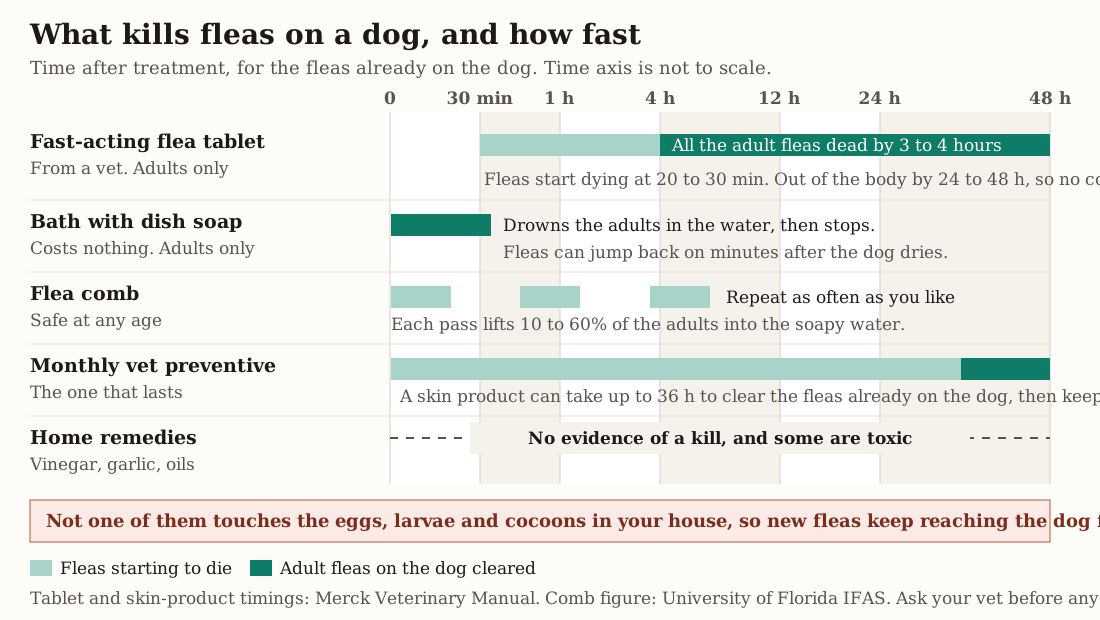
Table 1. What kills fleas on a dog today, and how fast
Fast-acting flea tablet from a vet
- How fast it kills adult fleas
- Fleas start dying in 20 to 30 minutes; all adults dead in 3 to 4 hours
- What it costs
- A vet visit or prescription
- What it does not do
- Leaves the body in 24 to 48 hours, so no protection after that
Bath with ordinary dish soap
- How fast it kills adult fleas
- Drowns the adults during the bath itself
- What it costs
- Nothing you do not already own
- What it does not do
- No residue, so fleas can jump back on minutes later
Flea comb into soapy water
- How fast it kills adult fleas
- Immediate, but it lifts only 10 to 60% of the adults per session
- What it costs
- About the price of a comb
- What it does not do
- Cannot reach eggs and larvae in the carpet
Monthly preventive from a vet (tablet, spot-on or collar)
- How fast it kills adult fleas
- A skin product can take up to 36 hours to clear the fleas already there
- What it costs
- Monthly, and the cheapest route long term
- What it does not do
- Not an instant fix on day one, which is why it pairs with the three above
Flea shampoo, powder, spray or dip
- How fast it kills adult fleas
- Kills on contact, then stops
- What it costs
- Low, but the risk is higher
- What it does not do
- Merck calls these older delivery systems essentially obsolete
Home remedies (vinegar, garlic, essential oils)
- How fast it kills adult fleas
- No evidence of any kill on a dog
- What it costs
- Low in money, high in risk
- What it does not do
- Several are toxic to pets, so they cost you time and safety
A fast-acting flea tablet from your vet
This is the option behind every “instantly” headline. The tablet contains a short-acting insecticide in the neonicotinoid class, and your dog swallows it rather than wearing it. It reaches the blood quickly, so fleas that bite begin dying within half an hour.
The numbers come from the Merck Veterinary Manual. Fleas start to die 20 to 30 minutes after the dose, and all of them are dead within 3 to 4 hours. More than 90% of the drug then leaves the body in the urine within 24 to 48 hours. That is exactly why it gives your dog no cover after that.
Ask your vet for it rather than guessing in a store aisle. Your vet matches the product to your dog’s weight, age and health, and can start a monthly preventive at the same time. We name no brands here, and we give no doses.
A bath with dish soap and a flea comb
A plain bath kills adult fleas well. CDC tells owners to bathe every pet with soap and water and then comb them, and says plainly that soap acts as a gentle insecticide against adult fleas. Dish soap breaks the surface tension of the water, so the fleas sink instead of floating off.
The catch is that a bath leaves no protection at all. PetMD puts it bluntly: your pet can be reinfected within minutes of the bath, because the rest of the flea population is in the house. Dish soap also strips oil from the coat, which can leave the skin dry and itchy.
One trade-off matters if your dog already wears a monthly product. Bathing can wash a skin treatment away, because some of these products dissolve in water. Check your label, and ask your vet before you bathe a dog that was treated in the last day or two.
A flea comb on its own
A flea comb is the one tool that is safe at any age, on any dog, on any day. Its teeth sit close enough together to trap an adult flea, and a dip in soapy water after each stroke kills what you catch. Comb the base of the tail, the belly and behind the ears first.
Be realistic about what it removes, though. University of Florida entomologists put a comb’s catch at 10 to 60% of the fleas on an animal. Combing is therefore a way to take the edge off and to check your progress, rather than a cure.
How to do the bath and comb, step by step
Comb first, over a white towel
Work through the coat before the dog gets wet. Black specks that smear red on a damp paper towel are flea dirt, so you have confirmed fleas rather than dry skin.
Fill a bowl with warm soapy water
Keep it beside you. Every flea you comb out goes straight in, because a flea on a towel jumps back.
Wet the dog with warm water, starting at the neck
A ring of lather around the neck first stops fleas running up to the face and ears.
Lather with a little dish soap or a dog flea shampoo
Leave it on for the time the label gives, usually about 5 minutes. Never use a product labelled for cats, people or the yard.
Rinse until the water runs clear
Then towel the dog dry in a warm room.
Comb again once the coat is damp
Fleas are slow and easy to catch at this point, so this pass gets the most.
Wash the bedding hot the same day
Use the hottest setting the bedding label allows, and dry it hot. This removes the eggs that fell off during the session.
What kills fleas on dogs without bathing
Plenty of dogs hate water, and some cannot be bathed at all. Luckily, bathing is the one step you can skip. A vet-given tablet, a flea comb and a monthly preventive all work on a dry dog, and together they do more than a bath does.
A comb and a bowl of soapy water is the whole kit. Work in sections for 10 to 15 minutes, dipping the comb after every stroke. Then vacuum where the dog sleeps and wash the bedding hot, which removes the eggs that fell off during the session.
Skip the dry shampoos, powders and sprays sold for this. Older delivery systems such as powders, dips and rinses have been made largely obsolete by modern spot-ons and tablets, the Merck Veterinary Manual says. Several of them carry more risk than benefit.
What kills fleas on dogs instantly, naturally? An honest scorecard
So what kills fleas on dogs instantly, naturally? Almost nothing, and the one exception is plain soap and water. We searched the research for vinegar, coconut oil and salt against the cat flea and found no study at all. NPIC, the pesticide information service, tells owners to avoid home remedies because most have not been found to work.
Soap is the one that earns its place. It is cheap, it is on the CDC page, and it kills adult fleas on contact. Garlic, brewer’s yeast and vitamin B1 do not stop fleas feeding, and ultrasonic devices and herbal collars do nothing either.
Table 2. Natural flea remedies for dogs, scored against the evidence
Dish soap and warm water
- What the evidence shows
- CDC calls soap a gentle insecticide that kills adult fleas on contact
- Verdict
- Works, for today only
Flea comb into soapy water
- What the evidence shows
- Removes 10 to 60% of adults per session (University of Florida)
- Verdict
- Works, partly
Apple cider vinegar spray
- What the evidence shows
- No study found. Even its supporters claim repelling, not killing
- Verdict
- No evidence
Coconut oil rubbed into the coat
- What the evidence shows
- No study found against the cat flea
- Verdict
- No evidence
Salt or baking soda on the dog
- What the evidence shows
- No study found. Both dry the skin
- Verdict
- No evidence
Garlic, brewer's yeast or vitamin B1 in food
- What the evidence shows
- Extension tests found no effect on feeding fleas
- Verdict
- Does not work
Essential oils, including tea tree and pennyroyal
- What the evidence shows
- 443 published tea tree poisoning cases in pets; pennyroyal causes seizures and liver failure
- Verdict
- Unsafe
Diatomaceous earth on the coat
- What the evidence shows
- Works only while bone dry, and the dust is a lung risk
- Verdict
- Not on the dog
Diatomaceous earth sits in its own category. It can dry out insects, but only an EPA-registered product used into cracks and crevices meets the safety rule, and the dust is a lung risk for you and your dog. Our guide to home remedies for fleas on dogs grades each remedy against the evidence, and diatomaceous earth for fleas covers that one in full.
What not to use on a dog for fleas
Four things come up again and again, and each one is a bad idea. Rubbing alcohol, essential oils, a product meant for another animal and a product for the wrong weight or age all put the dog at real risk. Two of them send pets to emergency vets every year.
Rubbing alcohol is the worst of them. EPA warns that rubbing alcohol can easily ignite, and the Merck Veterinary Manual notes that isopropanol is twice as toxic as drinking alcohol. Merck adds that overspraying pets with alcohol-based flea sprays often causes poisoning.
Essential oils have a published record too. In one review of flea products exempt from EPA registration, 92% of 48 exposed animals had an adverse reaction, and three died or were put to sleep. A separate study collected 443 cases of tea tree oil poisoning in dogs and cats, with signs starting 2 to 12 hours after exposure.
Then there is the label itself, which is federal law. EPA says to use a product only on the species and the weight range it names. Its label also sets a minimum age, and it may ban use in weak, old, sick, medicated, pregnant or nursing pets. Doubling a dose to work faster is both illegal and dangerous.
Myth 1
Myth: “Dawn dish soap gets rid of fleas.”
Truth: It kills the adult fleas in the bath water and nothing else. PetMD says a pet can be reinfected within minutes of the bath, because the eggs, larvae and cocoons are in the house.
Myth 2
Myth: “Apple cider vinegar kills fleas on a dog.”
Truth: No study supports it. Even the pages that recommend vinegar only claim it repels fleas, and a sprayed dog walks back into the same carpet.
Myth 3
Myth: “A flea problem clears in 2 to 4 weeks.”
Truth: Merck puts it at 6 weeks to 3 months. The shorter number describes the fleas on the pet, not the eggs and cocoons at home.
Myth 4
Myth: “Fleas on a treated dog mean the product failed.”
Truth: New fleas arrive from the carpet every day, and some bite before they die. Merck says sightings for up to 8 weeks are normal.
Myth 5
Myth: “If my dog has fleas, the cat is fine.”
Truth: Fleas move between animals, and CDC says every pet in the home must be treated. The cat needs a cat product, never the dog's.
Puppies, small dogs, and pregnant or sick dogs
Call your vet first for any of these dogs, before you buy anything. Most flea products carry a minimum age or weight on the label, and EPA’s own review of pet spot-on incidents found that small dogs were harmed more often than big ones. A heavily infested puppy is also a medical case, not a cleaning job.
Puppies have a safe route while you wait for that call. Warm water, a tiny amount of mild soap and a flea comb take fleas off a young puppy without any pesticide at all. Keep the puppy warm afterwards, because chilling is a real risk at that age.
Pregnant, nursing, old or sick dogs are the group where labels most often say no. Ask your vet which product the label clears for your dog’s situation, and mention every other medicine your dog takes.
If there is a cat in the house
This is the warning that matters most. Never put a dog flea product on a cat, and keep your cat away from a freshly treated dog for as long as the label says. Permethrin, which appears in many dog spot-ons and sprays, is highly toxic to cats and can cause muscle tremors and seizures.
Treat every pet in the home at the same time, as CDC advises. Fleas move between animals, so one untreated cat keeps the whole house supplied. Your vet can pick a cat-safe product on the same visit, and our guide to cat-safe flea treatment covers the differences.
The next 8 weeks: why the fleas come back
Whatever kills fleas on dogs instantly buys you a day, and the house decides the rest. Adults keep emerging from cocoons for about 2 weeks after a treatment, and clearing a home takes 6 weeks to 3 months in most cases. Knowing that number up front is what stops people giving up in week three.
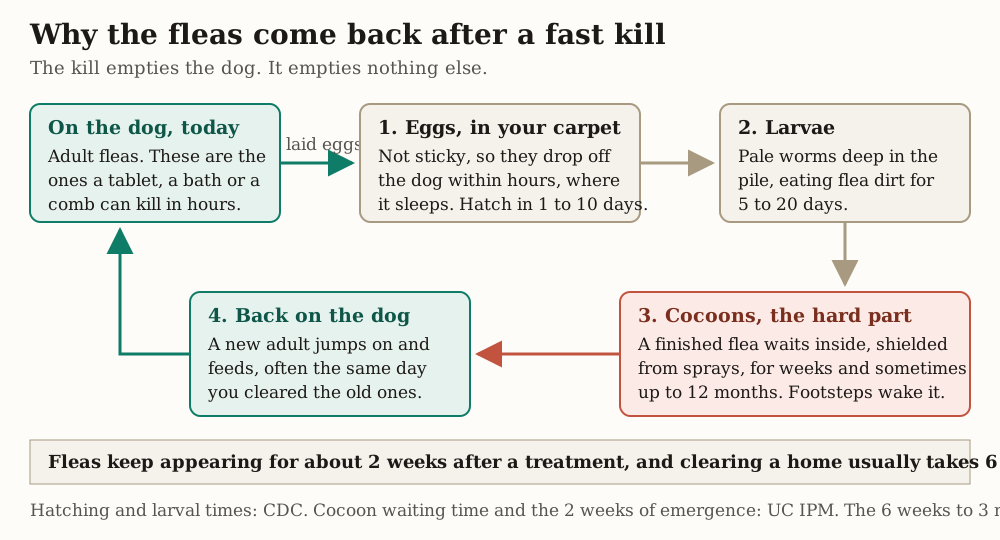
Four jobs break the cycle, and none of them is expensive. Keep every pet on a vet-chosen monthly product, vacuum daily where your dog sleeps, wash the bedding hot every week, and keep going after the fleas seem gone. Vacuuming also wakes fleas out of their cocoons, which is useful rather than a problem.
Our guide on how to get rid of fleas in carpet covers the house in detail, and the flea life cycle shows what you are looking for in the carpet. For the whole picture on your dog, including the early signs and how he picked them up, read fleas on puppies and dogs. To check the specks in the coat, see what flea dirt looks like, or start at our guide to fleas for the whole topic.
One claim deserves a correction here. Several pages ranking for this search say a flea problem clears in 2 to 4 weeks. That is the best case for the fleas on the pet, not for the house. Merck’s 6 weeks to 3 months is the figure a dog owner should plan around.
When your dog needs a vet now
Some flea cases are emergencies, and blood loss is the reason. Heavy infestations can make a dog anemic, and puppies are at the highest risk. A weak or wobbly dog with pale gums needs a vet the same day, whatever else you had planned.
Watch for three other reasons to call. Raw or infected skin over the hips and tail base points to a flea bite allergy. Rice-like segments near the tail suggest a tapeworm from a swallowed flea, and any reaction after a flea product needs advice straight away.
If your dog reacts to a product, EPA says to bathe him with mild soap and lots of water and take any collar off. Then call your vet, or the National Pesticide Information Center on 1-800-858-7378. For a person who swallows or spills a pet pesticide, call Poison Control on 1-800-222-1222.
Pest control disclaimer. Photo-based identification can help, but it is not always perfect. For dangerous spiders, large infestations, or anything you are unsure about, contact a licensed pest control professional.
Veterinary disclaimer. This page is general information for dog owners. It is not veterinary advice, a diagnosis or a treatment plan, and it names product classes, not brands or doses. Ask your veterinarian which flea product is right for your dog, and call them if your pet seems unwell.
Killing fleas on dogs: FAQ
What kills fleas on dogs instantly at home?
How long does it take for a flea tablet to work?
Can I use my cat's flea treatment on my dog?
Will a bath wash off my dog's flea treatment?
What kills fleas and ticks on dogs instantly?
Can I touch my dog if he has fleas?
Do I have to treat my house if my dog has fleas?
Related guides
Fleas on dogs
The full picture, from the first signs to how your dog picked them up.
How to get rid of fleas
Clearing the carpet, the bedding and the cocoons that keep hatching.
Home remedies for fleas
Every kitchen remedy graded against the evidence, honestly.
Flea dirt
Black specks in the coat, and the damp paper test that confirms them.
Flea eggs
Salt-like specks in bedding, and what they mean for your timeline.
Fleas on cats
Why cat products differ, and the dog treatments that can kill a cat.
Diatomaceous earth for fleas
What the dust really does, and the label rule for using it.
All about fleas
Where fleas come from, what they spread, and how long they live.
Sources
- CDC, Getting Rid of Fleas (treat every pet, soap as a gentle insecticide, follow-up timing)
- US EPA, Controlling Fleas and Ticks on Your Pet (the species, weight and age rules, and adverse reactions)
- US EPA, Introduction to Pesticide Labels (the label is the law)
- US FDA, Fact Sheet about Potential Adverse Events Associated with Isoxazoline Flea and Tick Products
- Merck Veterinary Manual, Ectoparasiticides Used in Small Animals (onset times by drug class, permethrin and cats)
- Merck Veterinary Manual, Fleas of Dogs (up to 36 hours for a skin product, 8 weeks of sightings, 6 weeks to 3 months)
- University of Florida IFAS, Cat Flea EENY-011 (a flea comb removes 10 to 60% of fleas)