How many eyes do spiders have?
Most spiders have eight eyes, arranged in two rows of four on the front of the head. BugGuide puts the share at 99% of all spiders. Nearly all the rest have six. A few have four or two, and some cave spiders have none. So how many eyes do spiders have? The honest answer is eight, with a short list of exceptions.
Spider eyes are simple eyes. Each one has a single lens over a small retina, a bit like a tiny camera. That makes them very different from the compound eyes of a fly, which are built from many small units. Scientists name each eye by where it sits, and the pattern changes from family to family.
That pattern matters, because there are a lot of spiders to sort. The World Spider Catalog lists about 54,200 species in 139 families. Eye count and layout are among the first things an expert checks to place a spider in its family.
How many eyes spiders have, by group
8
- Who has them
- About 99% of spiders
- Examples
- House spiders, wolf spiders, jumping spiders, orb weavers, black widows, tarantulas
6
- Who has them
- Most spiders in an old branch of the family tree, the haplogynes
- Examples
- Brown recluse, spitting spiders, the woodlouse spider, some cellar spiders
4
- Who has them
- A few small groups
- Examples
- Tetrablemma, and some feather-legged spiders (Uloboridae) such as Miagrammopes
2
- Who has them
- Most of the family Caponiidae
- Examples
- Small hunting spiders that live on the ground
0
- Who has them
- Some spiders that live deep in caves
- Examples
- Stalita taenaria in Europe, Sinopoda scurion in Laos
Do all spiders have 8 eyes?
No. The answer to “how many eyes do spiders have?” depends on the family. A spider with six eyes has lost its front middle pair, the main eyes, and kept the other three pairs. That is true of the brown recluse and the spitting spiders. The woodlouse spider, common in US gardens and basements, has six as well, and so do some cellar spiders.
Four eyes turn up in a few tiny spiders, such as Tetrablemma, and in some feather-legged spiders that lost a second pair. Two eyes are normal for most of the family Caponiidae. One family can even mix counts: BugGuide notes that Cybaeidae includes spiders with eight, six and no eyes.
Then there are the cave spiders that have no eyes at all. Sinopoda scurion, found in a cave in Laos and described in 2012, was the first huntsman spider known with no eyes. Its relatives in other caves still had theirs.
Do any spiders have 12 eyes?
No. No spider has more than eight eyes, so a spider with 10 or 12 eyes does not exist. Every spider eye belongs to one of the four pairs. Spiders have lost pairs over time, but none has gained an extra one. Still, the idea spreads. A 2021 article from the Forest Preserve District of Will County, which ranks on Google for spider eyes, says some spiders have “as many as 12.”
The likely mix-up is scorpions. They are arachnids too, and a scorpion carries one pair of eyes on top of its head plus up to five pairs along the front edges. A 2014 survey of scorpion eyes by Stephanie Loria and Lorenzo Prendini found the side eyes vary from none to five pairs. As for 2,000 eyes, that number fits the many small units in an insect’s compound eye, not the answer to “how many eyes do spiders have.”
Why do spiders have 8 eyes?
Spiders have eight eyes because each pair does a different job. One front pair sees detail. The other three pairs watch for movement and cover a wide view, in some spiders almost all the way around. A spider has no neck to turn its head, so several fixed eyes do the work of one moving pair.
Spider eyes also come from two different starting points. In a 2020 review in Current Biology, Nathan Morehouse of the University of Cincinnati explains that the front pair descends from ancient middle eyes. Those are the same kind as the small simple eyes on top of an insect’s head. The other three pairs seem to be what is left of a pair of compound eyes that broke up into separate eyes long ago.
So why have eight if they cannot see well? Because seeing well is not the job for most spiders. For a web spider, knowing that a shadow moved is enough to drop out of sight or freeze. The fine work, like finding prey in the web, is done by touch. Hunting spiders, on the other hand, rely on sight, and their eyes show it.
The two kinds of spider eyes
Spider eyes come in two kinds. The principal eyes are the front middle pair, called the anterior median eyes. They see the sharpest detail and, in some spiders, color. The secondary eyes are the other three pairs. They catch movement and work better in dim light, and in many spiders they carry a mirror layer that shines.
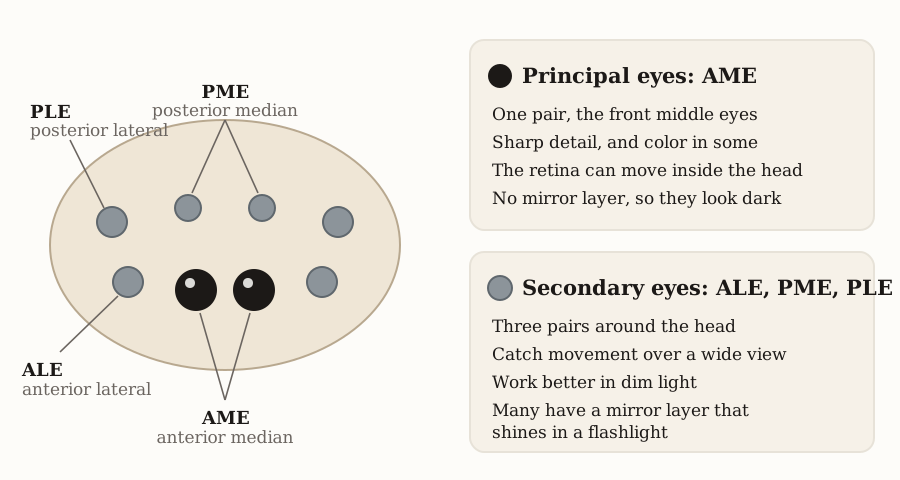
Each pair is named by its row and its position. Anterior means the front row, and posterior means the back row. Median means the middle, and lateral means the sides. That gives four names, usually shortened to AME, ALE, PME and PLE.
The four pairs of spider eyes and what they do
AME, anterior median
- Where it sits
- Front row, middle
- Kind
- Principal
- Main job
- Detail, shape and, in some spiders, color
ALE, anterior lateral
- Where it sits
- Front row, ends
- Kind
- Secondary
- Main job
- Movement ahead and to the sides. Jumping spiders use them to judge distance
PME, posterior median
- Where it sits
- Back row, middle
- Kind
- Secondary
- Main job
- Dim light. These are the giant eyes of wolf spiders and ogre-faced spiders
PLE, posterior lateral
- Where it sits
- Back row, ends
- Kind
- Secondary
- Main job
- A wide view, with movement to the sides and behind
You can often tell the two kinds of spider eyes apart by color. The principal eyes look dark, while the secondary eyes usually look silvery or pale. That pale look comes from the tapetum, a layer of reflective crystals behind the retina. It sends light back through the eye for a second pass, which nearly doubles the path the light takes through the cells.
The principal eyes have a trick of their own. Their retina can move behind the fixed lens, so the spider can look around without moving its body. Morehouse reports four tiny muscles on each retina in wolf, crab and wandering spiders. Jumping spiders have six, and they can shift their gaze up to 50 degrees.
Do spiders have compound eyes?
No. Spider eyes are all simple eyes, each with one lens. Insects such as flies and dragonflies have compound eyes, made of many small units packed together. Other arachnids, such as scorpions and harvestmen, also have simple eyes. Spiders do share a deep history with compound eyes, though, since their secondary eyes likely began as one.
Do spiders have pupils or eyelids?
Spiders have neither. Spider eyes have no iris to form a pupil and no lid to close, so spiders cannot blink. Their eyes stay open all the time, even when they rest.
The dark spot you see inside a jumping spider’s big front eyes is not a pupil, either. It is the retina, deep at the back of a long eye tube. If you look straight into those eyes, you can sometimes catch it flickering as the retina scans. Morehouse calls it a true “twinkling of an eye.”
Spider eye arrangement: how to identify a spider by its eyes
The arrangement of spider eyes is one of the best clues to a spider’s family. Most web spiders have two even rows of four small eyes. Wolf spiders have three rows, with two big eyes in the middle. Jumping spiders have two huge eyes in front. The brown recluse has only six, in three pairs. The pattern rarely names a species, though.
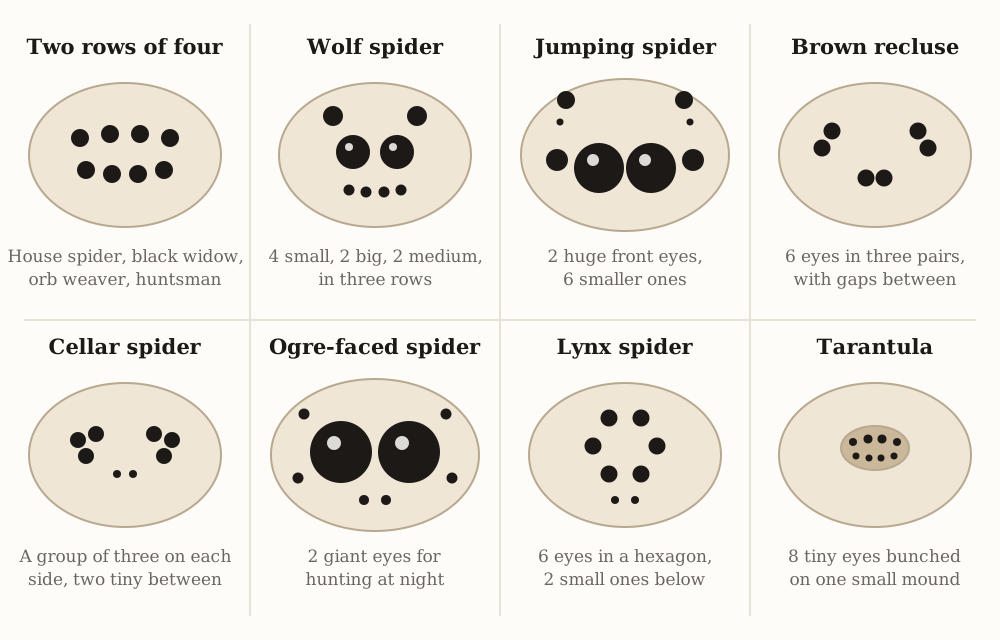
BugGuide, which keeps the best-known set of photos of spider eyes, says the eyes can sort a spider to its family and sometimes its genus. They are “almost never useful” for naming the species. For that, experts look at the male’s palps or the underside of the female under a microscope. Also, the viewing angle changes how the eyes look, so a round eye can appear oval in a photo.
Spider eye patterns you can see with a phone camera
Two huge eyes in front like headlights, with smaller eyes beside and behind
- Most likely
- Jumping spider
- Also check
- A short, fuzzy body. It turns to watch you
Four small eyes in a bottom row, two big eyes above, two more on top
- Most likely
- Wolf spider
- Also check
- Its eyes shine green in a flashlight at night
Six eyes in three pairs, with gaps between the pairs
- Most likely
- Brown recluse, or a spitting spider or woodlouse spider
- Also check
- Plain legs and a body no longer than 3/8 inch. See the warning below
Two even rows of four small eyes
- Most likely
- House spider, black widow, orb weaver, funnel weaver or huntsman
- Also check
- The web: a tangle, a sheet with a funnel, or a round web
A group of three on each side and two tiny eyes between
- Most likely
- Cellar spider
- Also check
- Very long, thin legs. It hangs upside down in a loose web
Six eyes in a hexagon with two small ones below
- Most likely
- Lynx spider
- Also check
- Spiny legs. It hunts on plants in the sun
Eight tiny eyes bunched on one small mound
- Most likely
- Tarantula
- Also check
- A big, hairy spider, often in the Southwest
Two giant eyes facing forward
- Most likely
- Ogre-faced spider
- Also check
- Rarely seen. One species lives in the US and hunts at night with a silk net
Only two eyes on a bump, and no waist in the body
- Most likely
- A harvestman or a camel spider, which are not spiders
- Also check
- Spiders always have a narrow waist
Our species guides show each pattern in more detail. The jumping spider guide names all four pairs on a living spider, and the wolf spider guide covers the three-row pattern and the flashlight trick. For two even rows, the common house spider, the black widow and the orb weavers are the usual suspects. Tarantulas are covered in our tarantula guide, and the two-eyed look-alike in our camel spider guide.
Six eyes: the brown recluse check
If you count six eyes in three pairs, slow down. UC IPM describes the brown recluse as having six eyes of equal size in three pairs: one pair in front and one on each side, with space between them. That six-eye pattern is the most useful single check, because nearly every common house spider has eight.
Six eyes alone do not prove a recluse, though. Spitting spiders and the woodlouse spider have six too. UC IPM lists the other features that must all match: a plain abdomen with fine hairs, plain legs with no spines, and a body no longer than 3/8 inch (about 10 mm). It also warns that the violin mark is not a reliable sign by itself. Our brown recluse guide walks through every check and the real US range.
How to count a spider's eyes from a photo
Keep your hands off
Do not pick the spider up or press it to get a look. If it is moving, cover it with a clear glass or jar. Otherwise, photograph it where it is.
Bring the phone close, not your face
Use your phone's macro or close-up mode. If the picture blurs, step back and zoom in 2x instead. Rest the phone on something to keep it steady.
Shoot the face from the front and from above
The eyes sit on the front edge of the head. Take one photo straight at the face and one from above, because some eyes only show from one angle.
Light it from the side
Shine a flashlight or a second phone light from one side. The domes of the eyes stand out, and a wolf spider's big eyes will shine.
Zoom in and count in pairs
Count left and right together, one pair at a time. Note which eyes are big and how many rows there are. Eight in two even rows, three rows with a big middle pair, and six in three pairs each point to a different family.
Match the pattern, then check the rest
Compare the photo with the eye pattern table above. Then check the body, the legs and the web. If you still are not sure, send the photos to your county extension office or run them through a bug identifier.
Still not sure which spider it is? Our spider identifier sorts spiders by eyes, web, markings and where you found them.
How do spiders see?
Most spiders see very little. Their eyes pick up light, shadow and movement, but not much detail, so touch, vibration and taste do most of the work. A web spider feels its prey through the silk. Hunting spiders are the exception. Jumping spiders, wolf spiders, crab spiders and ogre-faced spiders all use their eyes to hunt.
So what does spider vision look like? For a typical house spider, picture a coarse, grainy image in which anything that moves stands out. The lenses gather light very well, better than a camera lens. However, most spider retinas have few light-sensing cells, so the picture they make is rough.
Is a spider’s vision stitched together like ours? In a way, yes. The two kinds of eyes send their signals to separate parts of the brain, and the signals are combined later. Morehouse notes that some spider brain cells respond to more than one kind of eye. That suggests spiders build one view of the world out of several eyes.
How well different spiders see
Jumping spiders
- How well it sees
- Sharp detail, color and depth, by day
- What it relies on most
- Its eyes
Ogre-faced spiders
- How well it sees
- Very well in near darkness
- What it relies on most
- Two giant rear eyes, at night
Wolf spiders
- How well it sees
- Movement, including at dusk and at night
- What it relies on most
- Eyes and vibration
Crab and lynx spiders
- How well it sees
- Movement, well enough to ambush insects on plants
- What it relies on most
- Eyes, then a quick grab
Web spiders: orb weavers, house spiders, black widows
- How well it sees
- Light, dark and motion only
- What it relies on most
- Vibration in the web
Tarantulas
- How well it sees
- Light, dark and motion only
- What it relies on most
- Touch, its keenest sense
Cave spiders
- How well it sees
- Some have no eyes at all
- What it relies on most
- Touch, and some still sense light
Are spiders blind?
Most spiders are not blind, but many come close. A typical web spider can tell light from dark and notice a moving shape, and that is about all it needs. The spiders that are truly blind live in caves, where some have lost their eyes completely.
Even in caves, light can still matter. A 2023 study led by Jie Liu of Hubei University tested ten species of Leptonetela cave spiders from China. Most spiders of every species, the eyeless ones included, moved to the dark side of a box. The eyeless spiders had also kept nearly all of their light-sensing genes.
Can spiders see humans?
Most spiders cannot see you as a person. To a house spider, you are a large moving shape or a passing shadow, and its usual reaction is to freeze or run. Jumping spiders are the big exception. They see well enough to turn and face you, and they will follow your movements, even your head, as you move around them.
That sudden freeze is a reflex many animals share, called the looming response. When something large moves fast toward you, you duck. A spider does the same thing in its own way. Holding still also helps it hide, because many predators react to movement.
Do spiders know when you are looking at them? A web spider almost certainly does not, because it cannot make out your eyes. It does notice your movement, the air you push and any shaking of the surface it is on. A jumping spider clearly notices where you are and when you move. Whether it understands a gaze, though, no study has shown.
Can spiders see in the dark?
No spider can see in total darkness, but some see well in very dim light. Wolf spiders hunt at dusk and at night with large rear eyes backed by a mirror layer. Ogre-faced spiders do even better and can hunt by starlight. Most web spiders do not need sight at night at all, since they feel their prey through the silk.
The champion is the ogre-faced spider, also called the net-casting spider. Its two giant rear eyes have lenses 1.4 mm across with an f-number of 0.58. According to Morehouse, they are the largest single lenses known in any arthropod. The Australian Museum compares that f-number with 0.9 for a cat and 1.1 for an owl, and a lower number means a brighter image.
Those eyes have no mirror layer. Instead, the spider builds a large new layer of light-sensitive membrane inside them each night and breaks it down again at dawn. It then hangs head-down with a small silk net held in its front legs, ready to throw it over insects walking below.
Can a spider see you in a dark bedroom? Almost certainly not in any detail. A wolf spider might notice you move. A web spider in the corner relies on the feel of its web, not its eyes, and it has no reason to come looking for you.
Why spider eyes glow in a flashlight
That green or white sparkle in the grass at night is eyeshine. The mirror layer behind a wolf spider’s big eyes reflects your light straight back, the same way a cat’s eyes glow in headlights. Fishing spiders have the same kind of layer.
To see it, hold a flashlight or headlamp right beside your eyes, so the beam and your line of sight run together. Then sweep the lawn slowly after dark. Each bright dot that stays put is likely a spider looking back, and walking toward one usually turns up a wolf spider. Jumping spiders never shine, because their eyes have no mirror layer.
Can spiders see color?
Some spiders can. Most jumping spiders have two color receptors in their main eyes, one for ultraviolet and one for green, and at least one group adds red. Some orb weavers see ultraviolet, blue and green. For most spiders, though, nobody has tested color vision, and many probably see little color at all.
The red result came from a 2015 study by Daniel Zurek, Nathan Morehouse and colleagues. They found that the jumping spider Habronattus pyrrithrix has a red filter in front of some of its green receptors. The filter turns those cells into red detectors. As a result, the spider has three color channels, like us, and the males court females with red and orange patches.
Are spiders colorblind, then? Not the way people use the word. Jumping spiders see ultraviolet light, which we cannot. Without a red channel, however, most of them probably cannot tell red from green the way we can. The orb weavers in Argiope, the garden spiders, have ultraviolet, blue and green receptors in their secondary eyes.
Light we cannot see
Spiders can sense two kinds of light that people cannot. One is ultraviolet. The other is polarized light, the pattern in the sky that shows where the sun is even through clouds. The ground spider Drassodes cupreus uses its rear middle eyes as a sky compass, which guides it home at dawn and dusk.
Those two eyes have nearly lost their lenses, so they no longer form an image at all. They simply read the brightness of the polarized sky. Wolf spiders and funnel weavers also respond to polarized light, using their principal eyes.
Which spiders have the best eyesight?
Jumping spiders have the best eyesight of any spider. Their two big front eyes can separate points just 0.04 to 0.1 degrees apart, in the same range as pigeons and elephants. For their body size, no animal sees finer detail. Ogre-faced spiders see best in the dark, and wolf spiders see movement well by day and night.
Each big front eye works like a telephoto lens. It is a long tube with a large lens at the front and a second, tiny lens deep inside that magnifies the image. The retina sits in layers. Because each color comes into focus at a slightly different depth, the spider can judge distance by comparing how sharp the image is in each layer.
In a hunt, the rear side eyes spot movement first, and the spider turns to face it. Next, the big front eyes lock on. Finally, the front side eyes judge the distance, and the spider leaps from about 2 to 3 cm (about an inch) away. Our jumping spider guide covers the common US species and how to tell them apart.
How far can spiders see? It depends on the eye. Morehouse notes that the closest point a spider eye can focus on ranges from less than one body length to dozens of body lengths. Christopher Terrell Nield of Nottingham Trent University writes that the jumping spider Portia africanus can make out objects up to about 75 cm (30 inches) away.
Which spider has the biggest eyes? For sheer lens size, the ogre-faced spider wins. Which has the worst eyesight? Probably the eyeless cave spiders, followed by the web spiders that live by touch, such as black widows.
Spider eye myths
Most myths about spider eyes either add eyes that do not exist or take sight away from spiders that have it. Here are seven you will still find online, checked against the research. Four of them come from two articles that rank on Google for spider eyes today.
Myth 1
Myth: “Some spiders have 12 eyes.”
Truth: No spider has more than eight. A county forest preserve article that ranks on Google repeats the 12 figure. Scorpions, a different arachnid, are the likely source of the mix-up.
Myth 2
Myth: “Spiders are blind.”
Truth: Most spiders see light, shadow and movement, and jumping spiders see sharp detail and color. Only some cave spiders have no eyes at all.
Myth 3
Myth: “Spider eyes are just eye spots that cannot form an image.”
Truth: Each spider eye has a lens and a retina, like a tiny camera. A jumping spider's main eyes form an image about as sharp as a pigeon's.
Myth 4
Myth: “The ogre-faced spider's giant eyes are its principal eyes.”
Truth: They are its rear middle pair, which are secondary eyes. The Conversation's article on spider vision calls them principal eyes, but the Australian Museum and the Current Biology review both identify the rear pair.
Myth 5
Myth: “A wolf spider's two big eyes are its principal eyes.”
Truth: Those are the rear middle pair as well. A mirror layer behind them is what makes them shine. The principal pair is small and sits in the bottom row.
Myth 6
Myth: “Jumping spiders cannot move their eyes.”
Truth: The lenses are fixed, but the retinas behind the two big front eyes move. Six tiny muscles steer each one, so the spider can shift its gaze up to 50 degrees without turning.
Myth 7
Myth: “There are about 34,000 kinds of spiders.”
Truth: That figure is badly out of date. The World Spider Catalog now lists about 54,200 species in 139 families.
Pest control disclaimer. Photo-based identification can help, but it is not always perfect. For dangerous spiders, large infestations, or anything you are unsure about, contact a licensed pest control professional.
Frequently asked questions
Which animal has eight eyes?
Is it a coincidence that spiders have 8 legs and 8 eyes?
How many eyes does a house spider have?
Can spiders see behind them?
Related guides
Spider identifier
Work out which spider you found from its eyes, web and markings.
Jumping spider
The spiders with the best eyesight, and the species you are most likely to meet.
Wolf spider
Eight eyes in three rows, and the flashlight trick that finds them at night.
Brown recluse spider
Six eyes in three pairs, the violin mark, and where recluses really live.
Tarantula spider
Eight tiny eyes on one mound, and how to tell a tarantula from a wolf spider.
Cellar spider
The eye pattern of the daddy long legs spider, and the harvestman it gets mixed up with.
Sources
- Morehouse, Spider vision, Current Biology 30: R975-R980 (2020)
- Zurek, Cronin, Taylor, Byrne, Sullivan and Morehouse, Spectral filtering enables trichromatic vision in colorful jumping spiders, Current Biology 25: R403-R404 (2015)
- Australian Museum, How spiders see the world (updated 2022)
- BugGuide, Spider eye arrangements (Lynette Elliott)
- Wikipedia, Spider vision
- World Spider Catalog, Families (version 2026, read October 20, 2026)
- UC IPM Pest Notes, Brown recluse and other recluse spiders
- CDC NIOSH, Venomous spiders
- Loria and Prendini, Homology of the lateral eyes of Scorpiones: a six-ocellus model, PLoS ONE (2014)
- Scientific American, Eyeless cave spiders can still 'see' the light (2023)
- Sci.News, Eyeless species of huntsman spider found in Laos (2012)
- Washington State University, Ask Dr. Universe: Do spiders have good eyesight?
- The Conversation, How does the world look through a spider's eyes? (Christopher Terrell Nield, 2025)
- Forest Preserve District of Will County, Nature curiosity: Why do spiders have so many eyes? (2021)