What is an orb weaver?
An orb weaver is a spider in the family Araneidae, named for its orb, or round web. The World Spider Catalog lists 3,182 species in 200 genera. Most have a large, round abdomen and eight eyes. They build a flat web of straight spokes and a sticky spiral, then wait in it for insects.
That is about 6% of the 54,150 spiders named worldwide, or 1 in 17. Some popular articles say orb weavers are a quarter of all spiders, but the catalog does not back that up. Still, only jumping spiders and sheet weavers have more species. The family includes the garden spiders, the spotted and marbled orbweavers, the spiny orbweavers, and the big golden silk orb-weaver of the South.
Orb weavers tend to have poor eyesight, says the University of Kentucky. Instead, they feel the web and react to its vibrations. Each foot also carries a third claw, which helps them handle silk and walk on the dry threads of the web without sticking. Riveredge Nature Center adds that orb weavers have been spinning this kind of web for some 140 million years.
How to tell it is an orb weaver
A spider that matches the first two is almost certainly an orb weaver. The rest confirm it.
A round, flat web with straight spokes
Like a wheel or a dartboard, hung upright in the open. Cobweb spiders build a messy tangle instead (University of Kentucky).
The spider sits in the center, often head-down
Or it hides at the edge of the web in a curled leaf or a crack, holding a line to the center (UC IPM, Missouri Conservation).
A plump, round or triangular abdomen
Often patterned in yellow, orange, brown or gray. A few have spines or a hard, shell-like back.
Legs shorter and thicker than a cellar spider's
Orb weaver legs are often bristly (Riveredge), and in many kinds banded (Missouri Conservation). Very long, hair-thin legs point to a cellar spider instead.
Seen from late summer into fall
That is when the females are full size and their webs are biggest (Missouri Conservation).
Why the name? “Orb” means a circle or sphere, and it describes the web, not the spider. A few relatives in another family, the long-jawed orb weavers, also build round webs. The look-alikes section shows how to tell them apart.
Are orb weavers poisonous?
No. Orb weavers have venom, like almost all spiders, but it is made for insects. The University of Kentucky says no orb weaver there is dangerous to people, except the rare person with a severe allergy. Penn State Extension says a marbled orbweaver bite likely hurts no more than a wasp or bee sting for most people.
Poisonous and venomous mean different things. Poison hurts you when you eat or touch it, while venom goes in through a bite or a sting. So an orb weaver is not poisonous at all, and its venom matters mainly to the flies in its web.
Are orb weavers friendly? They are calm, at least. Missouri Conservation says orbweavers do not bite unless molested, and their bites are not dangerous anyway. When disturbed, most would rather escape than bite. The spined micrathena even keeps a long escape thread above its web, Missouri Conservation says. Can you touch one? You can, but handling is how most bites happen. Penn State says a bite is unlikely unless someone handles a female guarding an egg sac.
What happens if an orb weaver bites you
Colorado State University says a cat-faced spider bite feels like a sharp pinch and usually does not break the skin. The University of Wisconsin–Milwaukee Field Station says most people get only mild effects from a cross orbweaver bite, and they last a few days at most. Wash the bite with soap and water. Then hold ice or a cold, damp cloth on it to ease the swelling. UC IPM and NIOSH, part of the CDC, give the same first aid.
A bite on its own cannot tell you which spider made it. If you did not see the spider, our bite and sting chart lists the usual suspects and the signs that need a doctor. In the US, the spider bites that truly matter come from the black widow and the brown recluse.
Kids and pets
The same rules apply to children. An orb weaver will not go after a child, but a child who grabs one may get bitten. Teach kids to look and not touch, and to walk around big webs rather than through them.
We found no reports of an orb weaver seriously hurting a dog or a cat in the sources we checked. A curious pet may get a mild bite on the nose. If your pet’s face swells or it struggles to breathe, call your vet or an emergency animal clinic right away.
Common types of orb weavers in the US
About 180 kinds of orb weavers live north of Mexico, but most people meet the same eight or so. The black-and-yellow garden spider is common across much of the country, and the spotted and marbled orbweavers over much of the East. In the South, add the spiny ones and the golden silk orb-weaver. Start with what you see.
Which orb weaver is this? Start with what you see
A black-and-yellow spider head-down in a web with a thick zigzag band, in daylight
- Most likely
- Black-and-yellow garden spider, Argiope aurantia
- Where
- Most of the US, in sunny gardens and tall grass
- Bite
- Not dangerous, except with a severe allergy
A pointier, silver-and-yellow striped spider with a zigzag
- Most likely
- Banded garden spider, Argiope trifasciata
- Where
- Open fields and prairies
- Bite
- Not dangerous
A brown or gray hairy spider with banded legs, in a big web by a porch light at night, gone by morning
- Most likely
- Spotted orbweaver (barn spider), Neoscona
- Where
- Widespread, on eaves, porches and barns
- Bite
- Not dangerous
A fat orange or yellow spider with dark marbling, in late summer or fall
- Most likely
- Marbled orbweaver or shamrock orbweaver, the pumpkin spiders
- Where
- Woods and thickets, Canada and the eastern US
- Bite
- No worse than a bee sting
A brown spider with a cross of white spots, on the house
- Most likely
- Cross orbweaver, Araneus diadematus
- Where
- Southern Canada and New Jersey to northern California
- Bite
- Mild, a few days at most
Two bumps like cat ears at the front of the abdomen, near a porch light
- Most likely
- Cat-faced spider, Araneus gemmoides
- Where
- The West, including Colorado
- Bite
- A sharp pinch
A small, wide, hard-backed spider with six spines
- Most likely
- Spinybacked orbweaver, Gasteracantha cancriformis
- Where
- The southern US
- Bite
- Not known to cause serious effects
A tiny spiny spider in a web across a woodland trail at face height
- Most likely
- Spined micrathena, Micrathena gracilis
- Where
- Woodlands and yards with trees
- Bite
- Not dangerous
A huge web of golden silk with a long orange spider near the top
- Most likely
- Golden silk orb-weaver, the banana spider
- Where
- Florida, the Gulf states, north to North Carolina
- Bite
- Mild, and only if held or pinched
A yellow spider with blue-green bands across its back
- Most likely
- Joro spider, an invader from East Asia
- Where
- Georgia and much of the Southeast
- Bite
- No threat to people or pets (UGA)
Garden spiders
The black-and-yellow garden spider, Argiope aurantia, is the orb weaver most people know. Missouri Conservation gives the female a body 3/4 to 1 inch long, patterned in black and yellow, with silver hairs on her head. She hangs head-down in a web about 2 feet across, with a thick zigzag of silk running down the middle. Her other names include writing spider, zipper spider and corn spider.
The banded garden spider, Argiope trifasciata, is its slimmer cousin. Its abdomen has thin silver and yellow lines with black bands, and its rear end is more pointed. It favors open grassland. Both are day-shift spiders, sitting in plain view in the sun. In some northern states, people even call the yellow one a banana spider. Our guide to the banana spider explains why.
Spotted orbweavers
The spotted orbweaver, Neoscona crucifera, is the brown spider in the big web by the porch light. Missouri Conservation says it is usually about 1/2 inch long, with gray legs ringed in brown. Its abdomen carries a pattern like an upside-down spruce tree. Other names include barn spider and Hentz orbweaver, and some people search for it simply as the brown orb weaver.
This is the night shift. The female spins a new web at dusk, eats it at dawn, and hides in a crack or a corner all day. That is why so many people find a huge web across the door at night and nothing there in the morning. Its close relatives, such as the arabesque orbweaver, keep the same hours.
Marbled, shamrock and cross orbweavers
These belong to Araneus, one of the biggest spider genera, with 549 species in the World Spider Catalog. The marbled orbweaver, Araneus marmoreus, has a nearly round abdomen, mostly orange with brown to purple marks. Penn State gives adult females 9 to 20 mm. People call it the pumpkin spider, a name it shares with the shamrock orbweaver, Araneus trifolium.
The cross orbweaver, Araneus diadematus, came to North America from Europe, and it also goes by the European garden spider. Look for a cross of pale spots on its back, though not every one shows it clearly. It likes houses, especially walls with outdoor lights, and lives from New Jersey to northern California.
In the West and on the Plains, the cat-faced spider, Araneus gemmoides, has two bumps at the front of its abdomen that look like ears. Colorado State University says it is most often seen near porch lights or outside windows late in the season. One more famous member: E. B. White gave Charlotte, of Charlotte’s Web, her full name, Charlotte A. Cavatica, after a barn spider species now placed in this genus, says the American Museum of Natural History.
Spiny orb weavers
The spinybacked orbweaver, Gasteracantha cancriformis, looks more like a crab or a shell than a spider. UF/IFAS gives females 5 to 9 mm long but 10 to 13 mm wide, with six pointed spines. In Florida the back is often white with black spots and red spines. It lives across the southern US, and its bite is not known to cause serious effects.
Farther north, the spined micrathena, Micrathena gracilis, has ten spines on a chunky abdomen up to 3/8 inch long. Missouri Conservation says it strings webs across woodland trails, so hikers walk into them in August and September. For the red-spined forms and other red orb weavers, see our guide to red spiders.
Golden silk orb-weaver and Joro spider
The biggest orb weaver most Americans will see is the golden silk orb-weaver. UF/IFAS gives females a body 24 to 40 mm long and a web 1 to 2 meters across. It lives in Florida and the Gulf states, north to North Carolina, and many people there call it the banana spider. Its bite is mild, and it bites only if held or pinched.
Its cousin, the Joro spider, is an invader from East Asia. The University of Georgia says it first turned up in Georgia in 2014 and poses no threat to people or pets. If you are looking up an orb weaver you saw in Georgia, it may well be this one. Our Joro spider guide covers where it has spread and how to tell it from the native spiders.
The odd ones out
Not every orb weaver builds a classic orb. Bolas spiders build no catching web at all. The University of Kentucky says they lure insects with chemicals, then swing a sticky ball of silk on a line to snag them out of the air. The basilica orbweaver builds a web partly shaped like a dome, about 20 inches across, says NC State Extension.
Then there is the tropical orb weaver of the Gulf Coast, Eriophora ravilla. UF/IFAS says it builds its web after dark and takes it down before dawn. Females are 12 to 24 mm long. In Florida they are usually reddish brown, though the color varies a lot. They spend the day under a leaf rolled up with silk.
How big do orb weavers get?
Most orb weavers you notice have a body 1/2 to 1 inch long (13 to 25 mm). The range runs from tiny species about 1/8 inch long to the golden silk orb-weaver at up to 1 5/8 inches (40 mm). With its legs spread, a big garden spider can measure almost 3 inches across, says the University of Kentucky.
Female body length, legs not included
Acacesia hamata, one of the smallest
- Inches
- About 1/8
- Millimeters
- About 3
- Source
- University of Kentucky
Spined micrathena
- Inches
- Up to 3/8
- Millimeters
- Up to about 10
- Source
- Missouri Conservation
Spinybacked orbweaver
- Inches
- 3/16 to 1/3 long, 3/8 to 1/2 wide
- Millimeters
- 5 to 9 long, 10 to 13 wide
- Source
- UF/IFAS
Spotted orbweaver
- Inches
- About 1/2
- Millimeters
- About 13
- Source
- Missouri Conservation
Cross orbweaver
- Inches
- 1/4 to 3/4
- Millimeters
- 6 to 20
- Source
- UW-Milwaukee Field Station
Marbled orbweaver
- Inches
- 1/2 to 3/4
- Millimeters
- 13 to 19
- Source
- Missouri Conservation
Banded garden spider
- Inches
- 1/2 to 1
- Millimeters
- 13 to 25
- Source
- Missouri Conservation
Black-and-yellow garden spider
- Inches
- 3/4 to 1
- Millimeters
- 19 to 25
- Source
- Missouri Conservation
Tropical orb weaver
- Inches
- 1/2 to 1
- Millimeters
- 12 to 24
- Source
- UF/IFAS
Golden silk orb-weaver
- Inches
- 1 to 1 5/8
- Millimeters
- 24 to 40
- Source
- UF/IFAS
Why are orb weavers so big in fall? They hatch tiny in spring and grow all summer. Riveredge Nature Center notes that most are not big enough to notice until mid-summer or early fall. So the spider that seems to appear overnight in September has been there for months. It has just reached full size.
Male vs female orb weavers
The big orb weaver in the web is almost always a female. Males are smaller, often much smaller. A male black-and-yellow garden spider is about 1/4 inch long against her 3/4 to 1 inch, and a male spinybacked orbweaver is only 2 to 3 mm. In one tropical golden orb-weaver, research summarized on Wikipedia found females at least nine times larger than males.
Scientists think the gap exists because larger females can make more eggs. Males also live differently. Adult males rarely build catching webs, Missouri Conservation and Riveredge note, and wander in search of a mate instead. When a male finds a female, he plucks the threads of her web. That way she can tell him from a struggling insect.
The orb weaver web
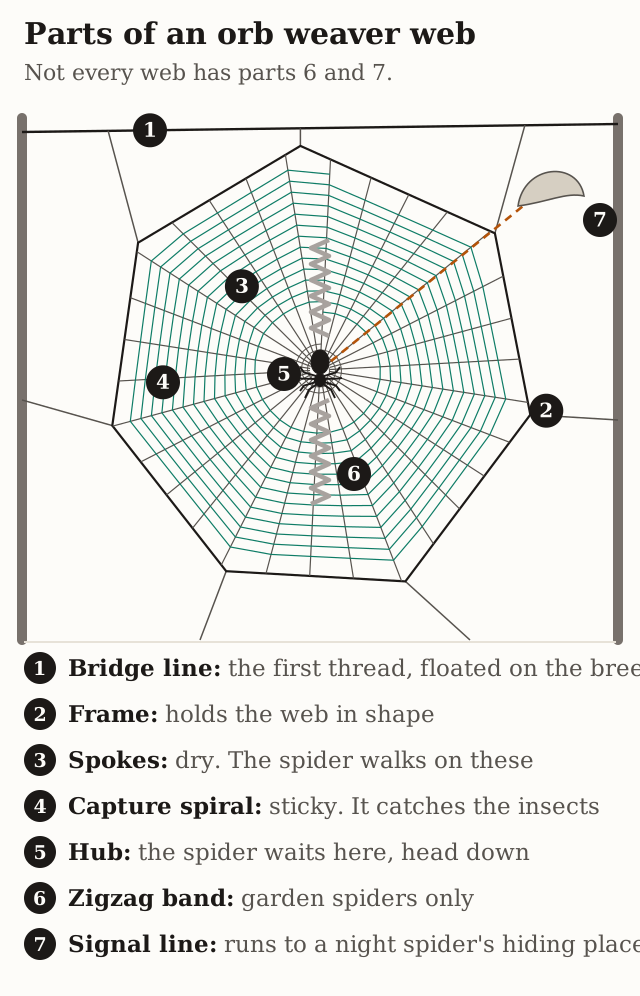
An orb weaver web is a flat wheel of dry spokes with a sticky spiral wound over them. Building one takes the spider about an hour, say both Arkansas Extension and Riveredge. A garden spider’s web is about 2 feet across (Missouri Conservation), and a golden silk orb-weaver’s can reach 1 to 2 meters (UF/IFAS).
First, the spider lets a single thread drift on the breeze until it catches on something. That is the bridge line. Next she drops a line from its middle to make a Y, adds the frame, and runs dry spokes out from the center. Finally, she lays the sticky capture spiral around them. She walks on the dry spokes, not the glue.
The record holder lives in Madagascar. Darwin’s bark spider was named in 2010, and a study that year by Ingi Agnarsson and colleagues found its webs reach 2.8 square meters over rivers, on anchor lines up to 25 meters long. Its silk was more than twice as tough as any silk described before.
Why do orb weavers make zigzag webs?
Only some do, mainly the garden spiders. The zigzag band is called a stabilimentum, and scientists still argue about what it is for. One test points to birds. In 1983, Thomas Eisner and Stephen Nowicki found that webs fitted with a fake band tended to survive the early morning, when birds are flying. Unmarked webs were often torn through.
Other ideas include luring insects that see ultraviolet light, steadying the web, or hiding the spider. Riveredge Nature Center lists all of them. No single answer has won, so treat any website that states one as fact with caution.
Why do orb weavers take down their webs?
Many orb weavers eat the old web and spin a fresh one. Riveredge Nature Center says many night-active orb weavers eat their dewy web in the morning and rebuild it each night. The spotted orbweaver eats hers at dawn, Missouri Conservation says. One Reddit commenter on a video of it put it simply: “She balls it up and eats it.”
Not all of them start over, though. The black-and-yellow garden spider uses a good web site over and over (Riveredge). The golden silk orb-weaver’s web is semipermanent, says UF/IFAS: she repairs large parts and leaves the rest. So a web that is gone in the morning usually means a night-shift spider ate it. She has not died or left.
Where do orb weavers go during the day?
Many orb weavers hide during the day. The spotted orbweaver, the marbled orbweaver and the tropical orb weaver spend daylight hours in a crack, a corner or a curled leaf at the edge of the web. Others, like the garden spiders, sit in the middle of the web all day. It depends on the species.
Where orb weavers wait, by day and by night
Black-and-yellow and banded garden spiders
- Where it waits
- Head-down at the hub, in plain view, by day (Riveredge, Missouri Conservation)
- Its web
- Used again and again at a good site (Riveredge)
Golden silk orb-weaver
- Where it waits
- At the hub, near the top of the web (UF/IFAS)
- Its web
- Semipermanent: repaired, not rebuilt (UF/IFAS)
Spotted orbweaver
- Where it waits
- At the hub at night. In a crack or corner by day (Missouri Conservation)
- Its web
- New each dusk, eaten at dawn (Missouri Conservation)
Arabesque orbweaver
- Where it waits
- In a curled-leaf retreat by day, at the center at night (Riveredge, quoting BugGuide)
- Its web
- Beside the retreat
Marbled orbweaver
- Where it waits
- In a folded-leaf retreat beside the web, holding a signal line (Penn State, Missouri Conservation)
- Its web
- Upright, among trees and tall weeds (Missouri Conservation)
Cat-faced spider
- Where it waits
- In a retreat at one corner of the web (Colorado State)
- Its web
- Often rebuilt or moved (Colorado State)
Tropical orb weaver (Gulf Coast)
- Where it waits
- Under a leaf rolled up with silk, by day (UF/IFAS)
- Its web
- Up after dark, down before dawn (UF/IFAS)
A hiding orb weaver still knows what lands in the web. The signal line, a single thread from the hub to the retreat, carries every vibration to her. Penn State describes the marbled orbweaver waiting this way in a folded leaf tied shut with silk. If an insect hits the web, she runs out along the line.
What do orb weavers eat?
Orb weavers eat whatever flies or blunders into the web. The University of Kentucky lists flies, mosquitoes and ants, and says they eat other spiders too. One Arkansas Extension writer found a web covered in gnats after a rain. That makes orb weavers good to have around a garden.
The spider bites its catch to stun it, wraps it in silk, and eats it later. Prey that can sting, such as a wasp, often gets wrapped first and bitten after (Riveredge). Do orb weavers eat their webs too? Many do, as the web section explains. Missouri Conservation calls spiders free, nontoxic pest control.
What eats orb weavers? Mud dauber wasps carry young spotted orbweavers to their mud nests as food for their larvae, Arkansas Extension notes. Birds and parasitic wasps raid their egg sacs, says Riveredge. And for most of them, the first hard freeze ends the year.
What attracts orb weavers to a house? Food. UC IPM explains that outdoor lights attract insects, which in turn attract spiders. That is why so many webs hang beside porch lights, and why the cross orbweaver favors walls with lighting.
How long do orb weavers live?
Most orb weavers live about one year. They hatch in spring, grow through the summer, mate and lay eggs in fall, and the adults die when it freezes. The University of Kentucky says many live one year or less. The eggs, or the young inside the sac, carry the family through the winter.
An orb weaver's year, in most of the US
Winter
- What happens
- No big webs. The young wait inside egg sacs (Missouri Conservation). A few, such as furrow spiders, spend the winter as adults (University of Kentucky)
Spring
- What happens
- Spiderlings leave the sac and drift away on silk threads, called ballooning (Missouri Conservation)
Summer
- What happens
- Small spiders in small webs, easy to miss (Riveredge)
Late summer and early fall
- What happens
- Females reach full size. Big webs at doors and porch lights. Males wander to find mates (Missouri Conservation)
Fall
- What happens
- Females make egg sacs, often in October (Penn State)
First hard freeze
- What happens
- The adults die. Only the egg sacs remain (Missouri Conservation)
The Gulf Coast runs on a different clock. In Florida, UF/IFAS finds adult spinybacked orbweavers all year, most of all from October to January. It also reports every life stage of the tropical orb weaver all year. So in the far South, an orb weaver at Christmas is normal.
Do orb weavers hibernate? Most do not. The adults die, and the young wait out the cold inside the egg sac. A Reddit post from Rhode Island put it this way: “My orb weaver ive been watching every day finally laid her eggs and died right near the sac.” She did not get sick. Her year was simply over.
Orb weaver egg sacs
A female wraps her eggs in a ball of silk in fall. Missouri Conservation says a black-and-yellow garden spider’s egg case is papery, tan, a little smaller than a ping-pong ball, and can hold over 1,000 eggs. She makes about four of them. A marbled orbweaver’s sac holds several hundred eggs (Penn State).
Some sacs hang in the web, and others are tucked into bark, a crack, or a rolled leaf. In many species the young hatch inside but stay put until spring, Riveredge says. If a sac is in the way, move it outdoors to a sheltered spot rather than throwing it out. Keep it outside, where it would spend the winter anyway.
Orb weaver look-alikes
The web gives an orb weaver away. In Kentucky, true orb weavers and long-jawed orb weavers are the only common spiders that build round, wheel-shaped webs, says the University of Kentucky. A messy tangle in a corner belongs to a cobweb spider, and a flat sheet with a funnel belongs to a funnel weaver. So check the web first.
Who made this web? Check the shape first
Round and flat, upright, many spokes, spider at the center or hiding at the edge
- Who made it
- An orb weaver
- What to know
- Harmless. This page
Round but with fewer spokes, often over water; a long, thin spider with big jaws
- Who made it
- A long-jawed orb weaver
- What to know
- A different family. Bites are rare and not dangerous except to allergic people (University of Kentucky)
A messy 3D tangle in a corner, garage or shed
- Who made it
- A cobweb spider: a house spider or a widow
- What to know
- Check for a red hourglass. See our black widow and house spider guides
A loose, untidy tangle on a ceiling, with a spider hanging upside down on very long legs
- Who made it
- A cellar spider
- What to know
- Harmless. See our cellar spider guide
A flat sheet on grass or a hedge that narrows into a tube
- Who made it
- A funnel weaver, such as a grass spider or hobo spider
- What to know
- See our hobo spider guide
No catching web at all, a spider running on the floor or the ground
- Who made it
- A hunting spider, such as a wolf spider
- What to know
- See our wolf spider guide
If the web is a tangle rather than a wheel, our guides to the common house spider, the cellar spider and the hobo spider cover those builders. A big spider running across the floor at night is more likely a wolf spider. For anything else, our spider identifier sorts spiders by web, eyes and markings.
Should you get rid of an orb weaver?
Usually not. An orb weaver eats flying insects, stays outdoors, and dies at the first hard freeze anyway. If a web blocks a door or a path, move the spider with a long stick and sweep the web. UC IPM says insecticides give no long-term control of spiders outdoors and should not generally be used against them.
Leave it, move it, or do something else
A web in the garden, a hedge or a corner nobody uses
- What to do
- Leave it. The spider will be gone after the first hard freeze
A web across a door, a path or a gate
- What to do
- Move the spider well away with a stick, then sweep the web (steps below)
New webs by the porch light every fall
- What to do
- Keep lights away from doors or switch them off, and sweep webs off the house (UC IPM)
An orb weaver indoors
- What to do
- Cover it with a cup, slide paper under it, and put it outside on a shrub. A vacuum also works (UC IPM)
An egg sac in an awkward spot
- What to do
- Move it outdoors to a sheltered spot. Keep it outside
Spiders getting into the house
- What to do
- Seal cracks in the foundation and gaps around windows and doors (UC IPM)
How to move an orb weaver off your door
Find a long stick or a broom
Pick something about 3 feet long, so your hand stays well away from the spider. A broom handle, a garden cane or a long branch all work.
Pick your moment
The spotted orbweaver, the usual porch spider, works at night and hides in a crack or corner by day (Missouri Conservation). If the web is empty in daylight, come back after dark, when she is sitting in it.
Let her climb on
Touch the web beside her with the end of the stick and let her walk onto it. You can also wind a little of the web around the stick and lift her with it.
Carry her well away
Take her to a shrub, a tree or a fence at the edge of the yard, away from the door and away from outdoor lights. Hold the stick against a branch until she walks off.
Sweep away the old web
Clear the silk from the door frame with a broom. UC IPM suggests a broom or a strong spray of water for webs on the outside of a house.
Move the light, then skip the spray
Outdoor lights draw insects, and insects draw spiders, says UC IPM. Keep fixtures away from doorways, or switch them off. If moving the spider and sweeping work, no insecticide is needed. Any product you do use must be registered with the EPA and used exactly as its label says, because the label is the law.
Orb weaver myths
Most orb weaver myths make them sound more dangerous, more numerous or more mysterious than they are. Here are seven claims you will still see, checked against the World Spider Catalog, extension services and the research. Two of them come from articles ranking at the top of Google today.
Myth 1
Myth: “Orb weavers make up about a quarter of all spider species.”
Truth: The World Spider Catalog lists 3,182 orb weavers out of 54,150 spiders, about 6%, or 1 in 17. That still makes them the third-largest spider family.
Myth 2
Myth: “Orb weavers are poisonous.”
Truth: They are venomous to insects, not poisonous to people. Penn State Extension says a marbled orbweaver bite would likely hurt no more than a wasp or bee sting for most people.
Myth 3
Myth: “Every orb weaver builds a new web every night.”
Truth: The spotted orbweaver does (Missouri Conservation). The black-and-yellow garden spider reuses a good web site again and again (Riveredge), and the golden silk orb-weaver keeps one web and repairs it (UF/IFAS).
Myth 4
Myth: “The female always eats the male.”
Truth: In some species she often does. Research on the wasp spider found males eaten in up to 80% of first matings (Wikipedia). In many others the male simply dies after mating (Riveredge).
Myth 5
Myth: “Orb weavers are aggressive and chase people.”
Truth: They stay in or near the web. Missouri Conservation says orbweavers do not bite unless molested. Most bites come from grabbing one or pressing it against skin.
Myth 6
Myth: “A big web in fall means a hard winter.”
Truth: Even the Farmers' Almanac admits the science behind that one is thin. Webs are big in fall because the spiders are full grown then.
Myth 7
Myth: “A writing spider writes your name in its web, and then you die.”
Truth: That is folklore, collected by University of Kentucky entomologists along with the belief that one can count your teeth. The zigzag is just silk.
When to call someone
Usually, nobody. Call 911 for trouble breathing, or for a swollen face or throat after any bite. See a doctor for a bite that keeps getting worse after a day or two. For a spider you cannot identify, a clear photo and your county extension office will settle it.
Who to call, and when
Trouble breathing, swelling of the face, mouth or throat, or fainting after a bite
- Who to call
- 911
- Why
- Signs of a severe allergic reaction (MedlinePlus)
A bite that keeps getting redder, more swollen or more painful
- Who to call
- A doctor
- Why
- Possible infection (MedlinePlus)
Questions about a bite
- Who to call
- Poison Help, 1-800-222-1222
- Why
- Free, confidential and open 24 hours a day (HRSA)
A spider with a red hourglass, or a brown spider in a closet or box
- Who to call
- Your county extension office, with a photo. Do not handle it
- Why
- CDC NIOSH names black widows and brown recluses as two venomous US spiders
A pet with a swollen face or trouble breathing
- Who to call
- Your vet or an emergency animal clinic
- Why
- The same warning signs as in people
Webs on the house every fall
- Who to call
- Usually no one
- Why
- A broom does the job, and UC IPM advises against outdoor sprays for spiders
Pest control disclaimer. Photo-based identification can help, but it is not always perfect. For dangerous spiders, large infestations, or anything you are unsure about, contact a licensed pest control professional.
Medical disclaimer. This page is for general information only. It is not a medical diagnosis. If you have severe symptoms, trouble breathing, swelling of the face or throat, fast spreading redness, fever, severe pain, pus, or signs of infection, contact a doctor or your local emergency number.
Frequently asked questions
Is a brown recluse an orb weaver?
Do orb weavers come inside the house?
Can you keep an orb weaver as a pet?
How many kinds of orb weavers live in the US?
What is the most dangerous spider in the US?
Related guides
Spider identifier
Work out which spider you found from its web, eyes and markings.
Banana spider
The golden silk orb-weaver, the biggest orb weaver in the US, and the dangerous spider that shares its name.
Joro spider
The invasive orb weaver from East Asia, where it has spread, and when to remove one.
Red spiders
The red-spined orb weavers and the other spiders that really are red.
Black widow spider
One of the two US spiders whose bite truly matters, and its messy, tangled web.
Brown recluse spider
The violin mark, the six eyes, and where recluses actually live.
Sources
- World Spider Catalog, Families (version 2026, read October 13, 2026)
- World Spider Catalog, Genus Araneus (read October 13, 2026)
- Missouri Department of Conservation, Arboreal orbweaver (spotted orbweaver)
- Missouri Department of Conservation, Marbled orbweaver
- Missouri Department of Conservation, Black-and-yellow garden spider
- Missouri Department of Conservation, Banded garden spider
- Missouri Department of Conservation, Spined micrathena
- Penn State Extension, Marbled orbweaver spider (Steve Jacobs, updated September 8, 2025)
- UF/IFAS Featured Creatures, Spiny orb weaver spider, Gasteracantha cancriformis, EENY-167 (G. B. Edwards, 2024)
- UF/IFAS Featured Creatures, Tropical orb weaver spider, Eriophora ravilla, IN568 (G. B. Edwards, 2025)
- UF/IFAS Featured Creatures, Golden silk spider, Trichonephila clavipes, EENY229 (2023)
- University of Kentucky Entomology, Critter Files: Orb weavers of Kentucky (Blake Newton)
- University of Kentucky Entomology, Critter Files: Long-jawed orb weavers and orchard spiders
- NC State Extension, Basilica orbweaver spider (James Baker, revised 2019)
- Colorado State University Extension, Cat-faced spider
- University of Wisconsin-Milwaukee Field Station, Cross orbweaver spider
- UC IPM Pest Notes, Spiders (R. S. Vetter, 2020)
- CDC NIOSH, Venomous spiders
- MedlinePlus, Insect bites and stings
- HRSA Poison Help, About the Poison Help line
- US EPA, Introduction to pesticide labels
- University of Georgia CAES, Joro or not? Test your spider-spotting skills (October 30, 2025)
- Eisner and Nowicki, Spider web protection through visual advertisement: role of the stabilimentum, Science 219: 185-187 (1983)
- Agnarsson, Kuntner and Blackledge, Bioprospecting finds the toughest biological material: extraordinary silk from a giant riverine orb spider, PLoS ONE 5(9): e11234 (2010)
- American Museum of Natural History, 60th anniversary of Charlotte's Web: Charlotte and the Museum (2012)
- University of Arkansas Cooperative Extension, Orb weaver spider (Gerald Klingaman, Musings on Nature)
- Riveredge Nature Center, Bug o'the Week: Big orbweaver spiders revisited (Kate Redmond)
- BugGuide, Genus Araneus
- Farmers' Almanac, Orb-weaver spiders: garden heroes with spooky webs (updated 2026)
- Wikipedia, Orb-weaver spider (web building, fossils, mating and size research)