What is a paper wasp?
A paper wasp is a social wasp of the genus Polistes, in the family Vespidae with yellowjackets and hornets. It is slim, 1/2 to 1 inch (13 to 25 mm) long, flies with its legs dangling, and builds one open comb of paper cells that hangs from a single stalk. About 24 species live in the US and Canada.
The paper is chewed wood. A paper wasp scrapes fibers from weathered fences, sheds and dead plant stems, mixes them with saliva, and spreads the pulp into six-sided cells. That is where the name comes from, and why the nest looks like gray paper.
Each nest is one family. A queen starts it alone in spring. Her daughters, the workers, take over the building and hunting through summer. In late summer the nest raises males and new queens, and by winter only the new queens are left alive.
People call paper wasps by many names. “Umbrella wasp” comes from the shape of the nest. “Paper hornet” and “paper bee” are common but wrong: paper wasps are neither hornets nor bees. Regional names cover single species, such as “guinea wasp” in the South for the guinea paper wasp, and “red wasp” for the two all-red species, which have their own guide.
Paper wasp at a glance
Size
- What to expect
- About 1/2 to 1 in (13 to 25 mm), depending on the species
Shape
- What to expect
- Slim, with a thin waist and a long, tapering abdomen
Flight
- What to expect
- Long legs hang down below the body
Colors
- What to expect
- Black and yellow, brown and yellow, red-brown, or almost all red
Nest
- What to expect
- One open paper comb on a single stalk, cells facing down, no outer cover
Colony
- What to expect
- About 15 to 200 wasps at the peak, often 20 to 30
Season
- What to expect
- Nests start in spring, peak in late summer, and die out in fall
Sting
- What to expect
- Painful and can be repeated. Only females sting
Diet
- What to expect
- Caterpillars and other insects for the young, nectar for the adults
Scientific name
- What to expect
- Polistes, family Vespidae, subfamily Polistinae
How many kinds of paper wasps are there?
There are about 220 species of Polistes worldwide and 24 in the US and Canada, counting the European paper wasp, which was brought in by accident. The 2008 identification atlas of eastern North American wasps by Buck, Marshall and Cheung gives the 24, and a 2017 revision in ZooKeys gives “over 220” for the world.
You will see other figures. Wikipedia’s paper wasp article says about 300 species, although its own Polistes article says over 200. For North America, UF/IFAS gives 17, and PestWorld and New York State IPM give 22. The gap is mostly older counts and how far south “North America” runs. Wikipedia’s article on paper wasps also counts more than Polistes, since in some parts of the world the name covers related wasps that live in the tropics.
What does a paper wasp look like?
A paper wasp is a long, thin wasp, 1/2 to 1 inch (13 to 25 mm) long, with a narrow waist, a smooth, almost hairless body and long legs that hang down when it flies. Its wings fold lengthwise along its back at rest. Colors range from black and yellow to brown, rust-red and almost all red.
Is it a paper wasp? Check these
Most of these should match. The dangling legs and the open nest settle it fastest.
Slim body with a clear, narrow waist
The waist sits between the chest and the abdomen.
Long legs that dangle in flight
Especially the back pair. A yellowjacket tucks its legs up.
Smooth and shiny, not fuzzy
A fuzzy body points to a bee.
Wings folded lengthwise at rest
When it lands they look like two narrow strips.
Walking slowly over an open paper comb
Or scraping wood on a fence or deck for nest paper.
An open nest
You can look straight up into the cells. Yellowjacket and hornet nests are closed.
The dangling legs are the quickest field mark. University of Idaho Extension describes paper wasps as “longer and slimmer than a yellowjacket”, and they “dangle their legs while in flight.” A yellowjacket tucks its legs up and looks compact.
How big is a paper wasp?
Most paper wasps are 3/4 to 1 inch (19 to 25 mm) long. The smallest, Hunter’s little paper wasp, and many European paper wasp workers are nearer 1/2 inch (13 mm). The largest in the East is the ringed paper wasp, with wings up to nearly 1 inch (23.5 mm) long.
Sizes on popular pages vary more than they should. Orkin gives 1.9 to 3.2 cm, which would put some paper wasps at 1 1/4 inches. No extension source we checked goes that high: Texas A&M says 3/4 to 1 inch, Utah State 5/8 to 3/4 inch, and BugGuide 13 to 25 mm across all US species. Cornell’s page lists both of its species as “¾-7/8 inch (19-22mm)”, but 3/4 inch is 19 mm, not 19 to 22.
Queens, workers and males
A queen looks almost the same as her workers. In some species, midsummer workers are as big as the queen. The easy way to spot a queen is timing: a lone wasp building a small nest in April or May is a queen, and so is a big, slow wasp indoors in winter or early spring.
Males are easier. They appear in late summer and fall, and they have curled antennae tips. In most US species they also have a pale or yellow face. A male cannot sting, because the stinger is a changed egg-laying tube and only females have one.
Workers are all female. They build, hunt, feed the young and defend the nest. Researchers have even shown that northern paper wasps know each other by face. In a 2002 study, Elizabeth Tibbetts painted over the yellow face markings of some wasps, and their nestmates attacked them more until they got used to the new look.
Are there baby paper wasps?
No small flying paper wasp is a baby. A wasp is full size the moment it leaves its cell and never grows after that. The young are soft, white, legless grubs, called larvae, that stay inside the nest cells and are fed chewed insects. That little wasp on your porch is a small species or a small adult.
Paper wasp or yellowjacket?
A paper wasp is slimmer and longer than a yellowjacket, with long legs hanging down in flight, and its nest is an open comb you can see into. A yellowjacket is stout, with a short waist and sharp yellow bands, flies with its legs tucked, and nests in a closed paper ball or a hole in the ground.
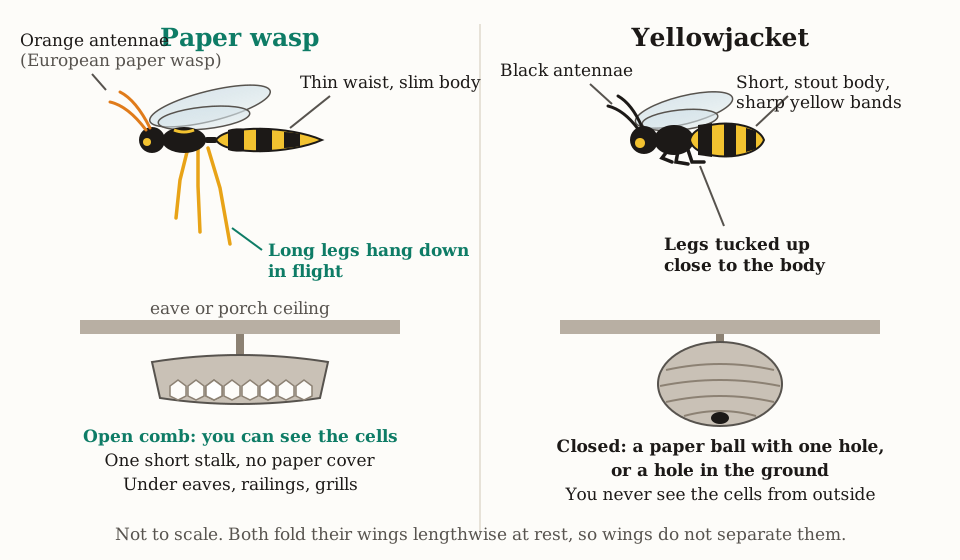
Paper wasp or a look-alike? The feature that separates them
Legs dangle in flight, thin waist, open comb
- What it is
- Paper wasp
- Size
- 1/2 to 1 in (13 to 25 mm)
- Nest
- Open umbrella comb on one stalk
Stout, legs tucked, sharp yellow bands, comes to food and trash
- What it is
- Yellowjacket
- Size
- 1/2 to 1 in (13 to 25 mm), but compact
- Nest
- Closed paper ball, or underground with one hole
Black with an ivory-white face and tail tip
- What it is
- Bald-faced hornet
- Size
- About 1/2 to 3/4 in (13 to 20 mm)
- Nest
- Gray football-shaped ball, up to 24 in (61 cm) tall, in trees
Bulky, brown and yellow, flies at night to porch lights
- What it is
- European hornet
- Size
- Up to about 1 3/8 in (35 mm)
- Nest
- Closed nest inside a hollow tree or wall
Thread-thin waist like a stalk, often all black or black and yellow
- What it is
- Mud dauber
- Size
- Varies by species
- Nest
- Tubes or lumps of mud, not paper
Rust-red all over, smoky black wings
- What it is
- Red wasp
- Size
- 3/4 to 1 in (20 to 25 mm)
- Nest
- Open comb: it is a paper wasp
Huge, black and yellow, digging holes in a lawn in July
- What it is
- Cicada killer
- Size
- Up to about 2 in (50 mm)
- Nest
- Burrows in soil
Sizes are typical, from the sources at the end. A wasp that hovers over the lawn and digs is a cicada killer, not a paper wasp. A giant one that worries you is almost never a murder hornet, which has not been confirmed in the US since 2021.
Black and yellow: European paper wasp or yellowjacket?
The black-and-yellow wasp under many American eaves is the European paper wasp, Polistes dominula. Its antennae are mostly orange, it flies with its legs hanging, and its nest is an open comb. A yellowjacket has black antennae, a blunter body and a closed nest. Both are banded like a warning sign.
The European paper wasp was first noticed near Boston in the late 1970s and has since spread coast to coast. It likes buildings more than most native species do, and it nests in odd places: grill lids, fence pipes, light fixtures and play sets. In parts of Michigan it has fully replaced the native northern paper wasp. In Idaho it is now the most common wasp of any kind.
Paper wasp vs hornet
A paper wasp is not a hornet, even though many people say “paper hornet.” The US has two true hornets in the wild: the European hornet, a bulky brown and yellow wasp up to 1 3/8 inches (35 mm), and the bald-faced hornet, which is really a black and white yellowjacket. Both build closed paper nests. A paper wasp’s nest is always open underneath.
What does a paper wasp nest look like?
A paper wasp nest is a single gray comb of six-sided paper cells, open on the bottom, hanging from one short stalk like an upside-down umbrella. It has no outer cover. Most stay smaller than an outstretched hand, about 6 to 8 inches (15 to 20 cm) at most, with up to about 200 cells.
The queen picks a dry spot with a roof over it. The usual places are eaves, porch ceilings, door and window frames, deck railings, the underside of a grill lid, shutters, mailboxes, play equipment, sheds and hollow metal pipes. A few species also hang their nests in shrubs and trees, which is how people find them while trimming a hedge.
What is a paper wasp nest made of?
A paper wasp nest is made of wood fiber and saliva. The wasps scrape thin fibers from dead wood, fence posts, sheds and plant stems, chew them with saliva into pulp, and press it into cells. The dried paper sheds water. On a gray, weathered fence you can sometimes see pale scrape marks where they collected it.
The queen also does something clever with the stalk. She rubs it with a secretion from a gland on her abdomen that repels ants, the biggest threat to an open nest. Researchers Post and Jeanne described that ant barrier in 1980.
How big does a paper wasp nest get?
A paper wasp nest starts in spring as a few cells the queen builds alone, grows to a few dozen cells once the first workers hatch, and reaches full size in late summer: usually about 6 to 8 inches (15 to 20 cm) across with up to about 200 cells. The guinea paper wasp can build combs of about 500 cells.
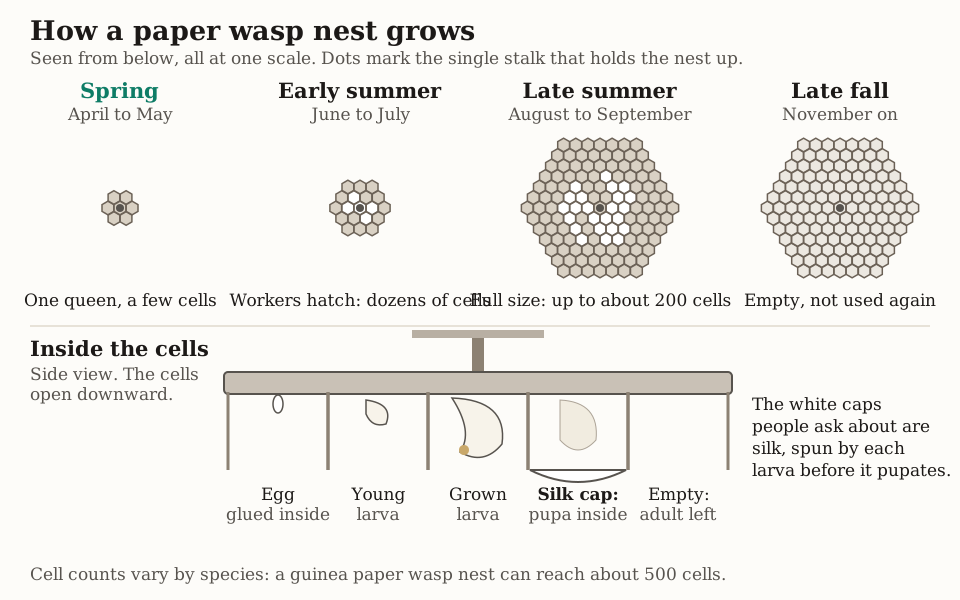
The number of wasps on it is far smaller than most people fear. UC IPM puts a colony at 15 to 200 wasps, and Texas A&M at 20 to 30 adults on a mature nest. A yellowjacket colony can reach up to 5,000 workers, according to Oregon State University. That difference is a big part of why paper wasps are easier to live with.
What are the white caps in a paper wasp nest?
The white domes over some cells are silk caps. When a larva is fully grown, it spins a silk lid over the open end of its cell and turns into a pupa inside. About two weeks later the adult chews through the cap and leaves. A comb with many white caps means a lot of new wasps are about to hatch.
Wikipedia says the workers seal the cells. They do not: the larva spins its own cap, as Stefano Turillazzi described in 1980.
Do paper wasps reuse their nests?
Almost never. A paper wasp nest lasts one season. The colony dies in fall, and next spring each new queen builds a fresh nest, often near the old one. European paper wasps are the exception: Washington State University notes that new queens occasionally build on an old comb. An empty gray nest in winter is safe to take down.
Which wasp built this nest?
Look at the outside first. Paper means a wasp, mud means a mud dauber, and holes in bare soil mean bees or yellowjackets. Only a paper wasp leaves its cells open to view, so if you can see the comb from below, you have your answer.
Which wasp built this nest? Look at the outside first
Open gray comb, cells visible from below, one stalk
- Whose nest
- Paper wasp
- Risk
- Stings if bumped. Usually 15 to 200 wasps
Round or football-shaped paper ball with one hole, in a tree or bush
- Whose nest
- Bald-faced hornet
- Risk
- Very defensive, hundreds of wasps
Paper nest inside a wall, attic, shed or hollow tree, wasps flying in and out of one gap
- Whose nest
- Yellowjacket or European hornet
- Risk
- Large colony. Do not plug the hole yourself
A single hole in the lawn with heavy wasp traffic
- Whose nest
- Yellowjacket
- Risk
- Large, defensive colony. Mark it and keep people away
Mud tubes or lumps on a wall or ceiling
- Whose nest
- Mud dauber
- Risk
- Solitary, rarely stings
Many small holes in bare soil in spring
- Whose nest
- Ground bees
- Risk
- Gentle solitary bees
Many small holes in a dry patch of lawn are the subject of our ground bees guide, which shows how to tell them from a yellowjacket nest before you touch anything.
Are paper wasps aggressive?
Paper wasps are defensive, not aggressive. Away from the nest they almost never sting unless they are trapped or pressed against skin. Near the nest they warn first: they turn to face you and lift their wings. Keep walking past and you will usually be left alone. Bump the nest and several wasps can sting at once.
UC IPM calls paper wasps “much less defensive” than yellowjackets, and says they “rarely sting humans.” Colorado State finds stings happen “almost exclusively” when someone disturbs a nest by accident, and most happen that way: reaching under a railing, closing a grill lid, trimming a shrub or mowing past a low nest. Readers’ stories add triggers people do not expect: a slammed front door, a garage door rolling under the nest, or a toddler wobbling past a play set.
Not every species is equally calm. New York State IPM says European paper wasps can react to movement up to 20 feet (6 m) from the nest. Mississippi State says guinea wasps react “quickly and viciously” once their nest is jarred. The size of the nest matters too: a big late-summer nest has more wasps to defend it than a spring nest with one queen.
You do not need to fear a lone wasp at a flower or on a window. A wasp away from its nest is out hunting or drinking nectar and has no reason to sting. Swatting at it is the most likely way to change that.
How bad is a paper wasp sting?
A paper wasp sting is sharp and burning, and hurts as much as or more than a honey bee or yellowjacket sting. Entomologist Justin Schmidt rated paper wasps 2 to 3 on his 1 to 4 pain scale, against 2 for honey bees and yellowjackets. A paper wasp can sting more than once, and its stinger stays in the wasp.
In his 2019 paper in Toxins, Schmidt rated the ringed paper wasp, a common species in the South, at 3, and most of the Polistes species he tested scored 3. Yellowjackets and the bald-faced hornet scored 2. They also inject more venom per sting: about 17 micrograms, against 1.7 to 3.1 for a yellowjacket, according to a 2020 study by Grosch and colleagues.
For most people the sting means a few hours of pain and a red, swollen welt that can last a day or two. The real danger is an allergic reaction. The CDC counted 788 deaths from hornet, wasp and bee stings in the US from 2011 to 2021, about 72 a year. Its count covers all stinging insects and does not separate paper wasps.
If you know you are allergic to yellowjackets, do not assume you are safe from paper wasps. The two venoms overlap only partly. Allergists test for both, and a 2017 study by Savi and colleagues found that about a third of people who tested positive to both were really allergic to yellowjacket venom alone.
What to do if a paper wasp stings you
Walk away from the nest
Walk away calmly. A paper wasp can sting again, and others may follow you for a few yards.
Check for the warning signs
Look for the signs in the red box below. If any appear, call 911 now. If the person has an epinephrine auto-injector, use it right away.
Wash the sting
Clean it with soap and water. A paper wasp does not leave a stinger behind, so there is nothing to scrape out.
Cool it
Hold ice wrapped in a cloth on the sting, 10 minutes on and 10 minutes off, as MedlinePlus advises.
Ease the itch and pain
Use an over-the-counter antihistamine or pain reliever, if you can take them, following the label.
Keep watching
A severe allergic reaction usually starts within minutes. Swelling that spreads over a day or two is common, but see a doctor for spreading redness, pus, fever or swelling that keeps growing.
Our bee sting guide covers first aid and how long swelling lasts in more detail, and our bug bite identification chart explains why a mark on the skin cannot tell you which insect it was.
Dogs and cats
Pets get stung when they snap at a wasp or nose into a nest, usually on the face, mouth or paws. Take your pet to an emergency vet for a sting inside the mouth, swelling of the face or throat, vomiting, pale gums, weakness or several stings. Do not give human medicine without asking a vet. Our guide to stings on dogs and cats lists what to watch for.
Should you remove a paper wasp nest?
Leave a paper wasp nest alone if it is out of the way: high on a wall, in a tree, or anywhere people and pets do not pass. The wasps eat garden caterpillars, and the nest will die out by late fall. Remove it if it is within a few feet of a door, path, play set or grill.
Leave it or remove it?
High eave, tree, fence line, far corner of the yard
- What to do
- Leave it
- Why
- Nobody will bump it. It dies out in fall
Within a few feet of a door, path, window you open, grill or play set
- What to do
- Remove it
- Why
- Stings come from accidental bumps
Anyone nearby is allergic to stings
- What to do
- Remove it, and let someone else do it
- Why
- One sting can be an emergency
Spring nest with one wasp and a few cells
- What to do
- Knock it down now
- Why
- The queen usually moves on
Inside a wall, attic or hollow pipe
- What to do
- Call a pest professional
- Why
- You cannot reach it safely
Gray, empty nest in late fall or winter
- What to do
- Take it down any time
- Why
- Nothing lives in it
The best time to deal with a nest is April or May, when it has a few cells and one queen. A broom handle is often all it takes. By August the same nest can hold dozens of wasps.
How to get rid of a paper wasp nest safely
To remove a paper wasp nest, wait until after dark, when every wasp is on the nest and slow. Spray it with a wasp and hornet aerosol labelled for the job, from as far away as the label allows, often 10 to 20 feet (3 to 6 m). Wait a day, then knock it down and throw it away.
How to remove a paper wasp nest
Check whether you need to
Leave the nest if it is out of the way. Do not do this yourself if you are allergic to stings: have someone else do it or call a professional.
Small spring nest: use a broom
If it has only a few cells and one wasp, knock it down with a long broom during the day, then crush it. The queen usually leaves to start again somewhere else.
Larger nest: wait for dark
At night all the wasps are on the nest and slow to react. Wear long sleeves, long pants, gloves and closed shoes. Do not shine a flashlight straight at the nest, since the light can draw wasps to you.
Spray from a distance
Use an EPA-registered wasp and hornet aerosol and follow its label exactly: the label is the law. Aim at the open cells for a few seconds from as far away as the label allows, often 10 to 20 feet, then walk away.
Wait a day, then remove it
Check from a distance the next day that no wasps are flying. Then scrape the nest down with a stick or broom and bag it. Leaving the dead brood can draw ants and beetles.
Watch the spot
Queens like the same sheltered places. Look again in April and May and knock down any new start.
How to stop paper wasps from nesting
The cheapest prevention is a spring walk-around. In April and May, check eaves, railings, grill lids, play sets and shutters every week or two, and knock down any new start while one queen is building it. Caulk gaps in soffits and siding and screen attic vents to keep queens from sheltering inside over winter.
Several popular fixes do not have evidence behind them. LSU AgCenter says there are “no data” to support fake nests, and points out that the wasps can use the paper as building material. The traps sold for yellowjackets do not draw paper wasps: University of Idaho Extension says so plainly, and UC IPM does not suggest trapping other social wasps.
The idea that wasps will not build on a sky-blue porch ceiling is folklore, and we found no study that tests it. Nor did we find one showing that peppermint or other oils keep paper wasps away for any useful length of time.
Why are paper wasps in my house?
Paper wasps in the house in winter or early spring are almost always queens that crept into the attic, walls or siding in fall to spend the winter. A warm day wakes them, and they follow the light into rooms. A slow wasp on a window in February or March does not mean there is a nest in your wall.
Only mated queens survive the winter. In fall they look for sheltered gaps: under siding and bark, in wall voids, attics, chimneys and sheds. Many end up indoors by accident. University of Arkansas Extension notes they tend to come out inside on warm days and head for windows and lights. Some come down a chimney or through a bathroom fan or a light fixture, which is how they turn up in rooms far from any outside door.
These wasps are sluggish and rarely sting. The usual risk is stepping on one barefoot or pressing it while grabbing a curtain. Trap it under a cup and a card and put it outside, or swat it. Then seal the gaps where it got in, in late spring or summer once the queens have left. Our red wasp guide has a diagram of the usual entry points.
If wasps keep coming out of the same light fixture, vent or wall gap in summer, flying in and out with purpose, that is different. It can be a nest inside the structure, and it is a job for a pest professional.
Types of paper wasps in the US
The four paper wasps Americans report most are the northern paper wasp in the North and East, the European paper wasp across the North and West, and the guinea and metric paper wasps in the South. Red wasps add to the South, and golden, Apache and horse paper wasps to the West and far South.
Common US paper wasps and the feature that separates them
Black and yellow, mostly orange antennae
- Species
- European paper wasp (Polistes dominula), introduced
- Where it lives
- Most of the US, commonest in the North and West
Dark brown to black, thin yellow or reddish marks, very variable
- Species
- Northern paper wasp (P. fuscatus)
- Where it lives
- East: Canada to Florida, west to Nebraska and Texas
Brown and yellow, with yellow bands on every segment of the abdomen
- Species
- Guinea paper wasp (P. exclamans)
- Where it lives
- South and Southwest, NJ to Florida and west to California
Reddish head and chest, black abdomen, yellow lower legs
- Species
- Metric paper wasp (P. metricus)
- Where it lives
- East and South, NY to Florida and west to Kansas and east Texas
Small, reddish with yellow; the smallest in the East
- Species
- Hunter's little paper wasp (P. dorsalis)
- Where it lives
- East and South, Massachusetts to Florida, west to Arizona and California
Dark red to black, one yellow ring near the waist
- Species
- Ringed paper wasp (P. annularis)
- Where it lives
- East and South, NY to Florida, west to South Dakota and Texas
Rust-red all over, smoky wings
- Species
- Red wasps (P. carolina, P. rubiginosus)
- Where it lives
- Southeast and south-central US
Black with rich yellow, more yellow wings
- Species
- Golden paper wasp (P. aurifer)
- Where it lives
- West: Washington and Montana to west Texas and California
Golden brown and yellow
- Species
- Apache paper wasp (P. apachus)
- Where it lives
- Texas, Oklahoma, Kansas, New Mexico, Colorado; introduced to California
Big, red-brown with broad yellow bands
- Species
- Horse paper wasp (P. major)
- Where it lives
- Florida, south Texas and the far Southwest
Ranges are from the CJAI identification atlas and BugGuide. Many species need a close look or a microscope to tell apart, and for safety it does not matter: every paper wasp nest is handled the same way. The two all-red species have a page of their own in our red wasp guide.
Which paper wasp lives in your state?
We counted 311,241 US sightings of paper wasps on iNaturalist, read on 2026-10-21. Texas had the most by far, 65,483, about one in five, and the guinea paper wasp led there. Here is the most-reported species in each region, with example states.
Most-reported paper wasps by region (iNaturalist, US sightings to 2026-10-21)
Northeast and Upper Midwest
- Most reported
- Northern paper wasp
- Next
- European paper wasp
- Example states
- NY 11,964 · PA 11,441 · OH 11,258 · MA 8,224 · MN 6,517 · WI 5,504 · MI 5,135
Mid-Atlantic and Southeast
- Most reported
- Metric paper wasp
- Next
- Guinea or northern paper wasp
- Example states
- NC 12,656 · VA 11,625 · GA 8,810 · AL 6,177 · SC 3,976
Florida and the Gulf
- Most reported
- Metric paper wasp
- Next
- Horse or Hunter's little paper wasp
- Example states
- FL 18,918 · LA 4,233 · MS 2,056
Texas and Tennessee
- Most reported
- Guinea paper wasp
- Next
- Metric paper wasp
- Example states
- TX 65,483 · TN 6,645
Mountain West and Pacific Northwest
- Most reported
- European paper wasp
- Next
- Golden paper wasp
- Example states
- WA 4,406 · CO 4,339 · UT 2,856 · OR 2,789 · ID 1,557
California
- Most reported
- European paper wasp
- Next
- Guinea, then golden paper wasp
- Example states
- CA 19,322
Arizona and New Mexico
- Most reported
- Yellow or golden paper wasp
- Next
- Comanche, Arizona or guinea paper wasp
- Example states
- AZ 5,782 · NM 1,931
Sightings follow people as much as wasps, so treat this as a guide to what you are likely to see, not a census. Ohio readers, for example, are mostly seeing northern and European paper wasps, while in Georgia, Alabama and the Carolinas the metric and guinea paper wasps lead. In Florida the metric, horse and Hunter’s little paper wasps are all common.
The paper wasp year
A paper wasp colony lives one year. Queens start nests in March to May, the first workers hatch about 5 to 7 weeks later, and the nest peaks from August to October, when it raises males and new queens. Then the colony dies, and only the mated queens survive the winter in sheltered gaps.
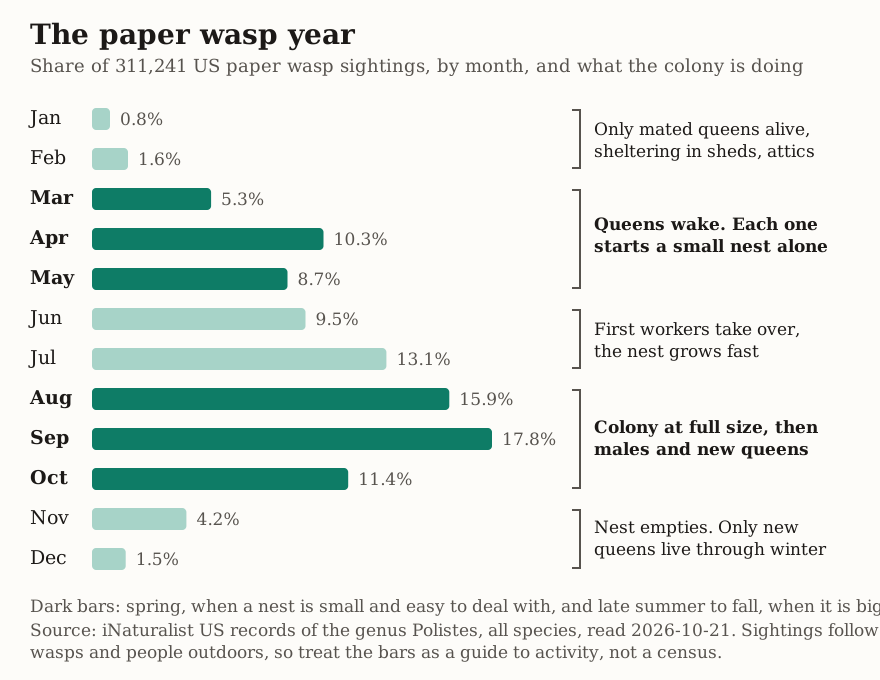
The paper wasp year, season by season
Winter (Dec to Feb)
- What the wasps are doing
- Mated queens shelter in sheds, attics, walls and under bark
- What you notice
- A slow wasp indoors on a warm day
Spring (Mar to May)
- What the wasps are doing
- Each queen builds a small nest alone and raises the first brood
- What you notice
- A single wasp on a tiny comb. The easiest time to remove it
Early summer (Jun to Jul)
- What the wasps are doing
- Workers take over building and hunting. The nest grows fast
- What you notice
- More wasps around eaves and railings
Late summer to fall (Aug to Oct)
- What the wasps are doing
- Nest at full size, then males and new queens
- What you notice
- Most stings. Wasps on fences, flowers and windows
Late fall (Nov)
- What the wasps are doing
- The colony dies. New queens look for winter shelter
- What you notice
- An empty gray nest. Wasps clustering at gaps in siding
Growth from egg to adult takes about 5 to 6 weeks in summer. In a Texas study of guinea paper wasps, eggs took 9 to 14 days to hatch, larvae fed for 13 to 18 days, and pupae took about 13 days. Cooler weather slows every stage.
How long do paper wasps live?
A worker or male paper wasp lives about 30 to 40 days. A queen can live up to a year, because she spends the winter resting. Those figures come from a 2021 study of European paper wasps by Beani and colleagues. So the wasps on a nest in August are not the ones that were there in June.
What do paper wasps eat?
Adult paper wasps drink nectar and other sugary liquids. They hunt caterpillars and other soft insects, chew them into a paste and feed it to the larvae in the nest. Garden pests on the menu include tomato hornworms, cabbage worms, armyworms and corn earworms, which is why gardeners often leave paper wasps alone.
There is real evidence that it helps. In a Wisconsin study published in 1984, Gould and Jeanne found that one nest of about 5.6 wasps cut cabbage caterpillars by up to 44% on nearby plants. Watch a paper wasp work a tomato hornworm and you will see why.
They also visit flowers and carry some pollen, but they are minor pollinators next to bees. Paper wasps do not eat wood. They only scrape it for nest paper, which leaves pale streaks on fences and decks, not holes. European paper wasps sometimes nibble ripe cherries and other soft fruit. They also take monarch caterpillars, which Penn State lists as one of the harms of this introduced species, and gardeners who plant milkweed often notice the losses.
What eats paper wasps?
Birds such as tanagers and orioles pick off adults and larvae. Raccoons, skunks and bears tear open nests. Ants raid open combs, which is why the queen coats the stalk with ant repellent. Tiny parasites live inside them too, including twisted-wing parasites called Xenos and a small moth whose caterpillars eat the brood. One study found that moth in almost half of the nests of one Southern species.
Paper wasp myths
Most paper wasp myths make the wasps sound worse than they are, or promise an easy fix that does not work. Several come from mixing paper wasps up with yellowjackets, whose colonies are far bigger and whose nests are closed. Here are eight we hear often, with what the extension sources and studies say.
Myth 1
Myth: “A paper wasp nest holds thousands of wasps.”
Truth: A paper wasp nest holds about 15 to 200 wasps, often 20 to 30. The thousands figure belongs to yellowjackets, whose colonies can reach 5,000 workers.
Myth 2
Myth: “The small wasps are babies.”
Truth: Wasps never grow after they leave the cell. The young are white grubs that stay inside the nest.
Myth 3
Myth: “Paper wasps are hornets.”
Truth: They are paper wasps. The only common true hornet in the US is the European hornet, and its nest is closed.
Myth 4
Myth: “They will chase you across the yard.”
Truth: Paper wasps defend the nest and a short distance around it. Away from the nest they rarely sting at all.
Myth 5
Myth: “A fake nest keeps them away.”
Truth: LSU AgCenter found no data behind the claim, and wasps can use the paper to build with.
Myth 6
Myth: “A hose is a safe way to knock a nest down.”
Truth: A jet of water knocks wasps loose and sends them into the air while you stand in range. Use a broom on a small spring nest, or a labelled spray at night.
Myth 7
Myth: “Kill one and the rest will attack.”
Truth: Venom released in a sting draws and excites other wasps, so a sting near the nest is your signal to walk away. Swatting a lone wasp at a flower, far from its nest, calls nobody.
Myth 8
Myth: “Gasoline or fire is the quickest fix.”
Truth: Both cause burns and house fires. A labelled wasp spray at night, or a broom on a small spring nest, does the job safely.
When to call someone
Call 911 for trouble breathing, a swollen face or throat, or fainting after any sting. Call a licensed pest professional for a nest inside a wall, attic or pipe, a nest you cannot reach from the ground, or any nest near someone with a sting allergy. Most open nests within reach you can handle yourself.
Who to call
Trouble breathing, swelling of the face or throat, fainting or spreading hives after a sting
- Who to call
- 911
- Why
- Signs of a severe allergic reaction (MedlinePlus)
A sting inside the mouth or throat
- Who to call
- 911 or the nearest emergency room
- Why
- Swelling can block the airway
Questions about a sting, or a child who was stung
- Who to call
- Poison Help, 1-800-222-1222
- Why
- Free, confidential and open 24 hours a day
A pet stung in the mouth, or vomiting, weak or collapsing
- Who to call
- An emergency vet
- Why
- Pets react fast to stings in the mouth
A nest in a wall, attic, hollow pipe or out of reach
- Who to call
- A licensed pest professional
- Why
- They have the gear and the products for it
You rent and the nest is on the building
- Who to call
- Your landlord
- Why
- It is usually their job to remove it
Not sure what wasp it is
- Who to call
- Our insect identifier
- Why
- Upload a photo taken from a safe distance
Not sure what you are looking at? The free insect identifier can name a wasp from a clear photo taken from a safe distance.
Pest control disclaimer. Photo-based identification can help, but it is not always perfect. For dangerous spiders, large infestations, or anything you are unsure about, contact a licensed pest control professional.
Medical disclaimer. This page is for general information only. It is not a medical diagnosis. If you have severe symptoms, trouble breathing, swelling of the face or throat, fast spreading redness, fever, severe pain, pus, or signs of infection, contact a doctor or your local emergency number.
Frequently asked questions
Can I move a paper wasp nest instead of killing it?
Will paper wasps get more aggressive as the nest grows?
Do paper wasps sting more than once?
What time of day are paper wasps least active?
Will paper wasps come back to the same spot?
Related guides
Red wasp
The two all-red paper wasps, and why their queens turn up indoors in spring.
Bee sting
First aid, the swelling timeline, stings on pets, and how to tell a bee sting from a wasp sting.
Cicada killer
The huge wasp that digs holes in lawns in July, and why it rarely stings.
Murder hornet
The giant hornet, the European hornet and the other big wasps people mix up.
Types of bees
Sort bees from wasps, then find the guide for the one you saw.
Insect identifier
Upload a photo and get an identification from the free AI tool.
Sources
- UC IPM, Yellowjackets and Other Social Wasps, Pest Notes 7450
- Buck, Marshall and Cheung, Identification Atlas of the Vespidae of the northeastern Nearctic region, Canadian Journal of Arthropod Identification 5 (2008), Polistes key
- Schmid-Egger and colleagues, Revision of the West Palaearctic Polistes, ZooKeys 713 (2017)
- Penn State Extension, European Paper Wasp (Skvarla, updated 2026)
- University of Idaho Extension, Wasp and Hornet Control (CIS 1218)
- University of Arkansas, Paper Wasp Management around your Home (Hopkins, 2018)
- LSU AgCenter, Fine-backed and Coarse-backed Red Paper Wasps (2022)
- Strassmann and Orgren, Nest architecture and brood development times in the paper wasp Polistes exclamans, Psyche 90 (1983)
- Schmidt, Pain and lethality induced by insect stings, Toxins 11(7): 427 (2019)
- CDC, QuickStats: deaths from hornet, wasp and bee stings, 2011 to 2021 (MMWR 72(27), 2023)
- MedlinePlus, Bee, wasp, hornet, or yellow jacket sting
- Tibbetts, Visual signals of individual identity in the wasp Polistes fuscatus, Proceedings of the Royal Society B (2002)
- Gould and Jeanne, Polistes wasps as control agents for lepidopterous cabbage pests, Environmental Entomology (1984)
- Beani and colleagues, Scientific Reports 11: 7235 (2021), lifespan of Polistes workers and queens
- iNaturalist, Polistes observations in the United States (read October 21, 2026)