What is a red wasp?
A red wasp is one of two native paper wasps that are rust-red from head to tail: Polistes carolina, the fine-backed red paper wasp, and Polistes rubiginosus, the coarse-backed red paper wasp. Both are about 3/4 to 1 inch (20 to 25 mm) long, have dark smoky wings, and build open paper nests.
They belong to the paper wasps, the genus Polistes in the family Vespidae, which also holds yellowjackets and hornets. The two are the only paper wasps in the eastern US with an almost all-red body. People also call them red paper wasps, Carolina paper wasps, red hornets and, in parts of the South, red waspers.
Red wasp at a glance
Length
- What to know
- About 3/4 to 1 in (20 to 25 mm)
Color
- What to know
- Rust-red body, smoky black to dark brown wings
Species
- What to know
- Polistes carolina and Polistes rubiginosus, both native
Nest
- What to know
- One open paper comb on a stalk, up to about 6 in (15 cm) across
Colony
- What to know
- About 20 to 30 adults at the peak
Sting
- What to know
- Females only, and they can sting more than once
Food
- What to know
- Caterpillars for the young, nectar and ripe fruit for the adults
Where
- What to know
- Eastern half of the US. Half of all records come from Texas
When
- What to know
- Queens indoors February to April, nests March to October
Is a red wasp a hornet?
No. A red wasp is a paper wasp, and there is no red hornet in the US. The only true hornet that is common here is the European hornet. It is bulkier, with a reddish-brown front half and a mostly yellow abdomen. So people who search for a “red hornet” usually mean a red wasp, and sometimes a European hornet. The look-alike table below shows how to tell them apart in a second.
Fine-backed or coarse-backed: the two red wasps
For a homeowner the two species are the same insect, with the same sting, nest and habits. Experts often can tell them apart only under a microscope. The clearest sign is on the back end of the thorax, just in front of the waist. In P. carolina it is smooth or finely ridged, while in P. rubiginosus it is coarsely ribbed.
Polistes carolina or Polistes rubiginosus?
Back of the thorax, before the waist
- Fine-backed (P. carolina)
- Smooth or finely ridged
- Coarse-backed (P. rubiginosus)
- Coarse ribs across it
Female's cheeks
- Fine-backed (P. carolina)
- Mostly bare
- Coarse-backed (P. rubiginosus)
- Covered in fine silvery hairs
Male's thorax
- Fine-backed (P. carolina)
- Almost all red
- Coarse-backed (P. rubiginosus)
- Clearly marked with black
Wing length
- Fine-backed (P. carolina)
- 15 to 20.5 mm
- Coarse-backed (P. rubiginosus)
- 17 to 21.5 mm
Usual nest site
- Fine-backed (P. carolina)
- Open spots, such as eaves
- Coarse-backed (P. rubiginosus)
- Hollows, such as tree trunks, birdhouses and pots
Range
- Fine-backed (P. carolina)
- New York to Florida, west to Kansas and east Texas
- Coarse-backed (P. rubiginosus)
- Pennsylvania to Georgia, west to Kansas, Oklahoma and Texas
Older guides call the second species Polistes perplexus. In 2012, Matthias Buck and colleagues showed that perplexus is the same species as P. rubiginosus, an older name that takes priority. Two extension guides, from UF/IFAS and LSU, also say P. carolina has more black on the thorax. BugGuide and Buck’s own descriptions say the reverse, so do not rely on black marks to tell them apart.
What does a red wasp look like?
A red wasp looks like a long, slim, rust-red wasp with a thin waist and dark, smoky wings. It is about 3/4 to 1 inch (20 to 25 mm) long, has no yellow stripes, and lets its long legs dangle in flight. At rest it folds its wings lengthwise along its back.
The red can be bright, dark or almost orange, and some have small black marks on the head or thorax. A fine-backed female may have one faint yellowish ring near the front of the abdomen. Their slow, legs-down flight is a good field mark too. Yellowjackets fly fast with their legs tucked in.
How to recognize a red wasp
Most of these should match. The all-red body and the open nest settle it fastest.
Rust-red body from head to tail
No yellow bands. Some have small black marks or one faint pale ring.
Smoky black to dark brown wings
Folded lengthwise along the back when it rests.
About 3/4 to 1 inch long
Longer than a yellowjacket, slimmer than a hornet.
Thin waist and long dangling legs
The legs hang down as it flies.
An open, umbrella-shaped paper nest
You can see the cells from below. A hornet's nest is a closed ball.
In the eastern half of the US
Most common from Texas east to Georgia and north to Tennessee and Missouri.
How big is a red wasp?
A red wasp is about 3/4 to 1 inch (20 to 25 mm) long, according to LSU AgCenter and Texas A&M AgriLife. That is big for a wasp, which is why readers call them “big red wasps” or “giant red wasps.” Some sources go larger. Wikipedia gives 25 to 32 mm, and one Texas pest company gives 1 to 1.5 inches. Neither figure matches the extension guides or the published wing lengths of 15 to 21.5 mm.
Red wasp queens, workers and males
A red wasp queen looks almost the same as her workers. Unlike a yellowjacket queen, a paper wasp queen is not much larger than her daughters. The queens you notice are the ones out of season: big, slow red wasps on windows and doors in late winter and spring, or clustered under eaves in the fall.
Workers are all female. Males appear in late summer and fall, and they cannot sting, because the stinger is a changed egg-laying tube that only females have. A group of slow red wasps on a fence or old nest in October is often males and new queens. No study gives a lifespan for red wasps themselves. In a close relative, the European paper wasp, Beani and colleagues note that workers and males live no more than about 30 to 40 days, and mated queens up to a year.
Red wasp look-alikes
Four things separate a red wasp from almost everything else: an all-red body with no yellow bands, smoky dark wings, a slim build of about 1 inch, and an open paper nest. Check the abdomen first. If it is yellow, striped or black, or if the insect has no wings, it is something else.
Red wasp or look-alike? Check the abdomen first
Red wasp
- Abdomen
- All rust-red
- Wings and build
- Smoky dark wings, slim, about 1 in
- Nest
- Open paper comb
Ringed paper wasp (P. annularis)
- Abdomen
- Dark red to black, one yellow ring near the front
- Wings and build
- Dark wings, orange-tipped antennae
- Nest
- Open paper comb
Metric paper wasp (P. metricus)
- Abdomen
- Black
- Wings and build
- Dark red thorax, yellow lower legs
- Nest
- Open paper comb
Guinea wasp (P. exclamans)
- Abdomen
- Brown with yellow bands
- Wings and build
- Smaller, often mistaken for a yellowjacket
- Nest
- Small open comb under eaves
European paper wasp
- Abdomen
- Black and yellow
- Wings and build
- Orange antennae
- Nest
- Open paper comb
European hornet
- Abdomen
- Mostly yellow with brown marks
- Wings and build
- Bulky, up to 1 3/8 in, flies at night
- Nest
- Closed paper nest in a hollow or wall
Velvet ant (cow killer)
- Abdomen
- Red and black fuzz
- Wings and build
- Female has no wings and runs on the ground
- Nest
- None, it lays eggs in bee nests
Tarantula hawk
- Abdomen
- Blue-black
- Wings and build
- Orange wings on a dark body, the reverse of a red wasp
- Nest
- None, it uses a burrow
The European hornet is the one people most often call a red hornet. It is thicker, has a yellow abdomen with brown tear-drop marks, and is drawn to porch lights at night, where red wasps are rarely seen. Our giant hornet guide covers it and the yellow-legged hornet in full. A red and black “wasp” with no wings, running over the ground, is a female velvet ant. Our cow killer guide explains why it is a wasp that looks like an ant.
A big blue-black wasp with orange wings is a tarantula hawk, which has the colors the other way round. Readers also post phone app results naming a reddish wasp a “red paper wasp” from Oregon or Montana, where red wasps do not live. If you are outside the eastern half of the country, check the range section below before you trust the app.
Why “red wasp” means different wasps in different states
The name is local, and BugGuide calls it “a rather ambiguous name shared by a plethora of species.” In most of the South it means the two all-red paper wasps on this page. Mississippi State Extension, though, uses “red wasp” for the darker metric and ringed paper wasps, and calls our two species “orange paper wasps.” A Kentucky image page on PBS LearningMedia also names the ringed paper wasp the red wasp.
The good news is that it makes little practical difference. All of these are paper wasps with open nests, the same habits and similar stings. What does matter is telling them from yellowjackets and hornets, which live in much bigger colonies.
Are red wasps aggressive?
Red wasps are defensive, not aggressive. A nest of 20 to 30 wasps will sting to protect itself, and each wasp can sting more than once. Away from the nest they almost never sting unless they are grabbed, stepped on or trapped in clothing. Texas A&M AgriLife says the same of all social wasps.
Sources split on how touchy red wasps are near the nest. UF/IFAS calls P. carolina “not particularly aggressive.” The University of Arkansas and Mississippi State call red wasps quick to sting people who work or play near the nest. Both are true: they leave you alone at 10 feet and defend hard at 2 feet. BugGuide adds that paper wasps defend their nests less fiercely than yellowjackets or hornets.
Watch for the warning. A guard wasp facing you, with her wings raised and her front legs lifted, is telling you to back off. Most stings happen when someone mows, trims a shrub, opens a grill or reaches under a railing without seeing the nest. Readers on Reddit also say red wasps get touchier on the hottest afternoons, and the wasps are calmest at night.
Are red wasps worse than yellow jackets?
Each sting probably hurts more, but you are less likely to get one. Justin Schmidt rated most paper wasps he tested a 3 on his pain scale, against a 2 for yellowjackets. A yellowjacket nest can hold thousands of workers that defend it in numbers, while a red wasp nest holds about 20 to 30. Yellowjackets also come to your food and drinks, and red wasps do not.
How bad is a red wasp sting?
A red wasp sting is sharp and burning, and probably worse than a honey bee sting. Schmidt never rated the red wasps themselves, but he rated their close relative, the ringed paper wasp, a 3 on his 1 to 4 scale, where honey bees and yellowjackets score 2. Expect a red welt and swelling that can last a few days.
Unlike a bee, a red wasp keeps its stinger and can sting again. Most serious harm from wasp stings comes from allergic reactions, not from the venom itself. The CDC counted 788 deaths from hornet, wasp and bee stings in the US from 2011 to 2021, about 72 a year. A large swelling around a sting is common. Texas A&M notes that about 5% of people who have one go on to have a severe reaction to a later sting, so mention it to your doctor.
What to do if a red wasp stings you
Get away from the nest first. If any warning sign in the red box appears, call 911 at once and use a prescribed epinephrine injector if the person has one. Texas A&M notes that a severe reaction usually comes within 20 to 30 minutes, but it can turn deadly in as little as 10 to 15, so act at the first sign. Otherwise, wash and cool the sting, following MedlinePlus advice.
Walk away from the nest
Walk well away from the nest, calmly. A red wasp can sting more than once, and other wasps from the nest may follow you for a short way. If any warning sign in the red box appears, call 911 right away.
Wash the sting
Clean the spot with soap and water. A red wasp does not leave a stinger behind, so there is nothing to scrape out.
Cool it
Hold ice wrapped in a cloth on the sting, 10 minutes on and 10 minutes off. Take off rings, watches and anything tight near the sting before it swells.
Watch for the warning signs
Stay with the person for at least half an hour and watch for the signs in the red box. Over the next few days, check for redness, swelling or pain that keeps getting worse, which can mean an infection.
Many Southern families swear by chewing tobacco, meat tenderizer paste or mud on a wasp sting. MedlinePlus does not list any of them. Its steps are soap and water, a cold pack, removing rings and keeping the area still. Our bee and wasp sting guide covers how long swelling should last and how to tell a normal reaction from an allergic one.
Dogs, cats and chickens
Pets get stung when they snap at a wasp or nose into a nest, usually on the face or paw. A sting in the mouth, swelling of the face or throat, vomiting, pale gums or collapse needs an emergency vet. Our guide to stings on dogs and cats lists the signs to watch. Readers with chicken coops often find red wasp nests under the roof. Treat those after dark, with the birds shut away from the spray.
Why are red wasps in my house?
Big, slow red wasps indoors from February to April are queens. They crawled into the attic or a wall in the fall to spend the winter, and warm days wake them. Sightings jump in March and April, to 20.5% of the year’s US records, as queens leave their winter shelter. With no nest to defend, they rarely sting unless squeezed.
The new queens start hunting for winter shelter by mid-October. In the wild they use hollow trees and loose bark, but they also crawl into attics, wall voids, barns and sheds. Mississippi State reports that some attics hold hundreds of them. They favor high spots, such as peaked attics and chimneys. In spring they wander toward light, which is why you find them on sliding doors and windows.
The good news is that it does not last. Mississippi State says this spring exodus lasts only a few weeks. Readers also find them in winter on warm spells, or near a fireplace once it is lit.
Is there a nest in my attic or walls?
Probably not, if you see a few slow wasps at a time in late winter or spring. That is queens leaving their winter shelter. A nest is likely if, in summer, you see a steady line of wasps flying in and out of one gap, or you find a pile of dead wasps under a light fixture or vent. Red wasps do build in sheltered gaps, especially the coarse-backed species.
A big wall or attic colony in summer is a job for a licensed pest control company. Do not plug the gap while wasps are still using it, because trapped wasps may find a new way into the house. Mississippi State advises waiting for the spring wasps to leave before you seal the cracks.
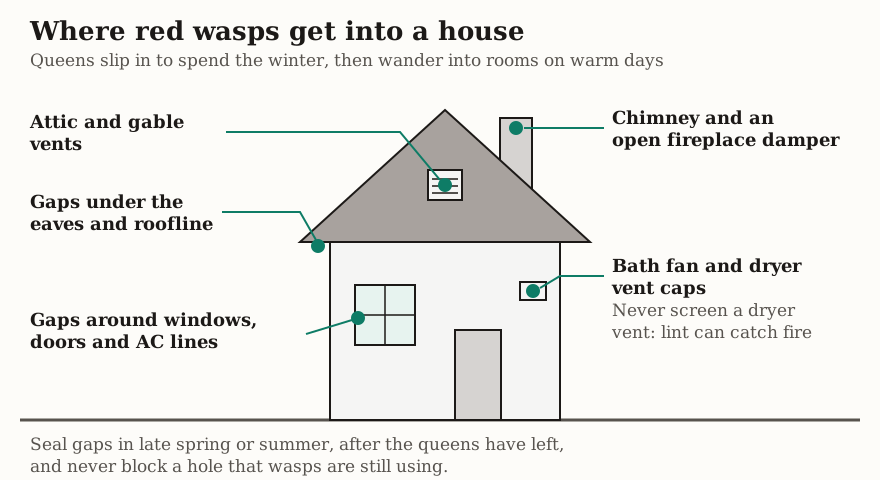
How to keep red wasps out of the house
Seal the way in after the queens leave, in late spring or summer, and finish before mid-October, when the next ones look for shelter. Check where a sloped roof meets a wall, gaps under the eaves, attic and gable vents, bath fan and dryer vent caps, loose window and door trim, and the gaps around air conditioner lines.
Close the fireplace damper, and screen attic vents with fine mesh. Do not screen a dryer vent, though. Lint clogs the screen and can start a fire, and the International Residential Code, section M1502.3, says screens shall not be installed there. A dryer vent should have a working flap instead. Indoors, gaps around ceiling lights and fan housings are common ways in, and a bead of caulk closes most of them.
How to get a red wasp out of your house
Keep children and pets away
Close the door to the room. A cat or dog that bats at a wasp can still get stung, even by a slow one.
Do not grab it with bare hands
A queen that spent the winter indoors is slow and has no nest to defend, but she will sting if she is squeezed or trapped against skin.
Catch it under a cup
Wait until it lands on a window or wall. Cover it with a clear cup or jar, slide stiff paper under the rim, and keep the paper pressed flat.
Let it go outside, or use a swatter
Release it away from doors, or kill it with a fly swatter if you prefer. Both are fine, and no spray is needed indoors.
Look for the way in
Check the room for a gap near a vent, a ceiling light, a fireplace or a window frame. Note it, but wait until the spring wasps are gone before you seal it.
What does a red wasp nest look like?
A red wasp nest is one open comb of gray or tan paper cells, shaped like an upside-down umbrella and hung from a single short stalk. A full-size nest is about 6 inches (15 cm) across, with up to about 200 cells and 20 to 30 adult wasps at one time. You can see into the cells from below.
The wasps make the paper themselves. They scrape fibers from weathered wood, fences and plant stems and chew them with saliva. The fine-backed red wasp usually builds in the open under a roof. The coarse-backed one prefers hollows, such as tree trunks, birdhouses, pipes, pots and wall gaps. Both like a spot out of the rain.
Readers find them under eaves and porch ceilings, in sheds and barns, and in mailboxes. Grills, bird feeders, gutters, light fixtures and the inside of a parked truck are other spots. LSU adds electrical boxes, patio furniture and wooden fences. A tool that has hung in the shed since last year, such as a fertilizer spreader, can hide a nest, so look before you grab.
Some sites claim a red wasp nest can hold 5,000 wasps. The University of Arkansas gives 3,000 to 5,000, and Southern Living says up to 5,000. Neither fits the extension data: LSU puts a mature nest at 20 to 30 workers, and Texas A&M at 20 to 30 adults. Penn State gives exactly 3,000 to 5,000 for the eastern yellowjacket, so the figure seems to come from a mix-up.
The red wasp year: when are red wasps active?
Red wasps are out from about March to November, with two peaks. The first, in March and April, is queens leaving winter shelter and starting nests. The second runs from July to October, when colonies are full size and then raise males and new queens. July to October holds 50.5% of all US sightings, and December and January only 2.5%.
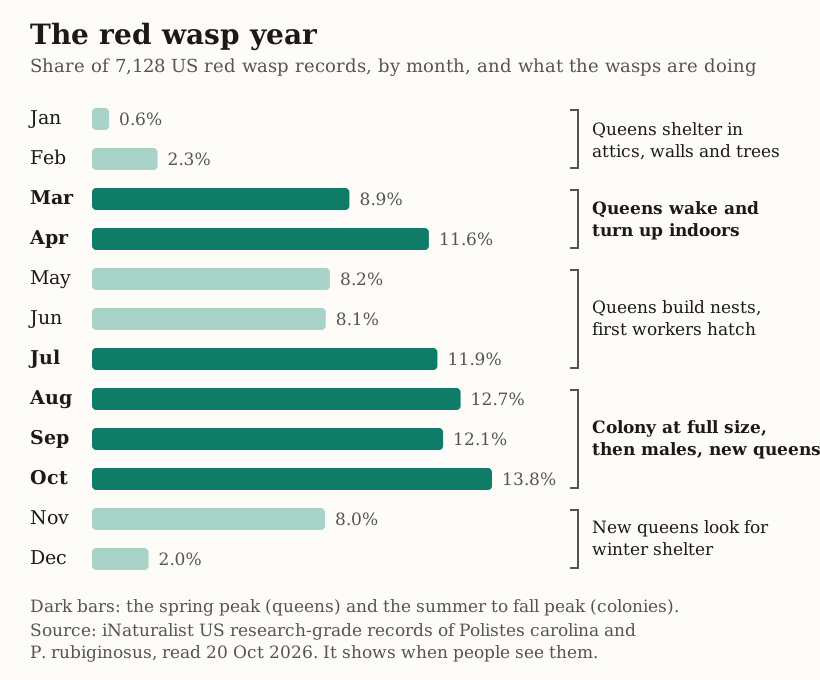
What red wasps are doing, season by season
Late winter to spring (Feb to Apr)
- What is happening
- Queens leave attics, walls and trees. Each one starts a nest, sometimes with a few others
- What it means for you
- Slow wasps indoors. Knock down small new nests near doors while only one wasp is on them
Late spring to summer (May to Jul)
- What is happening
- The first workers hatch and the nest grows. By midsummer one queen lays all the eggs
- What it means for you
- Nests get noticed. Leave the ones that are out of the way
Late summer to fall (Aug to Oct)
- What is happening
- Biggest colonies. Males and new queens appear, mate, and the old nest is abandoned
- What it means for you
- The most stings, at the busiest nests. Treat a nest only if it is in the way
Fall to winter (Oct to Feb)
- What is happening
- New queens find shelter, often in groups. The rest of the colony dies
- What it means for you
- Wasps clustered under eaves and in attics. Seal gaps before mid-October next year
In the far south the season starts earlier and runs later, and colonies can last longer. Old nests are rarely used again. Each spring a queen builds a new one, often in the same kind of spot near the last, which is why the same porch gets nests year after year.
What do red wasps eat?
Adult red wasps drink nectar and the juice of ripe fruit. For their young they hunt caterpillars and beetle larvae, chew them into a ball and carry it back to a nest of up to 200 cells. Red wasps do not come to your food, trash or soda, which is one easy way to tell them from yellowjackets.
That makes them useful in a garden. Their main prey is caterpillars, and gardeners often watch red wasps carry off tomato hornworms and other leaf-eating caterpillars. Leaf beetle larvae are on the menu too. They visit flowers for nectar and move a little pollen. Mississippi State says they are not good pollinators, though, so their real value is as caterpillar hunters. Clemson notes that they can mark ripe fruit as they feed on it.
Where do red wasps live?
Red wasps live in the eastern half of the US, from New York and Pennsylvania south to Florida and west to Kansas, Oklahoma and Texas. Of 7,128 US records on iNaturalist, 50.5% come from Texas. Georgia, Tennessee, Alabama, Oklahoma, Missouri and Arkansas hold most of the rest.
The table counts research-grade records, where other users have agreed on the species from a photo. It shows where people meet red wasps and post them, which is not quite the same as where most of them live.
Where people find red wasps: US iNaturalist records by state, read October 2026
Texas
- Fine-backed
- 2,667
- Coarse-backed
- 933
- Share of US records
- 50.5%
Georgia
- Fine-backed
- 634
- Coarse-backed
- 90
- Share of US records
- 10.2%
Tennessee
- Fine-backed
- 418
- Coarse-backed
- 155
- Share of US records
- 8.0%
Alabama
- Fine-backed
- 392
- Coarse-backed
- 100
- Share of US records
- 6.9%
Oklahoma
- Fine-backed
- 102
- Coarse-backed
- 238
- Share of US records
- 4.8%
Missouri
- Fine-backed
- 16
- Coarse-backed
- 226
- Share of US records
- 3.4%
Arkansas
- Fine-backed
- 54
- Coarse-backed
- 164
- Share of US records
- 3.1%
Florida
- Fine-backed
- 200
- Coarse-backed
- 1
- Share of US records
- 2.8%
Kentucky, North Carolina, Louisiana, Mississippi, South Carolina
- Fine-backed
- 324
- Coarse-backed
- 211
- Share of US records
- 7.5% together
Virginia, Illinois, West Virginia, New Jersey, Kansas, Pennsylvania, and others
- Fine-backed
- 75
- Coarse-backed
- 128
- Share of US records
- 2.8% together
The two species split the map. The fine-backed red wasp is far commoner in Georgia and Alabama, and almost the only one in Florida. The coarse-backed red wasp outnumbers it in Oklahoma, Missouri and Arkansas. A few coarse-backed records come from New Jersey and New York, beyond its published range.
West of Texas, red paper wasps are other species. In southern Arizona, the red ones people see are mostly Polistes canadensis and a red form of Polistes major, which have tropical ranges. So a red wasp photo from Oregon, Colorado or Montana is almost certainly something else.
Red wasps in Texas
Texas has more red wasp records than every other state together: 3,600 of the 7,128. Both species live there. The fine-backed red wasp outnumbers the coarse-backed one by about 3 to 1. In Texas the name “red wasp” usually means P. carolina. The coarse-backed one’s old name, P. perplexus, was based on Texas specimens that Ezra Cresson described in 1872.
Texans meet red wasps in every month of a mild winter, and queens on windows in February and March are a common sight from Austin to Houston and Dallas. Texas also has several other paper wasps, from the small brown and yellow guinea wasp to the darker metric paper wasp. The look-alike table above sorts them, and the same advice applies to all of them.
How to get rid of a red wasp nest
Leave a red wasp nest alone if it is out of the way, since the colony dies off by itself in the fall. Otherwise, treat it after dark, when all the wasps are on the nest, with a spray that reaches about 20 feet. In spring, a small nest with one queen can be knocked down with a broom.
Clemson Extension and Mississippi State both advise leaving nests that are not in the way, because the wasps eat garden pests. A nest by a door, a grill, a mailbox or a play set is a different story. The steps below are what Texas A&M, Clemson, UF/IFAS and LSU recommend.
How to get rid of a red wasp nest safely
Decide whether it needs to go
A nest high on the house, in a tree or in a corner nobody uses can stay. The wasps eat caterpillars, and the colony dies off by itself in the fall.
Find it in daylight, from a distance
Note where it hangs and how you will reach it. Plan to stand to one side, not right under it.
Get someone else if you are allergic
Anyone who has had a bad reaction to a sting should not do this job. Ask another adult or call a licensed pest control company.
Go back after dark
Wear long sleeves, long pants, gloves and closed shoes. At night the whole colony is on the nest and slow. Do not point a flashlight straight at the nest, since the light can draw the wasps to you.
Spray, or knock it down
Use a wasp and hornet spray that reaches about 20 feet, aimed at the open cells for a few seconds, and follow the label. A small spring nest with one wasp can simply be knocked down with a broom.
Wait, then remove the nest
Leave it for a day or two so returning wasps contact the spray. Then scrape the nest off into a bag, and paint or varnish the spot so a new queen is less likely to build there.
Never use gasoline, lighter fluid, brake cleaner or fire. Readers share these tricks online, and they cause burns and house fires. Do not flood a nest with a hose or pressure washer either. It knocks the nest down but leaves every wasp loose and close to the person holding the hose.
How to keep red wasps from nesting near your door
Check the eaves, porch ceiling, grill and mailbox every week or two from March through May. LSU says that is when queens start nests, and a nest with one wasp on it is easy to knock down. Remove old nests after the wasps are dead, and repaint or reseal the spot. Clemson notes that a fresh coat of paint or varnish makes it harder for wasps to attach a nest.
Skip the gadgets. LSU found no data that fake paper nests keep wasps away, and readers report wasps moving into them. University of Idaho Extension notes that paper wasps are not drawn to the traps sold for yellowjackets. No repellent oil, such as peppermint, has been shown to keep them off a house.
Red wasp myths
Most of what goes around about red wasps comes from fear of the sting, and even the top-ranking articles disagree on nest size, body size and how aggressive they are. Here are 8 claims you will still see, set against what extension entomologists and the research actually say.
Myth 1
Myth: “A red wasp nest can hold 5,000 wasps.”
Truth: A full-size nest holds about 20 to 30 adults at one time and up to about 200 cells. The 3,000 to 5,000 figure fits yellowjackets, whose nests are far bigger.
Myth 2
Myth: “Red wasps are hornets.”
Truth: They are paper wasps. The only true hornet common in the US is the European hornet, which is brown and yellow, not red.
Myth 3
Myth: “Red wasps attack for no reason.”
Truth: They defend the nest. Away from it, a red wasp almost never stings unless it is grabbed, stepped on or trapped in clothing.
Myth 4
Myth: “A wasp in the house in spring means a nest in the wall.”
Truth: Usually it is a queen that spent the winter in the attic or a wall void and is trying to get out. The colony starts outside.
Myth 5
Myth: “A fake paper nest keeps them away.”
Truth: No study shows it works. Some readers find real wasps nesting right on the decoy, and the paper can even become building material.
Myth 6
Myth: “Red wasps lose their stinger like bees.”
Truth: Their stinger is smooth. One wasp can sting several times.
Myth 7
Myth: “Gasoline or fire is the fastest way to kill a nest.”
Truth: Both cause burns and house fires. A labeled wasp spray at night, or a broom on a small spring nest, does the job without the risk.
Myth 8
Myth: “Red wasps are invasive.”
Truth: Both red wasps are native to the eastern US. The invader people mean is the European paper wasp, which is black and yellow.
When to call someone
Call 911 for trouble breathing, a swollen face or throat, or fainting after any sting. Call a licensed pest control company for a nest inside a wall, attic or chimney, one you cannot reach safely, or any nest when someone at home is allergic. Your county extension office can name a wasp from a photo.
Who to call, and when
Trouble breathing, swelling of the face or throat, fainting, or a spreading rash after a sting
- Who to call
- 911
- Why
- Signs of a severe allergic reaction (MedlinePlus)
A sting inside the mouth or throat
- Who to call
- 911 or the nearest emergency room
- Why
- MedlinePlus says to get urgent help for a sting in the mouth or throat
Questions about a sting, or a child who was stung
- Who to call
- Poison Help, 1-800-222-1222
- Why
- Free, confidential and open 24 hours a day (MedlinePlus)
Redness, swelling or pain that keeps growing days later
- Who to call
- Your doctor
- Why
- Possible infection
A pet stung in the mouth, vomiting or collapsing
- Who to call
- An emergency vet
- Why
- Swelling in the mouth or throat can block the airway
Wasps flying in and out of a wall, attic or chimney in summer
- Who to call
- A licensed pest control company
- Why
- A hidden nest needs insecticide dust and access to the wall or attic, a job best left to a pro
Slow red wasps indoors in late winter or spring
- Who to call
- No one
- Why
- They are queens leaving the attic. Swat or release them, then seal gaps later
Not sure what stung you? Our bite and sting chart compares the usual suspects. For any other wasp or bee, the bee and wasp guide sorts them, and the free insect identifier can name one from a clear photo.
Pest control disclaimer. Photo-based identification can help, but it is not always perfect. For dangerous spiders, large infestations, or anything you are unsure about, contact a licensed pest control professional.
Medical disclaimer. This page is for general information only. It is not a medical diagnosis. If you have severe symptoms, trouble breathing, swelling of the face or throat, fast spreading redness, fever, severe pain, pus, or signs of infection, contact a doctor or your local emergency number.
Frequently asked questions
What is the difference between a red wasp and a red paper wasp?
Do red wasps die after they sting?
Is a small red wasp a baby red wasp?
Can red wasps chew through drywall?
Do red wasps use the same nest again next year?
Do red wasps sting at night?
Related guides
Paper wasp
The whole paper wasp family: the US species by region, the nest, and when to leave it or remove it.
Bee sting
First aid, the swelling timeline, stings on pets, and how to tell a bee sting from a wasp sting.
Murder hornet
The giant hornet, the European hornet and the other big wasps people mix up.
Cow killer
The red and black wingless wasp that runs over the ground, and how bad its sting is.
Types of bees
Sort bees from wasps, then find the guide for the one you saw.
Insect identifier
Upload a photo and get an identification from the free AI tool.
Sources
- Texas A&M AgriLife Extension, Paper Wasps, Yellowjackets and Solitary Wasps (E-239)
- LSU AgCenter, Polistes carolina and P. rubiginosus, red paper wasps (McComic and Carlton, 2022)
- UF/IFAS EDIS, Paper Wasp, Red Wasp, Polistes carolina (Paulus and Lucky, EENY640)
- Mississippi State University Extension, Bug-Wise No. 7: Paper wasps (Layton, 2012)
- Mississippi State University Extension, Bug-Wise No. 9: Overwintering insects (Layton, 2011)
- Clemson Cooperative Extension, HGIC 2481, Paper Wasps
- BugGuide, Polistes carolina, Fine-backed Red Paper Wasp
- Buck, Cobb, Stahlhut and Hanner, Unravelling cryptic species diversity in eastern Nearctic paper wasps, Zootaxa 3502 (2012)
- Schmidt, Pain and lethality induced by insect stings, Toxins 11(7): 427 (2019)
- CDC, QuickStats: deaths from hornet, wasp and bee stings, 2011 to 2021 (MMWR 72(27), 2023)
- MedlinePlus, Bee, wasp, hornet, or yellow jacket sting
- MedlinePlus, Insect bites and stings (reviewed October 14, 2025)
- iNaturalist, Polistes carolina and Polistes rubiginosus, US research-grade records (read October 20, 2026)
- Beani and colleagues, Scientific Reports 11: 7235 (2021), lifespan of Polistes workers and queens
- University of Idaho Extension, Wasp and Hornet Control (CIS 1218)
- International Residential Code, M1502.3, dryer duct termination (as adopted in South Carolina)