Where do bed bugs come from? The short answer
Where do bed bugs come from? Another building where people sleep, and a person or an object carried them to you. Luggage after travel is the most common route, then used furniture, then a neighbor’s unit. One mated female is enough, because she lays 1 to 7 eggs a day and needs no male to do it.
- They are carried in. Bed bugs cannot fly or jump, so they only travel inside the things people move, or by walking from an attached unit.
- Three routes cover most cases. Luggage, used furniture, and the apartment next door.
- Dirt has nothing to do with it. They drink blood, so a tidy bedroom suits them as well as a messy one.
- You often cannot prove which one. That is normal, and it does not stop you fixing the problem.
An adult is about 1/5 inch (4 to 5 mm) long, flat, oval and reddish brown, which is roughly the size of an apple seed. Young ones are smaller and almost colorless until they feed. For photographs at actual size, start there, and the main bed bugs guide covers the whole problem from first signs to treatment.
One thing worth saying early. Bed bugs turn up in every US state, in spotless homes and cluttered ones alike. Pest companies answer as many calls to new builds as to old buildings, so finding them says nothing about you.
How do you get bed bugs? Every route that is real
You get bed bugs when they ride in on something, or when they walk in from an attached unit. Eight routes account for almost every case. Travel and luggage lead, used furniture is second, and in apartment buildings 53% of units next door to an infested one were infested too.
How bed bugs get into a home, ranked by how strong the evidence is
Luggage and overnight bags
- How common
- The most common route
- What the evidence shows
- Public health guidance names the seams and folds of luggage, bags and folded clothes first. A bag left on a hotel bed or a padded rack is the classic case.
Used furniture and mattresses
- How common
- Very common
- What the evidence shows
- Second only to travel. A couch from the curb or a refurbished dresser can arrive with live bugs, eggs and shed skins in the joints.
A neighbor's unit in a shared building
- How common
- Common in apartments
- What the evidence shows
- In a 223-unit high-rise, 53% of units beside an infested one were infested too, and about six bugs a month left through entry doors.
Moving boxes and storage units
- How common
- Common
- What the evidence shows
- Boxes packed in an infested room hold bugs in the dark for months. Without feeding they last 20 to 400 days depending on temperature, around 70 days as a room-temperature average.
Visitors, family and workers
- How common
- Occasional, and rarely proved
- What the evidence shows
- A bug rides in on a bag, a coat or a tool roll. Half the people who have bed bugs do not know it, so a visitor can be the source in good faith.
Shared laundry rooms and laundromats
- How common
- Occasional
- What the evidence shows
- Bed bugs gathered on bags of worn clothes twice as often as on clean ones, so a full laundry basket on a folding table is the weak point.
Public seating, transit and rideshares
- How common
- Uncommon
- What the evidence shows
- Possible, but a short ride gives a bug little reason to leave its host. Far less likely than a place where someone sleeps or stores things.
On your body
- How common
- Rare
- What the evidence shows
- A bed bug feeds for 5 to 10 minutes and leaves. Unlike head lice, it does not live on a person.
That order is a ranking by evidence rather than a guess. Travel and used furniture appear in every health department guide. The apartment numbers come from researchers who trapped and marked bugs through a 223-unit building for four months. Meanwhile the bottom three rows are real but thin, so treat them as possible rather than likely.
What causes bed bugs, and why dirt is not one of them
Nothing in your home causes bed bugs. Something brings them in every time: a live bug or an egg from elsewhere. Dirt plays no part. The EPA says bed bugs go for warmth, blood and carbon dioxide rather than dirt and grime. The CDC puts it plainly: how clean a place is does not decide whether they are present.
So the honest answer to where do bed bugs come from is always somewhere else. That matters more than it sounds, because shame keeps people quiet, and quiet is how a bed bug problem spreads through a building.
What does draw a bed bug is a sleeping body: the warmth, the carbon dioxide you breathe out and the smell of skin. Clutter changes none of that. It simply gives bugs more cracks to sit in, which makes a treatment harder and nothing else. The hub covers what actually draws them to a bed in more detail.
Can you get bed bugs out of nowhere?
No. Bed bugs do not form from dust, damp, old mattresses or neglect, because no insect appears from nothing. Every infestation starts with at least one bug or egg that crossed your doorway.
What feels like nowhere is usually a route nobody noticed, or a bug that arrived weeks before the first bite. A few bugs leave almost nothing behind, and people blame the early bites on mosquitoes or a new washing powder. By the time the specks and shed skins show up, the bugs have often been there a month or two.
In other words, out of nowhere is nearly always out of sight.
How did I get bed bugs if I haven’t traveled?
Travel is only the most common route, not the only one. Eight other routes need no trip at all, and in a shared building the strongest of them is the unit next door. A study of 223 apartments found 53% of units beside an infested one were infested as well, and half those residents had no idea.
Eight ways bed bugs arrive without a trip
Work down the list and mark anything that happened in the three months before the first bite.
An attached unit
A shared wall, floor or hallway. Bugs walk under doors and through gaps around outlets and pipe runs, so nobody has to carry anything.
A unit that stood empty
Bed bugs survive months with nobody to feed on. An apartment that was vacant for half a year is not a clean one.
A delivered or refurbished item
A new mattress, a reupholstered chair, a secondhand dresser. Delivery crews often take the old infested item away on the same truck.
A move
Movers' blankets, a shared truck, or a storage unit. Boxes packed in an infested bedroom carry them too.
A visitor who stayed over
Family, a friend, a partner's bag on your bed. Half the people with bed bugs do not know they have them, so nobody is lying to you.
Workers in the house
Painters, carpet fitters, cleaners and care staff. They move between several homes a day, carrying bags and tool rolls.
Someone in the house who sleeps elsewhere
A child at a sleepover or a dorm. A partner who travels for work. A relative moving between home and care.
Your workplace
Offices, hospitals, schools and shelters all report cases. A coat on a shared hook or a bag under an upholstered chair is the usual way out.
None of those needs a hotel, and several leave no trace at all. Once you have marked two or three, you have enough to act on. If you are still working out whether you actually have them, read how to check for them properly before you spend money on anything.
It was probably the apartment next door
In a shared building, a neighbor is the single most likely source. Researchers marked and trapped bed bugs through a 223-unit high-rise. They found 45% of all apartments infested. Next door to an infested unit, the figure was 53%. Adults were 9 times more likely than young bugs to move.
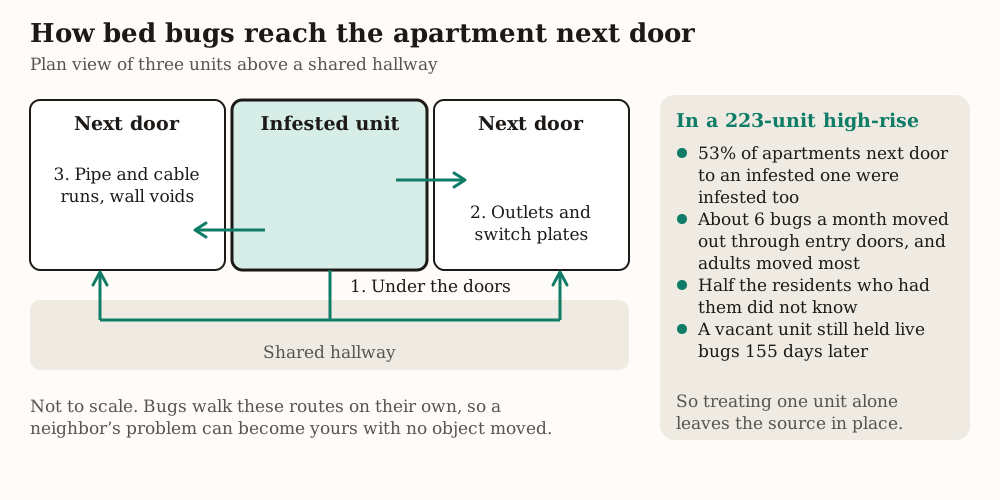
A second study marked bugs in six apartments and then found marked bugs in the neighbors of five of those six. Bed bugs really do make the trip on their own, under doors, around outlet and switch plates, and along pipe and cable runs.
Here is the uncomfortable part. Your neighbor may be doing nothing wrong and may not even know: half the residents with bed bugs in that high-rise did not. So treating your unit alone often fails, because the source stays in place and bugs walk back within weeks.
Tell the landlord or building manager in writing. Ask them to inspect the units beside, above and below yours at the same time, because a coordinated treatment is the only kind that holds in a shared building.
You moved in and the place had been empty
An empty apartment is not a safe one. In one study a resident moved out of an infested unit and researchers were still catching live bugs there 155 days later, including adults and large nymphs. Starved bed bugs average about 70 days at room temperature, so some of those had clearly found something to feed on.
The full range is wider than most people expect. UC IPM gives 20 to 400 days without a meal, depending on temperature and humidity, which is why a cool and empty apartment can stay infested for a very long time.
So a landlord saying the place stood empty for six months proves nothing at all. If the bites started in your first week, the bugs were almost certainly there before you arrived. Photograph everything with a date, keep the photographs, and report it in writing straight away.
New furniture, deliveries, movers and storage
A brand new mattress can arrive with bed bugs, and that is not a fault in the mattress. Delivery crews often take the old infested one away on the same truck. Refurbished and reupholstered furniture is riskier still, because bugs sit in joints and staples where nobody looks.
Here is where we stop short of the internet. Plenty of people blame the delivery truck or the moving van, and it is a reasonable guess, but we found no study that measures it. What research does show is that infested furniture brought into a building starts infestations. So treat the item as the known risk and the vehicle as unproven.
Storage units cause the same problem in slow motion. Boxes packed in an infested bedroom hold bugs and eggs in the dark for months, then release them into a new home on the day you unpack.
Visitors, family and workers
One bug on the couch the day after family leave is a story we read constantly, and it is a plausible one. Bags, coats and tool rolls all travel between homes. Since half the people with bed bugs do not know it, nobody in that chain is lying to you.
Workers come up often too. Painters, carpet fitters, cleaners and care staff move between several homes a day, and a single bug carried that way cannot be traced afterwards. So the useful response is to check rather than to accuse.
How a bed bug infestation starts
One mated female is enough. She stores sperm, so she needs no male to begin laying, and she can mate with her own grown offspring later on. She lays 1 to 7 eggs a day for about 10 days after each blood meal, and 5 to 20 eggs from each meal.
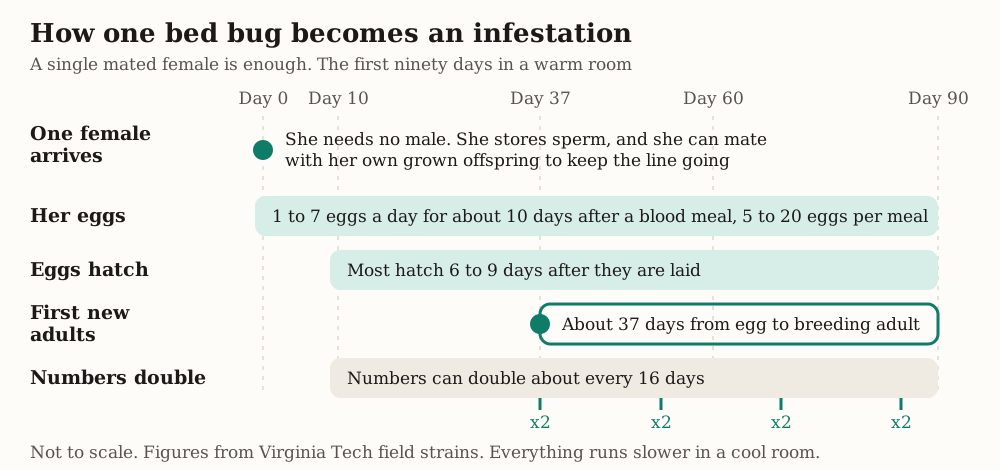
After that the numbers compound. In a room above 72F (22C), an egg becomes a breeding adult in about 37 days. The population can then double roughly every 16 days, as long as somebody keeps sleeping there.
Sources disagree on the lifetime egg total, and the gap is wide enough to matter. UC IPM gives 200 to 500 eggs. Virginia Tech’s work on bed bugs collected from Virginia apartments averages about 113. We name both rather than pick one, because the field strains in a real bedroom are not the same animal as a laboratory colony.
Either way the direction is the same. A few bugs in week one becomes a problem you can see by month two, which is why catching it early is worth so much money.
How long have the bed bugs been here?
What you found gives you a rough age. Live adults on their own can mean days. Shed skins mean bugs have molted in your bed, which takes weeks. Eggs with several sizes of nymph mean a breeding population, usually two months or more, since egg to adult takes about 37 days.
Reading the age of an infestation from what you found
One adult, nothing else after a careful search
- Likely age
- Days to a few weeks
- How sure we are
- Low. A single bug proves arrival, not breeding. It may also be a lone hitchhiker that cannot start anything
A few dark specks on one mattress seam
- Likely age
- Two to six weeks
- How sure we are
- Moderate. Specks last for months, so an old mark can look new
Specks plus pale shed skins
- Likely age
- Four to eight weeks at least
- How sure we are
- Good. A bug only molts where it has been feeding, so this is breeding on site
Eggs as well as skins
- Likely age
- Six weeks or more
- How sure we are
- Good. Eggs mean a mated female has been feeding in that spot
Nymphs in several different sizes
- Likely age
- Two months or more
- How sure we are
- Strong. Egg to breeding adult takes about 37 days, so mixed sizes mean overlapping generations
Specks on the frame, headboard and nearby furniture
- Likely age
- Three months or more
- How sure we are
- Strong. They spread outward from the bed as numbers rise
A sweet musty smell you notice walking in
- Likely age
- Many months
- How sure we are
- Strong, but late. It takes a lot of bugs, so by then it is not an early case
Dating it is the other half of where do bed bugs come from, because a three-month-old problem points at a different route than a two-week-old one. If the evidence says months, look at neighbors, a vacant unit or a piece of furniture rather than at last weekend’s trip.
Treat that table as a guide and not a date stamp. Temperature changes everything, so a cool spare room slows every stage while a warm bedroom speeds it up. Bites are no help at all, because reactions vary so much that two people in one bed can look completely different, and some people never react.
Not sure what you are looking at yet? Start with the signs that show up first, which lists them in the order they appear. For the marks themselves, read what the bites look like. Bites alone cannot identify any insect, so treat them as a reason to inspect rather than proof of anything.
How bed bugs spread once they are inside
Inside a building they simply walk. The CDC says a bed bug can cover over 100 feet in a night, though it tends to live within 8 feet (2.4 m) of where people sleep. UC IPM puts the hiding places closer still, within about 6 feet, so expect most of them near the bed.
That range explains the odd finds. A bug on the stairs, by the front door or on a hallway carpet is not a separate problem. It is a bug that wandered, or one on its way to or from the next unit.
Between rooms they use the gaps you cannot see: under doors, around outlet and switch plates, along pipe and cable runs, and behind baseboards. A heavy infestation pushes bugs outward, so a second bedroom or a living room couch starts to fill up.
They also leave scent trails for each other. That is why you find a cluster packed into one seam rather than a few bugs spread evenly around a room.
Do bed bugs travel on your body or your clothes?
On your clothes, sometimes. On your body, hardly ever. A bed bug feeds for 5 to 10 minutes and then leaves, so it has no reason to stay on a person the way head lice do. What it will do is climb into a bag, a coat lining or a shoe that is sitting still.
Worn clothes are the exception worth knowing about. In one experiment bed bugs gathered on bags of worn clothes twice as often as on bags of clean ones, with nobody in the room. So a holdall of yesterday’s clothes on a hotel floor is a better target than the clothes you have on.
This also settles the contagious question. You cannot catch bed bugs by standing near somebody. What moves between people is the insect, in a bag or on a coat, never something passed skin to skin.
Can bed bugs come from outside or the yard?
No. Bed bugs do not live in gardens, on plants or on wild animals out in the open, so your yard is not where they came from. A couch left on the curb is the one thing that looks like an exception, and it is not: that couch is an infested object which happens to be outdoors.
There is one real exception, and we used to miss it ourselves. The common bed bug also feeds on animals kept close to a house. UC IPM lists chickens, mice, rats and rabbits, so a backyard coop or a rodent problem in the walls can hold a small population. That is rare, and it is still a structure rather than open ground.
What this rules out is bigger than what it leaves in. Garden pests do not turn into bed bugs. A bug that flew to your porch light is not one either, because bed bugs have no working wings.
Can dogs, cats or backyard chickens bring bed bugs in?
Not as a route in. A bed bug will bite a dog or a cat that sleeps on the bed. But it does not live in fur, and no study supports a pet as the way bugs enter a home. Chickens are the one real exception, because bed bugs do feed on them.
Which animals can and cannot bring bed bugs into a house
Dog
- Can it bring bed bugs in?
- No evidence it can
- What to check
- The dog bed, if it sits in the bedroom. Check its seams the way you would a mattress, not the dog
Cat
- Can it bring bed bugs in?
- No evidence it can
- What to check
- Same as a dog: the bedding and the favorite chair, not the fur
Backyard chickens
- Can it bring bed bugs in?
- Yes, rarely
- What to check
- Nest boxes, perch ends and cracks in the coop. Bed bugs do feed on chickens
Mice or rats in the walls
- Can it bring bed bugs in?
- Yes, rarely
- What to check
- A rodent problem can keep a small population fed. Deal with the rodents first
Pet rabbits
- Can it bring bed bugs in?
- Yes, rarely
- What to check
- Hutch joints and bedding, especially a hutch kept indoors
Birds nesting on the house
- Can it bring bed bugs in?
- Not bed bugs, but a close relative
- What to check
- Swallow bugs live with cliff swallows and bite people once the birds leave
Bats in the attic
- Can it bring bed bugs in?
- Not bed bugs, but a close relative
- What to check
- Bat bugs, a separate species that needs bats. The fix starts with the bats, not the bed
Fleas and ticks do ride on animals, which is where the confusion starts. Bed bugs do not, because they feed and then go straight back to a crack near the bed. So washing the dog will not help you, while washing the dog bed on a hot cycle might.
When the source really is bats or birds
Sometimes the insects in the bedroom are not bed bugs at all. Bat bugs (Cimex adjunctus) are a separate species that lives with bats, usually up in an attic. Iowa State Extension says both insects bite people, but only bed bugs can survive and reproduce on human blood.
That difference changes what you do. Treating the bed achieves nothing while bats are still overhead, so the fix starts with removing the bats and sealing the attic. Bat bugs can also live for months without their hosts, which means the problem does not end on the day the bats leave.
Telling the two apart needs a lens. The giveaway is the fringe of hairs on the plate behind the head, longer than the eye is wide on a bat bug and shorter on a bed bug. In practice the simpler question is whether there are bats or a swallow colony on your building. For the full set, see the insects people mistake for them.
Where people pick bed bugs up
Places where people sleep or store their things. Hotels, shelters, dorms and furnished apartments carry the highest risk. A bug gets both a host and a crack to hide in within 8 feet (2.4 m) of the bed. Theaters, buses and trains come up occasionally, and a short ride is far less risky than a whole night.
Where bed bugs are picked up, and what to do in each place
Hotels, motels and short-term rentals
- Risk
- Highest
- What to do there
- Keep the bag in the bathroom until you have checked the mattress seams and behind the headboard. Then use the rack, not the bed or the floor
Shelters, dorms and furnished rentals
- Risk
- Highest
- What to do there
- Encase the mattress and put interceptor cups under the bed legs on day one
A friend or relative's spare room
- Risk
- High, and never discussed
- What to do there
- The same checks as a hotel. Dry everything you took on high heat when you get home
Secondhand shops and curbside finds
- Risk
- High
- What to do there
- Check seams, screw holes, drawer runners and staples in daylight, before it goes in the car
Shared laundry rooms and laundromats
- Risk
- Moderate
- What to do there
- Carry laundry in a bag, fold at home, and take dry clothes straight from the dryer into a clean bag
Offices, schools and hospitals
- Risk
- Moderate
- What to do there
- Keep bags off upholstered chairs and coats off shared hooks
Movie theaters, buses and trains
- Risk
- Low
- What to do there
- Nothing special is needed. Dry your clothes on high heat if you have a specific reason to worry
Cars and rideshares
- Risk
- Low
- What to do there
- A bug can ride in, but a car is a poor home. Vacuum it out and check the seat seams
Your yard, a park or a campsite
- Risk
- None
- What to do there
- Bed bugs are not there. Nothing you do outdoors brings them in
Notice the pattern in that table. Risk tracks time and somewhere to sleep, not dirt and not crowding. A two-hour train ride is a poor opportunity for an insect that feeds at night, while eight hours in a bed is an excellent one.
Bed bugs in cars and rideshares
A car can carry bed bugs, and it nearly always belongs to somebody who has them at home. Bugs ride in on a bag or a coat and shelter in the seat seams, under the mats and in the trunk. A car is a poor long-term home though, because nobody sleeps in it.
If you have an infestation at home, assume the car needs dealing with too. Take everything out, vacuum the seams and crevices thoroughly, and empty the vacuum into a sealed bag outside. For the heat and cold methods and the temperatures that actually kill them, use the treatment guide rather than guessing at a hot day in a parked car.
Can you find out where your bed bugs came from?
Often not, and that is the honest answer. Half the residents with bed bugs in one 223-unit study did not know they had them. So the person or place that passed them on may stay a mystery. You can usually narrow it to two or three routes, which is enough to act on.
Narrowing it down is worth half an hour. Write down every trip, delivery, visitor, worker and move in the three months before the first bite. Then look at where the evidence is heaviest in the home, because bugs build up nearest their first foothold.
The question behind where do bed bugs come from is usually whether it can happen again, and you can answer that without naming the source. Close the routes you can see, and the odds drop sharply whether or not you ever know which one it was.
Where it matters most is a shared building, because the answer changes the treatment. If the source is next door, treating only your unit leaves it in place. Where it matters least is a house you own and a single object you have already thrown out. The route is closed, so only the bugs remain.
Three findings justify calling a professional rather than trying on your own first. Bugs in more than one room. Bugs in a shared building. Or evidence that the infestation is months old rather than weeks.
Where did bed bugs originally come from?
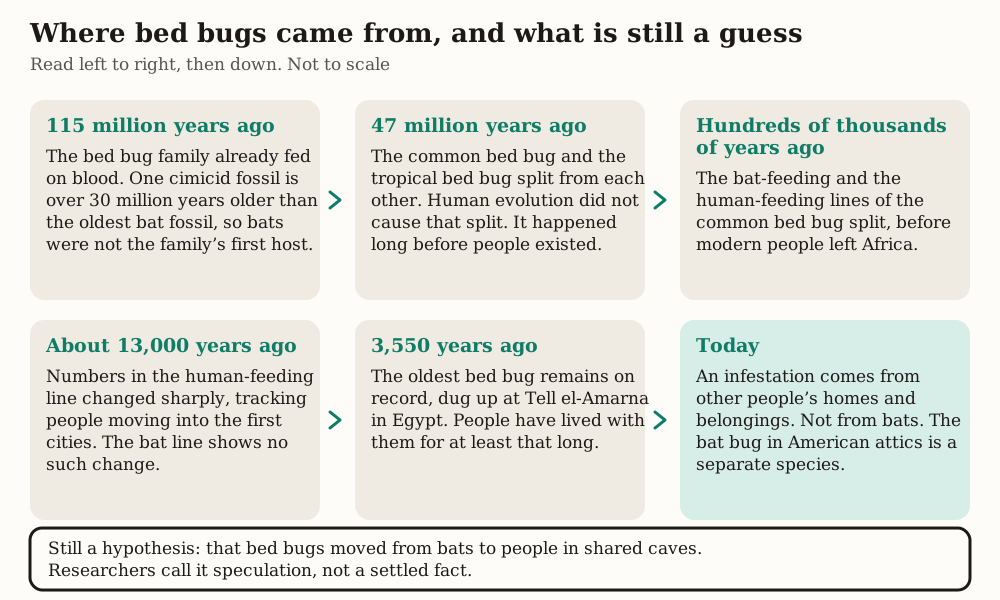
Far further back than most pages say. The bed bug family was already feeding on blood about 115 million years ago, which makes it older than bats. The common bed bug probably fed on bats before it fed on people, but the two lines split so long ago that today’s infestations have nothing to do with bats.
Most readers asking where do bed bugs come from mean their own bedroom. A smaller group means the species, and that question has a surprisingly bad answer online, so it is worth doing properly.
The popular version runs like this: bed bugs lived in caves, fed on bats, and switched to people when humans moved into the same caves a few thousand years ago. Google’s own AI answer tells it that way, sourced from a Reddit comment. Three parts of it do not hold up.
Three problems with the cave story
First, the family is older than its supposed first host. Roth and colleagues (Current Biology, 2019) dated the bed bug family to around 115 million years ago. They also found a fossil more than 30 million years older than the oldest bat fossil. So bats were not the family’s original hosts.
The same work dates the split between the common and the tropical bed bug to about 47 million years ago. That is long before people existed, so human evolution did not drive it.
Second, the cave switch is a hypothesis rather than a finding. Booth and colleagues (Molecular Ecology, 2015) describe it as something that has been speculated. Nobody has shown that it happened.
Third, the timescale is far too short. Balvín and colleagues (Parasitology Research, 2012) compared bat-feeding and human-feeding bed bugs and found largely separate populations. Their split appears to predate modern humans leaving Africa. Later genome work puts a sharp change in the human-feeding line at about 13,000 years ago, tracking people moving into the first cities. The oldest physical remains are about 3,550 years old, from Tell el-Amarna in Egypt.
What the bat bug actually tells you
Then there is the conclusion people actually draw from the bat story, which is the part that matters. That same 2012 work found the limited gene flow running mostly from human bed bugs into bat populations. Its results, the authors said, contradict bat roosts as a source of the modern comeback. A bat roost is not where your bed bugs came from.
We have already applied this correction to our own hub. Our main bed bugs guide used to present the cave origin as settled and called the bat bug the same old bat link in modern homes. The bat bug is a separate species, Cimex adjunctus, not the bat-feeding line of the common bed bug. That page now names the hypothesis as a hypothesis.
Here is the short version of what is solid and what is not. Solid: the family is ancient, bats were an early host of the common bed bug, and the two lines parted long before recorded history. Not solid: that the switch happened in caves as humans moved in, and that bats have anything to do with the bugs in your bed tonight.
Why bed bugs came back
Bed bugs almost vanished from American homes after DDT arrived in the 1940s, then returned from the late 1990s onward. Four things did it. The US banned DDT in 1972, and that was a national ban rather than a global one. Pest control then moved to baits, which do nothing to an insect that drinks blood. Travel grew enormously. Meanwhile resistance spread, so the sprays on sale today often fail.
The hub tells that story in full, including why they came back after decades of being rare.
Six myths about where bed bugs come from
Six beliefs about how bed bugs arrive are wrong, and each one sends people looking in the wrong place. Dirt, the garden, the pet, the attic, nowhere at all, and the hotel you happen to remember. The costliest of the six is dirt, because shame stops people asking for help while the problem is still small.
Myth 1
Myth: “Bed bugs mean a dirty home.”
Truth: They feed on blood, so crumbs and dust make no difference. Clutter only matters because it adds hiding places and makes treatment harder. Five-star hotels, hospitals and brand new houses all report infestations.
Myth 2
Myth: “They came in from the garden.”
Truth: Bed bugs do not live on plants or on wild animals out in the open. The only outdoor link is an infested object that happens to be outside, such as a couch on the curb. Animals kept close to the house, like chickens or rabbits, are the other exception.
Myth 3
Myth: “My cat brought them in from the neighbor's house.”
Truth: No evidence supports a pet as a route in. Bed bugs will bite a dog or a cat on the bed, but they do not live in fur. In a shared building the far likelier answer is that they walked over through a wall or a hallway.
Myth 4
Myth: “Bed bugs come from bats, so check the attic.”
Truth: Not today's bed bugs. Genetic work found the bat-feeding and human-feeding lines parted long before recorded history. The same work contradicted bat roosts as a source of the modern comeback. If bats are in your attic, the insects coming down are probably bat bugs, which are a different species.
Myth 5
Myth: “Bed bugs can appear out of nowhere.”
Truth: Every case starts with a bug or an egg that something or someone carried in. What feels sudden is the gap. A few bugs leave almost no trace for weeks, and people blame the first bites on mosquitoes.
Myth 6
Myth: “They came from the hotel we stayed at, and that is that.”
Truth: Travel is the most common route, not the only one. In a shared building the unit next door beats travel outright, and furniture, visitors, workers and moves all account for real cases. Pinning it on one trip can leave the actual source in place.
How to stop the next bed bugs getting in
Four habits catch nearly everything, and all four are free. Check a hotel mattress seam and headboard before the bag comes off the rack. Dry travel clothes on the hottest cycle the fabric allows for at least 30 minutes. Inspect any used item outside. And in an apartment, seal the gaps bugs walk through.
- In a hotel: stand the suitcase in the bathtub or on a hard luggage rack away from the bed. Pull the sheet back at the head of the mattress, look along the piped seam, then check behind the headboard if it lifts off.
- Coming home: unpack over a hard floor rather than on the bed. Put everything washable straight into the dryer on high for 30 minutes before it goes into a drawer.
- Used furniture: look in daylight at seams, screw holes, drawer runners and staples. Say no to anything sitting on a curb, because somebody put it there for a reason.
- In an apartment: fit door sweeps, then seal the gaps around outlets, switch plates and pipe runs. Put interceptor cups under the bed legs too, so a problem shows up in week one instead of month three.
If a visitor has bed bugs
Do not ban them. Keep bags off beds and upholstered chairs, give them a hard floor or a plastic crate for luggage, and run coats through a hot dryer afterwards.
Nothing on that list needs a product. The EPA is blunt about sprays. Used properly they may be part of a strategy, but on their own they will not eliminate bed bugs. Some populations are already resistant anyway. Prevention is the one part of this problem that stays cheap.
Our check guide walks through the inspection step by step. It also covers how to check a used piece before it comes inside.
Pest control disclaimer. Photo-based identification can help, but it is not always perfect. For dangerous spiders, large infestations, or anything you are unsure about, contact a licensed pest control professional.
Where bed bugs come from, questions people ask
Are bed bugs caused by poor hygiene?
Is it possible to get bed bugs out of nowhere?
What causes bed bugs to start?
Can bed bugs come from pets or outside?
Can bedbugs appear in my car?
How do you get bed bugs in your bed?
Can you feel bed bugs crawling on you?
Do bed bugs still live in the wild?
Did bed bugs come to the US from another country?
Related guides
Bed bugs
The main guide: what they are, the signs, the health effects, treatment and cost.
Early signs of bed bugs
The seven signs in the order they appear, starting with the mattress seam.
How to check for bed bugs
The room by room inspection, what to move, and how to check a hotel room.
What do bed bugs look like
Eggs, nymphs and adults at actual size, against a coin for scale.
Bugs that look like bed bugs
Bat bugs, carpet beetles, booklice and the rest, with the feature that separates each.
What kills bed bugs instantly
Heat, steam and cold compared, with the temperatures and timings that work.
Sources
- CDC, About Bed Bugs (cleanliness, and how far they travel)
- US EPA, Bed Bug Myths (dirt and grime, and why sprays alone fail)
- University of California IPM, Bed Bugs Pest Notes (animals near the home, survival without feeding)
- Virginia Cooperative Extension, Bed Bug Biology and Behavior ENTO-8 (one mated female, eggs, development, starvation)
- Iowa State University Extension, Bed Bugs or Bat Bugs (telling them apart, and why it changes the fix)