Do wolf spiders bite?
Yes, wolf spiders bite, but only when they are handled, trapped against skin or squashed. The bite hurts right away, like a bee sting. In 45 bites where an arachnologist identified the spider, pain lasted a median of 10 minutes, and none of those bites caused an ulcer.
The reason is simple. These are ground hunters with good eyesight, and running is their first move. A spider that can see you coming does not wait around to fight, so it has to be cornered before it uses its fangs on anything as big as a person.
So the bites that do happen follow a short list of situations. Someone picks the spider up, moves it too fast or closes a hand around it. It gets caught in a shoe, a sleeve or shorts left on the floor. Somebody sits or kneels on it. Or a female guarding an egg sac defends herself instead of running.
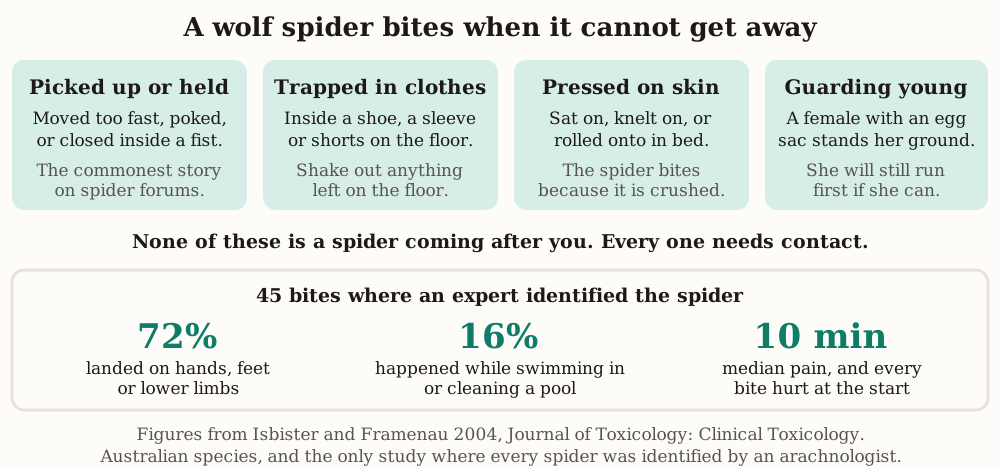
The research matches that pattern. Isbister and Framenau recorded 45 verified bites in 2004. Of those, 72% landed on hands, feet or lower limbs, and 16% happened while the person was swimming in or cleaning a pool. No bite happened at a distance, because that is not how a wolf spider behaves.
Can a wolf spider kill you?
No. Nobody has ever died from one of these bites anywhere on record. The venom is built for crickets and other small prey, not for anything our size. Isbister and Framenau found minor whole-body effects in 3 of 45 people, and the worst of those was nausea, a headache or feeling run down for a while.
So the honest answer to “are wolf spiders dangerous to humans” is no, with one condition. Any break in the skin can get infected, and that risk is real for a thorn or a cat scratch too. The spider is not the danger; a wound left dirty is.
Are wolf spiders poisonous to humans?
They are venomous, not poisonous, and the difference is more than wording. Poison is something that harms when you eat or touch it. Venom is injected, so a wolf spider has to bite you for it to matter at all. Nearly every spider on earth is venomous in that sense.
What matters is whether the venom does anything to a person. CDC NIOSH names only two spiders as venomous threats to people in the United States: the black widow and the brown recluse. Wolf spiders are not on that list, and neither is any other common house spider. Our guide to how wolf spider venom rates goes further into the spider itself.
What does a wolf spider bite feel like?
It feels like a sharp jab, closest to a bee sting or a rose thorn. Pain happened in all 45 verified bites and was severe in 11 of them, which is 24%. Yet the median duration was only 10 minutes, and the middle half of cases ran from 2 minutes to an hour. So a quarter of people did hurt for longer than an hour.
Most of that pain is mechanical. Two fangs puncture the skin, and the skin reacts the way it reacts to any puncture. Isbister and Framenau reached that conclusion directly: the effects “are likely to be due to mechanical injury,” with only minor local envenomation in some species. That explains why a bite hurts immediately and then drops off so fast.
Size changes the experience. The same study found that larger spiders more often caused severe pain and left fang marks. A heavy Hogna or Tigrosa female, 1 inch (25 mm) or more in body length, delivers a real jab. By contrast, a small Pardosa at 5 mm may not break the skin at all.
People who keep spiders describe it the same way. A widely read r/spiders thread comes from a keeper who was bitten while moving a spider too quickly. She reports that “the pain & swelling went away within an hour.” Another first-hand account calls the bite “more surprising than anything,” sore for about a day and gone with no mark.
What does a wolf spider bite look like?
It looks like a plain red bump, nothing more dramatic. In the 45 verified bites, 67% showed redness, 33% showed puncture marks or a spot of bleeding, 20% swelled and 13% itched. So two neat fang marks are the exception, not the rule. Only about a third of bites leave any mark at all.
That matters, because several popular pages lead with the fang marks. Google’s AI Overview on this topic describes “two faint fang marks” as a typical sign. The numbers say otherwise. If you are checking your skin for a pair of dots, you will miss most real bites and wrongly match plenty of other bumps.
The spot is usually small, under half an inch across, and it stays where it started. It does not develop a blister with a dark middle, and it does not spread outward over days. Those two things belong to other causes, and this page covers both further down.
Why this page shows no pictures of bites
Healthline’s page on this subject has “Pictures” in its title. We publish none on purpose. A photo of someone else’s skin invites a match nobody can make. Red bumps from twenty different causes look alike in a photograph.
Cleveland Clinic says the same thing in clinical terms: “There’s no test that can tell what kind of spider bit you.” Only seeing the spider settles it. So this page shows the spider, and every diagram here compares what happens over time rather than what a bump looks like in a stranger’s photo.
How long do wolf spider bites last? An hour by hour timeline
Pain peaks in the first minute and is typically over within 10 minutes. Redness and slight swelling follow for a few hours, and Penn State Extension reports that symptoms “generally subside within 24 hours.” A faint mark may stay for a day or two. Anything still getting worse on day 3 is not the venom.
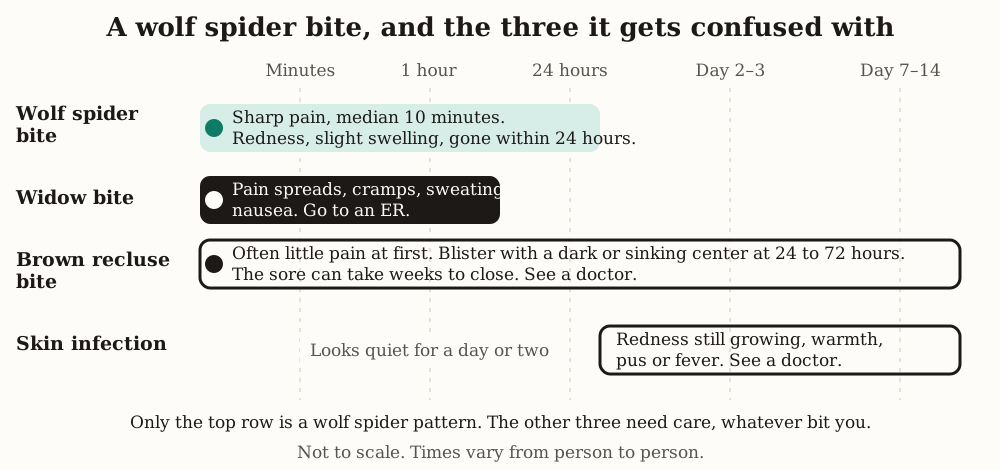
A wolf spider bite over time, and what each stage should look like
First minute
- What is normal
- Sharp pain, like a bee sting. You usually see the spider
- What would not be normal
- Pain that spreads up the limb within minutes
2–60 minutes
- What is normal
- The pain fades. Median is 10 minutes
- What would not be normal
- Hives away from the bite, a tight throat, dizziness
1–6 hours
- What is normal
- A red bump, mild swelling, sometimes a spot of blood
- What would not be normal
- Muscle cramps, sweating, vomiting, a racing pulse
24 hours
- What is normal
- Signs are fading. Most people are back to normal
- What would not be normal
- A blister forming with a dark or sinking center
Day 2–3
- What is normal
- A faint mark or a little tenderness, and nothing new
- What would not be normal
- Redness spreading outward, warmth, pus or a fever
Day 7–14
- What is normal
- Gone, with no scar
- What would not be normal
- An open sore, or a wound that will not close
Timings from Isbister and Framenau 2004 and Penn State Extension. The right-hand column points at an allergic reaction, a different spider or an infection, not at a worse bite from the same one.
People search for “day 1” and “day 7” pictures of these bites, and that search itself reveals the problem. A bite that still needs tracking on day 7 has stopped being a venom question and become a wound question. At that point the thing to watch is the redness, not the calendar.
What to do after a wolf spider bites you
Wash it with soap and water, put a wrapped cold pack on it for 10 minutes at a time, and raise the limb if it swells. That is the whole treatment, and it comes straight from CDC NIOSH and MedlinePlus. No bite like this needs antivenom, and 3 of 45 verified bites produced any whole-body effect at all.
Wolf spider bite first aid, step by step
Get the spider off you, then stop
Brush it away rather than slapping it, and step back. A wolf spider bites once and runs. It does not stay on skin and it does not come back for a second try.
Check for emergency signs first
Trouble breathing, swelling of the face or throat, hives spreading away from the bite, fainting, or pain that spreads with cramps and sweating all mean call 911. Everything below is for a reaction that stays at the bite.
Wash it with soap and water
CDC NIOSH puts washing first for any spider bite, because infection is the real risk and soap lowers it. Plain soap and running water are enough.
Put something cold on it
MedlinePlus suggests ice wrapped in a washcloth, 10 minutes on and 10 minutes off. Cold eases the sting and the swelling. Do not hold ice straight against skin.
Raise the limb if it is swelling
Most bites land on a hand, a foot or a lower leg, so this is usually easy. Elevation is a standard first aid step for a bite that swells. Loose clothing around the spot helps too.
Keep the spider if it is still there
MedlinePlus says to bring the spider with you if you seek care, so a clinician can identify it. Trap it under a cup, slide a card underneath, and take a clear photo from above. That photo answers the question. A photo of your skin cannot.
Watch the spot for two days
Redness and tenderness on the first day are the ordinary reaction. Redness that keeps spreading after that, warmth, pus or a fever needs a doctor, because those point to a skin infection rather than venom.
What not to put on it
CDC NIOSH gives one blunt instruction for any spider bite: “Do not attempt to remove venom.” So skip suction kits, cutting the skin and tourniquets. None of them works, and all of them add a wound where infection can start.
Some home routines are popular and unsupported. One r/spiders post described three days of Epsom salt baths, triple antibiotic ointment and frequent hydrogen peroxide before asking whether to go to the ER. Neither MedlinePlus nor CDC NIOSH lists any of those for a spider bite, and repeated peroxide slows healing in an open wound.
For itching or pain, an over-the-counter antihistamine or pain reliever is reasonable, used exactly as the package directs. We print no doses here. The right product and amount depend on age, weight, pregnancy and other medicines, so ask a pharmacist, and ask a pediatrician before giving anything to a child.
When to see a doctor, and when to call 911
Call 911 for trouble breathing, swelling of the face or throat, hives spreading away from the bite, or fainting. Go to an ER for pain that spreads with muscle cramps, sweating or vomiting. See a doctor within a day for redness that keeps growing after 48 hours, pus or a fever. Everything else can be watched at home.
Sort what you see: what it points to, and what to do
Sharp pain that fades in minutes, then a red bump
- What it usually points to
- An ordinary spider bite
- What to do
- Wash, cool, watch it for two days
Hives spreading, face or throat swelling, trouble breathing, fainting
- What it usually points to
- An allergic reaction
- What to do
- Call 911 now
Pain spreading with cramps, sweating, vomiting, a fast pulse
- What it usually points to
- The widow bite pattern
- What to do
- Go to an ER now, and call Poison Control on the way
A blister with a dark or sinking center after 24–72 hours
- What it usually points to
- Not a wolf spider pattern. Possibly a recluse, or another wound
- What to do
- See a doctor today
Redness growing after day 2, warmth, pus, fever, or a red streak
- What it usually points to
- A skin infection
- What to do
- See a doctor the same day. A streak means go now
A child with vomiting, belly pain or any whole-body sign
- What it usually points to
- Needs assessing, whatever bit them
- What to do
- Go to an ER. Do not wait it out
The widow pattern, and the one case in a child
Google’s AI Overview tells readers to seek care after a wolf spider bite for “severe muscle cramping, severe abdominal pain, vomiting, or a rapid pulse.” Those are real emergency signs, yet they are the black widow picture, not the wolf spider one. MedlinePlus lists spreading muscle pain, cramps, sweating and nausea under black widow spider bite.
The mix-up has a clear path. Cleveland Clinic’s wolf spider page lists cramping, severe headache, sweating, nausea and weakness under “When should I see my healthcare provider?” That list is the general venomous-spider list, written for widow and recluse bites, and the page does not say so. Readers and search engines then attach it to wolf spiders.
We keep those signs on this page, because they mean get care now whatever bit you. We just label them honestly.
There is one documented exception, and it matters. Bansal and colleagues reported a case in Wilderness and Environmental Medicine in 2026. A 10-year-old boy in Texas had nausea, vomiting, severe abdominal pain and a headache within minutes of a wolf spider bite. All of it cleared within 3 hours with supportive care. The authors call that a significant difference from the usual mild local effects. So a child with those signs goes to an ER, and nobody should say a wolf spider cannot cause them.
Is it infected?
An infection shows itself by getting worse after the first day or two, instead of better. Watch for redness that keeps spreading, warmth, swelling and pain that grow, cloudy pus, a yellow crust or a fever. Infection is uncommon after a spider bite: it happened in 7 of 750 verified bites, which is 0.9%.
Timing is the clue that separates the two. Redness in the first 24 hours is the body reacting to the puncture. Redness that starts later, or keeps growing after 48 hours, has a different cause. Draw a pen line around the edge of the red area and check it a few hours later, which is the simplest way to see whether it is actually moving.
A published case shows how this plays out. Livshits and colleagues described a 20-year-old man with a confirmed wolf spider bite who developed redness with ulceration. He had no skin necrosis. His doctors treated a wound infection with wound care and antibiotics, and his symptoms cleared. The bite was the doorway; the infection was the problem.
Do you need a tetanus shot?
Possibly, and it is worth checking. CDC NIOSH advises keeping tetanus boosters current, roughly every 10 years, because a spider bite breaks the skin and bites can be contaminated with tetanus spores. If your last booster was more than a decade ago, ask your doctor rather than wait for a reason.
ER or urgent care?
For a plain bite with a red bump, neither. Breathing trouble, face swelling, fainting or spreading pain with cramps means the ER or 911, not urgent care, because those need treatment within minutes. A sore that looks infected is urgent care or your own doctor instead, and either can prescribe antibiotics.
What wolf spider venom does, and what it does not
It causes local pain, redness and sometimes brief swelling, and that is close to the whole list. Minor whole-body effects turned up in 3 of 45 verified bites, which is 7%: two people felt nauseated, one had a headache, one felt run down. No case needed antivenom, and no case left lasting damage.
There is no antivenom for these bites anywhere, because nobody has needed one. Doctors gave antivenom in only three of the 515 wolf spider bites treated in Sao Paulo between 1979 and 1983. Ribeiro and colleagues, writing in Toxicon in 1990, read that as evidence that physicians simply do not treat these bites as severe.
One widespread claim deserves correcting. Wolf spiders are not a single species with a single venom. The family Lycosidae holds 2,552 species in 143 genera, by the World Spider Catalog’s count. WebMD’s figure of “more than 24,000” is wrong by a factor of nine. Still, a Pardosa the size of a pea and a Carolina wolf spider that spans 3 inches with its legs are not the same animal, even though neither is dangerous.
Do wolf spider bites cause necrosis, ulcers or scars?
No. Across the two largest studies of bites with the spider actually identified, 45 in Australia and 515 in Brazil, there were zero necrotic ulcers. A wider study of 750 verified spider bites of all families found the same: no necrotic ulcers at all, with a 99% confidence interval of 0 to 0.7%.
The blame has a history. Campbell, Rees and King wrote in Cutis in 1987 that wolf spiders are “often confused with the much more dangerous brown recluse spider.” Their paper adds that wolf spider envenomation “seldom causes cutaneous necrosis or systemic symptoms.” Ribeiro and colleagues went further. They concluded that the old necrosis reports had misdiagnosed Loxosceles bites, meaning recluse bites blamed on the wrong spider.
The myth survives because it is still printed. Healthline’s page ranked eighth on this search in October 2026. It opens by saying a bite leaves fang marks that “may look slightly torn,” and that “some bites may cause redness, swelling, and ulcers.” Yet its own source list includes Isbister 2004, the study that recorded no ulcers in 45 bites.
Was it even a spider that bit you?
Most of the time, nobody can say. Unless you saw the spider bite you and still have it, the bump has no label. One emergency department study found that just 3.8% of suspected spider bites were spider bites, while 85.7% turned out to be skin infections.
The commonest story on medical forums runs like this: someone sees a big spider in the bedroom on Monday, finds a sore bump on Thursday, searches for images and decides the two are connected. They almost never are. A wandering spider seen three days earlier is a coincidence, not evidence.
The moderators of r/spiders remove these posts under a rule worth repeating. Once a person has been bitten, it is usually impossible to confirm that the biting agent was even a spider, unless the culprit was caught. Cleveland Clinic says the clinical version of the same thing: no test identifies the spider.
So the useful question is not which spider, but what the wound is doing. Our comparison of real spider bites with mosquito bites walks through the same evidence. The bite identification chart then sets twenty kinds of bite side by side by timing and place, rather than by appearance alone.
Wolf spider bite or brown recluse bite?
The bites behave differently from the first minute. A wolf spider bite hurts immediately and fades within hours. A recluse bite often hurts little at first, then over 24 to 72 hours forms a blister with a dark or sinking center that can take weeks to heal. Geography settles most cases on its own.
“What’s worse, brown recluse or wolf spider?” is one of the questions Google shows on this search, and the answer is not close. The recluse is worse, and so is the black widow. Those two are the only spiders in the US whose bites are treated as a medical threat, and a wolf spider is not in that company.
How the three bites differ, from the first minute on
Pain at the moment of the bite
- Wolf spider
- Sharp at once, like a bee sting
- Brown recluse
- Often little or nothing felt
- Black widow
- Sharp pinprick, sometimes unnoticed
How long the pain lasts
- Wolf spider
- Median 10 minutes
- Brown recluse
- Builds over hours
- Black widow
- Spreads from the bite over 1–3 hours
What the skin does
- Wolf spider
- Red bump, gone within a day
- Brown recluse
- Blister, then a dark sinking center over 24–72 hours
- Black widow
- Small red mark, often with little change
Whole-body signs
- Wolf spider
- Minor nausea or headache in 7% of verified bites
- Brown recluse
- Fever and body aches in some cases
- Black widow
- Muscle cramps, abdominal rigidity, sweating, vomiting
Ulcer or necrosis
- Wolf spider
- None in 45 and 515 verified bites
- Brown recluse
- The reason the spider matters
- Black widow
- No
Where it lives in the US
- Wolf spider
- Every state, in yards and on floors
- Brown recluse
- Mostly the south-central states
- Black widow
- Across the country, in sheds and woodpiles
Antivenom
- Wolf spider
- None exists, and none is needed
- Brown recluse
- No FDA-approved antivenom in the US
- Black widow
- Antivenom exists and is used in severe cases
Telling the spiders apart is a different job from telling the bites apart, and it is easier. A recluse has six eyes in three pairs and a violin mark; a wolf spider has eight eyes with two big ones facing forward, and a hairy, striped body. For that comparison, see how to recognize a brown recluse and its real US range and the red hourglass on a widow.
The spider itself: check it, then put it outside
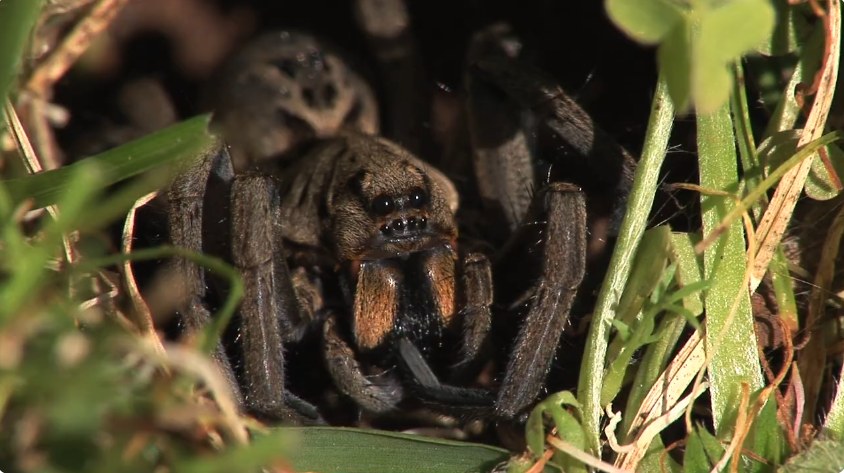
A wolf spider is hairy and brown or grey. The ones found indoors have a body of about 3/8 to 1 inch (10 to 25 mm), with a leg span of 1 1/4 to 2 1/4 inches (30 to 55 mm). Two large eyes face forward above a row of four small ones. It runs on the floor and builds no catching web, so a spider sitting in a web is not this family.
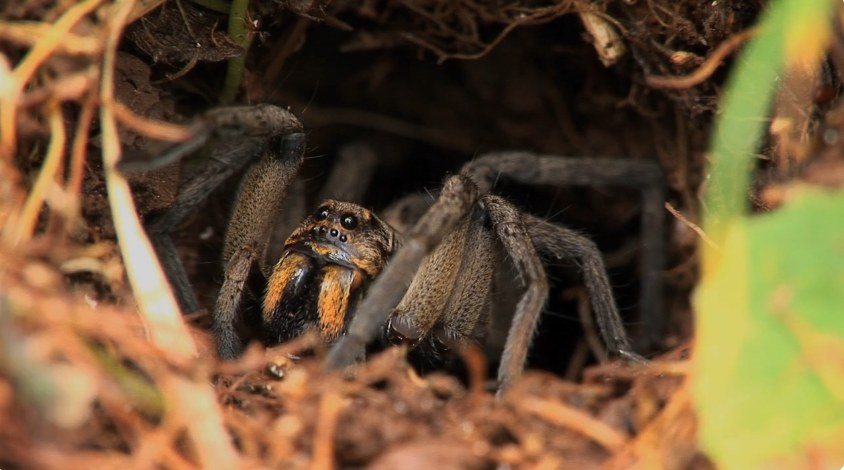
If the spider is still around, trap it under a clear cup, slide a card underneath and look at it through the side. A photo from above on white paper, with a ruler beside it, is worth more than any picture of your skin. Run that photo through our bug identifier, or compare it in our full guide to wolf spider identification.
Why shouldn’t you smash a wolf spider?
Because a female may be carrying her young. Wolf spider mothers carry an egg sac on the spinnerets and then carry the hatched spiderlings on their back, sometimes a hundred of them. Hit her with a shoe and the spiderlings scatter across your floor, which turns one spider into a problem.
There is a practical reason too. Leaning in to squash a spider is exactly the contact that causes a bite in the first place. A cup and a card take ten seconds, and nothing presses against skin.
Is it safe to pick up a wolf spider?
It is not dangerous, but it is the one thing that reliably gets people bitten. Every verified bite in the 2004 study involved contact, and keepers who handle these spiders report being bitten when they moved one too quickly. Use a cup rather than a hand, and keep children from scooping one up.
How to avoid getting bitten again
Three free habits prevent nearly all of them. Shake out shoes, boots and clothes left on a floor or in a garage. Wear gloves when you move logs, mulch, pots or pool covers. Then use a cup instead of a hand when a spider turns up indoors. Those cover the situations behind 72% of verified bites.
Wolf spiders come inside after prey and shelter, mostly in early autumn as the nights cool. So the longer-term fix is sealing the gaps they walk through and cutting the insects that draw them. Our guide to keeping these spiders out of the house covers door sweeps, outdoor lighting and the clutter they shelter under.
Seven myths about wolf spider bites
Seven beliefs about these bites come up again and again, and every one of them is wrong. Some come from forums, and several come from health sites that rank on the first page of Google.
Myth 1
Myth: “A wolf spider's bite leaves a permanent double scar.”
Truth: A claim from an old r/spiders argument, with nothing behind it. In 45 verified bites only 33% showed any puncture mark at all, and none left an ulcer or scar.
Myth 2
Myth: “These bites rot the skin and leave a hole.”
Truth: Zero necrotic ulcers in 45 Australian bites, zero in 515 Brazilian bites, and zero in 750 verified spider bites of all kinds. The old necrosis reports actually described recluse bites.
Myth 3
Myth: “The pain is so bad it puts you in the hospital.”
Truth: Pain was severe in 24% of verified bites, yet the median duration was 10 minutes. The hospital visit most of these bites earn is none.
Myth 4
Myth: “Two fang marks are how you spot one.”
Truth: Puncture marks or bleeding showed in only a third of bites. Most leave a plain red bump with nothing to count.
Myth 5
Myth: “Wolf spiders chase people and bite them in bed.”
Truth: They hunt insects on the ground and run from anything large. A bite needs someone to handle, trap or press the spider against skin.
Myth 6
Myth: “Antivenom exists for wolf spider bites.”
Truth: None exists anywhere, because nobody needs one. In Brazil, doctors gave antivenom in 3 of 515 cases. Antivenom in the US exists for black widow bites.
Myth 7
Myth: “A rabid wolf spider's bite is worse, or carries rabies.”
Truth: The rabid wolf spider, Rabidosa rabida, is named for its jerky running, not for any disease. Spiders do not carry rabies, and its bite is an ordinary one.
Medical disclaimer. This page is for general information only. It is not a medical diagnosis. If you have severe symptoms, trouble breathing, swelling of the face or throat, fast spreading redness, fever, severe pain, pus, or signs of infection, contact a doctor or your local emergency number.
Pest control disclaimer. Photo-based identification can help, but it is not always perfect. For dangerous spiders, large infestations, or anything you are unsure about, contact a licensed pest control professional.
Wolf spider bite FAQ
Do wolf spiders bite you in your sleep?
Can a wolf spider bite through clothes?
Is there antivenom for a wolf spider bite?
Do baby wolf spiders bite?
Is a wolf spider bite dangerous to a dog or cat?
Can a bite still be raised a year later?
Related guides
Wolf spider
Identification, size by species, the eye pattern, the mothers that carry young, and how to keep them out.
Brown recluse spider
The violin mark, six eyes in three pairs, the real US range, and how that bite progresses.
Black widow spider
The red hourglass, where widows hide, and the bite symptoms that need an ER.
Spider identifier
Name a spider by photo, color, markings, eyes and web type, with a venom ladder.
Bug bite identification
Twenty kinds of bite compared by look, body location, timing and feel.
Spider bite vs mosquito bite
Why an itchy bump after time outdoors is almost always a mosquito.
Hobo spider
The funnel web, the chevron pattern, and the 2017 CDC reversal on its bite.
Sources
- MedlinePlus Medical Encyclopedia, Insect bites and stings (first aid, when to call 911, and bringing the spider for identification)
- CDC NIOSH, Venomous Spiders at Work (the two venomous US spiders, first aid, “do not attempt to remove venom”, tetanus)
- MedlinePlus Medical Encyclopedia, Black widow spider (the cramping and sweating pattern this page labels as a widow sign)
- Isbister GK, Framenau VW. Australian wolf spider bites (Lycosidae): clinical effects and influence of species on bite circumstances. J Toxicol Clin Toxicol 2004;42(2):153-61 (the 45 verified bites, the 10-minute median and the zero ulcers)
- Penn State Extension, Wolf Spiders (bites when mishandled or trapped, symptoms subside within 24 hours, no serious medical consequences)
- Cleveland Clinic, Wolf Spider Bite: Symptoms & Treatment (no test identifies the spider; the symptom list this page corrects)
- Healthline, Wolf Spider Bite: Pictures, Treatment, Symptoms (the ulcer claim this page corrects)