Spider bite vs mosquito bite: the clues side by side
To settle spider bite vs mosquito bite, look past the bump. Both can leave a red, swollen mark, so the mark itself tells you little. The useful clues are what you were doing, how many bites you have, whether it itched or hurt first, and how it changes over the next two days. The table puts the strongest clue first.
Spider bites compared with mosquito bites, strongest clue first
Did you see it bite?
- Mosquito bite
- You swatted a mosquito, or heard the whine
- Spider bite
- You saw a spider on the spot, or found one crushed in your clothes
- How much it tells you
- The only proof. Without it, even doctors are guessing
What you were doing
- Mosquito bite
- Outdoors or near an open window, often around dusk or dawn
- Spider bite
- Reaching into a box or woodpile, pulling on a shoe or glove, or rolling onto one in bed
- How much it tells you
- Strong
How many bites
- Mosquito bite
- Often several, on bare skin
- Spider bite
- Almost always one
- How much it tells you
- Strong. Several bites point away from spiders
How it changes by day 2 or 3
- Mosquito bite
- A firmer itchy bump that then fades
- Spider bite
- Most settle in 1 to 2 days. A recluse bite may blister, turn purple and sink
- How much it tells you
- Strong for the rare serious bite
The first feeling
- Mosquito bite
- Itch
- Spider bite
- A sharp prick or pain, though some go unnoticed
- How much it tells you
- Some help. Reactions vary
How long it lasts
- Mosquito bite
- Itch for 3 or 4 days, swelling up to a week
- Spider bite
- 1 to 2 days for most. A recluse sore can take weeks to months
- How much it tells you
- Some help
Season
- Mosquito bite
- The warm months
- Spider bite
- Brown recluse bites mostly April to September
- How much it tells you
- Weak
Body-wide symptoms
- Mosquito bite
- Rare. A fever days later can mean a virus such as West Nile
- Spider bite
- Cramps, sweating, fever or chills can follow a widow or recluse bite
- How much it tells you
- A reason to see a doctor, not a clue to the bug
Two tiny marks
- Mosquito bite
- Not expected
- Spider bite
- Sometimes with a black widow bite, often none
- How much it tells you
- Weak. Two bumps side by side can be two bites
From CDC, CDC NIOSH, Mayo Clinic, Seattle Children’s and UC Riverside’s spider research program.
Read the table from the top. Spiders bite people only to defend themselves, when they are trapped against skin. Mosquitoes, by contrast, come looking for you. So a bite with no spider in the picture, after an evening outside, is a mosquito until something says otherwise.
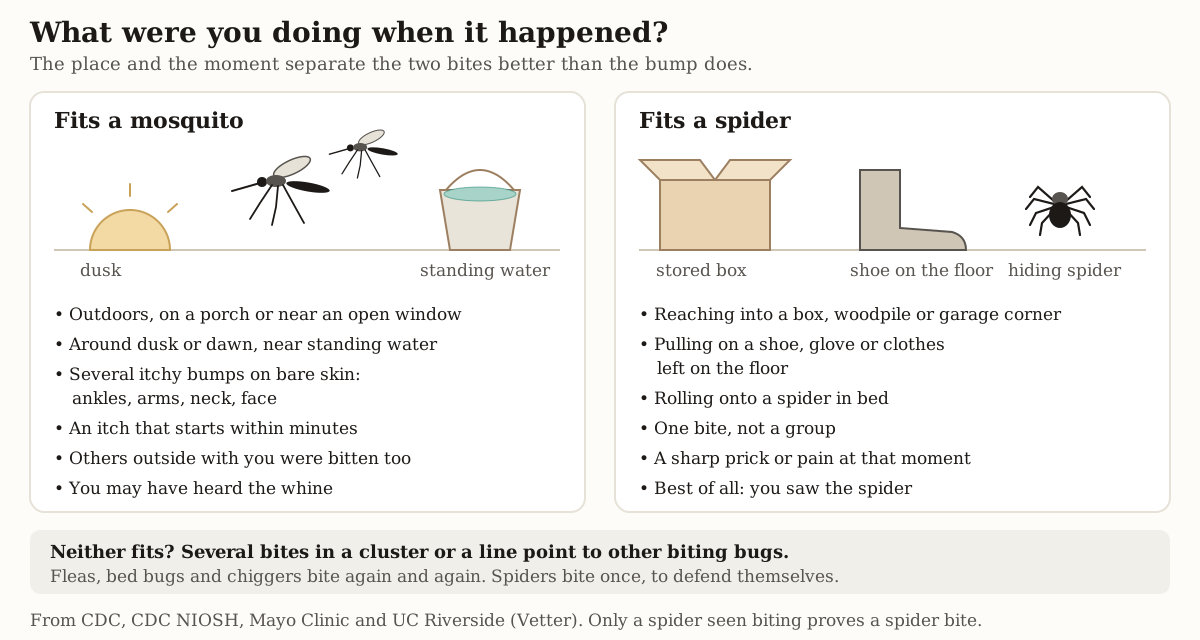
Do two fang marks mean a spider bite?
Not on their own. Google’s AI Overview for this search says spider bites may show two tiny fang marks, and several top pages offer the marks as the test. A black widow bite can leave two puncture marks, CDC NIOSH notes. Still, most spider fangs are tiny, and many bites leave no visible mark. Two bumps side by side can just as easily be two bites from a flea or a mosquito.
The bigger problem is what the fang test misses. In a study at the University of California, Irvine, 182 emergency patients said a spider had bitten them. Doctors diagnosed a real spider bite in only 7 of them, or 3.8%. In contrast, 156 people, or 85.7%, had a skin infection (Suchard, Journal of Emergency Medicine, 2011).
That is why a picture of the bite cannot settle spider bite vs mosquito bite. Mayo Clinic says that unless you saw a spider bite you, it is hard to be certain. A photo of the spider, on the other hand, can be identified. If you caught or snapped the spider, try our spider identifier.
What kind of spider bite looks like a mosquito bite?
Most of them. More than 50 kinds of US spiders have venom, but their bites cause only pain, redness and swelling, much like a bee sting, according to Seattle Children’s pediatric guidelines. These bites settle in 1 or 2 days. Bites from common house spiders and wolf spiders belong in this group.
In the first hour, such a bite can look just like a mosquito bite. The difference is the feeling. It hurt when it happened, and it does not keep itching for days the way a mosquito bite does.
How a spider bite and a mosquito bite change over hours and days
Time is the best test you have. A mosquito bite is at its worst early: a bump within minutes, a firmer itchy bump about a day later, then it fades over 3 or 4 days. Most spider bites fade even faster, in 1 or 2 days. So a bite or sore that is getting worse after day 2, not better, is the one to watch.
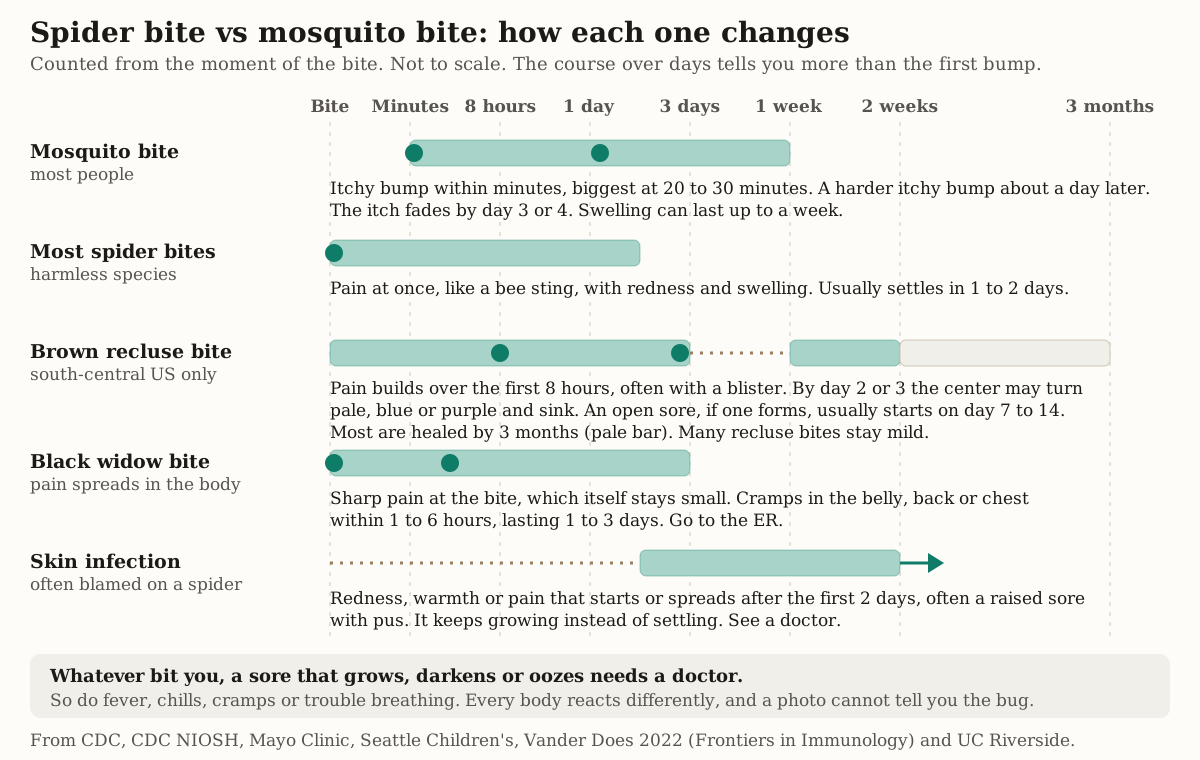
First, the mosquito bite. CDC describes a puffy, reddish bump a few minutes after the bite. Then a hard, itchy, reddish-brown bump appears a day or so later. A 2022 review in Frontiers in Immunology adds numbers: the first bump is 2 to 10 mm (about 1/8 to 3/8 inch) and peaks at 20 to 30 minutes. The second bump peaks at 24 to 36 hours.
After that, the itch fades. Most mosquito bites itch for 3 or 4 days, and the swelling can last 7 days, Seattle Children’s says. Some people also get small blisters or dark spots that look like bruises. Our guide to mosquito bites covers those normal variations.
The brown recluse bite runs the other way. According to Mayo Clinic, the pain increases over the first 8 hours. The wound can then form a pale center that turns dark blue or purple, with a red ring around it. Seattle Children’s gives the pace: a blister within 4 to 8 hours, and a bluish, sunken center over 2 to 3 days.
Some recluse bites go on to open into a sore. UC Riverside’s spider experts say that usually happens on day 7 to 14, and most are healed by the third month. Many recluse bites, however, never get that far.
A black widow bite is different again. The bite itself stays small, but the venom acts on nerves. Pain spreads from the bite to the belly, back or chest. Severe cramps can start within 1 to 6 hours, Seattle Children’s says, and Mayo Clinic notes that symptoms can last 1 to 3 days.
Is it getting worse after two days?
This is the question that matters most. Redness that shows up in the first day is your body reacting to the bite, Seattle Children’s explains. In contrast, painful redness that starts or spreads after 48 hours can be an infection, and needs a doctor within a day. CDC adds that an infected bite may look red, feel warm, or send a red streak outward from the bite.
A pen helps here. Draw around the edge of the redness, then check it that evening and the next morning. A line the redness has crossed is a clear sign it is spreading.
Most “spider bites” are not spider bites
Most sores people call spider bites turn out to be something else. In the Irvine emergency study, 85.7% of suspected spider bites were skin infections, and only 3.8% were spider bites. Infections, other bug bites and skin conditions are simply far more common than a spider that bites.
The brown recluse shows this best. Rick Vetter, the spider researcher at UC Riverside, has collected medical reports of skin problems that doctors misdiagnosed as recluse bites. They include staph and strep infections, shingles, poison ivy, flea and mite bites, and the bull’s-eye rash of Lyme disease.
Meanwhile, where recluses really live, bites are rare. One Kansas family collected 2,055 brown recluses in their home in 6 months. Yet in 8 years, no one in the house showed a sign of a bite (Vetter and Barger, 2002).
So if you did not see a spider, think of the sore as a sore. A doctor can examine it and, if needed, test it for bacteria such as MRSA, a staph germ that resists some antibiotics. That matters, because an infection treated as a spider bite keeps getting worse. If a ring-shaped rash appeared after time in tall grass, read what a tick bite and a Lyme rash look like.
Spider bite or skin infection: the signs doctors look at
Doctors who see recluse bites use a checklist called NOT RECLUSE. Two dermatologists and Vetter published it in JAMA Dermatology in 2017. Each sign below makes a recluse bite unlikely and points toward another cause.
Signs that point away from a brown recluse bite (NOT RECLUSE)
Several sores at once, or in several people
- Why it points elsewhere
- Spiders bite once, to defend themselves
- What it may be instead
- Bites from fleas, bed bugs or mites, an infection, or shingles
It showed up after gardening
- Why it points elsewhere
- Recluses do not live in green plants
- What it may be instead
- A fungal skin infection picked up from plants
It appeared between October and March
- Why it points elsewhere
- Most recluse bites happen April to September
- What it may be instead
- Something other than a recluse
A red center
- Why it points elsewhere
- A serious recluse bite is pale, blue or purple in the middle
- What it may be instead
- An infection, or another bug bite or sting
Raised high above the skin
- Why it points elsewhere
- Recluse bites are flat or slightly sunken
- What it may be instead
- A bacterial infection such as MRSA
It opened before day 7
- Why it points elsewhere
- Recluse sores usually open on day 7 to 14
- What it may be instead
- Another skin condition
Major swelling below the neck
- Why it points elsewhere
- Recluse bites rarely swell much there
- What it may be instead
- Cellulitis (a skin infection), or a bee, wasp or ant sting
Oozing pus or fluid
- Why it points elsewhere
- Recluse bites are usually dry
- What it may be instead
- A bacterial infection, the most common look-alike
From Stoecker, Vetter and Dyer, JAMA Dermatology 2017, as summarized by UC Riverside. Its authors made it to help doctors, not for self-diagnosis.
Read it as a reason to see a doctor, not as a reason to relax. Most of these signs point to an infection, and an infection needs treatment as much as a bad bite does. UC Riverside suggests printing the list and taking it to the appointment.
The two US spiders whose bites matter
Only two groups of US spiders cause bites that need medical care: widow spiders and recluse spiders. CDC NIOSH names the black widow and the brown recluse as the venomous US spiders to know. Both are shy, and both bite only when pressed against skin.
Brown recluse: only in the south-central states
The brown recluse lives in a fixed part of the country. Its native range runs from southeastern Nebraska south to Texas. From there it reaches east to Georgia, the western tip of South Carolina and southern Ohio, according to UC Riverside’s range notes and map. A few related recluses live in the deserts of the Southwest.
Outside that range, a recluse bite is very unlikely. In four western states, Vetter and colleagues counted 216 recluse bite diagnoses in 41 months. Yet only 35 recluse spiders had ever been verified in those states. To check the spider itself, look for the violin mark and six eyes in three pairs, shown in our brown recluse identification guide.
Black widow: pain that spreads
The adult female black widow is shiny black with a red or orange hourglass on her underside. Black widows live throughout North America, most commonly in the southern and western US, CDC NIOSH says. They build webs in woodpiles, sheds, outdoor toilets and other quiet corners.
A widow bite feels sharp at once. Then the pain spreads, with cramps, sweating or nausea within hours. That spreading pain, not the look of the bite, is what sets it apart. Our black widow guide shows the markings and the look-alikes.
What about wolf spiders and hobo spiders?
A local TV health piece that ranks for this search names the wolf spider as one to watch out for. In fact, a wolf spider bite hurts but is not dangerous, and its venom causes only local pain and swelling. The hobo spider is not on CDC NIOSH’s venomous spider page either. Our guides to the wolf spider and the hobo spider explain why.
What to do for a spider bite or a mosquito bite
Start the same way for both bites: wash, then cool. For a mosquito bite, that plus an anti-itch cream is usually all you need. For a suspected spider bite, CDC NIOSH adds three steps. Raise the limb, identify the spider if you can do it safely, and get medical care if symptoms appear.
What to do right after the bite
Wash the bite
Clean the bite and the skin around it with soap and water. This is the first step for either bite.
Cool it
Hold a cloth soaked in cold water, or ice wrapped in a cloth, on the bite to ease swelling and pain. CDC suggests 10 minutes at a time for a mosquito bite.
Raise the arm or leg
If a spider bit a hand, arm, foot or leg, keep it raised when you can. It helps the swelling go down.
Get a look at the spider, safely
If it is still there, trap it in a jar or take a clear photo. Do not pick it up with bare hands. Knowing the spider helps a doctor choose care.
Do not cut, suck or squeeze the bite
You cannot draw venom out, so do not try. Skip a tourniquet too. Breaking the skin only lets bacteria in.
Watch it for two days
Check the bite each morning and evening. Mark the edge of any redness with a pen, so you can tell whether it is spreading. Use the warning signs below to decide when to get help.
CDC also suggests an over-the-counter anti-itch or antihistamine cream for a mosquito bite, used as the label directs. Above all, try not to scratch, because broken skin is how bites get infected. CDC NIOSH also advises keeping tetanus shots up to date, every 10 years, because spider bites can become infected with tetanus.
Which is more dangerous, a spider bite or a mosquito bite?
Day to day, the mosquito. One mosquito bite is only a nuisance, but mosquitoes spread germs such as West Nile, dengue and Zika viruses, CDC says. Spiders do not feed on blood, so they do not carry germs from one person to the next. Serious spider bites, meanwhile, are rare and treatable.
Even West Nile, the most common mosquito-borne virus in the US, usually passes quietly. About 8 in 10 infected people never feel ill. About 1 in 5 get a fever and flu-like illness, and less than 1% become seriously ill, according to CDC. Symptoms usually start 2 to 6 days after the bite.
For black widows, deaths are now virtually unheard of thanks to modern medical care, UC Riverside notes. Still, a widow bite with spreading pain is an emergency, and a darkening recluse wound needs a doctor.
Other bites that get blamed on spiders
When a bite is neither a clear mosquito bite nor a spider you saw, a few other biters are more likely. Each has one giveaway, usually the number of bites or where they are. Our comparison pages go through each one.
Bites people often mistake for spider bites
Small bites in groups on the ankles and lower legs, with a pet at home
- What it likely is
- Fleas
- Where to read more
- Flea bites vs mosquito bites
Bites found on waking, night after night
- What it likely is
- Bed bugs, or a mosquito in the room
- Where to read more
- Bed bug vs mosquito bites
A small bug still fixed in the skin, or a bite after a hike
- What it likely is
- A tick
- Where to read more
- Tick bite
A burning sting near a mound, then a white pustule within a day
- What it likely is
- Fire ants
- Where to read more
- Fire ant bites
A mosquito bite that swells into a big, hot patch
- What it likely is
- A large reaction to the mosquito bite
- Where to read more
- Skeeter syndrome
Fleas and mosquitoes are the pair people mix up most, and our guide to flea bites versus mosquito bites sorts them by place and pattern. For bites found in bed, see how bed bug bites compare with mosquito bites. A tick usually stays attached, and our tick bite guide covers what to do next. To compare 20 kinds of bites at once, use the bug bite identification chart.
Spider bite or mosquito bite? What to do next
Match what you have to the table below. For most readers, the spider bite vs mosquito bite question ends at the first row: an itchy mosquito bite that needs a cold pack and two days of patience. The later rows are the ones that need a doctor, whatever caused them.
What you have, what it likely is, and what to do
One or more itchy bumps after time outdoors, itching within minutes
- What it likely is
- Mosquito bites
- What to do
- Wash, cool, use an anti-itch cream as labeled, and leave them alone
One painful bump right after moving a box or pulling on a shoe, easing within a day or two
- What it likely is
- A harmless spider bite, most likely
- What to do
- Wash, cool, raise the limb and watch it for two days
You saw a black widow, or pain spreads with cramps or sweating
- What it likely is
- A possible black widow bite
- What to do
- Go to the ER now. Bring the spider in a jar if it is safe
A sore that blisters, turns purple or sinks over 2 to 3 days, in a recluse state
- What it likely is
- A possible recluse bite
- What to do
- See a doctor today
A raised, hot, swollen sore, often with pus, worse after day 2
- What it likely is
- Most likely a skin infection
- What to do
- See a doctor today. Do not squeeze it
Many bites in a cluster or a line, indoors
- What it likely is
- Fleas or bed bugs, not a spider
- What to do
- Check the pets and the bed
To avoid the next spider bite, shake out shoes, gloves and clothes left in the garage before you put them on. Wear gloves when you move boxes or firewood, as CDC NIOSH advises. To avoid the next mosquito bite, empty standing water each week and use an EPA-registered repellent, following the label. Our guides to picaridin and DEET and getting rid of mosquitoes cover both. For everything else about the insect, start at our complete guide to mosquitoes.
Medical disclaimer. This page is for general information only. It is not a medical diagnosis. If you have severe symptoms, trouble breathing, swelling of the face or throat, fast spreading redness, fever, severe pain, pus, or signs of infection, contact a doctor or your local emergency number.
Spider bite vs mosquito bite FAQ
What are 5 signs and symptoms of a spider bite?
Do spider bites itch?
Can a spider bite you in your sleep?
Should I pop or squeeze a spider bite?
Can a mosquito bite look like a spider bite?
Related guides
Mosquitoes
The hub: what mosquitoes are, how to spot one, and every mosquito guide on the site.
Mosquito bites
What a normal bite looks like, how long it lasts, and the signs that need a doctor.
Flea bites vs mosquito bites
Small bites on the ankles: how place and pattern separate the two.
Bed bug vs mosquito bites
Woke up with bites? The clues in the bed, and how to confirm them.
Brown recluse spider
The violin mark, six eyes, the real range, and how a bite progresses.
Black widow spider
The red hourglass, male vs female, and the bite symptoms that need an ER.
Spider identifier
Caught the spider? Name it by color, markings, eyes and web.
Skeeter syndrome
When a mosquito bite swells to the size of a palm, and what helps.
Tick bite
Found something attached? Take it off, keep it, and note the date.
Bug bite identification
A chart of 20 bites by look, place and timing.
Sources
- CDC NIOSH, Venomous spiders
- CDC, About mosquito bites
- CDC, Symptoms of West Nile virus disease
- Mayo Clinic, Spider bites: symptoms and causes
- Seattle Children's, Spider Bite (Schmitt Pediatric Guidelines)
- Suchard JR, "Spider bite" lesions are usually diagnosed as skin and soft-tissue infections, J Emerg Med 2011
- UC Riverside (Vetter), NOT RECLUSE: what is not a recluse bite
- UC Riverside (Vetter), Causes of necrotic wounds other than brown recluse bites, with range map