Love bugs are short-lived flies that swarm across the Gulf states in spring and late summer. They do not bite, sting or harm pets, so the goal here is not to kill them. It is to keep them off your paint, out of your rooms and out of your face until the flight is over. Our page on what love bugs are explains why they fly in pairs.
How to get rid of love bugs, and why you cannot clear them
You cannot get rid of love bugs from your yard or your street. Extension entomologists in Florida, Louisiana, Texas, Mississippi and Georgia all say the same thing. Adults drift in constantly from fields, pastures and roadsides around you, and each one lives only a few days, so spraying kills a handful that are replaced within the hour.
A University of Georgia entomologist put it plainly: to make a difference, you would have to spray the whole grassy roadside every two hours for several weeks. So here is how to get rid of love bugs in practice, in three parts. Protect your car, keep them out of the house, and wait about four weeks for the flight to end.
How to get love bugs off your car
The best way to get love bugs off your car is to soak them, then wipe, and to do it fast. Fresh splatter is close to neutral, about pH 6.5. Within 24 hours bacteria turn it acidic, about pH 4.25. Even so, UF/IFAS found no paint damage after 21 days indoors, so the real enemy is the sun baking it on.
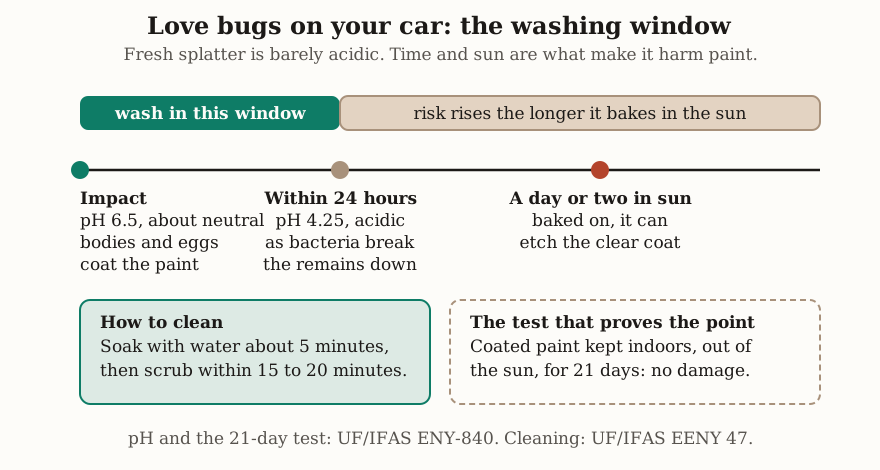
Love bug removal from a car, step by step
Wash the same day if you can
Fresh remains are close to neutral and come off easily. Within 24 hours they turn acidic, and once the sun bakes them for a day or two they can etch the clear coat.
Soak the front of the car for about five minutes
Wet the bumper, grille, hood edge, mirrors and windshield with plain water and keep them wet. Soaking softens the bodies and eggs, so you scrub less.
Wipe within 15 to 20 minutes
Use a soft, wet microfibre cloth or a wet dryer sheet and wipe gently. Rewet any patch that starts to dry.
Use a bug remover on stubborn spots
A car-safe bug and tar remover lifts what water leaves behind. Follow the label and rinse it off.
Wash, rinse and dry as normal
Finish with car shampoo and water, then dry the paint so no residue is left to bake.
Wax the front of the car
A fresh coat of wax or a paint sealant keeps the next batch from sticking and makes the next wash quicker.
Check the radiator grille
In a heavy flight, packed bodies can block air through the radiator and make the engine overheat. Rinse the grille from the engine side outward if you can reach it.
For the windshield, run the washer fluid as soon as they start hitting, before they dry. Wipers on dry glass just smear them. Then clean the glass properly when you stop.
Why love bugs damage paint
It is not instant acid. Each splattered fly, especially a female full of eggs, leaves a sticky coat. Bacteria slowly make it more acidic, and heat from the sun bakes it into the clear coat. Modern paints resist it better than older ones did, but remains left to bake for a few days can still mark the finish.
What not to use on paint
Drivers on Reddit warn against all of these. Skip abrasive sponges and scouring pads, including melamine foam erasers, because they can dull the clear coat. Avoid household solvents and cooking spray, which are not made for paint. Also, do not take a car caked in dried bugs through a brush car wash first, since the brushes can drag the grit across the paint.
Pressure washers get mixed advice online, but no study has tested one on love bugs. A five-minute soak with a garden hose does the same job more gently. If you use one, keep the nozzle well back from the paint.
How to protect your car before you drive
Prevention matters most if you drive highways during a flight. A waxed car is the single biggest help, and UF/IFAS pairs it with one rule: get the remains off within 24 hours.
- Wax the front of the car, or use a paint sealant, before the flight starts.
- Fit a hood deflector, which lifts the air and some of the bugs over the car.
- On long trips, hook a nylon bug screen over the front grille to protect the radiator.
- Drive early in the morning or after dark if you can. They do not fly at night.
- Drive a little slower on highways, which UF/IFAS also suggests.
- Keep the washer fluid topped up, and carry a damp cloth or a few dryer sheets.
Highways are worst from about 10 AM to 4 PM on days above 82°F, because sunlit exhaust fumes draw the pairs to traffic. Trucks and vans need checking too. Texas A&M notes that packed love bugs can make the cooling units of refrigerated vans fail, as well as clog radiators.
How to keep love bugs away from your house
The way to keep love bugs away from your house is to keep them from getting in, not to make the house unattractive. Wind decides where they land. Homes downwind of a field or a pasture collect them, and owners often think the house is drawing them in, UF/IFAS notes. Love bugs are weak fliers, so air and mesh stop them.
- Keep doors closed during the day, when they fly.
- Check window and door screens, especially on the side the wind comes from.
- Run your air conditioner fan so the house pushes air out, not in. Weak fliers cannot get through.
- Put an outdoor fan on the porch or patio. A steady breeze keeps them off a seating area.
- Postpone outdoor painting until the flight is over, because fresh, light paint attracts them.
Light-coloured walls and freshly painted surfaces collect more love bugs. You do not need to repaint a white house, but if a paint job is due, book it outside the April to May and August to September flights.
Love bugs in the yard, and inside
The larvae live in damp lawn thatch and rotting leaves, where they eat dead plant matter and do no harm. Mississippi State says controlling the larvae is not feasible, and spraying adults in the yard does not help much either, because new ones arrive hourly during a heavy flight. So leave the lawn alone.
If you are outside a lot, take shady paths away from freshly mown grass, where fewer of them fly. Glasses or sunglasses keep them out of your eyes on a walk or a bike ride.
Inside, a few love bugs will get in. Vacuum them up, or simply wait, because they live only a few days. You do not need to treat the house.
If the dark specks indoors keep arriving after the flight ends, they are something else. A love bug is about 1/4 inch with a red thorax and it is slow and clumsy, so anything quick, jumping or hiding in a seam is not one. Our guide to the small black bugs found indoors sorts the common ones by size and room, a dark fly that runs across a surface more than it flies is usually a phorid fly from a drain, and a weak drifting fly around a houseplant is a fungus gnat from wet potting soil.
Does any love bug repellent work?
No love bug repellent has been shown to work. Nobody has found a scent that drives them off. In fact, research shows floral scents attract them, and so does anethole, the anise-like smell in some plant oils. Here is how the common advice holds up.
Love bug remedies and repellents, against the evidence
Insecticide sprays
- Does it work?
- No
- Why
- Extension experts call them of no value. New adults keep drifting in
Foggers and bug bombs
- Does it work?
- No
- Why
- Same problem, plus a risk to people and pets
Mouthwash, dish soap, citrus or vinegar sprays
- Does it work?
- No evidence
- Why
- Soap kills the few it hits. None has been tested as a repellent
Peppermint or other essential oils
- Does it work?
- No evidence
- Why
- Never tested on love bugs. Some plant scents attract them
Yellow bug bulbs on the porch
- Does it work?
- No
- Why
- Love bugs do not respond to lights and do not fly at night
Baby oil on the car front
- Does it work?
- Untested
- Why
- Wax does the same job and is made for paint
Wax or paint sealant on the car
- Does it work?
- Yes, for cleaning
- Why
- Remains wipe off before they can bake on
Wet dryer sheets
- Does it work?
- Yes, for cleaning
- Why
- UF/IFAS suggests them for easy removal
Fans, screens, closed doors
- Does it work?
- Yes
- Why
- Weak fliers cannot get through moving air or mesh
Removing standing water
- Does it work?
- No
- Why
- That is mosquito advice. Love bug larvae live in damp thatch, not water
What about traps?
University of Florida researchers tested traps. A yellow funnel trap baited with a floral scent caught love bugs well, with only about 6% other insects, and the lure lasted two weeks. However, a trap catches the ones nearby while thousands more drift in, so it is a research tool, not a fix for a yard.
What kills love bugs, and why spraying fails
Almost anything kills a love bug it touches, even soapy water. That is not the problem. As UF/IFAS puts it, spraying can only kill the love bugs that are present, and more arrive all day. Treating an area costs money, puts chemicals around people and pets, and changes nothing by the next morning.
Spraying also kills the wrong insects. Several black and red insects get mistaken for love bugs, and some of them are helpful. For example, the boxelder bug and the soldier beetle are both harmless. If you are not sure what you have, check the look-alikes on our love bugs page first.
When will love bugs go away?
Waiting is the last part of how to get rid of love bugs, and the surest. Each flight lasts about four weeks. Across Florida and the Gulf states, the spring flight runs through April and May and the late summer flight through August and September. Numbers peak about two weeks in, then drop fast as the short-lived adults die off. Our guide to love bug season has the months for each state.
Myths about getting rid of love bugs
Myth 1
Myth: “A homemade spray recipe keeps them away.”
Truth: No spray has been tested as a repellent. Soap kills only the few it hits.
Myth 2
Myth: “You need several fogger treatments.”
Truth: Foggers do not control love bugs at all. New adults drift in from the land around you.
Myth 3
Myth: “Yellow porch bulbs keep them off the house.”
Truth: Love bugs do not fly at night or respond to light traps. Wind and light paint decide where they land.
Myth 4
Myth: “Their acid ruins paint in minutes.”
Truth: Fresh remains are near neutral. Paint damage takes time and sun, so a wash within a day prevents it.
Myth 5
Myth: “Draining standing water will cut their numbers.”
Truth: Love bug larvae live in damp thatch and rotting leaves, not in water. That tip is for mosquitoes.
Something bit you during a swarm? It was not a love bug. Our bug bite guide can help you find the culprit, and our kissing bug identification guide covers the black and red bug that does bite.
Pest control disclaimer. Photo-based identification can help, but it is not always perfect. For dangerous spiders, large infestations, or anything you are unsure about, contact a licensed pest control professional.
Frequently asked questions
What makes love bugs go away?
What smells do love bugs hate?
What kills love bugs instantly?
Why are love bugs all over my car?
Do love bugs damage car paint?
Is it safe to use a pressure washer on love bugs?
Does dryer sheet removal hurt car paint?
Related guides
Love bugs
What they are, why they fly joined, and the lab myth.
Kissing bug
The black and red bug that does bite, and how to tell it apart.
Boxelder bug
Red and black, harmless, and in your house every fall.
What eats mosquitoes?
Love bugs never did. Here is what does.
Natural ant repellent
Which home remedies work on ants, and which are myths.
Sources
- UF/IFAS ENY-840, Living with Lovebugs (Leppla): pH figures, the 21-day test, wax, positive pressure, insecticides of no value
- UF/IFAS EENY-47, Lovebug, Plecia nearctica Hardy: soak five minutes then scrub, deflectors and screens, radiators
- UF News, Lovebugs are back! (May 19, 2026): dryer sheets, fans, screens and closed doors, shady paths
- UF/IFAS Gardening Solutions, Lovebugs: waxing, front screens, driving at night or slower
- Mississippi State University Extension, Bug's Eye View: Lovebug (Layton, 2018): yards, larvae, painting
- Texas A&M Forest Service, Lovebugs: not attracted to electric lights, refrigerated vans
- UGA CAES Field Report, Plague of Lovebugs Probably Over (2000): why roadside spraying fails
- Arthurs, Morales-Reyes and Cherry 2015, trap design for lovebugs, Florida Entomologist 98:892