Part 1 of 6
Start here
What eats mosquitoes? The short list, and the catch
Bats, dragonflies, damselflies, birds, spiders, frogs, fish, copepods and some other mosquitoes all eat mosquitoes. But most are generalists that take a mosquito when one is handy. In the studies we read, predators of the water stage have the strongest record. Only one small test shows a predator of flying adults making a dent. That is the honest answer to what eats mosquitoes: many animals, but few that make a difference.
The reason is simple. A mosquito is a tiny meal, so a hunting bat or bird does better on moths and beetles. Meanwhile, a mosquito goes from egg to adult in about two weeks, and sometimes in as little as 4 days. As the West Baton Rouge Parish mosquito program puts it, predators play a part, but not to an extent that counts as control.
What eats mosquitoes, which stage, and whether it helps your yard
Bats
- Stage it eats
- Flying adults
- How strong the evidence is
- Mosquito DNA in many droppings; amount unknown; one enclosure test cut egg-laying 32%
- Can a homeowner encourage it?
- Yes, by protecting roosts; bat houses are slow to fill
Dragonflies and damselflies
- Stage it eats
- Adults and larvae
- How strong the evidence is
- Nymphs eat about 40 larvae a day in lab containers; no field count for adults
- Can a homeowner encourage it?
- Yes, with a clean pond and native plants
Spiders
- Stage it eats
- Flying and resting adults
- How strong the evidence is
- They catch what reaches the web; one African spider prefers mosquitoes
- Can a homeowner encourage it?
- Leave them alone
Swallows, nighthawks, hummingbirds
- Stage it eats
- Flying adults
- How strong the evidence is
- Eat small flies; no study counts their mosquitoes
- Can a homeowner encourage it?
- Yes, with native plants and nest sites
Purple martins
- Stage it eats
- Flying adults
- How strong the evidence is
- No mosquitoes in 230 stomachs or 350 food samples
- Can a homeowner encourage it?
- Yes, but not for mosquitoes
Copepods
- Stage it eats
- Young larvae
- How strong the evidence is
- Over 40 larvae a day each; 99 to 100% fewer Aedes in containers
- Can a homeowner encourage it?
- No; used by control programs
Toxorhynchites larvae
- Stage it eats
- Larvae
- How strong the evidence is
- Up to 5,000 prey larvae in one lifetime; released by some programs
- Can a homeowner encourage it?
- Not sold; some may arrive on their own
Fish in ponds
- Stage it eats
- Larvae
- How strong the evidence is
- Keep permanent ponds fairly free of larvae
- Can a homeowner encourage it?
- Yes, native fish in a pond
Mosquitofish
- Stage it eats
- Larvae
- How strong the evidence is
- Eat larvae, but harm native fish and frogs
- Can a homeowner encourage it?
- Ask your district first; restricted in some states
Frogs and lizards
- Stage it eats
- Adults (and a few tadpoles eat larvae)
- How strong the evidence is
- Eat some; no count found
- Can a homeowner encourage it?
- Yes, a healthy pond helps
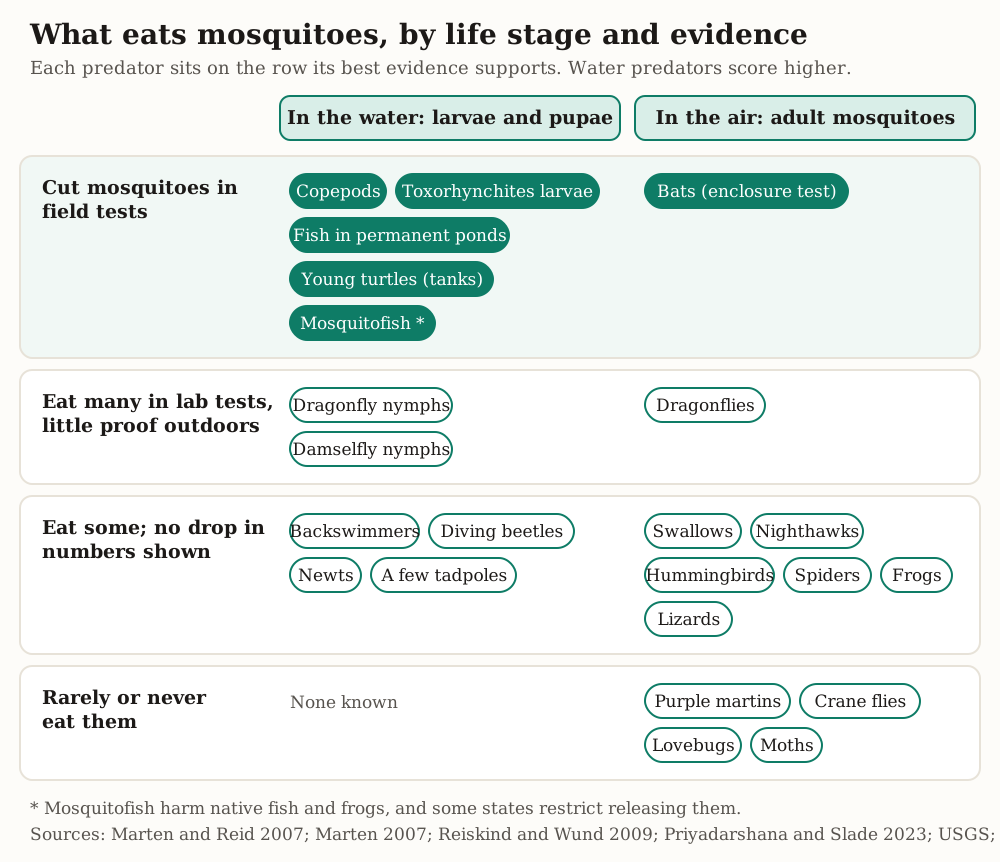
Our reading: welcome every one of these animals, but do not count on them. The free steps in our guide to getting rid of mosquitoes in the yard cut more bites than any predator. Each animal on the list is covered below, with the study behind its row.
Part 2 of 6
Bats
Do bats eat mosquitoes?
Bats are the first answer most people give to what eats mosquitoes, and they do eat them, more often than scientists once thought. In a 2018 Wisconsin study, mosquito DNA turned up in 71.9% of little brown bat dropping samples and 33.3% of big brown bat samples. Still, that shows how often bats eat mosquitoes, not how many. Mosquitoes are one part of a mixed diet of moths, beetles and other insects.
The study, by Amy Wray and colleagues at the University of Wisconsin, used droppings collected under 22 bat roosts in the summer of 2014. The team found 17 kinds of mosquito, 15 named to species. Little brown bats had eaten mosquitoes at every site, according to the paper in the Journal of Mammalogy. Big brown bats, which are larger, ate them at half the sites.
Other DNA studies agree. In Florida, a 2022 study of 180 dropping samples from three bat species found the southern house mosquito, a West Nile carrier, in 51.3% of the bats. In Australia, mosquitoes showed up only in the two smallest bats tested, at 4 and 4.5 grams.
Why “often” does not mean “a lot”
A DNA test answers one question: did this bat eat any mosquito? A sample with one mosquito and a hundred moths still counts as a yes. That is why the old gut studies and the new DNA studies seem to disagree. The American Mosquito Control Association (AMCA) notes that mosquitoes made up less than 1% of the gut contents of wild bats in every study it reviewed.
Both can be true at once. Bats may eat mosquitoes on most nights, yet still get most of their food from bigger insects. Wray, the lead author, said as much: the study does not show whether bats actually suppress mosquito populations.
How many mosquitoes do bats eat? Where “1,000 an hour” came from
No one has counted how many mosquitoes a wild bat eats in an hour. The famous 1,000 most likely traces to a 1960 Harvard study of how bats find insects by echolocation. In that test, the best catcher took about 10 mosquitoes a minute, for 15 minutes, in a closed room stocked with mosquitoes.
The details matter. Donald Griffin’s team put little brown bats and small-footed bats into a room 8 by 16 feet, with about 2,000 mosquitoes at the start. Fewer than 1 in 10 bats showed any catching behavior, an entomologist at the mosquito company VDCI found when he reread the paper. The team then worked out catches from how much weight each good catcher gained. The top rate, 9.5 a minute, came from one small-footed bat.
From there, the number grew in the retelling. Ten a minute became 600 an hour, a figure AMCA says bat expert Merlin Tuttle worked out. Then 600 was rounded up to 1,000, and a popular Reddit post now says 1,200. Each step assumes a wild bat eats nothing but mosquitoes, at a lab rate, for a full hour.
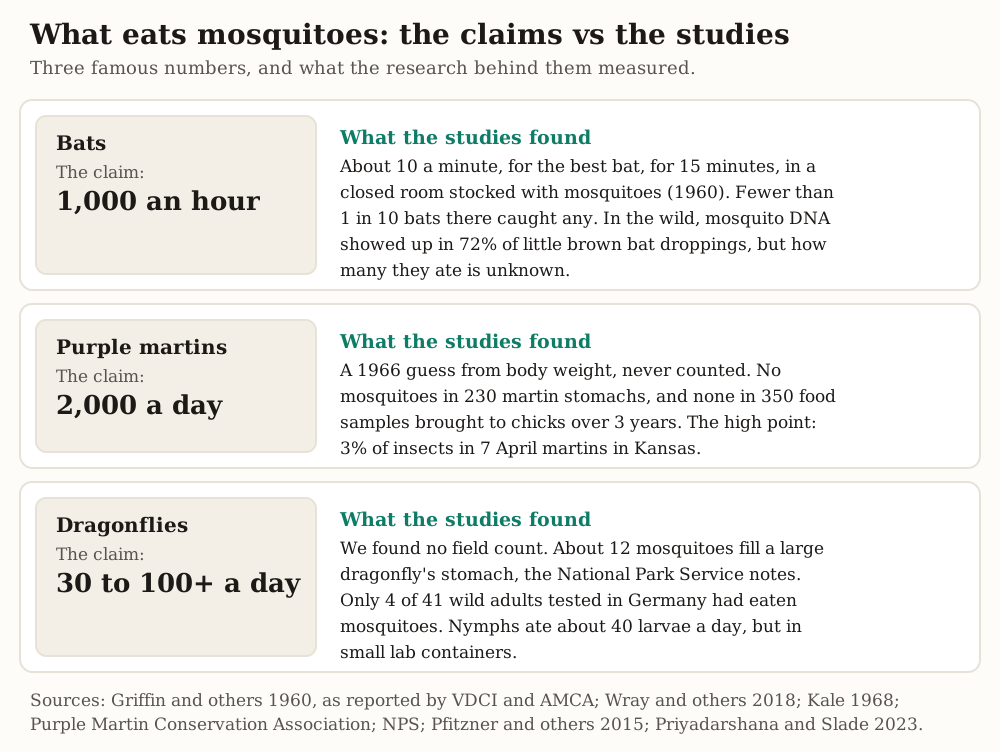
There is a better way to estimate it. A 2013 Australian study did the math for a 4-gram bat. To meet its energy needs on mosquitoes alone, it would need about 600 to 660 in a whole night. The same bat would need only 160 to 180 moths. In other words, one small moth is worth about four mosquitoes to a hungry bat.
Do bats lower mosquitoes in a yard?
There is one real test, and it found an effect. In Michigan, Michael Reiskind and Matthew Wund let northern long-eared bats hunt inside enclosures, using wild mosquitoes. There was 32% less egg-laying in water inside the bat enclosures. They also found fewer larvae there. The authors called for more research before anyone relies on it.
Large-scale tries have failed, though. In the early 1900s, Dr. Charles Campbell built bat towers around San Antonio to fight malaria, and AMCA reports that mosquito numbers did not change. In 1929, a fishing lodge owner in the Florida Keys built one more. The bats he put in it reportedly flew away and never came back.
Will a bat house reduce mosquitoes?
Probably not by much. A bat house helps bats, which have declined from white-nose syndrome, and bats eat many garden and farm pests. However, bats can take a year or more to move into a new house, an Oregon extension office notes, and some never do. Bat Conservation International no longer recommends single-chamber houses.
On Reddit, one gardener said bats wiped out their mosquitoes once a colony moved in, while another put up a well-reviewed house and got nothing. Both are honest. Whether bats come depends on what already lives nearby, not on the box.
Part 3 of 6
Dragonflies and other bugs
Do dragonflies eat mosquitoes?
Yes, dragonflies are a true part of what eats mosquitoes, at both stages of their lives. Dragonfly nymphs hunt mosquito larvae in the water, and adults catch flying mosquitoes. A 2023 review of 31 lab studies found one nymph eats about 40 larvae a day. For adults, though, no one has measured how many mosquitoes a wild dragonfly eats in a day.
That review, by Tharaka Priyadarshana and Eleanor Slade, pooled tests of 47 kinds of dragonfly and damselfly nymphs from 14 countries. On average, one nymph cut the larvae in a container by 45% a day, and it made no difference whether the prey was Aedes, Anopheles or Culex. The authors call dragonflies effective control, based on their meta-analysis. Keep in mind that a small container leaves the larvae nowhere to hide.
How many mosquitoes does a dragonfly eat a day?
The figure on Google’s results page, “30 to over 100 mosquitoes per day”, comes from a Reddit post with over 11,000 upvotes. That post linked a Collier County, Florida mosquito district article. But the article itself calls the range an estimate, and it adds that the National Park Service puts the real number near the low end.
The Park Service gives the reason: about 12 mosquitoes fill the stomach of a large dragonfly. Field tests back up a modest number. In Germany, researchers tested the guts of 41 wild dragonflies and damselflies, and only 4 had eaten mosquitoes. In a 2021 study of damselflies in a city park, mosquitoes of two Aedes species made up 2.4% of what they ate.
Can you buy dragonflies for mosquito control?
You can find nymphs for sale, but stocking them did not work in the one field test. In Maine, a long-running program has encouraged stocking dragonfly nymphs. Researchers there added 4, 2 or 0 nymphs to forest pools and found no difference in mosquito larvae.
Worse, the shipments from two out-of-state suppliers held species not native to Maine: 6.8% of species in one and 38.5% in the other. The Collier district adds that it has never released dragonflies, despite a popular local story.
Will dragonflies keep mosquitoes away from your yard?
Not by themselves, but they are good neighbors. Dragonflies breed in clean, still or slow water with plants, so a small pond with native plants at the edge invites them. Gardeners on Reddit also set tall stakes around the yard as perches, and report the dragonflies use them.
Just keep the pond from breeding mosquitoes of its own. Moving water, fish and a Bti product all help. The Collier district’s summary fits well: dragonflies are partners, not heroes.
What bugs eat mosquitoes? Spiders, wasps and the rest
Spiders, damselflies, wasps and praying mantises all catch a mosquito now and then. In water, backswimmers and diving beetles hunt the larvae. However, several bugs people ask about, such as crane flies, lovebugs and moths, never eat mosquitoes at all. The table below sorts out the ones people search for most.
Do these bugs eat mosquitoes?
Spiders
- Does it eat mosquitoes?
- Yes, whatever reaches the web or the hunter
- What it eats instead
- Flies, gnats, moths, other spiders
Damselflies
- Does it eat mosquitoes?
- Yes, adults and larvae
- What it eats instead
- Small flying insects; nymphs eat water insects
Wasps
- Does it eat mosquitoes?
- Rarely; some catch flies for their young
- What it eats instead
- Caterpillars, flies, nectar
Praying mantises
- Does it eat mosquitoes?
- Only if one comes within reach
- What it eats instead
- Any insect it can grab
Crane flies (mosquito hawks)
- Does it eat mosquitoes?
- No
- What it eats instead
- Adults barely eat; larvae eat plant matter
Lovebugs
- Does it eat mosquitoes?
- No
- What it eats instead
- Adults sip nectar or pollen; larvae eat dead plants
Moths
- Does it eat mosquitoes?
- No
- What it eats instead
- Nectar, or nothing at all; moths are bat food
Ladybugs
- Does it eat mosquitoes?
- Not known to
- What it eats instead
- Aphids and other slow insects on plants
Fireflies (lightning bugs)
- Does it eat mosquitoes?
- Not known to
- What it eats instead
- We found no record of them hunting mosquitoes
Venus flytrap (a plant)
- Does it eat mosquitoes?
- Only by chance
- What it eats instead
- Whatever walks or lands inside the trap
Do spiders eat mosquitoes?
Yes. Web spiders catch any mosquito that flies into silk, and the long-legged cellar spiders in basements eat plenty of them. One spider goes further. In East Africa, a tiny jumping spider, Evarcha culicivora, picks out female mosquitoes that have just fed on blood, by sight and by smell, a 2005 study found.
No American spider is known to do that. Still, the spiders around your porch light are doing you a small favor. Our page on cellar spiders, the daddy long legs of basements explains why they are worth leaving alone.
Do mosquito hawks, lovebugs or wasps eat mosquitoes?
The insect most people call a mosquito hawk is a crane fly, and it cannot catch a mosquito. Our crane fly guide explains the name. In some places, though, people call dragonflies mosquito hawks, and those do hunt them.
Lovebugs are harmless flies that feed on nectar or pollen, according to the University of Florida. As for wasps, some, such as sand wasps, stock their nests with flies. A mosquito could be one of them, but no wasp is known for it.
Part 4 of 6
Birds
Do birds eat mosquitoes? Purple martins, swallows and hummingbirds
Some birds eat mosquitoes, but none eats many, as far as studies show. Swallows, nighthawks, flycatchers and hummingbirds catch small flying insects, and mosquitoes are among them. Purple martins, the most famous “mosquito bird”, had no mosquitoes in 230 stomachs examined, a 1968 review found.
Do purple martins eat mosquitoes?
Almost never. In 1968, Herbert Kale reviewed every martin diet study for The Auk. A 1918 study of 205 stomachs from across the US and Canada found no mosquitoes. In Kansas, mosquitoes were 3% of the insects in seven martins caught in April, and none after that. That April 3% is the likely source of the “0 to 3%” figure often quoted.
Kale also found the source of the “2,000 mosquitoes a day” claim. It came from J.L. Wade, an amateur ornithologist, whose 1966 book said he originated the figure. Wade reasoned that a 4-ounce martin must eat its own weight in insects, which equals about 14,000 mosquitoes. Nobody counted any.
Later work agrees. The Purple Martin Conservation Association ran a 3-year diet study in Pennsylvania. It did not find one mosquito in 350 food samples that parent martins brought to their chicks, AMCA reports. The reason is timing and height: martins hunt by day, often 100 to 200 feet up, while most mosquitoes fly low, at dusk and at night.
Do hummingbirds eat mosquitoes?
Yes, sometimes. Hummingbirds drink nectar for energy, but they need small insects for protein, especially to feed their chicks. A 2019 DNA study of the food rufous hummingbird mothers brought to their nests found mostly small, soft-bodied flies. A mosquito fits that menu.
Even so, we found no study that counts mosquitoes in a hummingbird’s diet. So enjoy your feeder, and plant native flowers, but do not expect a dent in the mosquitoes.
What other birds eat mosquitoes?
Birds that hunt flying insects at dusk have the best chance. The National Wildlife Federation names the common nighthawk as a champion, with a wide, bristled mouth for scooping insects from the air. It also lists eastern bluebirds, house wrens, yellow warblers and others. None comes with a count of mosquitoes eaten.
Chickens and ducks are another common question. Both will snap up insects and, for ducks, water bugs. But we found no study measuring mosquitoes in their diet, so treat them as a guess, not a plan.
Part 5 of 6
In the water
What eats mosquito larvae? The predators that really work
When people ask what eats mosquitoes, they picture bats and birds, but the predators with the best record hunt larvae, not adults. Copepods, tiny crustaceans a little over 1 mm long, can each kill more than 40 young Aedes larvae a day. Toxorhynchites larvae may eat up to 5,000 prey larvae while they grow. Fish keep most permanent ponds fairly free of larvae, which is why a healthy pond rarely breeds many.
Each of these works where the larvae cannot escape: a container, a tank or a small pool. For a full picture of the larvae themselves, see our guide to mosquito larvae and wigglers in water.
Copepods: the best record of any predator
Copepods are almost invisible, but in containers they work better than any other invertebrate predator, a 2007 review by Gerald Marten and Janet Reid concluded. The best kinds typically cut Aedes production by 99 to 100%. They mostly eat the youngest larvae, and they do poorly against Culex, the common house mosquito.
In New Orleans, Marten tested six kinds in old tires. One, Macrocyclops albidus, cut Asian tiger mosquito larvae by 99% in 6 to 8 weeks. In Vietnam, community programs using local copepods eliminated the yellow fever mosquito from 32 of 37 communes. Even so, copepods are a tool for control programs, not for a backyard.
Toxorhynchites: the mosquito that eats mosquitoes
Toxorhynchites is a large mosquito whose adults never bite and drink only nectar. Its larvae, however, hunt other mosquito larvae in tree holes and containers. One larva may eat up to 5,000 prey larvae in its development, a 2020 review reports.
Harris County, Texas raises the native species, Toxorhynchites rutilus, to release against the Asian tiger and yellow fever mosquitoes. Rearing is hard, since the larvae eat each other, and none are sold. In the eastern US, a native kind may already breed in tree holes near you.
Mosquitofish: effective, but check the law first
Mosquitofish (Gambusia affinis) do eat mosquito larvae, and some mosquito districts stock them. However, the US Geological Survey says reviews have not found them especially effective. They have helped wipe out rare native fish in the West, and in California they eat newt larvae and treefrog tadpoles.
Releasing them is restricted in some states. Washington, for example, bans it except by public health agencies. Its wildlife department suggests moving pond water with a pump and cleaning small water features weekly instead. So ask your local mosquito control district first; some supply fish where they are allowed.
Turtles, newts, backswimmers and beetles
Young turtles can eat over 500 large larvae a day, Marten reported. One turtle per water tank stopped mosquitoes breeding in a Honduras dengue project. In Louisiana, turtles in polluted ditches cut house mosquito larvae by more than 99%, though he judged ditches impractical. Never release a pet turtle to try it.
Eastern red-spotted newts eat mosquito eggs and larvae, the National Wildlife Federation notes. Backswimmers and predaceous diving beetles hunt larvae too. They all need a pond that stays wet, which is exactly where mosquitoes do worst.
Do frogs, toads and lizards eat mosquitoes?
Adult frogs, toads and lizards eat mosquitoes they can catch, but mosquitoes are a small part of what they eat. Most tadpoles graze on algae, so they do little to larvae, and only a few kinds hunt small animals. We found no study counting mosquitoes in a frog’s or a lizard’s diet.
The West Baton Rouge Parish program says frogs and toads are not the mosquito vacuums people want. Still, they are a sign of a healthy pond. Anoles and geckos on a porch wall may also pick off a mosquito drawn to the light.
Part 6 of 6
What to do instead
Can predators control mosquitoes in your yard?
Knowing what eats mosquitoes is useful, but no predator controls them in a typical yard. Mosquitoes breed too fast and in too many hidden spots, and most predators eat whatever is easiest. A forgotten bucket can turn out hundreds of adults, while dragonflies take months or years to grow. What works is removing the water where they breed, which is free.
Readers already know this, even when they hope otherwise. In the r/NativePlantGardening thread “Mosquito predators needed, nay, DEMANDED”, the top replies suggested bat houses and dragonflies. But the most useful ones said to dump water weekly, check the gutters and build a bucket trap.
Five steps that beat any predator
Dump standing water every week
Tip out buckets, toys, plant saucers, tarps and old tires, and scrub the bowl of the birdbath when you refill it. A mosquito can go from egg to biting adult in as little as 4 days in hot weather.
Clear gutters and downspouts
Clogged gutters and corrugated downspout extensions hold water for days. Readers on Reddit flag them as a hidden source.
Treat water you cannot dump
In a rain barrel, pond or fountain, use an EPA-registered Bti product made for mosquito larvae, exactly as its label says. Keep fountain water moving.
Make the yard good for predators
Plant native plants, skip broad insect sprays, and keep a clean pond with plants at the edge. Dragonflies, birds and bats will use it. Treat what they eat as a bonus.
Protect your skin at dusk
Use an EPA-registered repellent such as DEET or picaridin, and wear long sleeves when mosquitoes bite. Predators will not stop the mosquito that is already on your arm.
Our mosquito control guide for the house and yard covers each step in detail, from the bucket of doom to screens. For skin protection, see which natural repellents actually work. And for everything else about the insect, start at our complete mosquito guide.
Mistakes in other what-eats-mosquitoes guides
Several pages that rank for what eats mosquitoes repeat claims the studies do not support. Here are five, with the source of each. They matter because each one can lead a reader to skip the water checks that do work.
Claim 1
Claim: A single adult dragonfly can eat anywhere from 30 to over 100 mosquitoes per day (Google's AI Overview, citing a Reddit TIL post).
What the studies show: The Reddit post linked a Collier Mosquito Control District article. That article calls 30 to 100 an estimate and says the real number is likely near the low end. We found no field count of what a wild adult eats in a day.
Claim 2
Claim: The small brown bat can catch up to 600 mosquitoes in just one hour (Terminix).
What the studies show: That is 10 a minute times 60. The 10 came from the best of a few bats hunting for 15 minutes in a closed room stocked with mosquitoes in 1960. No study has timed a wild bat for an hour.
Claim 3
Claim: The mosquitofish is the most effective predator of mosquito larvae (Google's AI Overview and several pest company pages).
What the studies show: It does eat larvae, but the US Geological Survey says reviews have not found it especially effective. It also eats native fish, newt larvae and tadpoles, and Washington bans releasing it except by public health agencies.
Claim 4
Claim: Crane flies sometimes feed on mosquito larvae (Terminix).
What the studies show: Crane fly larvae live in damp soil and feed on plant matter, and adults barely eat. No crane fly hunts mosquitoes at any stage.
Claim 5
Claim: Putting out birdseed attracts mosquito-eating birds (Terminix).
What the studies show: Birds that catch insects in the air, such as swallows, martins and nighthawks, do not eat seed. A seed feeder draws seed eaters, and spilled seed can draw mice.
Pest control disclaimer. Photo-based identification can help, but it is not always perfect. For dangerous spiders, large infestations, or anything you are unsure about, contact a licensed pest control professional.
What eats mosquitoes: FAQ
What animal eats the most mosquitoes?
What kills mosquitoes the best naturally?
Do possums eat mosquitoes?
Could we live without mosquitoes?
Do mosquito eaters eat mosquitoes?
Related guides
Mosquitoes
The full guide: how to identify them, their life cycle and the diseases they carry.
Getting rid of mosquitoes
Yard and house fixes, cheapest first, and what to skip.
Mosquito larvae
Wigglers in water: what they look like and how to stop them.
Crane fly
Why the mosquito hawk cannot bite you or eat a mosquito.
Natural repellents
Which plant-based options last, and for how long.
Cellar spider
The long-legged house spider that eats mosquitoes.
What eats ticks?
Chickens, opossums and other tick eaters, tested.
How long mosquitoes live
Adult lifespan, indoors and out.
Why do mosquitoes exist?
What a world without mosquitoes would lose, and how sure scientists are.
Types of mosquitoes
Including the elephant mosquito, whose larvae hunt other larvae.
Mosquito dunks
When predators are not enough: treating a pond or barrel with Bti.
Sources
- American Mosquito Control Association, FAQs (bats and purple martins)
- CDC, Preventing Rabies from Bats
- Wray AK and others. Incidence and taxonomic richness of mosquitoes in the diets of little brown and big brown bats. Journal of Mammalogy (2018)
- VDCI, Debunking Myths: Bats for Effective Mosquito Control (on Griffin and others, 1960)
- Kale HW II. The relationship of purple martins to mosquito control. The Auk (1968)
- Priyadarshana TS, Slade EM. A meta-analysis reveals that dragonflies and damselflies can provide effective biological control of mosquitoes. Journal of Animal Ecology (2023)
- Marten GG, Reid JW. Cyclopoid copepods. Journal of the American Mosquito Control Association (2007)
- US Geological Survey, Western Mosquitofish (Gambusia affinis) fact sheet