Why do mosquitoes exist? The short answer
Why do mosquitoes exist? For the same reason any living thing does: their ancestors survived and left young. Nothing made them to do a job. They have been around for about 100 million years, and CDC now counts over 3,700 kinds. They last because they breed fast in almost any standing water.
So the better question is what mosquitoes do, now that they are here. When someone asked “why do mosquitoes exist?” on Reddit’s r/biology, the top answer made the same point. Evolution does not hand out purposes, it said. Mosquitoes simply survive and do well in their corner of nature.
Their roles are real but modest. Larvae are food in ponds and puddles. Adults feed birds, bats and dragonflies, and a few kinds pollinate wild orchids. However, no animal or crop is known to need them. Meanwhile, the germs some of them carry kill hundreds of thousands of people a year.
Mosquitoes at a glance: the numbers behind the answer
How long have mosquitoes existed?
- The short answer
- About 100 million years; fossils in amber 99 million years old, and older ones from Lebanon
- Who says so
- Borkent and Grimaldi, 2016; Azar and others, 2023
How many kinds are there?
- The short answer
- Over 3,700 worldwide; over 200 in the US and its territories
- Who says so
- CDC
How many spread disease in the US?
- The short answer
- About 12 kinds
- Who says so
- CDC
Do they pollinate?
- The short answer
- A few plants; the best proof is one wild orchid
- Who says so
- Lahondère and others, 2020
Does any animal depend on them?
- The short answer
- None is known to
- Who says so
- EPA; American Mosquito Control Association
What if they went extinct?
- The short answer
- Most likely a short shake-up, worst in the Arctic
- Who says so
- Nature, 2010
How many die from malaria?
- The short answer
- About 610,000 people in 2024
- Who says so
- WHO
How long have mosquitoes been around?
For years, the oldest known mosquito was Burmaculex antiquus, a female preserved in 99-million-year-old amber from Myanmar. Then, in 2023, scientists described two male mosquitoes in older amber from Lebanon, from the Early Cretaceous. Oddly, those males had piercing mouthparts and probably drank blood. No male mosquito does that today.
Genetic studies suggest the family is older still, reaching back to the Jurassic, when dinosaurs ruled. In other words, mosquitoes have outlasted the dinosaurs. That long record is why some pages say they “must” have a purpose. Long survival shows they are good at surviving, though, not that they were meant for something.
Why don’t mosquitoes go extinct when everyone swats them?
Because swatting barely touches them. A mosquito can go from egg to adult in about two weeks, and some eggs survive dry spells for a few months, the EPA says. Most kinds also breed in marshes, tree holes and puddles far from people, so no swatter ever reaches them.
A 2026 thread on r/NoStupidQuestions asked this exact question. The best replies pointed to the same two facts: huge numbers and fast breeding. As one person put it, you can empty the pots in your yard, but you will never empty every puddle in the woods. That is also why the mosquito control that works starts with the water near your home.
How many kinds of mosquitoes bite people or spread disease?
Most mosquitoes leave people alone. CDC counts over 3,700 kinds worldwide and over 200 in the US and its territories. Yet only about 12 of the US kinds spread germs that make people sick. Many species feed on birds, frogs or other animals instead, and one Florida mosquito, Uranotaenia sapphirina, feeds on earthworms and leeches.
You will see other numbers, too. They differ because each counts something different, and the species total keeps growing as experts name new kinds. Here is where the common figures come from.
Mosquito numbers you will see, and where they come from
CDC (2024)
- Kinds worldwide
- Over 3,700
- How many matter to people
- About 12 kinds spread germs in the US
Nature, A world without mosquitoes (2010)
- Kinds worldwide
- 3,500 named
- How many matter to people
- A couple of hundred bite or bother people
Smithsonian magazine, quoting the Walter Reed Biosystematics Unit
- Kinds worldwide
- More than 3,500
- How many matter to people
- Around 400 can carry diseases such as malaria
NICD, South Africa
- Kinds worldwide
- 3,500
- How many matter to people
- Females of about 40 kinds are truly dangerous
Google's AI Overview (2026)
- Kinds worldwide
- About 3,500
- How many matter to people
- The few hundred that harm people
The lower species counts are older or rounded. The disease counts differ more, because one asks which kinds can carry any germ anywhere, while another asks which kinds spread disease in one country. CDC’s figure is the one that matters for a reader in the US. Even so, you cannot tell which kind is biting you, so the advice on bites is the same for all of them. Our complete guide to mosquitoes covers the main US kinds.
What is the purpose of mosquitoes in the ecosystem?
Mosquitoes have no purpose in the sense of a job, but they play three roles. Their larvae are food and recyclers in water. Adults are food for small hunters. A few kinds pollinate flowers. Each role is real, yet in each one other animals do the same work. That is why most scientists in a 2010 Nature survey saw mosquitoes as useful but replaceable.
Food for fish, birds and other wildlife
In still water, mosquito larvae can make up a large share of all the animal life, Nature reported in 2010. Fish, dragonfly nymphs, water beetles, frogs and salamanders all eat them. Adults, in turn, feed birds, bats, spiders and dragonflies. For who eats the most, and the bat and purple martin myths, see our guide to what eats mosquitoes.
There is real evidence that birds notice when mosquitoes vanish. In France’s Camargue wetlands, researchers watched house martins before and during 3 years of spraying with Bti, a larvicide. At sprayed sites, each nest raised 2.3 chicks on average, against 3.2 at unsprayed sites. Still, Bti also cut the midges the birds ate, so the loss was not mosquitoes alone.
Even so, no predator is known to rely on mosquitoes alone. The EPA reached that view when it reviewed mosquito releases: predators that eat them have a varied diet. The American Mosquito Control Association agrees that mosquitoes feed many animals but are not essential to any of them.
What do mosquito larvae do for the environment?
Mosquito larvae are filter feeders. They eat rotting leaves, bits of dead matter and microbes in the water, which helps break that matter down. However, many other small animals do the same work. As one ecologist told Nature, mosquitoes are neither the only nor the most important ones.
One place they may matter more is the purple pitcher plant of eastern North America. Rainwater pools inside its leaves, and drowned insects collect there. Midge larvae chew up the bodies, and the larvae of one mosquito, Wyeomyia smithii, feed on their waste. That frees nitrogen for the plant. So in this tiny pool, losing the mosquito could slow the plant’s growth. For what the larvae look like and where they live, see our page on mosquito larvae.
Google’s AI Overview adds that without mosquito larvae, ponds would suffer oxygen depletion and algal blooms. It names no study for this, and we could not find one.
Mosquitoes and caribou in the Arctic
The Arctic tundra is where mosquitoes may matter most. They hatch after the snow melts and swarm for a few short weeks in huge numbers. Nature reported estimates of up to 300 milliliters of blood a day, about 10 ounces, taken from each caribou in a herd. Caribou are thought to walk into the wind to escape them, which shifts where herds trample and graze.
The evidence is mixed, though. Britannica reports a guess by some researchers: without mosquitoes, caribou would roam freely and crush plants they now avoid. Yet a 2007 to 2009 study of Canada’s Bathurst caribou herd found that mosquito activity had relatively little effect on caribou behavior. Black flies and bot flies drove most of the insect dodging.
Arctic birds are debated too. One entomologist told Nature that tundra-nesting birds could fall by more than half without mosquitoes. A US Fish and Wildlife Service biologist replied that Arctic mosquitoes seldom turn up in bird stomachs, and that midges matter more. Meanwhile, a 2015 study in Greenland found that warming brings mosquitoes out in step with the caribou, which could mean more bites for the herds, not fewer.
Are mosquitoes pollinators?
Yes, some mosquitoes pollinate flowers, but far less than bees do. Both male and female mosquitoes drink nectar for energy, CDC says, and pollen can stick to them. The best proof is one wild orchid. For most flowers, though, mosquitoes drink the nectar without giving much back.
In 2020, a University of Washington team studied the blunt-leaf orchid, Platanthera obtusata, in Washington’s Okanogan-Wenatchee National Forest. Aedes mosquitoes fed on its nectar and flew off with pollen packets stuck to their eyes. Plants that mosquitoes could reach set more fruit and seed than plants bagged to keep them out. In field cages, about 10% of the mosquitoes carried pollen.
The same paper adds a caution. Most known visits by mosquitoes to flowers give the plant little in return, the authors wrote, and this orchid is one of the few clear cases. A 2010 letter in Nature went further. It called mosquitoes more likely nectar thieves than pollinators.
Pollination is the answer many websites give to “why do mosquitoes exist?” Google’s AI Overview, citing the National Wildlife Federation, goes further. It says mosquitoes move pollen “just like bees or butterflies.” That overstates it. They can, for a few plants. But no crop people depend on needs them, a CDC entomologist told Nature in 2010.
Do mosquitoes do more harm than good?
For people, yes, by a wide margin. Malaria, spread by Anopheles mosquitoes, caused about 282 million cases and 610,000 deaths in 2024, the World Health Organization says. Most of those deaths were young children in Africa. Dengue, spread mainly by Aedes aegypti, set a record that year with over 14.6 million reported cases.
The toll of mosquito-borne disease, from WHO
Malaria
- Spread by
- Anopheles mosquitoes
- Toll
- About 282 million cases and 610,000 deaths in 2024; about 95% in Africa
- Source
- WHO malaria fact sheet, December 2025
Dengue
- Spread by
- Mainly Aedes aegypti
- Toll
- Over 14.6 million cases and over 12,000 deaths reported in 2024, a record
- Source
- WHO dengue fact sheet, August 2025
Chikungunya, Zika, yellow fever, West Nile, Japanese encephalitis
- Spread by
- Aedes and Culex mosquitoes
- Toll
- Major outbreaks of chikungunya, yellow fever and Zika in many countries since 2014
- Source
- WHO vector-borne diseases fact sheet, 2024
All diseases spread by vectors
- Spread by
- Mosquitoes, ticks, flies, snails and others
- Toll
- More than 700,000 deaths a year
- Source
- WHO vector-borne diseases fact sheet, 2024
You may read that mosquitoes kill 700,000 to 1 million people a year. Google’s AI Overview gives that range and cites social media posts for it. In fact, the WHO’s figure of more than 700,000 covers every disease spread by a vector, including ticks, sandflies and snails, not just mosquitoes. The malaria number above is the firmer one.
In the US, the risk is far lower. Only about 12 of the more than 200 kinds here spread germs, and West Nile is one of the most common, CDC says. Most bites are just itchy. Our guide to mosquito bites lists the signs that need a doctor.
The cost is money too. Countries with heavy malaria may lose about 1.3% of economic growth a year to the disease, Nature reported in 2010, citing a WHO estimate. Against that, the good mosquitoes do in nature is small, and other insects could take over most of it.
So why do mosquitoes exist if they cause so much harm? Because evolution does not weigh harm to people. A mosquito that breeds well leaves more young, whatever its bite costs us.
What would happen if mosquitoes went extinct?
Most experts expect a short shake-up, not a collapse. In 2010, Nature asked scientists what a world without mosquitoes would look like, and they found few jobs mosquitoes do that other living things could not. The biggest losses would be in the Arctic and a few small habitats. Meanwhile, the biggest gain would be far less malaria and dengue.
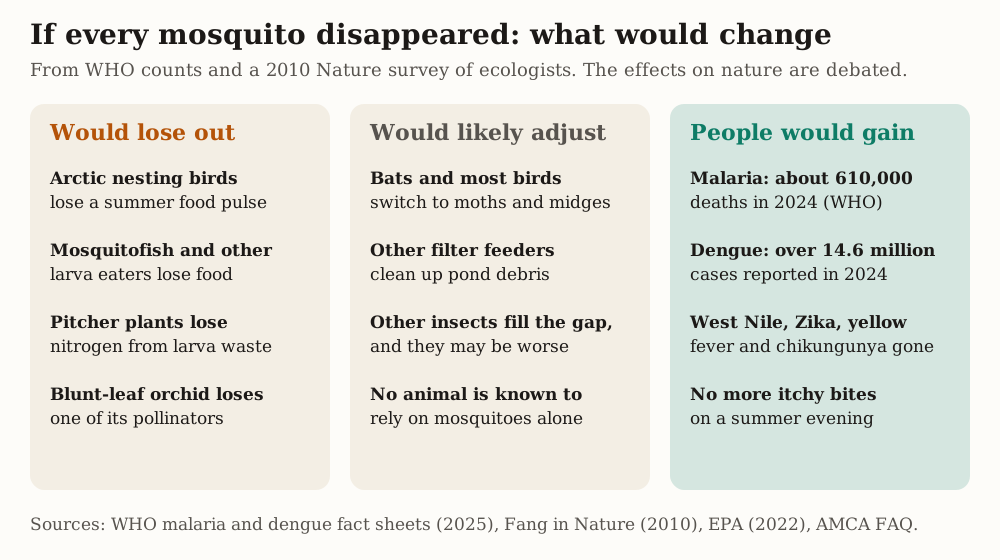
If every mosquito disappeared: who would notice, and how sure we are
People
- Likely effect
- Hundreds of thousands fewer deaths a year from malaria, dengue and other germs
- How sure
- High: WHO counts
Arctic nesting birds
- Likely effect
- Lose a short summer food pulse; one estimate says numbers could halve
- How sure
- Debated: midges may matter more
Caribou
- Likely effect
- Fewer bites; possibly freer movement
- How sure
- Debated: one herd study found little effect
Fish that eat larvae, such as the mosquitofish
- Likely effect
- Must switch food; Nature named the mosquitofish as a specialist at risk
- How sure
- Medium
Bats and most birds
- Likely effect
- Switch to moths, midges and other insects
- How sure
- Fairly high
Pitcher plants
- Likely effect
- Less nitrogen from larva waste
- How sure
- Possible; not tested at scale
Blunt-leaf orchid and a few other plants
- Likely effect
- Lose one of their pollinators
- How sure
- Possible
The empty niche
- Likely effect
- Other insects move in, and some may bite or spread disease
- How sure
- Unknown
That last row is the real unknown. Other species would fill the gap after a shuffling period, the American Mosquito Control Association says, and it warns that they might be worse. Nature’s 2010 feature reached a similar view: ecosystems would stumble briefly, then carry on.
Readers sense the same risk. In a 2025 r/NoStupidQuestions thread on this question, one of the top replies said that scientists expect little harm, but that people often underestimate their impact on nature. Both points are fair. By contrast, one reply claimed that fish do not eat the larvae, which is wrong.
Could we live without mosquitoes?
Yes. Mosquitoes give people almost nothing we use. In Nature, a CDC entomologist summed it up: if they did us any good, we would have found a way to use it. Far fewer people would die of malaria and dengue. Yet the full effect on nature is not known, and nobody could test it without doing it.
Could we actually wipe out mosquitoes?
Not all of them. The AMCA says mosquitoes adapt so well that wiping them out is all but impossible. Instead, programs aim at the few kinds that spread disease, one area at a time. As Nature put it in 2010, the limits of our tools, not a lack of will, make a mosquito-free world unlikely.
Are they releasing mosquitoes? Oxitec, Wolbachia, Google and Bill Gates
Yes, in limited programs the EPA has approved. Both methods the EPA has approved use male mosquitoes, which do not bite. Some carry Wolbachia bacteria, so the females they mate with have no young that survive. Others, from the company Oxitec, carry a gene that kills their daughters. Both aim to shrink one disease-spreading species, not all mosquitoes.
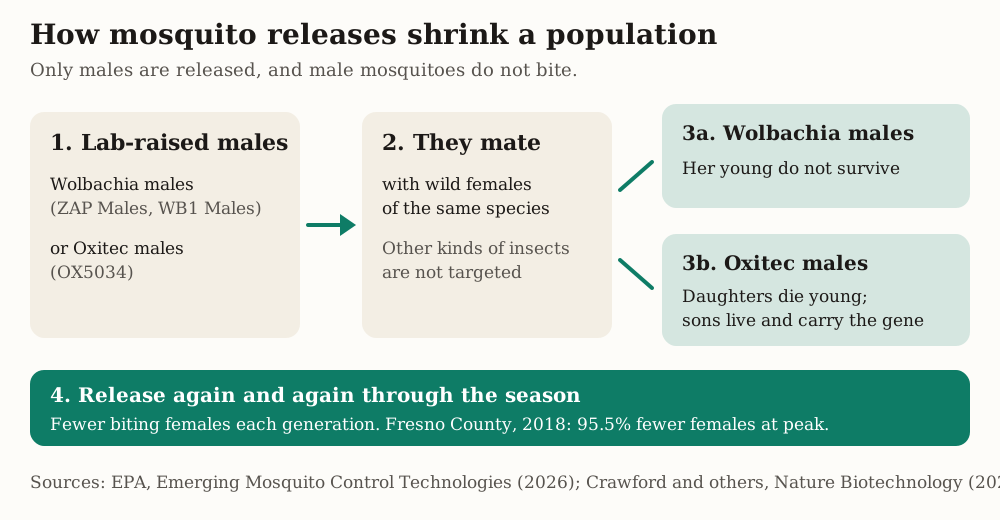
Mosquito releases in the US, from the EPA's own pages
ZAP Males (MosquitoMate)
- How it works
- Males carry a Wolbachia strain; offspring do not survive
- Target
- Asian tiger mosquito
- US status
- Registered November 3, 2017, in 20 states and DC; all states and territories since December 5, 2023; runs to December 31, 2028
WB1 Males (MosquitoMate)
- How it works
- Males carry a Wolbachia strain; offspring do not survive
- Target
- Aedes aegypti
- US status
- Registered for all states and territories on April 14, 2024
Oxitec OX5034 males
- How it works
- A gene kills female offspring; sons carry it on
- Target
- Aedes aegypti
- US status
- Test permit from 2020; Florida Keys releases since April 2021; four California counties added in 2022; no releases allowed after April 30, 2024
Gene drive mosquitoes
- How it works
- A gene copies itself into nearly all offspring
- Target
- Malaria mosquitoes
- US status
- None on the EPA's list; tested in labs and large cages
Both methods target one species at a time. The EPA found no expected harm to birds, bats or fish, since no predator relies on these mosquitoes. A few females can slip through the sorting. The EPA expects about one Wolbachia female per 250,000 males, and the maker must report any batch above that. The EPA’s 2023 approval of ZAP Males sets out the rules.
A second Wolbachia method works differently. Its mosquitoes breed into the wild population, so the bacteria spread and the mosquitoes pass on dengue less well. In a trial in Yogyakarta, Indonesia, it cut dengue cases by 77%. That approach is not on the EPA’s US list.
Is Google releasing mosquitoes?
Not Google itself. The “Google mosquitoes” in the news came from Verily, a life sciences company that began as Google Life Sciences and now sits under Google’s parent, Alphabet. In 2018, Verily worked with MosquitoMate and the Consolidated Mosquito Abatement District in Fresno County, California.
Together they released 14.4 million male Aedes aegypti with Wolbachia across three neighborhoods. At the peak of mosquito season, female numbers were 95.5% lower than in areas with no release. Male mosquitoes do not bite, and the aim was fewer yellow fever mosquitoes, the kind that can spread dengue and Zika.
Did Bill Gates release mosquitoes in the US?
No. In 2023, the first US cases of locally spread malaria in 20 years turned up, four in Florida and one in Texas. Social posts blamed mosquitoes funded by Bill Gates. However, the Gates Foundation funded Oxitec for malaria projects in Africa, in 2018, 2020, 2021 and 2022, and it told FactCheck.org that it funds no mosquito releases in the US.
The biology rules it out too. Oxitec’s US releases were Aedes aegypti, and malaria is spread by Anopheles mosquitoes. Besides, the released insects were males, which do not bite. The “Bill Gates mosquito farm” posts mix up these real programs with a disease they cannot spread.
What is a gene drive, and has one been released?
A gene drive is a gene built to copy itself, so that nearly all offspring inherit it instead of about half. In a 2018 lab study, a gene drive aimed at a malaria mosquito spread to every mosquito in small cages within 7 to 11 generations, and the caged population collapsed. In 2021, the same approach wiped out mosquito populations in larger indoor cages within a year.
None of this has reached US skies. The EPA’s list of mosquito technologies it has reviewed since 2012 has two kinds, Wolbachia males and Oxitec males, and neither is a gene drive. After Oxitec releases end, the company must keep checking until the gene has been absent for at least 10 weeks, the EPA says. A gene drive, by contrast, is built to keep spreading.
Do mosquitoes feel pain when squished?
Nobody knows for sure, and we found no study of what a mosquito feels when it is swatted. A 2022 review found strong evidence of something like pain in adult flies, the insect order that includes mosquitoes. That finding covers flies as a group, though, not mosquitoes in particular. A hard swat also kills a mosquito almost at once.
The review, by researchers in London, checked insects against 8 signs that an animal can feel. Adult flies and mosquitoes met 6 of them, as did cockroaches and termites. In a 2019 study, fruit flies with an injured nerve stayed oversensitive long after the injury. That pattern looks like chronic pain in people.
So the honest answer is maybe. It does not change the advice on bites. It does mean the old line that insects feel nothing is no longer settled. To learn why some people get bitten more, read what really draws mosquitoes to you. And if one escapes your hand, our page on mosquito lifespans says how long it may live.
Not medical advice. This page gives general information about mosquitoes and the diseases they carry. It is not a diagnosis. For a bite that worries you, see a doctor, and call 911 for trouble breathing or swelling of the face or throat.
Why do mosquitoes exist: FAQ
What do mosquitoes do with the blood they drink?
Do mosquitoes prefer fat or skinny people?
What did mosquitoes evolve from?
Are all mosquitoes bad?
Related guides
Mosquitoes
The full guide: what they look like, where they breed and the diseases they carry.
What eats mosquitoes
Fish, dragonflies, bats and birds, and how many mosquitoes each really eats.
Larvae in standing water
How to spot wrigglers, pupae and egg rafts, and what to do about them.
Asian tiger mosquito
The striped daytime biter that the ZAP Males releases target.
How long they live
Adults last about 2 to 4 weeks; winter females, up to 6 months.
Bites and when to worry
What a normal bite looks like and the signs that need a doctor.
Why some people get bitten more
Blood type, breath, heat and skin odor, and what the studies found.
Getting rid of mosquitoes
Standing water, screens and when a yard treatment is worth it.
Sources
- World Health Organization, Malaria fact sheet (December 2025, World malaria report 2025 figures)
- World Health Organization, Vector-borne diseases fact sheet (September 2024)
- CDC, About Mosquitoes in the United States (June 2024)
- US EPA, Emerging Mosquito Control Technologies (Oxitec and MosquitoMate; updated May 2026)
- Fang, A world without mosquitoes, Nature 466:432 (2010)
- Lahondère and others, The olfactory basis of orchid pollination by mosquitoes, PNAS (2020)
- American Mosquito Control Association, Frequently asked questions
- Gibbons and others, Can insects feel pain? Advances in Insect Physiology (2022)