Part 1 of 4
Start here
How many types of mosquitoes are there?
The CDC counts over 200 types of mosquitoes in the continental US and its territories. About 12 of them spread germs that make people sick. The rest are nuisance mosquitoes: they bite, but they do not carry disease. Worldwide, the count passes 3,700, as our guide to mosquitoes explains.
You will see other US numbers, too. Google’s AI Overview for this search puts two side by side: about 180 in North America, from Ecolab, and over 200, from the CDC. Both can be right, because they count different places. The CDC figure includes Puerto Rico and the other territories.
Table 1. How many types of mosquitoes live in the US? Five sources
CDC (June 2024)
- Count
- Over 200
- What it counts
- The continental US and the US territories
Terminix (February 2026)
- Count
- Around 200
- What it counts
- The United States
Insect Shield
- Count
- More than 180
- What it counts
- The United States
Ecolab (January 2025)
- Count
- About 180
- What it counts
- North America
American Mosquito Control Association
- Count
- 174
- What it counts
- Species recognized in the United States
Each state has its own share. Texas has the most species, 85, and Hawaii the fewest, 6, according to the American Mosquito Control Association (AMCA). Florida has over 80, says UF/IFAS. Still, the species list matters less than the water in your yard, which decides how many mosquitoes you actually get.
What are the three types of mosquitoes?
The three types most people mean are Aedes, Culex and Anopheles. These are groups (genera), not single species, and the CDC names all three as the common US mosquitoes that can spread germs. Aedes bite by day, Culex mostly at night, and Anopheles late in the evening or at night.
The list leaves out the group Americans photograph most after Aedes. On iNaturalist, we counted research-grade US mosquito sightings on October 26, 2026. Psorophora, the gallinipper and its relatives, came second, with 7,616 confirmed sightings. Culex had 1,958.
First, is it a mosquito?
Check for a long, straight needle on the head before you try to name a type. Many insects that people call mosquitoes have none. On Reddit’s r/whatsthisbug, posts titled “What kind of mosquito is this?” often turn out to show a crane fly, a midge or a robber fly.
A huge, long-legged insect at the porch light is almost always a crane fly, which cannot bite. Our crane fly guide shows the one check that settles it. A small fly that holds its front legs up in the air, with no needle, is a non-biting midge. A real mosquito also has scales along the edges of its wings, which a phone camera can catch up close.
Mosquito identification chart: how to tell the types apart
You can tell most types of mosquitoes in the US apart by four things: the back, the legs, the resting posture and the biting time. The chart puts the mark you can see first. The diseases listed are reference only, from the CDC and university extension services, and a mosquito that can carry a germ is rarely infected.
Table 2. Mosquito identification chart: the US types people ask about most
Black, one white stripe down the back, white-banded legs
- Mosquito
- Asian tiger mosquito (Aedes albopictus)
- How it rests
- Tail level, hunched
- When it bites
- Daytime
- Where it breeds
- Small containers, tree holes
- Can carry
- Dengue, chikungunya, Zika
Black, white lyre shape on the back, white-banded legs
- Mosquito
- Yellow fever mosquito (Aedes aegypti)
- How it rests
- Tail level, hunched
- When it bites
- Daytime, often indoors
- Where it breeds
- Small containers, vases, drain pans
- Can carry
- Dengue, chikungunya, Zika, yellow fever
Small and dark, banded legs, pale marks on each belly segment; after rain
- Mosquito
- Inland floodwater mosquito (Aedes vexans)
- How it rests
- Tail level, hunched
- When it bites
- May to October; among the first in spring
- Where it breeds
- Rain pools, flooded ground
- Can carry
- West Nile virus, dog heartworm
Plain brown or straw-colored, no bands on legs or needle
- Mosquito
- Northern and southern house mosquitoes (Culex)
- How it rests
- Tail level, hunched; blunt tail tip
- When it bites
- Dusk to dawn, indoors too
- Where it breeds
- Foul or still water, drains, buckets
- Can carry
- West Nile, St. Louis encephalitis, eastern equine encephalitis
Brown, one white band around the middle of the needle, banded legs; West
- Mosquito
- Western encephalitis mosquito (Culex tarsalis)
- How it rests
- Tail level, hunched
- When it bites
- Dawn, dusk and after dark
- Where it breeds
- Vegetated pools, farm water
- Can carry
- West Nile, St. Louis and western equine encephalitis
Dark spots on the wings, long palps beside the needle
- Mosquito
- Malaria mosquitoes (Anopheles)
- How it rests
- Straight line, tail up
- When it bites
- Late evening and night
- Where it breeds
- Clean, still water with plants
- Can carry
- Malaria (rare in the US)
Very large, gold stripe on the back, shaggy banded hind legs
- Mosquito
- Gallinipper (Psorophora ciliata)
- How it rests
- Tail level
- When it bites
- Day or night, after heavy rain
- Where it breeds
- Flooded ground, ditches, pastures
- Can carry
- Not known to spread disease to people
Large and shiny blue, green or purple; needle curved down
- Mosquito
- Elephant mosquito (Toxorhynchites rutilus)
- How it rests
- Not a useful check
- When it bites
- Never bites
- Where it breeds
- Tree holes, tires, plant saucers
- Can carry
- Nothing; it does not take blood
Markings from the UF/IFAS Florida Medical Entomology Laboratory, Oklahoma State Extension and the California Department of Public Health. Biting times and diseases from the CDC, UF/IFAS and Oklahoma State Extension.
How to identify a mosquito in five checks
To identify a mosquito type, work from the whole insect down to the details. First confirm it is a mosquito, then read the back, the legs, the head and the posture. Finally, add when and where you found it, because place rules out many types before you look closer.
Identify a mosquito, step by step
Make sure it is a mosquito
Look for a long, straight needle (the proboscis) pointing forward from the head, and scales along the wing edges. No needle means a crane fly, a midge or another fly.
Check the back behind the head
One white stripe means an Asian tiger mosquito. A white lyre shape means a yellow fever mosquito. If a big mosquito has a gold stripe, it is a gallinipper. Plain brown means a Culex.
Look at the legs and wings
White bands point to Aedes or Psorophora. Shaggy hind legs mean a gallinipper. Dark spots on the wings mean an Anopheles. Plain legs with no bands point to a Culex house mosquito.
Check the head and how it rests
Palps as long as the needle, with the body tilted tail-up, mean Anopheles. A needle that curves down like a trunk means an elephant mosquito. A pointed tail tip suggests Aedes; a blunt one suggests Culex.
Add the time and the place
Note when it bit and where you live. A striped day-biter in the yard is likely an Aedes. Plain brown mosquitoes biting at night indoors are likely Culex. A giant after heavy rain in the East is likely a gallinipper.
How do Anopheles, Culex and Aedes mosquitoes rest?
An Anopheles mosquito rests with its needle, head and body in one straight line, tilted so the tail points up and away from the wall. Culex and Aedes keep the abdomen level with the surface and bend the head down, which gives them a hunched look. That one check separates the malaria mosquitoes from the other two.
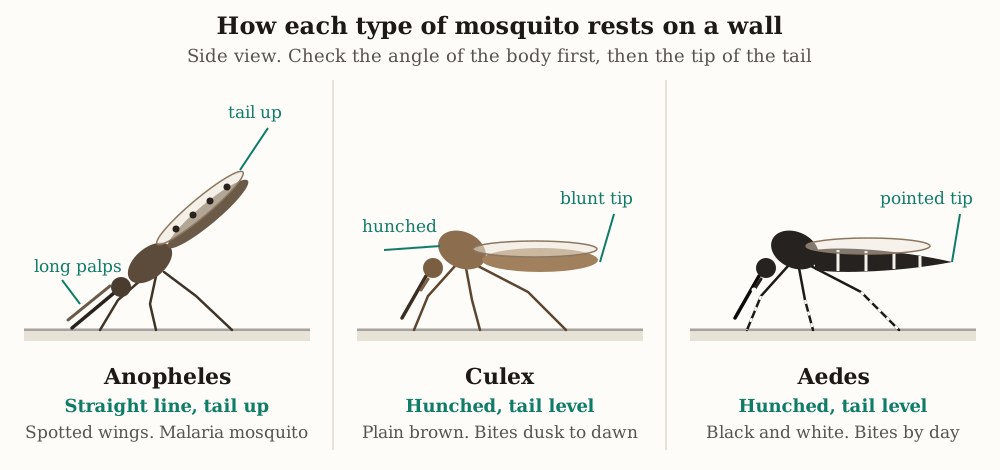
Popular guides get this mixed up. Terminix gives Culex an “upright resting posture”, and Google’s AI Overview calls the Culex shape a hunched “V”. The Wellcome Sanger Institute, which the AI Overview cites, says both Aedes and Culex rest hunched over. The California Department of Public Health, meanwhile, notes that the western malaria mosquito “typically rests with abdomen pointed up”. So the tilted tail is the Anopheles mark, not a Culex one.
The tail tip helps with the other two. Oklahoma State Extension notes that Aedes have a very pointed tip to the abdomen, while Culex have a very blunt one. Anopheles also have palps, the feelers beside the needle, as long as the needle itself. Seen head-on, that looks like three tubes instead of one.
Black, brown, yellow or blue: mosquitoes by color
Color narrows the type fast. In the US, a black mosquito with white stripes is an Aedes, and a plain brown one is usually a Culex house mosquito. A big yellow-and-dark mosquito with shaggy legs is a gallinipper. A shiny blue, green or purple one with a curved needle is an elephant mosquito.
Table 3. What a mosquito's color tells you
Black with white stripes or bands
- Most likely type
- Asian tiger or yellow fever mosquito (Aedes)
- The check that confirms it
- The back: one stripe or a lyre. See Asian tiger mosquito
Plain brown or straw-colored
- Most likely type
- Culex house mosquito
- The check that confirms it
- No bands on the legs or the needle
Brown with a white band on the needle
- Most likely type
- Western encephalitis mosquito (West) or eastern saltmarsh mosquito (coasts)
- The check that confirms it
- Where you are: inland West or the Atlantic and Gulf coasts
Yellow and dark, very large
- Most likely type
- Gallinipper
- The check that confirms it
- Shaggy, banded hind legs and a gold stripe on the back
Dark with white feet
- Most likely type
- White-footed woods mosquito (Psorophora ferox)
- The check that confirms it
- White tips on the hind legs; woodland
Shiny blue, green or purple, large
- Most likely type
- Elephant mosquito
- The check that confirms it
- A needle curved down like a trunk
Tiny, with a thin blue stripe
- Most likely type
- Sapphire-striped mosquito (Uranotaenia sapphirina)
- The check that confirms it
- Very small; feeds on earthworms and leeches, not people
Brownish with spotted wings
- Most likely type
- Anopheles
- The check that confirms it
- Rests tail-up
What about a bright blue mosquito you saw online? That is usually Sabethes cyaneus, a mosquito with iridescent blue scales and paddles on its legs. It lives in Central and South America, not the US. In the US, shiny blue scales mean an elephant mosquito or one of the tiny Uranotaenia.
What a photo can and cannot tell you
A sharp photo of the back names a striped or giant mosquito easily. Plain brown ones are much harder. On iNaturalist, 82% of US elephant mosquito sightings reach a confirmed name, against only 21% of Culex sightings, by our count of October 26, 2026. Many brown Culex look alike without a microscope.
A squashed or wet mosquito is harder still. As one r/whatsthisbug commenter put it, water can wash off the scales and hide the leg bands. So photograph a whole mosquito from above, in daylight, on white paper. Our bug identifier by picture works best that way. A photo of a bite, however, can never tell you which mosquito made it.
Part 2 of 4
The mosquitoes, one by one
Aedes mosquitoes: the striped daytime biters
Of all the types of mosquitoes in the US, Aedes are the easiest to spot: small and dark, often with white bands on the legs and body. The two best known, the Asian tiger mosquito and the yellow fever mosquito, bite by day and breed in small containers around homes. Other Aedes breed in floodwater or salt marshes and appear in huge numbers after rain or high tides.
Asian tiger mosquito
The Asian tiger mosquito is the black mosquito with one white stripe down the middle of its back. It bites in the daytime and breeds in bottle caps, buckets and plant saucers. It is also the mosquito Americans photograph most, at 21.7% of the 34,340 research-grade US mosquito sightings on iNaturalist.
- Scientific name
- Aedes albopictus
- Size
- About 1/8 to 1/4 in (3 to 6 mm)
- The mark to look for
- One white stripe from between the eyes down the middle of the back
- When it bites
- Daytime, outdoors
- Where it breeds
- Small containers, tires, tree holes
- Where in the US
- Much of the East and South, north to Boston, and parts of California
- Can carry (CDC and extension)
- Can carry dengue, chikungunya and Zika viruses
Aedes aegypti: the yellow fever mosquito
Aedes aegypti, the yellow fever mosquito, is a small dark mosquito with a white lyre shape on its back and white-banded legs. It prefers to bite people, and it lives indoors as well as out, the CDC says. In the US it lives mainly in the South: UF/IFAS finds it in all of Florida except the Panhandle counties.
- Scientific name
- Aedes aegypti
- Size
- 4 to 7 mm (about 1/8 to 1/4 in)
- The mark to look for
- A white lyre or harp shape on the back, curved lines on each side
- When it bites
- Daytime, indoors and outdoors
- Where it breeds
- Small containers: vases, tires, toys, drain pans, bromeliads
- Where in the US
- Florida, Texas, Louisiana, other Gulf states and parts of California and the Southwest
- Can carry (CDC and extension)
- Dengue, chikungunya and Zika viruses; yellow fever abroad
It does not travel far. The CDC says Aedes aegypti and the Asian tiger mosquito fly only a few blocks in a lifetime. Their eggs stick to container walls above the water and can survive drying out for up to 8 months. That is why emptying and scrubbing small containers works so well against both.
Does the US have Aedes mosquitoes? Yes. The CDC says Aedes aegypti and the Asian tiger mosquito live in many areas of the US, and native Aedes such as the floodwater mosquitoes are widespread. What happens if one bites you? In almost every case, an itchy bump. Outbreaks of dengue, Zika and chikungunya have occurred in only a few places, including Florida, Texas, Hawaii and Puerto Rico, the CDC says.
Floodwater and saltmarsh mosquitoes
Floodwater mosquitoes lay their eggs on damp ground that later floods. The eggs wait, sometimes for months, then hatch all at once after heavy rain. That is why a week or two after a storm, the yard can suddenly fill with biting mosquitoes that were not there before.
The inland floodwater mosquito (Aedes vexans) is the common one. It is small and dark with banded legs, and each belly segment has two pale, lobed marks. Oklahoma State Extension says it is usually one of the first mosquitoes of spring, and it can carry West Nile virus and dog heartworm.
Along the coasts, saltmarsh mosquitoes hatch when high tides flood the marsh. The eastern saltmarsh mosquito (Aedes sollicitans) is golden brown, with a cream band around the middle of its needle. Its cousin, the black salt marsh mosquito (Aedes taeniorhynchus), is smaller and black, and UF/IFAS calls it a strong flier. According to the AMCA, saltmarsh mosquitoes have been known to travel up to 100 miles in exceptional cases.
Eastern treehole mosquito
The eastern treehole mosquito (Aedes triseriatus) is a dark mosquito with silvery marks on the sides of its body. It breeds in tree holes and old tires. Oklahoma State Extension calls it the main carrier of La Crosse virus, which the CDC lists among US mosquito-borne diseases.
Culex mosquitoes: the plain brown house mosquitoes
Culex are the plainest types of mosquitoes: brown or straw-colored, biting from dusk to dawn, often indoors. They have no bold stripes, and the tip of the abdomen is blunt. They are the main US carriers of West Nile virus. The CDC names three: the northern and southern house mosquitoes and the western encephalitis mosquito.
A Culex female lays her eggs in a floating raft of 100 to 300, the CDC says, on still water such as ponds, ditches, neglected pools and buckets. An egg can become a biting adult in 7 to 10 days. By day, adults rest in grass, shrubs and other thick plants. Most stay close, but the CDC notes they can fly up to 2 miles (3.2 km).
Northern house mosquito
- Scientific name
- Culex pipiens
- Size
- 3 to 7 mm (1/8 to 1/4 in)
- The mark to look for
- Plain brown; a cream, bent line across each belly segment
- When it bites
- Dusk to dawn; prefers birds but also bites people
- Where it breeds
- Foul water: storm drains, sewage, buckets, rain barrels
- Where in the US
- The northern US, in cities and suburbs
- Can carry (CDC and extension)
- West Nile, St. Louis encephalitis and eastern equine encephalitis viruses
It is probably the most common carrier of West Nile virus, Oklahoma State Extension says. Mated females spend the winter as adults in basements, sheds and caves. As a result, these small mosquitoes are some of the first to appear in spring.
Southern house mosquito
- Scientific name
- Culex quinquefasciatus
- Size
- About 4 mm (about 1/8 in)
- The mark to look for
- Straw-colored back; plain dark legs and needle; white M-shaped bands on the belly
- When it bites
- Dusk to dawn
- Where it breeds
- Water rich in organic matter: catch basins, ditches, containers
- Where in the US
- The southern US; every county in Florida
- Can carry (CDC and extension)
- West Nile and St. Louis encephalitis viruses; dog heartworm
It was the first mosquito to reach Hawaii, around 1826, in ships’ water barrels, according to the AMCA. Today it is abundant across Florida, says UF/IFAS. The northern and southern house mosquitoes look almost the same, so scientists group them together as the Culex pipiens complex.
Western encephalitis mosquito
- Scientific name
- Culex tarsalis
- Size
- Medium-sized
- The mark to look for
- Brown, one white band around the middle of the needle, white bands on the legs
- When it bites
- Dawn, dusk and after dark
- Where it breeds
- Vegetated pools, ditches and farm water, from sea level into the mountains
- Where in the US
- The West and the Plains
- Can carry (CDC and extension)
- West Nile, St. Louis encephalitis and western equine encephalitis viruses
The white band on the needle is the giveaway, since house mosquitoes have none. Oklahoma State Extension calls it a very important carrier that often infects people. It feeds on birds in spring and then switches to mammals, including people, in midsummer.
What happens if a Culex mosquito bites you?
Usually nothing beyond an itchy bump that fades in a few days. Few Culex carry West Nile virus. Even after an infected bite, about 8 in 10 people have no symptoms and about 1 in 5 get a fever, the CDC says. Less than 1% develop severe illness of the brain or spinal cord. Our guide to mosquito bites and when they need a doctor covers the warning signs.
Anopheles mosquitoes: the malaria mosquitoes
Anopheles mosquitoes are slender, long-legged mosquitoes that rest with the tail tilted up. Their palps are as long as the needle, and many have dark spots on the wings. They are the only mosquitoes that spread malaria. Most of the lower 48 states have them, the CDC says, mainly the common malaria mosquito in the East and the western malaria mosquito in the West.
Females bite late in the evening or at night, and they feed on people and on animals such as cattle. They lay eggs one at a time, right on the water, in marshes and near the banks of shallow creeks and streams. The eggs float, but unlike Aedes eggs they cannot survive drying out.
Common malaria mosquito
- Scientific name
- Anopheles quadrimaculatus
- Size
- Medium; slender, with long legs
- The mark to look for
- Four distinct dark spots on each wing; dark palps as long as the needle
- When it bites
- Late evening and night; often comes indoors
- Where it breeds
- Edges of ponds and lakes among water plants
- Where in the US
- The eastern US, especially the Southeast and the Gulf Coast
- Can carry (CDC and extension)
- Malaria (very rare in the US now); dog heartworm
Its name means “four-spotted”, after the wing spots. It was historically the most important malaria carrier in the US, Oklahoma State Extension notes. Females spend the winter in barns and tree holes.
Western malaria mosquito
The western malaria mosquito (Anopheles freeborni) is light brown, with dashed black marks on the wings. The California Department of Public Health lists it among the state’s important mosquitoes. It breeds in vegetated pools, algae mats and farmland water, and it bites at dawn, dusk and after dark.
Can mosquitoes spread malaria in the US?
Rarely. Malaria was common in the US into the 20th century. Over the past 50 years, local spread caused more than 150 cases and more than 60 small outbreaks, according to the CDC’s page on US mosquitoes. Most of the more than 2,000 cases reported each year are in travelers returning from abroad.
The gallinipper: the giant mosquito that bites
The gallinipper (Psorophora ciliata) is one of the largest mosquitoes in the US, with a body about 1/2 inch long, a 2013 UF/IFAS report says. Look for shaggy, banded hind legs and a gold stripe down the back. It is a floodwater mosquito that swarms after heavy rain east of the Rockies, and its bite hurts.
- Scientific name
- Psorophora ciliata
- Size
- Body about 1/2 in (13 mm); one of the two largest mosquitoes in Florida
- The mark to look for
- Gold stripe down a dark back, yellowish needle with a dark tip, shaggy hind legs with white bands
- When it bites
- Day or night, mostly in spring and summer
- Where it breeds
- Ditches, grassy pools, flooded fields and pastures
- Where in the US
- East of the Rocky Mountains, from South Dakota and Quebec south to Florida
- Can carry (CDC and extension)
- Not known to spread disease to people (UF/IFAS)
Its eggs wait in damp, low ground for months or even years. When heavy rain floods the ground, they hatch together. In June 2026, a UF/IFAS Extension post from Okaloosa County, Florida noted that numbers often jump one to two weeks after the rain. Gallinippers also fly fast and travel farther than most mosquitoes.
Even the larvae are fierce. Most mosquito larvae eat bits of plants and microbes, but gallinipper larvae eat other mosquito larvae and even tadpoles. That sounds useful, yet as one UF graduate student put it, using them for control has a flaw: it results in more gallinippers.
How painful is a gallinipper bite?
It hurts more than an ordinary bite. “The bite really hurts, I can attest to that,” UF entomologist Phil Kaufman said in 2013. On Reddit, people describe them biting through socks. Still, the bite is no more dangerous than other mosquito bites. UF/IFAS says gallinippers play no major role in spreading disease in Florida.
Are gallinippers aggressive?
Yes. UF/IFAS calls the species notoriously aggressive, and Oklahoma State Extension describes Psorophora as very painful and persistent biters. The females prefer to feed on large mammals, people included.
Why is it called a gallinipper?
The nickname comes from people who claimed the mosquito takes a gallon of blood when it bites, UF/IFAS says. It does not, of course: like any mosquito, it takes a tiny meal. The name is older than the science, too. In African-American folk tales, the gallinipper was a legendary giant mosquito.
How to get rid of gallinippers
You cannot drain a flooded pasture, so protect yourself first. Use an EPA-registered repellent, and wear long sleeves and long pants near woods and standing water after storms. Kaufman noted that DEET repels them, though their size may make them a little more tolerant of it. Our picaridin vs DEET guide compares the two main choices.
Around the house, empty buckets, toys and plant saucers, and fill low spots where water pools. For water you must keep, such as a birdbath or a pond, UF/IFAS suggests a Bti larvicide (sold as mosquito dunks or bits), used as the label directs. Our guide to getting rid of mosquitoes in the yard covers the rest.
Other Psorophora: dark ricefield and white-footed woods mosquitoes
Two relatives also bite hard. The dark ricefield mosquito (Psorophora columbiae) is large and dark, with white bands on the legs and one on the needle. It breeds in flooded fields, and its swarms have killed cattle, Oklahoma State Extension reports. In summer it can grow from egg to pupa in just 3.5 days.
The white-footed woods mosquito (Psorophora ferox) is dark, with white tips on its hind legs that look like little boots. It breeds in woodland pools and bites painfully, mostly away from towns.
The elephant mosquito: a giant that never bites
The elephant mosquito (Toxorhynchites rutilus) is one of the largest mosquitoes in North America, and it never takes blood. Its needle curves down at a right angle, like an elephant’s trunk, and its body shines with blue, green, white and purple scales. Both sexes drink nectar, honeydew and fruit juice, and they fly by day.
- Scientific name
- Toxorhynchites rutilus
- Size
- Up to about 7 mm long, with a wingspan of about 12 mm (1/2 in)
- The mark to look for
- Needle curved sharply down; shiny, metallic scales
- When it bites
- Never; adults feed only on sugars
- Where it breeds
- Tree holes, tires, flowerpot saucers, cans
- Where in the US
- The eastern half of the US
- Can carry (CDC and extension)
- Nothing; it cannot spread germs because it never bites
Its larvae are hunters. A single larva can eat thousands of small water animals as it grows, UF/IFAS’s profile of the elephant mosquito explains. Late in life, a larva even kills prey it does not eat. New Orleans once used the larvae to control container mosquitoes.
Do the larvae mostly eat other mosquitoes, though? Less than you would think. In a Florida field study cited by UF/IFAS, mosquitoes made up only 6% of the prey found in larvae from tree holes and 5% in larvae from tires. The rest were other small water animals and insects that fell in.
Gallinipper or elephant mosquito?
People mix up the two giants both ways. On r/whatsthisbug, a 2018 post asking “Is this a gallinipper?” turned out to show an elephant mosquito, named from its curved needle. A 2013 post asking about an elephant mosquito was a female gallinipper, named from its banded legs. The needle settles it.
Table 4. Gallinipper vs elephant mosquito
Needle
- Gallinipper
- Straight, yellowish with a dark tip
- Elephant mosquito
- Curved down like a trunk
Body
- Gallinipper
- Dark back with a gold stripe; shaggy, banded hind legs
- Elephant mosquito
- Shiny blue, green, white and purple scales
Bites people?
- Gallinipper
- Yes, painfully
- Elephant mosquito
- Never
When you see it
- Gallinipper
- After floods, day or night
- Elephant mosquito
- By day, near tree holes and containers
Larvae eat
- Gallinipper
- Other mosquito larvae and tadpoles
- Elephant mosquito
- Small water animals, some mosquito larvae
What is the biggest mosquito?
Among the types of mosquitoes in the US, the biggest are the gallinipper and the elephant mosquito. UF/IFAS names them as the two largest in Florida. Worldwide, the biggest are tropical elephant mosquitoes, which reach about 18 mm (0.7 in) long with a wingspan of about 24 mm. Wikipedia names the Australian elephant mosquito the largest of all.
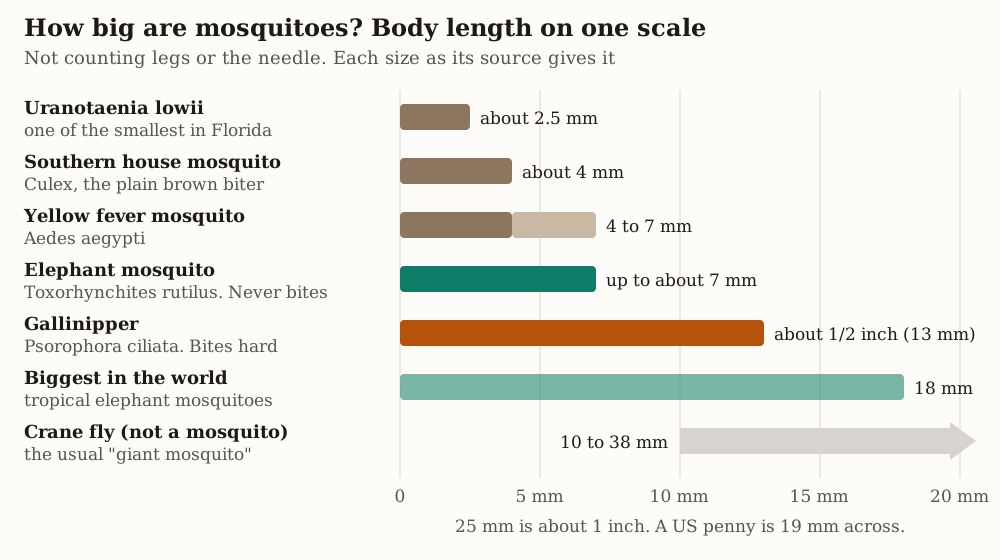
Which US giant is bigger depends on the source. That is because sources measure different things: body length, wingspan, or a single wing. Table 5 shows how far apart they are. Weight tells the story more simply: the AMCA says the largest US mosquitoes weigh about 10 milligrams, four times the small mosquitoes found around houses.
Table 5. How big are the two US giants? The sources disagree
UF/IFAS homeowner guide (ENY-753)
- Gallinipper
- Wingspan about 6 to 7 mm
- Elephant mosquito
- Wingspan about 6 to 7 mm
Wikipedia species pages
- Gallinipper
- Wingspan 7 to 9 mm
- Elephant mosquito
- Up to 7 mm long, wingspan 12 mm
UF/IFAS news report (2013)
- Gallinipper
- Body about 1/2 inch (13 mm)
- Elephant mosquito
- Not given
The truly huge “mosquito” on your ceiling is another matter. An insect 1 inch or more long, with very long legs and no needle, is a crane fly, often called a mosquito hawk. It cannot bite. In a 2022 r/whatsthisbug thread from Hong Kong about a “mosquito” 2 to 3 times normal size, some replies guessed crane fly. The long needle proved it was a real mosquito, so check the needle first.
The smallest mosquitoes
At the other end, Uranotaenia lowii is one of the smallest mosquitoes in Florida, at about 2.5 mm, says UF/IFAS. It has iridescent blue scales and feeds on frogs, toads and salamanders, not people. Its relative, the sapphire-striped mosquito, carries a thin blue stripe and feeds on earthworms and leeches.
Part 3 of 4
Risk and region
Which types of mosquitoes are dangerous?
Only about 12 of the 200-plus types of mosquitoes in the US spread germs to people, the CDC says. The main ones are Culex house mosquitoes, which carry West Nile virus, and Aedes aegypti, which carries dengue, chikungunya and Zika. Anopheles can carry malaria, though local spread is rare. The giants, by contrast, are mostly harmless beyond the bite.
Table 6. What each type of mosquito can carry in the US: reference only, not a diagnosis
Culex house mosquitoes and the western encephalitis mosquito
- Can carry
- West Nile, St. Louis encephalitis, eastern and western equine encephalitis viruses
- How common is spread to people?
- West Nile is one of the most common mosquito-borne diseases in the continental US (CDC)
Yellow fever mosquito (Aedes aegypti)
- Can carry
- Dengue, chikungunya, Zika viruses
- How common is spread to people?
- Local outbreaks in Florida, Texas, Hawaii, Puerto Rico and other territories (CDC)
Asian tiger mosquito
- Can carry
- The same viruses
- How common is spread to people?
- The CDC’s list of US germ spreaders names Aedes aegypti, not this one. See Asian tiger mosquito
Eastern treehole mosquito
- Can carry
- La Crosse virus
- How common is spread to people?
- Rare (Oklahoma State Extension; CDC list)
Eastern saltmarsh and inland floodwater mosquitoes
- Can carry
- Eastern equine encephalitis (saltmarsh); West Nile (floodwater); dog heartworm (both)
- How common is spread to people?
- Uncommon; the saltmarsh mosquito can bridge a virus from birds to mammals
Anopheles
- Can carry
- Malaria, lymphatic filariasis
- How common is spread to people?
- Rare; most US malaria is caught abroad (CDC)
Gallinipper
- Can carry
- Nothing known in people
- How common is spread to people?
- Painful bite only (UF/IFAS)
Elephant mosquito
- Can carry
- Nothing
- How common is spread to people?
- Never bites
A mosquito that can carry a germ is rarely infected. Several of these also spread dog heartworm, so ask your vet about prevention.
What type of mosquito kills the most humans?
Anopheles, because only Anopheles spread human malaria. The World Health Organization estimates 610,000 malaria deaths in 2024, up from 598,000 in 2023, and 95% of them in Africa. In the US, by contrast, West Nile, carried by Culex, is one of the most common mosquito-borne diseases, the CDC says.
What is the most aggressive type of mosquito?
It depends on what bothers you. For daytime biting around the house, the Asian tiger mosquito is the usual culprit. For a painful, persistent bite, the gallinipper and its Psorophora relatives win. Saltmarsh mosquitoes win on sheer numbers: they once made parts of Florida nearly unlivable, Oklahoma State Extension notes.
What is the most common type of mosquito?
There is no single count of every mosquito in the US. In towns, the house mosquitoes are strong candidates. Wikipedia calls the northern house mosquito the most common mosquito in the northern US, and UF/IFAS calls the southern house mosquito abundant across Florida. Yet they are hard to name from a photo, so they rarely top sighting lists.
On iNaturalist, by contrast, the mosquitoes people photograph and confirm most are the easy-to-name ones. We counted 34,340 research-grade US sightings on October 26, 2026. The Asian tiger mosquito led with 21.7%, then the gallinipper (11.0%) and the elephant mosquito (7.3%). Big or striped mosquitoes get photographed; plain brown ones get swatted.
Medical disclaimer. This page is for general information only. It is not a medical diagnosis. If you have severe symptoms, trouble breathing, swelling of the face or throat, fast spreading redness, fever, severe pain, pus, or signs of infection, contact a doctor or your local emergency number.
Types of mosquitoes by state: Florida, Texas, California and the North
The types of mosquitoes you meet depend on where you live. In the Southeast and along the Gulf, the gallinipper and the Asian tiger mosquito lead the sightings. California is different: the yellow fever mosquito leads there. In the North, floodwater mosquitoes and the Asian tiger mosquito top the list.
We read the research-grade iNaturalist sightings for six states on October 26, 2026. State health and extension lists fill in the plain mosquitoes that people rarely photograph.
Table 7. Types of mosquitoes by state (iNaturalist research-grade sightings, read October 26, 2026, plus state lists)
Florida
- Most photographed
- Gallinipper, Asian tiger, yellow fever mosquito
- Also important
- Southern house mosquito, black salt marsh mosquito
- Note
- Over 80 species (UF/IFAS)
Texas
- Most photographed
- Gallinipper, Asian tiger mosquito, Psorophora cyanescens
- Also important
- Yellow fever mosquito, dark ricefield and eastern saltmarsh mosquitoes
- Note
- 85 species, the most of any state (AMCA)
Louisiana and the Gulf
- Most photographed
- Inland floodwater, Asian tiger, gallinipper
- Also important
- Elephant mosquito, white-footed woods mosquito
- Note
- Floodwater kinds surge after storms
California
- Most photographed
- Yellow fever mosquito (723 of 1,925 sightings)
- Also important
- Western encephalitis mosquito, house mosquitoes, western treehole mosquito, western malaria mosquito
- Note
- CDPH list of important mosquitoes
New York and the Northeast
- Most photographed
- Asian tiger, Asian bush, white-footed woods mosquito
- Also important
- Northern house mosquito, cattail mosquito
- Note
- The northern house mosquito is probably the top West Nile carrier (Oklahoma State)
Minnesota and the upper Midwest
- Most photographed
- Inland floodwater, cattail mosquito, woodland malaria mosquito
- Also important
- Northern house mosquito
- Note
- Floodwater mosquitoes are among the first in spring
Hawaii
- Most photographed
- Few sightings
- Also important
- Southern house mosquito, both Aedes (AMCA list)
- Note
- 6 species, none native (AMCA)
“Most photographed” shows what people confirm on iNaturalist, mostly outdoors. It is not how often each mosquito bites.
What US state has the worst mosquito problem?
No state is worst everywhere. Texas has the most kinds, but the AMCA notes that mosquito numbers depend on local breeding water, hosts and weather, not on the species count. Even dry states such as Nevada and Arizona can have intense mosquito activity wherever water sits. For Alaska’s famous swarms, see our mosquito guide.
Types of mosquitoes in Florida
Florida has over 80 species. UF/IFAS lists five that feed on people around homes: the yellow fever mosquito, the Asian tiger mosquito, the southern house mosquito, the black salt marsh mosquito and the gallinipper. The black salt marsh mosquito is a major pest along the coasts in summer and early fall.
Types of mosquitoes in Texas and California
Texas has 85 species, more than any other state. Its most photographed are the gallinipper and the Asian tiger mosquito, almost tied, then another Psorophora and the yellow fever mosquito. In California, the state health department lists seven to know. They are the western encephalitis mosquito, the northern and southern house mosquitoes, the yellow fever and Asian tiger mosquitoes, the western treehole mosquito and the western malaria mosquito.
Part 4 of 4
What to do
Found a mosquito? What to do next
For almost all types of mosquitoes, the next step is the same. Find and empty standing water within a week, and use an EPA-registered repellent when you go out. The type matters for when to protect yourself. Aedes need daytime repellent, while Culex and Anopheles call for screens and repellent at dusk.
Table 8. What to read next, by the mosquito you found
A black mosquito with one white stripe, biting by day
A huge, long-legged insect with no needle
Wigglers in a birdbath, bucket or pool
- Read next
- Mosquito larvae, eggs and pupae
A yard full of mosquitoes after rain
- Read next
- How to get rid of mosquitoes
One mosquito loose in the house for days
- Read next
- How long mosquitoes live indoors
Itchy bumps and a question about disease
- Read next
- Mosquito bites: relief and red flags
A repellent to choose
- Read next
- Picaridin vs DEET
For floodwater types and gallinippers, timing is the key. Expect them one to two weeks after heavy rain, and plan outdoor work with long sleeves and repellent. For the elephant mosquito, do nothing at all: it cannot bite you. For an overview of how mosquitoes live and breed, start at our mosquito hub.
Four mix-ups in popular mosquito guides
Myth 1
Myth: “Culex mosquitoes rest in an upright posture.”
Truth: Terminix says so, and Google's AI Overview calls the Culex shape a hunched V. Culex keep the tail level with the surface. The tail-up posture belongs to Anopheles (California Department of Public Health).
Myth 2
Myth: “Elephant mosquito larvae live on other mosquito larvae.”
Truth: They do eat them, but in a Florida field study cited by UF/IFAS, mosquitoes were only 5% to 6% of the prey found in wild larvae. Most of their food was other small water animals.
Myth 3
Myth: “The eastern saltmarsh mosquito does not spread disease.”
Truth: Thermacell's guide says so. Oklahoma State Extension lists it as a carrier of dog heartworm and eastern equine encephalitis, and as a bridge between birds and mammals.
Myth 4
Myth: “Culex tritaeniorhynchus is the common US house mosquito.”
Truth: Rentokil's US page names it. It is native to Asia and parts of Africa, where it is the main carrier of Japanese encephalitis. The CDC's US Culex are Culex pipiens, Culex quinquefasciatus and Culex tarsalis.
Pest control disclaimer. Photo-based identification can help, but it is not always perfect. For dangerous spiders, large infestations, or anything you are unsure about, contact a licensed pest control professional.
Types of mosquitoes FAQ
Is Culex male or female?
Do all types of mosquitoes bite people?
Can you tell what type of mosquito bit you from the bite?
What are the 4 types of mosquitoes?
Related guides
Mosquitoes
The mosquito hub: what they are, male vs female, life cycle, season and every mosquito guide.
Asian tiger mosquito
Black and white, bites by day, and breeds in bottle caps.
Crane fly
Why the giant “mosquito hawk” on your ceiling cannot bite.
Mosquito larvae
Eggs, wigglers and tumblers in water, and how to stop them.
Mosquito bites
Why bites itch, how long they last, and when a bite needs a doctor.
How to get rid of mosquitoes
Standing water, Bti and screens for the yard and the house.
How long do mosquitoes live?
Lifespan by sex and type, and winter survivors.
Picaridin vs DEET
Protection hours, feel and safety of the two main repellents.
What eats mosquitoes?
Bats, dragonflies, birds and fish, and the real numbers behind each claim.
Sources
- CDC, About Mosquitoes in the United States (June 4, 2024)
- CDC, About Culex Mosquitoes (September 3, 2025)
- CDC, Life Cycle of Aedes Mosquitoes (April 16, 2024)
- CDC, Life Cycle of Anopheles Mosquitoes (May 14, 2024)
- Oklahoma State University Extension, Guide to the Twelve Most-Important Oklahoma Mosquitoes (EPP-7335)
- UF/IFAS Florida Medical Entomology Laboratory, Species Identification Table: Adult
- UF/IFAS EDIS, Mosquitoes and their Control (ENY-753)
- iNaturalist, research-grade mosquito (Culicidae) observations in the United States (read October 26, 2026)