If you live anywhere from Texas to the Carolinas, you have met them: slow, clumsy flies drifting in pairs over roads and yards, then piling onto your windshield. They are a nuisance, not a danger. And despite the story you may have heard, nobody made them in a lab.
What are love bugs?
Love bugs are flies in the March fly family, Bibionidae, and their scientific name is Plecia nearctica. So they are not true bugs at all. Like house flies and mosquitoes, they have one pair of wings. They are also called lovebugs, honeymoon flies and double-headed bugs, after the way the pairs fly.
An adult is a small, velvety black fly with a red or orange patch on top of the thorax, the part behind the head. The male is smaller, with huge eyes that meet on top of his head. The female is bigger and heavier, with small eyes and a short snout. In fact she weighs about two to three times as much as he does.
How to identify love bugs
Check each clue below to narrow down what you saw.
A small black fly with a red or orange patch behind the head
The top of the thorax is red. The head, wings and abdomen are black and look a little velvety.
One pair of smoky wings
It is a true fly, so it has two wings, not four. Beetles and true bugs that look similar have hard or leathery wing covers.
Often flying joined to a second fly, tail to tail
The pair faces opposite ways. The bigger one, the female, does most of the flying.
About 1/4 to 1/3 inch long, slow and clumsy in the air
A joined pair is a bit over half an inch from head to head.
Hundreds at once in spring or late summer, worst near roads
Flights come in April and May and again in August and September across the Gulf states.
Love bug sizes, from UF/IFAS and LSU AgCenter
Male
- Length
- About 1/4 inch (6 to 7 mm)
- What to look for
- Big rounded eyes that meet on top of the head
Female
- Length
- 1/4 to 1/3 inch (6 to 9 mm)
- What to look for
- Small eyes, a longer head, a heavier body
Joined pair
- Length
- About 0.6 inch head to head
- What to look for
- Two flies facing opposite ways
Larva
- Length
- About 1/2 inch (11 to 13 mm) when grown
- What to look for
- Legless, slate grey, darker head, lives in thatch
Why are love bugs stuck together?
Love bugs are stuck together because they are mating. Males hover in swarms over the grass where the flies emerged. When a female flies in, a male grabs her almost at once, and the pair lands on a plant. Within 1.5 to 10 minutes he turns around to face the other way, and that is the tail-to-tail pair you see.
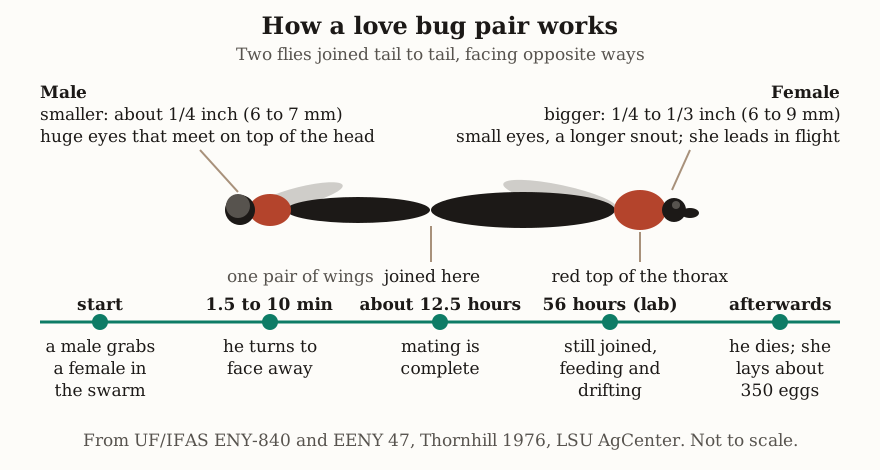
Mating itself takes a while. Sperm transfer averages about 12.5 hours, UF/IFAS reports, and in the lab pairs stayed joined for 56 hours on average. Meanwhile they fly, feed and drift on the wind, still joined. The bigger female does most of the flying, and the male helps once he has fed.
What happens if you separate them?
Pairs split up on their own once they are done, and both flies may mate again. Males compete hard for females: in one study, bigger males pushed smaller ones off about 20% of the time. After a pair splits, the male dies. The female lays her eggs in rotting grass or leaves, and then she dies too.
Do love bugs bite? Are they dangerous?
No. Love bugs do not bite, sting or spread disease, and they are not poisonous. Adults have no biting mouthparts at all, because they live on flower nectar and pollen. If something bit you during a swarm, it was another insect. Our guide to identifying bug bites can help you work out which one.
A black and red bug that bit you at night is worth a closer look, though. Kissing bugs also come in black and red, but they are bigger true bugs, about an inch long, with a cone-shaped head. See our guide to kissing bugs and their look-alikes and our page on kissing bug bite symptoms before you assume it was a love bug.
Are love bugs dangerous to dogs and cats?
UF/IFAS experts call them harmless to people and pets. However, we found no study or vet source on a dog or cat eating large numbers of them, so we cannot tell you more than that. If your pet eats a lot of any insect and then vomits or seems unwell, call your vet.
When is love bug season?
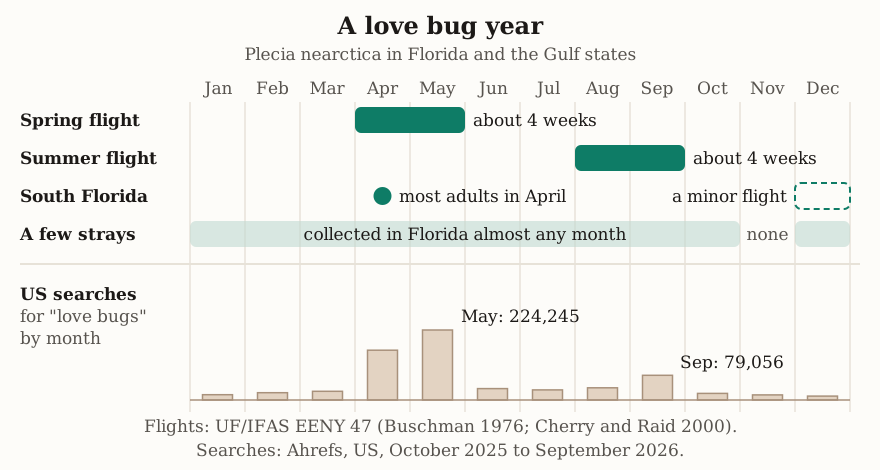
Love bug season comes twice a year: a spring flight in April and May and a summer flight in August and September. Each lasts about four weeks across Florida and the Gulf states. Numbers build to a peak in about two weeks, then fall away. In warmer south Florida the flights peak a little earlier.
Love bug season by state
Florida
- Spring flight
- April to May (south Florida peaks in April)
- Late summer flight
- August to September, plus a small December flight in south Florida
Texas
- Spring flight
- May
- Late summer flight
- September; mid-August to September around Galveston
Louisiana
- Spring flight
- Adults start in March or April
- Late summer flight
- Late summer; a flight can last over a month
Mississippi
- Spring flight
- Late spring
- Late summer flight
- September, usually the bigger flight there
When do love bugs go away?
Each flight ends on its own about four weeks after it starts. The adults live only a few days, so once the last of a generation has emerged, numbers crash. So if they appeared in late April, expect them gone by late May. Frost can end a fall flight early. Lovebugs have been found in Florida in every month except November, so a few strays between flights are normal.
What time of day are they worst?
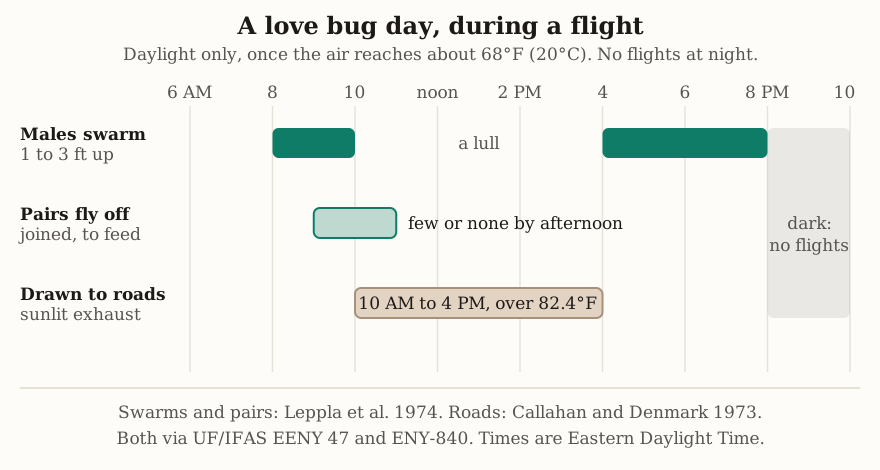
Love bugs fly only in daylight, once the air warms to about 68°F. Male swarms peak in the late morning and again in the early evening. On roads they are worst from about 10 AM to 4 PM on days above 82°F. They do not fly at night, so a drive after dark avoids most of them.
Where do love bugs live?
Love bugs live from Central America through Mexico and along the Gulf Coast of the US. UF/IFAS lists them as established in Texas, Louisiana, Mississippi, Alabama, Florida, Georgia and South Carolina. In 2006 one was reported as far north as Wilmington, North Carolina. Love bugs in Florida get the most attention, because the whole state sits in prime habitat.
Where love bugs are seen most: verifiable iNaturalist records by state (counted October 2026)
Florida
- Records
- 5,361
- State
- Georgia
- Records
- 496
Texas
- Records
- 3,577
- State
- South Carolina
- Records
- 335
Louisiana
- Records
- 1,322
- State
- Mississippi
- Records
- 318
Alabama
- Records
- 661
- State
- North Carolina
- Records
- 31
Records follow people as well as flies, so treat these as a rough guide. Still, the pattern is clear. Florida and Texas have the most, and the Carolinas are the edge of the range. September has the most records of any month, even though more people search for love bugs in May.
Where did love bugs come from? The UF lab myth
Love bugs came from Central America and spread east along the Gulf Coast on their own. A popular story says the University of Florida bred them in a lab to kill mosquitoes and some escaped. UF/IFAS calls that a myth, and the dates show why.
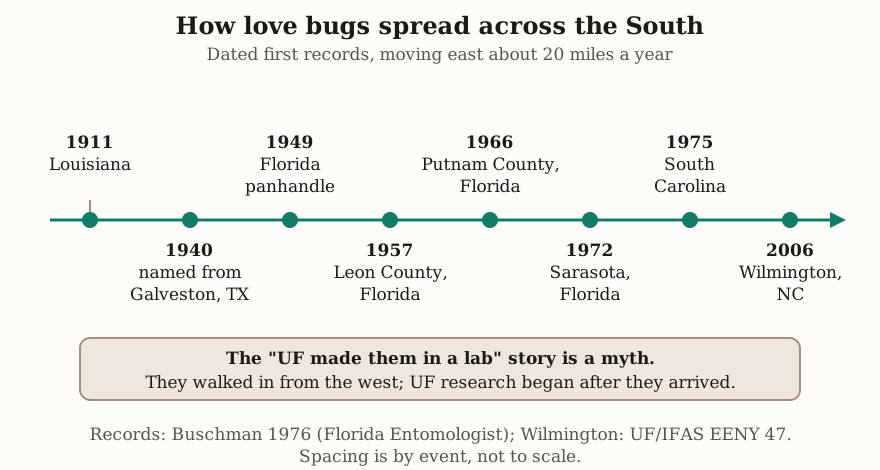
Love bugs were in Louisiana by 1911. The species was described from Galveston, Texas, in 1940 and first collected in Florida, in the far western panhandle, in 1949. From there they moved east and south about 20 miles a year, Buschman found, reaching south Florida and South Carolina by 1975. Wind, traffic, shipped sod, mown highway verges and new pastures all helped.
UF research came only after they were well established. Florida's legislature funded it during the outbreaks of the early 1970s, and the lab story goes back at least that far. Also, the mosquito part makes no sense: adults eat nectar, have no jaws for hunting, and fly by day, while most mosquitoes fly at dusk or at night.
Why are there so many love bugs some years?
Rain and weather drive most of the swings. Larvae need steady moisture, so wet seasons can mean bigger flights. On the other hand, cold winters and dry weather kill many larvae, and floods can drown them. A fungus, Beauveria bassiana, killed 27 to 33% of lovebugs in one test, and fungi seem to have cut the May 1973 flight.
Land use matters too. UF/IFAS links the big numbers to less burning of woodlands, more improved pastures and more cattle, while LSU points to wide, often-mown highway verges full of grass clippings. Hotspots also move: places 20 to 30 miles apart can have very different flights in the same year. Overall, UF/IFAS notes they have become less abundant over the past 30 years.
What attracts love bugs?
Sunlit car exhaust is the big one. In a 1973 test, Callahan and Denmark found that 92.8% of mating pairs flew toward exhaust fumes lit by ultraviolet light. By contrast, only 10% went to exhaust alone and 4% to the light alone. The pull works between about 10 AM and 4 PM, above 82°F, which is why highways fill up at midday.
Later work pointed to formaldehyde and heptaldehyde in the fumes. Females may mistake these for the smell of rotting plants where they lay eggs. Engine heat and vibration add to the pull. Light colours and fresh paint draw them as well, so white cars and newly painted houses collect more.
Electric lights do not attract them. Love bugs do not fly at night and ignored light traps in research. Flower scents do, though. Researchers saw hundreds on oakleaf hydrangea blooms, whose floral scent also drew them to traps.
Love bugs on your car
Love bugs damage car paint only when the remains are left to bake. Fresh splatter is close to neutral, pH 6.5. Within 24 hours, though, bacteria turn it acidic, to about pH 4.25. UF/IFAS found no paint damage even after 21 days indoors, so it is the sun that does the harm. Wash the front of the car within a day.
Soak the splatter with water for about five minutes, then scrub it off within 15 to 20 minutes. A wet dryer sheet or a damp cloth helps, and a coat of wax makes the next wash easier. In a heavy flight, check the radiator grille too, because packed bodies can make an engine overheat. Our guide to how to get rid of love bugs has the full car routine, with what to avoid on paint.
Can you get rid of love bugs?
Not from an area. Every extension service we checked says insecticides do not work against love bugs, because new adults drift in all day from the land around you. Spraying kills only the ones already there, and it harms the beneficial insects that get mistaken for them.
What works is keeping them off things. Fans, screens and closed doors keep them out of a house, and an air conditioner that pushes air outward does too. A vacuum handles the few that get in. Then wait about four weeks. Our love bug removal guide covers the house, the patio and the remedies that do not work.
What do love bugs eat, and what eats them?
Adult love bugs eat flower nectar and pollen. In Florida they favour blackberry and clover in May and goldenrod in September, as well as sweet clover, Brazilian pepper and saw palmetto. They do not eat mosquitoes, so they are no help there. For insects that really do, see our guide to what eats mosquitoes.
The larvae eat dead leaves, grass and other rotting plant matter in damp thatch, even under cow manure in pastures. That is their purpose in nature: they turn dead plants back into soil. Few animals eat the adults. Spiders, dragonflies and birds take some now and then, and fire ants avoid them. Their red and black colours may warn predators off, but nobody has tested that.
Love bug life cycle, and how long they live
Love bugs go through four stages: egg, larva, pupa and adult. There are two generations a year, so the larvae you never see spend most of the year in the grass. The adults you do see live only three or four days.
The love bug life cycle, from UF/IFAS
Egg
- How long
- Hatches in about 3 weeks
- Where
- About 350 per female, in rotting grass or leaves
Larva
- How long
- About 4 months (summer) to 8 months (winter)
- Where
- Damp thatch, pastures, roadside grass
Pupa
- How long
- 7 to 9 days
- Where
- Where the larva fed
Adult
- How long
- About 3 to 4 days
- Where
- Swarms, flowers, roads
Sources disagree on adult lifespan, from two days to a week, partly because males and females differ. Egg counts vary as well: 20 females dissected in 1968 held between 152 and 602 eggs each. Because a whole generation emerges at once, a flight looks sudden, then ends just as fast.
Bugs that look like love bugs
Several black and red insects get called love bugs. The quickest check is the wings: a love bug is a fly with one pair of thin wings, while beetles and true bugs have wing covers. Some look-alikes are helpful insects, so it pays to be sure before you swat.
Insects mistaken for love bugs, and the feature that separates each one
Plecia americana, the other US lovebug
- How to tell it from a love bug
- Thorax red on the sides too; flies only April to June, in woodland, not on highways
Dilophus sayi, a March fly
- How to tell it from a love bug
- All black with no red; smaller; gathers at parked cars and grills
Black flies (buffalo gnats)
- How to tell it from a love bug
- Tiny, 2 to 5 mm, humpbacked and shiny; the females bite
Kissing bugs
- How to tell it from a love bug
- A true bug about an inch long, cone-shaped head, light stripes along the abdomen edge; can bite
Fireflies
- How to tell it from a love bug
- A beetle; the head is hidden under a shield from above
Soldier beetles
- How to tell it from a love bug
- A beetle with soft wing covers; the head shows from above
Boxelder bugs
- How to tell it from a love bug
- A true bug with red eyes and red markings on the wings
Red-shouldered bugs
- How to tell it from a love bug
- A bigger true bug with a broad red edge behind the head; feeds on seeds
A love bug flying in the fall is always Plecia nearctica, because the other US species flies only in spring. For the most common red and black true bug, see our boxelder bug guide.
Love bug facts other pages get wrong
A lot of what you read about love bugs online is borrowed from other species. Here is what the research on this one says.
Common love bug claims, checked against UF/IFAS
Pairs stay joined from 30 minutes to a few days
- What the research says
- That range covers the whole March fly family. In love bugs, mating alone takes about 12.5 hours
Each female lays 100 to 300 eggs
- What the research says
- UF/IFAS gives 100 to 300 for Dilophus sayi. Love bug females average about 350
Adults live 72 to 92 hours in the lab
- What the research says
- Those are UF/IFAS lab figures for Dilophus sayi
They are drawn to porch lights
- What the research says
- Not this species. They do not fly at night and ignore light traps
Less than an inch long
- What the research says
- That is a joined pair. One fly is 1/4 to 1/3 inch
Their acid eats paint at once
- What the research says
- Fresh remains are near neutral. Damage needs a day or two of sun
Myths about love bugs
Myth 1
Myth: “The University of Florida made them.”
Truth: Dated records show them moving east from Louisiana long before any UF work. Research began only after they arrived.
Myth 2
Myth: “They were bred to eat mosquitoes.”
Truth: Adults sip nectar and have no jaws for hunting. They fly by day, while most mosquitoes fly at dusk or night.
Myth 3
Myth: “They mate the whole time they are joined.”
Truth: Mating takes about 12.5 hours. Afterwards pairs often stay joined while they feed and drift.
Myth 4
Myth: “Spraying the yard will clear them.”
Truth: New adults drift in all day from the land around you. Every extension service we checked says sprays do not work.
Myth 5
Myth: “Love bugs have no natural enemies.”
Truth: Spiders, dragonflies and birds take some. Fungi also kill many larvae in the grass.
Not sure what you found? Take a photo and try our bug identifier online. For a similar long-legged fly that also cannot bite, see our crane fly guide.
Pest control disclaimer. Photo-based identification can help, but it is not always perfect. For dangerous spiders, large infestations, or anything you are unsure about, contact a licensed pest control professional.
Frequently asked questions
Why are there so many love bugs this year?
What happens if you separate love bugs?
Are love bugs attracted to light?
Do love bugs hurt plants or lawns?
Will love bugs spread to the north?
Are Korea's lovebugs the same as ours?
What do love bugs do when they land on you?
Do love bugs die after mating?
Related guides
How to get rid of love bugs
Your car, your house and your yard, and why no spray clears them.
Kissing bug
The black and red bug that does bite, and how to tell it apart.
Boxelder bug
Red and black, harmless, and in your house every fall.
Crane fly
A giant mosquito look-alike that cannot bite or eat mosquitoes.
What eats mosquitoes?
The predators that do the job love bugs never did.
Bug bite identification
If something bit you during a swarm, find out what it was.
Sources
- UF/IFAS ENY-840, Living with Lovebugs (Leppla): safety, myths, pH figures, what helps
- UF/IFAS EENY-47, Lovebug, Plecia nearctica Hardy (Featured Creatures, revised 2024): identification, range, seasons, car cleaning
- UF News, Lovebugs are back! (May 19, 2026): harmless to people and pets, fans and screens
- LSU AgCenter Pub. 3692, Plecia spp., Lovebugs (Carlton): sizes, male and female eyes, Louisiana season
- Texas A&M Forest Service, Lovebugs: Texas season, not attracted to electric lights, weather
- Callahan and Denmark 1973, attraction of the lovebug to UV-irradiated exhaust fumes, Florida Entomologist 56:113
- Buschman 1976, invasion of Florida by the lovebug, Florida Entomologist 59:191
- Texas A&M AgriLife, Kissing bug identification requires closer look